
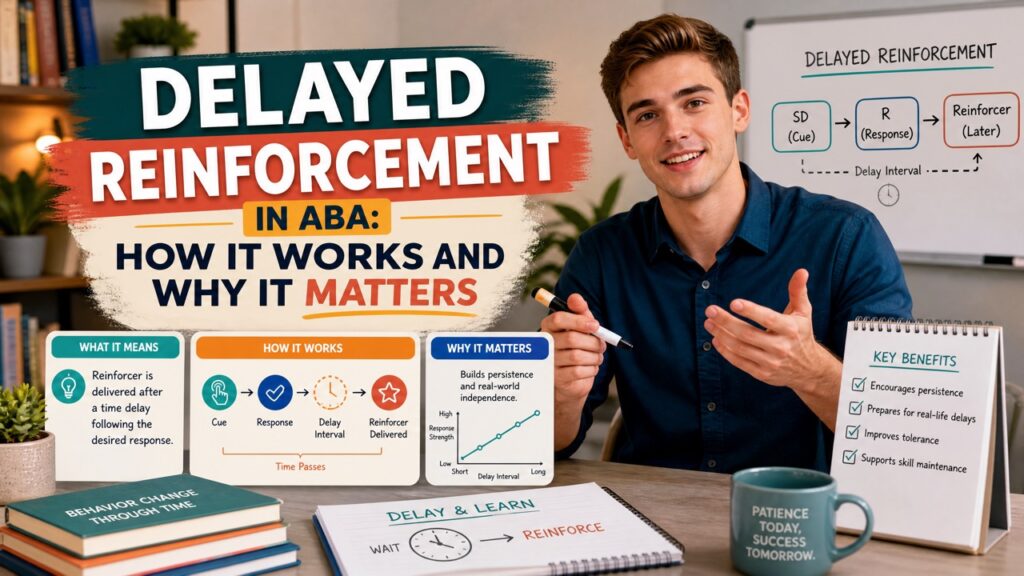
In applied behavior analysis (ABA), reinforcement is most effective when it immediately follows the target behavior. But real-world settings often require waiting—a teacher might deliver praise seconds after a correct answer, or a supervisor might provide a bonus at the end of the month. This is where delayed reinforcement comes into play. Understanding how delays affect the response-reinforcer contingency is essential for designing effective interventions and for success on the BCBA exam.
Table of Contents
- What Is Delayed Reinforcement in ABA?
- How Delayed Reinforcement Affects Behavior
- Delayed Reinforcement vs. Immediate Reinforcement
- Delayed Reinforcement vs. Delayed Matching-to-Sample
- How to Measure Delay in Delayed Reinforcement
- Practical Applications: Token Economies and Signals
- Factors That Influence the Effectiveness of Delayed Reinforcement
- Ethical Considerations
- Common Traps and Misconceptions
- Study Checklist for Delayed Reinforcement
- How to Apply This in Your BCBA Practice
- Ready to Practice? Test Your Knowledge with a Free BCBA Mock Exam
Delayed reinforcement is a schedule parameter, not a distinct schedule type. It refers to the time between the occurrence of a response and the delivery of a reinforcer. Many practitioners confuse it with interval schedules or with other procedures like delayed matching-to-sample. This article provides a clear definition, explains why delay matters, offers practical examples, and outlines common traps and study tips.
What Is Delayed Reinforcement in ABA?
Delayed reinforcement occurs when a reinforcer is presented after a specified time interval following the target response. For example, if a child raises their hand and the teacher provides attention 5 seconds later, that is delayed reinforcement. The delay is measured from the onset of the response to the delivery of the reinforcer.
It is a parameter of reinforcement, not an independent schedule like fixed ratio (FR) or variable interval (VI). In other words, any schedule can have an added delay. For instance, a token economy might use a fixed ratio 5 schedule with a 10-minute delay before tokens can be exchanged for backup reinforcers. The delay is part of the contingency, but the schedule itself remains FR5.
How Delayed Reinforcement Affects Behavior
Research shows that, generally, longer delays weaken the response-reinforcer contingency. When a delay occurs, the temporal contiguity between response and reinforcer is reduced, which can slow acquisition and reduce the overall effectiveness of reinforcement. However, the impact is not uniform; it depends on several factors.
Conditioned reinforcers, such as tokens or praise, can bridge the delay. By pairing a neutral stimulus with a primary reinforcer, that stimulus becomes a conditioned reinforcer. For example, in a token economy, tokens are conditioned reinforcers that are immediately delivered after the target behavior, while the backup reinforcer (e.g., a snack) is delivered later. This immediate delivery of tokens helps maintain the response-reinforcer contingency, even if the backup is delayed.
Other factors that influence delay effects include reinforcer magnitude, quality, and the use of signals. A large or high-quality reinforcer may maintain responding better across a delay than a small or low-quality one. Also, presenting a signal (e.g., a light or a verbal statement) during the delay can help the learner anticipate the reinforcer.
It is important to note that delayed reinforcement is not always less effective than immediate reinforcement. In some cases, particularly when delay is brief and signaled, its effects can approach those of immediate reinforcement. Thus, practitioners should evaluate each situation individually.
Delayed Reinforcement vs. Immediate Reinforcement
Immediate reinforcement occurs when the reinforcer is delivered immediately after the response, typically within a few seconds. Delayed reinforcement involves a longer interval, often minutes, hours, or days. The key difference is the temporal gap.
Immediate reinforcement is generally preferred because it creates a clear response-reinforcer contingency, which accelerates learning. However, in natural settings, immediate reinforcement is not always possible. For example, a teacher cannot give a gold star for every correct answer instantly if they must record it in a log. In such cases, delayed reinforcement can still be effective if implemented thoughtfully. When comparing, remember that the effects of delay are not all-or-nothing. Short delays may have minimal impact, while long delays can significantly weaken the contingency. This is why careful measurement and planning are crucial.
Delayed Reinforcement vs. Delayed Matching-to-Sample
Delayed matching-to-sample is a procedure in which a sample stimulus is presented, removed, and then after a delay, comparison stimuli are presented. The learner must select the comparison that matches the sample. This is not a reinforcement procedure; it is a stimulus control procedure used to test memory or relational learning.
In contrast, delayed reinforcement is about when the reinforcer is delivered relative to the target response. They are often confused because both involve delays, but they serve different purposes. Delayed matching-to-sample might involve reinforcement for correct matching, but the delay is in the stimulus presentation, not the reinforcer delivery. Thus, it is a different concept entirely.
How to Measure Delay in Delayed Reinforcement
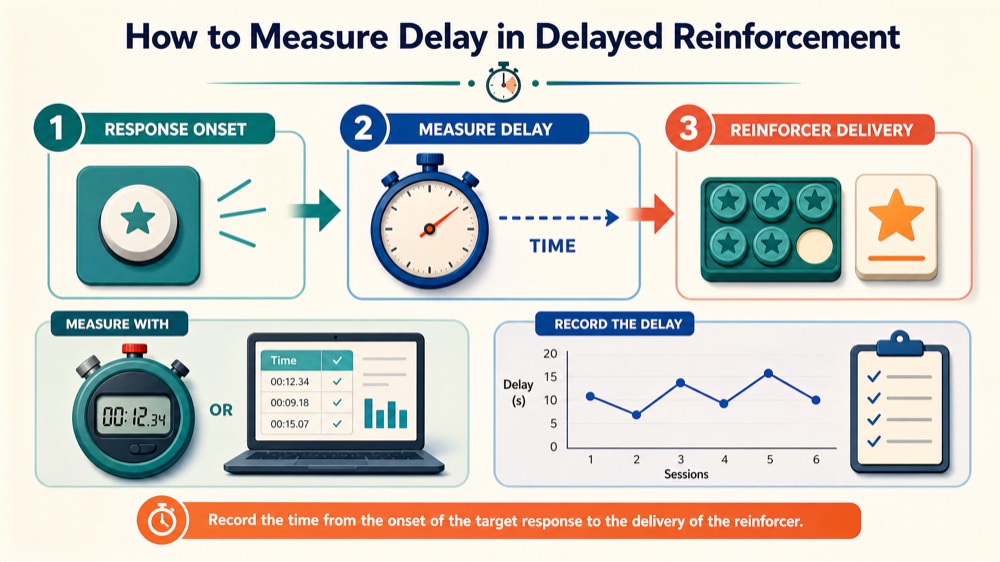
To measure delay, you record the time from the onset of the target response to the delivery of the reinforcer. This can be done using a stopwatch or data collection software. For example, if a response occurs at 2 seconds and the reinforcer is delivered at 7 seconds, the delay is 5 seconds. Calculation example: Response onset at 2 s, reinforcer at 7 s, delay = 7 s – 2 s = 5 s.
When measuring delay, ensure that the response onset is clearly defined and that you record the exact moment the reinforcer is presented. This measurement is essential for evaluating the effectiveness of the reinforcement procedure and for making data-based decisions. In applied behavior analysis, the primary measurable outcome is often the rate or frequency of the target behavior, which allows practitioners to objectively assess whether the delayed reinforcement is effective. By tracking this outcome alongside the delay, you can determine the functional relation between the delayed reinforcer and the behavior—that is, whether the behavior change is actually caused by the reinforcement procedure rather than by extraneous variables.
Practical Applications: Token Economies and Signals
Delayed reinforcement is widely used in applied settings. One common application is a token economy. Here, tokens serve as conditioned reinforcers. For example, a child earns a token immediately after completing a chore. They can exchange tokens later for a preferred activity or item. The token bridges the delay, maintaining the response-reinforcer contingency.
Another application uses signals. A signal, such as a verbal statement (“Good job, you earned 5 minutes of computer time after lunch”), can help the learner understand that reinforcement is coming. This can reduce the negative effects of delay.
But caution is warranted: long delays can slow acquisition. If you are teaching a new skill, it is often best to use immediate reinforcement initially, then gradually increase the delay. This gradual increase helps the learner tolerate longer waits. For example, start with immediate praise, then introduce a 5-second delay, then 10 seconds, and so on. This is similar to delay tolerance training, but it applies to reinforcement delivery.
Factors That Influence the Effectiveness of Delayed Reinforcement
Several factors affect how well delayed reinforcement works:
- Reinforcer magnitude: Larger reinforcers may sustain behavior better across delays.
- Reinforcer quality: High-quality or highly preferred reinforcers can maintain responding.
- Signals and instructions: A clear signal or instruction can bridge the delay.
- Gradual delay increases: Slowly increasing the delay can help learners adapt.
- Individual differences: Some learners may tolerate delays better than others.
These factors highlight that delayed reinforcement is not a one-size-fits-all concept. Behavior analysts must consider them when designing interventions.
Ethical Considerations
When using delayed reinforcement, ensure that delays are introduced appropriately. Do not impose long delays on a learner who has no history with them. Provide alternative reinforcement when needed, especially if the learner becomes frustrated or the behavior declines.
According to the BACB Ethics Code, behavior analysts must select interventions that are effective and do not cause harm. This includes ensuring that reinforcement procedures are not overly delayed to the point of being aversive. Also, consider the learner’s rights: they should have access to reinforcement in a timely manner whenever possible. In addition, be transparent about delay procedures with stakeholders. Explain why delays are used and how they will be gradually increased.
Common Traps and Misconceptions
- Trap: Believing delayed reinforcement is always less effective. Fact: It depends on many factors.
- Trap: Confusing delayed reinforcement with the interval between responses (i.e., interresponse time).
- Trap: Assuming all delays weaken behavior equally.
- Trap: Thinking that conditioned reinforcers completely eliminate the negative effects of delay.
- Trap: Treating delayed reinforcement as a distinct schedule type.
- Trap: Expecting delayed reinforcement to work the same way for every learner.
- Trap: Believing the topic is guaranteed to appear on the BCBA exam—it is just one concept among many.
Study Checklist for Delayed Reinforcement
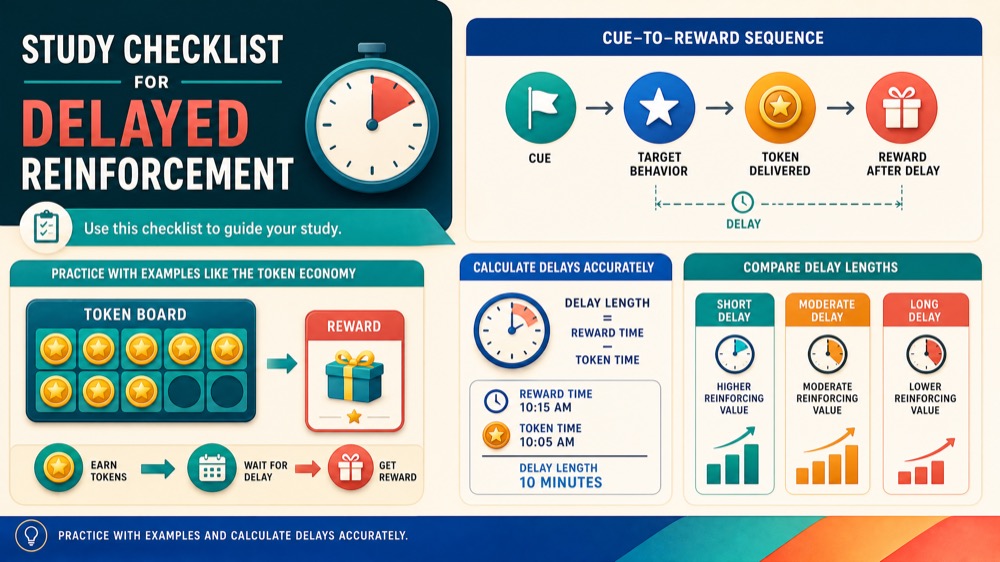
- Define delayed reinforcement as a schedule parameter, not a schedule.
- Understand the difference between delayed reinforcement and delayed matching-to-sample.
- Know how to measure delay from response onset to reinforcer delivery.
- Explain the role of conditioned reinforcers in bridging delays.
- Identify factors that influence delay effects (magnitude, quality, signals).
- Apply the concept to a token economy example.
- Recognize ethical considerations when using delayed reinforcement.
Use this checklist to guide your study. Practice with examples like the token economy and ensure you can calculate delays accurately.
How to Apply This in Your BCBA Practice
In practice, you might use delayed reinforcement when immediate reinforcement is not feasible. For example, you might deliver praise immediately and a backup reinforcer later. Or you might use a token system where tokens are immediately given and exchanged later. These applications are common in classrooms and clinics.
When designing interventions, assess whether delayed reinforcement is suitable. Consider the learner’s age, skills, and history. Use gradual increases to minimize disruption. Always collect data on response latency and reinforcer delivery to ensure the delay is as specified. For more on related concepts, see our guides on stimulus control and stimulus generalization. You can also test your knowledge with free BCBA mock exam.
Ready to Practice? Test Your Knowledge with a Free BCBA Mock Exam
Now that you understand delayed reinforcement, it’s time to practice. Our free BCBA mock exam offers realistic practice questions and instant feedback to help you identify areas for improvement. It does not contain questions specifically on this topic, but it provides a broad range of questions to test your overall ABA knowledge. Start your practice today and build your confidence for the big day. For authoritative guidance, always refer to the BACB BCBA Test Content Outline (6th ed.) and the current BACB Ethics Code.
Next step for BCBA exam prep
Turn this topic into exam-day practice
Use this topic as a focused review, then test it in exam-style conditions with a free mock before deciding whether five full-length mocks are the right next step.
Start the Free BCBA Mock ExamContinue with Five Full-Length Mocks — $99
Review the included materials and access details before ordering. No pass guarantee is implied.



