
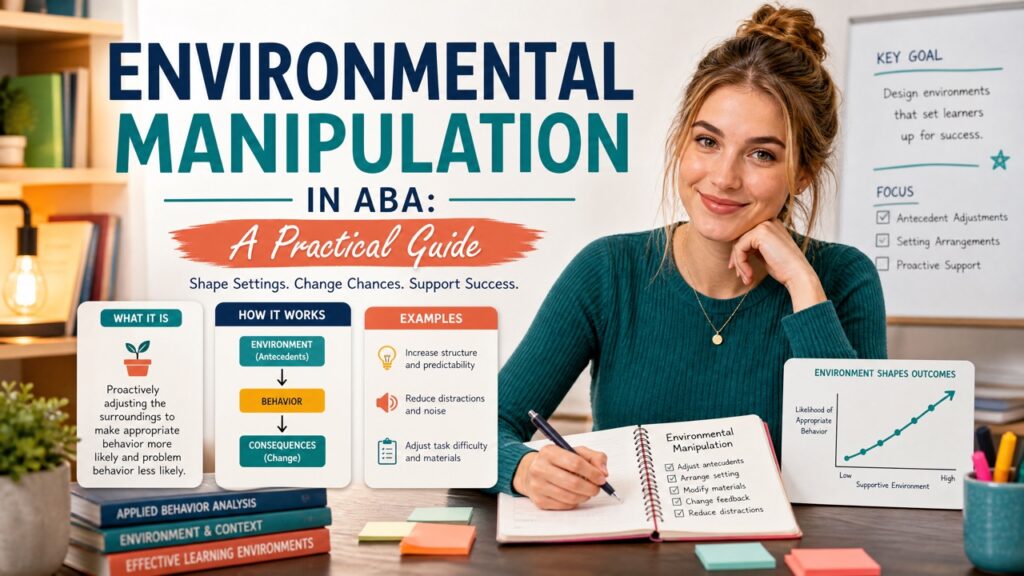
Environmental manipulation in applied behavior analysis (ABA) is a broad and practical strategy that involves systematically altering physical, social, or temporal variables to influence behavior. It is not limited to changing what happens before a behavior; it also includes rearranging consequences and adjusting the availability of reinforcers. This guide explains what environmental manipulation is, how it differs from related concepts, and how it can be applied ethically across settings. You will find original examples, guidance on using it for behavior reduction, and a clear distinction from functional analysis. The goal is to help practitioners and students understand this foundational tool and use it to produce meaningful, measurable outcomes.
Table of Contents
- What Is Environmental Manipulation in ABA?
- How Environmental Manipulation Differs from Antecedent Manipulation
- Practical Examples of Environmental Manipulation
- Using Environmental Manipulation for Behavior Reduction
- Common Misconceptions and Ethical Considerations
- Distinguishing Environmental Manipulation from Functional Analysis
- Applications Beyond Clinical Settings: OBM and Classrooms
- Stimulus Control and Environmental Manipulation
- Study Checklist for Environmental Manipulation
- Test Your Knowledge with a Free BCBA Mock Exam
What Is Environmental Manipulation in ABA?
Environmental manipulation in ABA refers to the deliberate and systematic modification of an individual’s surroundings to influence behavior. This includes changes to the physical layout, social interactions, task demands, and schedules of reinforcement. Unlike a one-time antecedent change, environmental manipulation often involves ongoing adjustments to maintain behavior change. For example, a teacher might move a student’s desk away from a window to reduce visual distractions, or a therapist might adjust the timing of breaks to prevent escape behavior. These changes are based on functional assessment data, not guesswork.
In behavior analysis, environmental manipulation is a broad term that encompasses both antecedent and consequence manipulations. While antecedent interventions focus on what happens immediately before a behavior, environmental manipulation can also involve altering what happens after the behavior. For instance, changing the availability of reinforcers or the delay to reinforcement are environmental changes. The goal is to create an environment that naturally supports adaptive behavior and reduces the likelihood of problem behavior.
How Environmental Manipulation Differs from Antecedent Manipulation
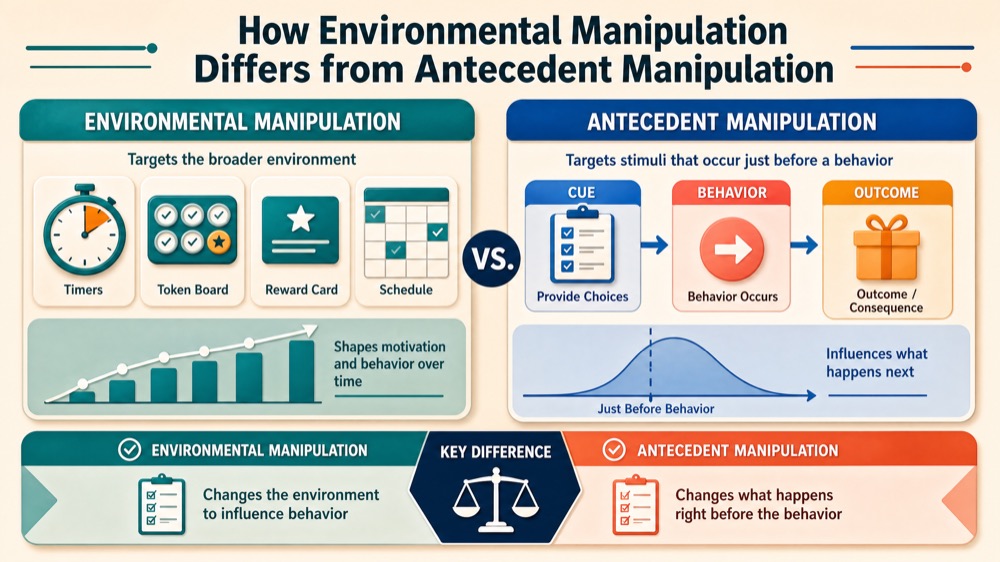
Many students confuse environmental manipulation with antecedent manipulation. Antecedent manipulation specifically targets stimuli that occur just before a behavior, such as providing choices or changing instructions. It is a subset of environmental manipulation. Environmental manipulation is broader and includes changes to the physical layout, social interactions, and consequence delivery. For example, rearranging furniture to create a calm study area is an environmental manipulation, while offering a choice between two tasks is an antecedent manipulation.
Another difference is that environmental manipulation can involve consequences. For instance, increasing the magnitude of a reinforcer or altering the schedule of reinforcement are consequence-based changes. These go beyond antecedent events. Additionally, environmental manipulation often changes discriminative stimuli (SDs) that signal reinforcement availability. A discriminative stimulus (SD) is a specific environmental cue that indicates a particular behavior will be reinforced. By removing an SD that triggers problem behavior, you reduce the likelihood of that behavior occurring. This distinction is vital for designing effective interventions.
- Antecedent manipulation: modifies events immediately before behavior (e.g., giving choices, changing instructions).
- Environmental manipulation: includes antecedents plus physical, social, and consequence changes (e.g., room layout, manager feedback, reinforcer schedules).
- Example: Moving a noisy fan away from the student’s desk is an environmental manipulation; telling the student to “work quietly” is an antecedent manipulation.
Practical Examples of Environmental Manipulation
Here are concrete examples from schools, clinics, and homes. Each one is based on a functional assessment and targets a specific behavior change.
- Rearranging furniture: Move a student’s desk away from a high-traffic area to reduce off-task behavior.
- Offering choice: Present a menu of preferred activities to increase engagement and reduce escape-maintained problem behavior.
- Changing staff behavior: Train paraprofessionals to deliver praise immediately after appropriate behavior, altering the social environment.
- Modifying task difficulty: Break a complex assignment into smaller steps to reduce frustration and escape behavior.
- Altering reinforcer availability: Keep a preferred toy inside a clear bin that the child must request to open, promoting communication.
- Increasing response effort: Use a lid on a trash can to reduce rummaging, or have a child wear gloves to reduce thumb-sucking.
These examples show that environmental manipulation targets both antecedents and consequences. For example, if a behavior is maintained by access to attention, you might provide attention for asking nicely instead of for whining. This involves changing the social environment, which is a form of manipulation. The key is that each change is systematic and data-driven.
Using Environmental Manipulation for Behavior Reduction
Behavior reduction is a common goal in ABA. Environmental manipulation can proactively reduce problem behavior by removing discriminative stimuli (SDs) that evoke the behavior or by increasing response effort. For example, if a child frequently asks for a tablet during homework, the parent might remove the tablet from sight, eliminating the SD for requesting. This reduces interruptions. Alternatively, increasing response effort, such as placing a heavy cover on a discarded snack, can reduce scavenging.
Environmental manipulation also affects motivating operations. If a learner is motivated to escape a difficult task, you might make the task shorter or provide frequent breaks, reducing the value of escape. This is function-based because you know the behavior is escape-maintained. Without a functional assessment, you might inadvertently make the behavior worse. Always collect data to evaluate the impact of your environmental changes, and adjust as needed.
Common Misconceptions and Ethical Considerations
Environmental manipulation is powerful but often misunderstood. Below are common misconceptions that can lead to errors in practice.
- Equating it with antecedent manipulation: Environmental manipulation is broader and includes consequence changes.
- Assuming it always adds stimuli: Removing or rearranging stimuli is equally valid.
- Believing one change guarantees behavior change: Multiple variables often influence behavior; a single change may not be sufficient.
- Thinking changes are permanent: Environments are dynamic; you may need to adjust as behavior changes.
- Using it only in clinical settings: It applies to schools, homes, workplaces, and other natural environments.
- Treating it as a one-size-fits-all solution: Interventions must be individualized based on functional assessment.
- Assuming it is always ethical: Restrictive changes, such as isolation, require careful ethical consideration.
Ethical practice requires that environmental manipulations are positive, proactive, and least restrictive. The BACB BCBA Test Content Outline emphasizes the importance of using behavior-change procedures that are based on assessment and that protect client dignity. For example, instead of sending a student to a separate room, modify the classroom to reduce distractions. Before implementing environmental changes, conduct a functional assessment when appropriate to confirm that the plan is function-based and responsive to the behavior’s context.
Distinguishing Environmental Manipulation from Functional Analysis
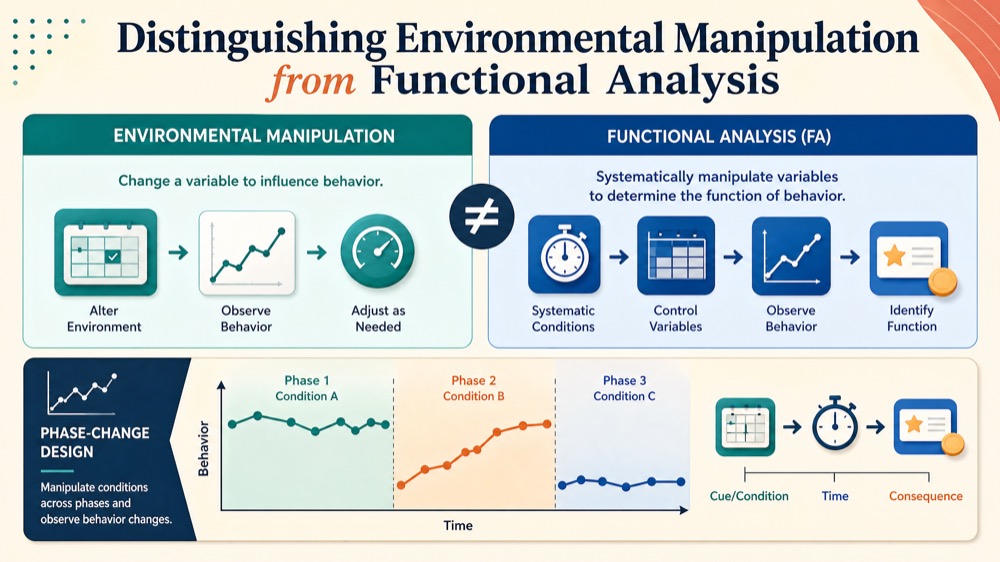
Functional analysis (FA) is a specific assessment method used to determine the function of behavior. It involves systematically manipulating environmental variables to observe their effect on behavior. In contrast, environmental manipulation is a broad intervention strategy that can be used in any context, not just for assessment. FA is a controlled experiment, while environmental manipulation is often implemented in natural settings as a treatment.
For the BCBA exam, understand that FA is a type of environmental manipulation, but not all environmental manipulation is an FA. FA requires precise control of antecedents and consequences, and it often involves brief, repeated conditions. Environmental manipulation as an intervention may be less formal but still requires data collection. For example, if you suspect attention is maintaining a behavior, you might provide attention for appropriate behavior and withhold it for problem behavior—that is an environmental manipulation, but not necessarily an FA unless you use a specific experimental design. Learn more about related concepts in our articles on stimulus control in ABA and stimulus generalisation in ABA.
Applications Beyond Clinical Settings: OBM and Classrooms
Environmental manipulation is not limited to one-on-one therapy. In organizational behavior management (OBM), consultants change office layouts, alter feedback schedules, or redesign incentive systems to improve productivity and safety. In classrooms, teachers rearrange seating, modify the pace of instruction, or change the type of prompts used. All these are environmental manipulations because they alter the context in which behavior occurs.
For example, a manager might move a team’s workstations to reduce noise, leading to fewer errors. Or a teacher might place a timer on a desk to help a student manage time. These changes are proactive and often prevent problems before they start. The same principles apply: understand the function of behavior, make a systematic change, and measure the impact.
Stimulus Control and Environmental Manipulation
Environmental manipulation often relies on stimulus control. Stimulus control occurs when a behavior is more likely in the presence of a specific SD and less likely in the presence of an S-delta. For example, a child may read more when their book is on the desk (SD) and less when a tablet is also present (S-delta). By manipulating which stimuli are present, you can shift behavior. This is a core concept for BCBA exam prep.
To increase appropriate behavior, you can add SDs that signal reinforcement for that behavior. To decrease problem behavior, you can remove or alter SDs that evoke it. For example, if a student raises their hand when the teacher looks at them, you can train the teacher to look at the class to evoke hand-raising. This is a natural environmental change. For a deeper review, see our stimulus control in ABA article.
Study Checklist for Environmental Manipulation
Use this checklist to solidify your understanding of environmental manipulation. Each point relates to the BACB Test Content Outline and common practice scenarios.
- Define environmental manipulation and give one original example.
- Explain how it differs from antecedent manipulation.
- Identify at least five ways to manipulate the environment (e.g., rearrange, remove, add, alter schedule, change social interactions).
- Describe how environmental manipulation can be used for behavior reduction.
- List two ethical considerations when changing the environment.
- Explain the role of SD and S-delta in environmental manipulation.
- Distinguish environmental manipulation from functional analysis.
- Practice with scenario-based questions: “What can you change in the environment to reduce disruptive behavior?”
Review the concepts above, and then test yourself with our free BCBA mock exam.
Test Your Knowledge with a Free BCBA Mock Exam
Now that you understand environmental manipulation, apply your knowledge. Our free BCBA mock exam provides broad practice across ABA concepts with feedback. It is designed to mimic the real exam format and provide detailed rationales. Sign up to access practice questions, track your progress, and identify areas for improvement. Don’t wait—start practicing today to boost your confidence. Visit https://bcbamockexam.com/free-bcba-mock-exam/ and take the first step toward passing your exam.
Next step for BCBA exam prep
Turn this topic into exam-day practice
Use this topic as a focused review, then test it in exam-style conditions with a free mock before deciding whether five full-length mocks are the right next step.
Start the Free BCBA Mock ExamContinue with Five Full-Length Mocks — $99
Review the included materials and access details before ordering. No pass guarantee is implied.



