
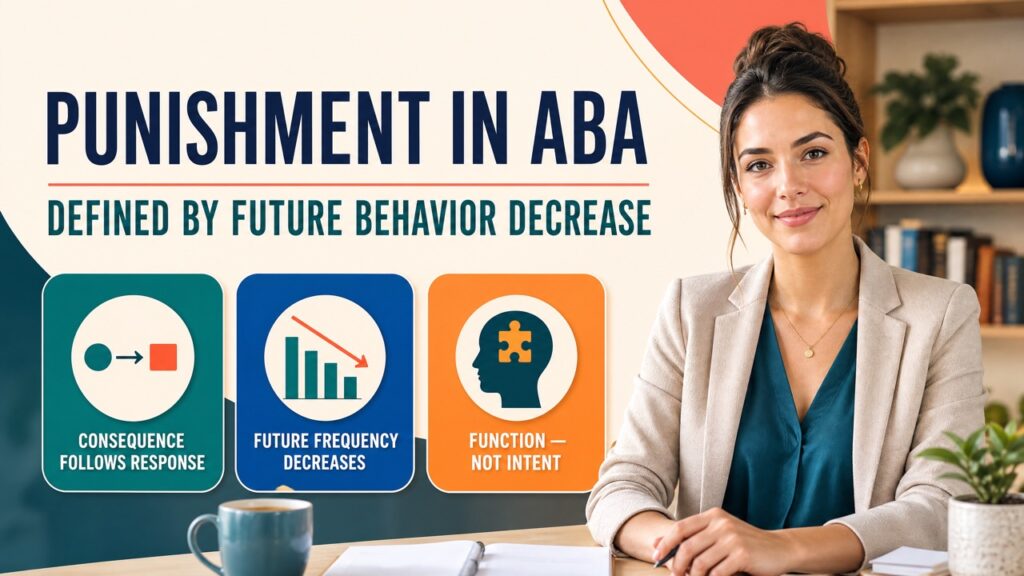
Punishment procedures in applied behavior analysis (ABA) are interventions that decrease the future frequency of a behavior by presenting or removing a stimulus immediately after that behavior. In ethical practice, reinforcement-based methods are tried first, and punishment is considered only when necessary. This guide provides a practical, step-by-step approach to implementing punishment procedures within a comprehensive, reinforcement-based framework. You will learn the definitions of positive and negative punishment, how to conduct a functional assessment, how to select a procedure based on behavioral function, and how to measure outcomes and side effects. Ethical cautions, a worked example with a data sheet, and a study checklist are included to help BCBA candidates and practitioners apply these procedures safely and effectively.
Table of Contents
- Understanding Punishment in ABA: Definitions and Core Concepts
- Positive and Negative Punishment: Definitions and Examples
- Step-by-Step Implementation of Punishment Procedures
- Treatment Integrity and Interobserver Agreement
- Ethical Considerations and Side Effects of Punishment
- Worked Example: Response Cost Procedure with Data Sheet
- Data Analysis and Decision-Making
- Common Traps and Study Checklist
- Conclusion and Free Mock Exam
Understanding Punishment in ABA: Definitions and Core Concepts
In applied behavior analysis, punishment is a behavioral process in which a stimulus change immediately following a behavior results in a decreased future frequency of that behavior. It is essential to distinguish between a punishment procedure (the environmental arrangement), the punishing stimulus (the stimulus that functions as a punisher), and the punishment effect (the observed decrease in behavior). A stimulus is only a punisher if it demonstrably reduces the future probability of the behavior; we cannot infer punisher status from appearance or intent. For example, a reprimand may look punishing, but if it does not decrease the behavior, it is not functioning as a punisher.
There are two basic types of punishment: positive punishment and negative punishment. Positive punishment involves presenting a stimulus after the behavior, such as a reprimand or extra work. Negative punishment involves removing a reinforcing stimulus, such as response cost or time-out. Both types are defined by the operation of adding or removing a stimulus, not by whether the stimulus is “good” or “bad.” Punishment is not the same as extinction or reinforcement: extinction involves withholding the reinforcer that maintains behavior, while punishment involves a response-contingent stimulus change. The effectiveness of a punishment procedure depends on immediacy, consistency, and the availability of reinforcement for alternative behavior.
Positive and Negative Punishment: Definitions and Examples
Positive punishment involves the presentation of a stimulus immediately following a behavior, resulting in a decrease in that behavior. For example, if a child throws a toy and the therapist delivers a loud verbal reprimand, and the throwing decreases, the reprimand is a punisher. Note that “positive” means the stimulus is added; it does not mean the procedure is desirable. Negative punishment involves the removal of a reinforcing stimulus after a behavior, producing a decrease in behavior. Common examples include response cost (removing a token or privilege) and time-out (removing access to reinforcement). Here are practical examples of both types:
- Positive punishment: A teacher gives a student a written reflection assignment after the student uses profanity. If profanity decreases, the assignment is a punisher.
- Positive punishment: A parent sprays a bitter-tasting substance on a child’s thumb to reduce thumb-sucking, contingent on thumb-sucking behavior.
- Negative punishment: A child loses 10 minutes of game time (response cost) after hitting a sibling. If hitting decreases, the removal of game time is a punisher.
- Negative punishment: A child who throws a tantrum in the classroom is removed from the play area and placed in a quiet time-out chair. If tantrums decrease, time-out is functioning as a punisher.
It is critical to identify the function of the behavior before selecting a punishment procedure. For attention-maintained behavior, time-out from attention may be effective if the time-out setting truly lacks access to social reinforcement. For escape-maintained behavior, response cost that removes access to a preferred activity might be less effective if the behavior already results in escape. Therefore, a functional assessment is the first step in any punishment-based intervention.
Step-by-Step Implementation of Punishment Procedures
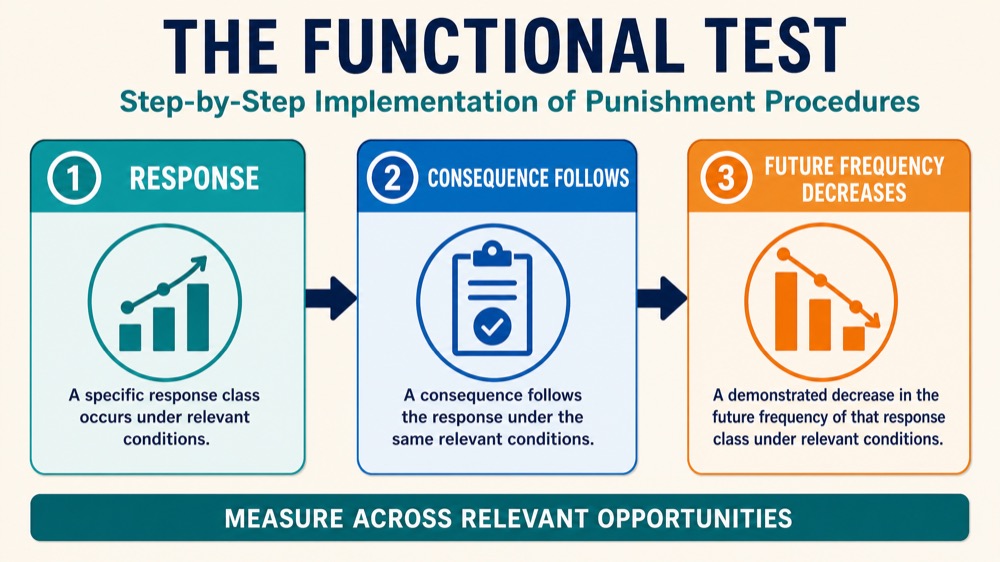
Step 1: Assess the function and establish baseline. Complete an FBA using direct observation, interviews, and other appropriate methods. Identify whether the behavior contacts attention, tangibles, escape, automatic reinforcement, or more than one consequence. Define the target response and collect stable baseline data before selecting a punishment procedure.
Step 2: Start with reinforcement and review risk. Implement and document function-based reinforcement strategies such as DRA, DRO, or NCR. If the response remains dangerous or clinically significant, conduct a risk-benefit review. Confirm competence, resources, informed consent, and assent when applicable; document why the proposed procedure is necessary and what less restrictive options were considered.
Step 3: Match the procedure to the function. For attention-maintained behavior, a brief time-out from social attention is relevant only when the time-out area does not provide attention or other reinforcement. For tangible-maintained behavior, response cost may remove access to a defined reinforcer. For escape-maintained behavior, pair task participation with reinforcement and avoid making the procedure an unexamined source of escape.
Step 4: Define and train the plan. Specify the antecedent, target response, stimulus to be presented or removed, delivery schedule, duration, data measure, and stopping criteria. Train every implementer with modeling, role-play, feedback, and a checklist so treatment integrity can be measured rather than assumed.
Step 5: Implement while monitoring. Continue reinforcement for the alternative response. Record the target behavior, treatment integrity, and possible side effects such as new problem behavior, distress, or avoidance. Review data on a planned schedule instead of relying on a single session or subjective impression.
Step 6: Evaluate, adjust, and plan fading. Compare intervention data with baseline and ask whether the consequence is actually producing a reliable decrease. If not, check the function, measurement, schedule, and implementation integrity. Modify or discontinue the procedure when risk exceeds benefit, and plan maintenance, generalization, and gradual fading while reinforcement remains available.
Treatment Integrity and Interobserver Agreement
Treatment integrity refers to the extent to which the punishment procedure is implemented exactly as designed. High treatment integrity is essential for making valid conclusions about the intervention’s effectiveness. Measure integrity by having a trained observer use a task analysis checklist to assess whether the implementer delivers the punisher immediately, consistently, and correctly. Interobserver agreement (IOA) on the target behavior and on treatment integrity should be collected for at least 25-30% of sessions, with acceptable agreement generally at or above 80%. Regular data review should include graphs of the target behavior, integrity scores, and side-effect data. If integrity is low, retrain implementers before making decisions about the procedure’s effectiveness.
Ethical Considerations and Side Effects of Punishment
The BACB Ethics Code requires that behavior analysts prioritize the client’s welfare and use the least restrictive effective intervention. Punishment should only be used after reinforcement-based procedures have been tried and found insufficient, and when the benefits outweigh the risks. Potential side effects of punishment include an increase in negative emotional responses, escape and avoidance of the punisher or the therapist, and the possibility of modeling aggression. Ethical cautions include the need for competent implementation, informed consent/assent, and ongoing monitoring. Punishment must always be part of a comprehensive treatment plan that includes reinforcement for alternative behaviors. Here are ethical guidelines to follow when considering punishment:
- Use punishment only after reinforcement-based interventions have been systematically tried and documented as ineffective.
- Obtain informed consent from the client or guardian, and assent from the client when appropriate.
- Monitor for side effects such as increased problem behavior, emotional distress, or escape/avoidance of the intervention setting.
- Always include reinforcement-based procedures in the treatment package.
- Choose the least restrictive procedure that is likely to be effective based on the behavior’s function.
- Discontinue or modify the punishment procedure if it is not effective or if side effects outweigh benefits.
Worked Example: Response Cost Procedure with Data Sheet
Consider a 6-year-old child, Alex, who engages in hitting behavior to gain access to a preferred tablet. A functional assessment indicates the behavior is maintained by access to tangibles. The intervention plan includes DRA (reinforcing appropriate requests for the tablet) and a response cost procedure: each time Alex hits, he loses 5 minutes of tablet time. Baseline data shows an average of 8 hits per hour. After implementing the response cost, the frequency drops to 2 hits per hour over two weeks. Throughout implementation, the therapist collects data on hits, integrity of the response cost delivery, and any side effects such as crying or aggression. The data sheet includes columns for date, session, number of hits, minutes lost, and notes.
This example illustrates how a punishment procedure can be effective when matched to function and combined with reinforcement. It also highlights the importance of collecting baseline data to demonstrate the intervention’s effect. For practice with data analysis, see our BCBA practice questions on stimulus control.
Data Analysis and Decision-Making
Effective use of punishment procedures ABA requires continuous data analysis. After implementing the procedure, graph the target behavior across baseline and intervention phases. Look for a clear decrease in level and trend. Also monitor treatment integrity scores and side-effect data. If the behavior does not decrease, consider possible reasons: the punisher may not be truly punishing, the schedule may be too thin, or the procedure may be implemented inconsistently. Use the data to make informed decisions about modifying the procedure or discontinuing it. The graph should be visually inspected, and decisions should be based on data patterns rather than subjective impressions.
Common Traps and Study Checklist
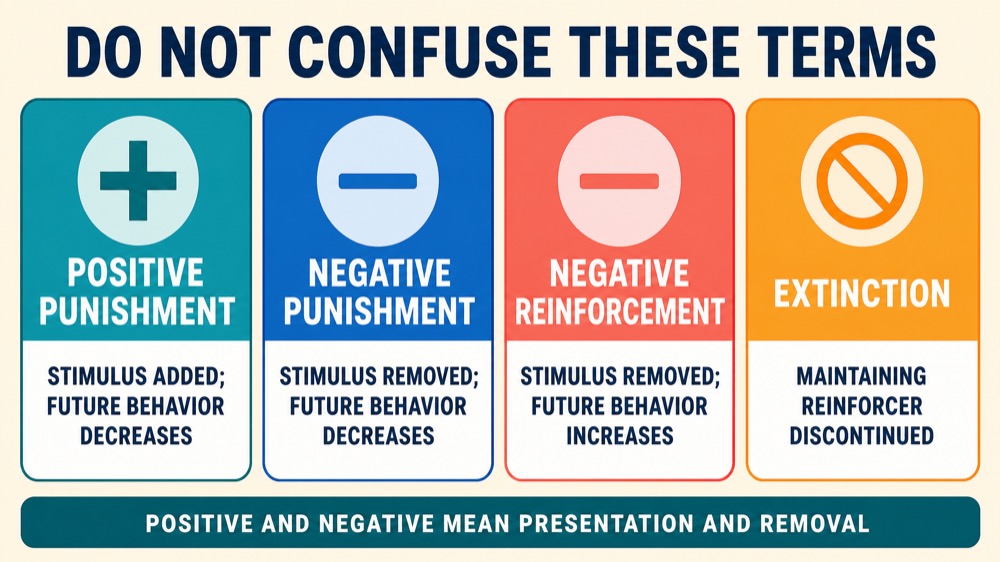
BCBA candidates often confuse positive and negative punishment, or they assume that a stimulus is punishing without verifying the effect. Here are common traps to avoid:
- Confusing positive punishment with negative reinforcement: positive punishment adds a stimulus, while negative reinforcement removes a stimulus to increase behavior.
- Assuming a reprimand is a punisher without data: it may actually serve as attention and reinforce the behavior.
- Selecting a punishment procedure without a functional assessment.
- Using punishment without first trying reinforcement-based interventions.
- Failing to monitor side effects or treatment integrity.
Use this study checklist to solidify your understanding:
- Define positive and negative punishment and provide examples.
- Explain the role of functional assessment in selecting punishment procedures.
- List at least three ethical considerations.
- Describe how to measure treatment integrity and IOA.
- Identify SD vs S-delta in a punishment scenario.
- Practice interpreting data graphs from punishment interventions.
Conclusion and Free Mock Exam
Punishment procedures in applied behavior analysis require function-based assessment, reinforcement for alternatives, ethical review, treatment-integrity data, and ongoing monitoring. For additional practice, take the free BCBA mock exam and use the explanations to check your reasoning.
For the current scope of BCBA examination content, consult the BACB BCBA Test Content Outline when reviewing punishment procedures and related behavior-change standards.



