
What is Curriculum Based Assessment?
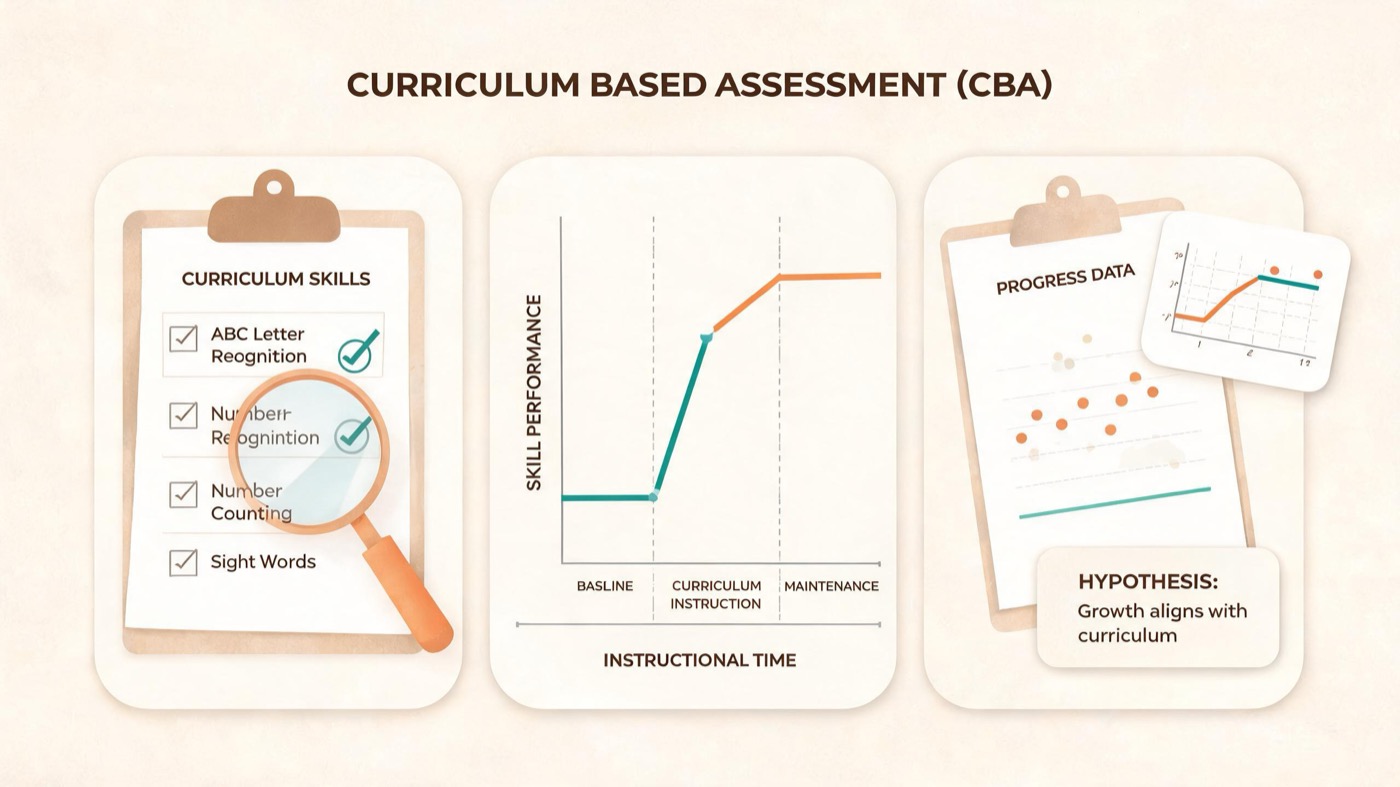
Curriculum based assessment (CBA) is a systematic method of evaluating a student’s performance by directly measuring their skills against the content of their instructional curriculum. Unlike norm-referenced tests, CBA focuses on what the student has been taught and uses materials drawn directly from the classroom. This makes it a highly relevant tool for behavior analysts working in educational settings.
Table of Contents
- What is Curriculum Based Assessment?
- Why CBA Matters for the BCBA Exam
- Worked ABA Examples of Curriculum Based Assessment
- Common Traps to Avoid on the Exam
- Quick Study Checklist for Curriculum Based Assessment
- Final Summary
Core Components of CBA
- Direct observation: Data are collected by observing the student performing the actual academic task (e.g., reading aloud, completing math problems).
- Curriculum-linked: Assessment items are drawn from the student’s current instructional materials, not from a standardized test bank.
- Ongoing: CBA is repeated frequently (e.g., weekly) to monitor progress and adjust instruction.
- Data-driven: Results are graphed and analyzed to make data-based decisions about intervention effectiveness.
Why CBA Matters for the BCBA Exam
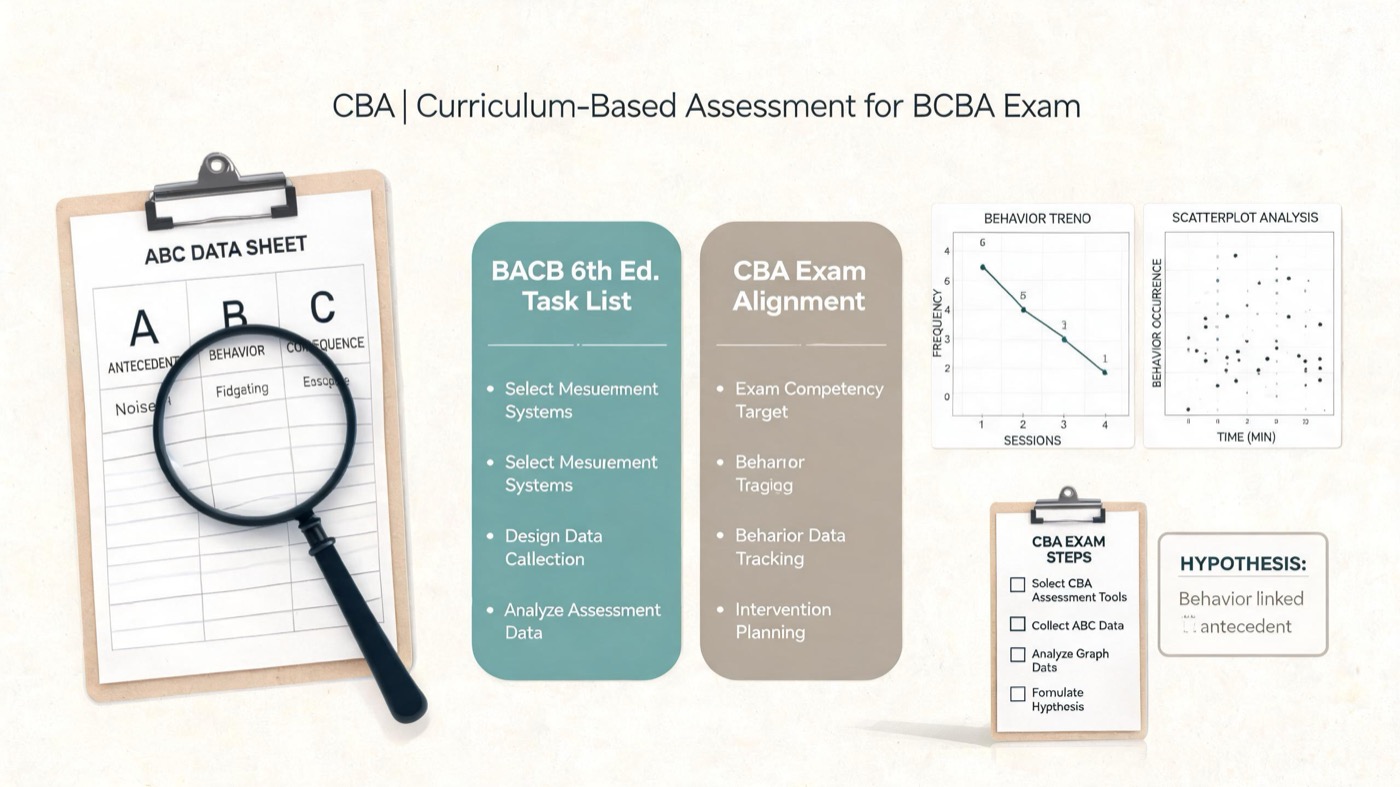
The BCBA exam tests your ability to select and use appropriate assessment methods. CBA appears in the assessment section of the BACB Task List (6th edition) under areas such as selecting measurement systems, designing data collection, and interpreting results to inform intervention. Exam questions may ask you to identify when to use CBA versus other assessment types, or to interpret CBA data to recommend next steps.
Common Exam Question Formats for CBA
- Scenario-based multiple choice: A description of a student and a referral question; you must choose the best assessment approach.
- Identify the assessment type: Given a brief description of data collection, decide whether it is CBA, criterion-referenced, or norm-referenced.
- Choose the next step: After viewing a CBA graph, you select the appropriate instructional decision (e.g., reteach, advance, modify intervention).
Worked ABA Examples of Curriculum Based Assessment
The following examples show how a BCBA might use CBA in school settings. Each includes an ABC analysis and a hypothesized function.
Example 1: Reading Fluency in a 3rd Grader
Antecedent: Teacher presents a grade-level reading passage and asks the student to read aloud for one minute.
Behavior: Student reads 45 words correctly, makes 8 errors (e.g., substitutions, omissions), and hesitates frequently.
Consequence: Teacher records errors, provides corrective feedback, and moves on to the next activity.
Hypothesized function: Escape from aversive reading demands. The student’s errors and hesitations may be maintained by avoidance of difficult text.
Example 2: Math Computation in Middle School
Antecedent: Teacher hands out a worksheet of 20 two-digit multiplication problems.
Behavior: Student completes only the first 5 problems, then stares at the paper or draws on the margins.
Consequence: Teacher prompts the student to continue, but eventually takes the unfinished worksheet.
Hypothesized function: Task avoidance. The student escapes the demanding task by engaging in off-task behavior.
Example 3: Written Expression in High School
Antecedent: Teacher assigns a 5-paragraph persuasive essay with a rubric.
Behavior: Student writes three brief sentences and turns in the paper.
Consequence: Teacher gives a low grade and asks for revisions; student does not revise.
Hypothesized function: Escape from written expression demands, possibly due to poor prewriting skills.
Common Traps to Avoid on the Exam
Many test-takers lose points by confusing CBA with other assessment methods or by missing key procedural details. Here are the most frequent pitfalls.
Confusing CBA with Norm-Referenced Assessments
A norm-referenced test compares a student’s performance to that of a peer group (e.g., percentiles). In contrast, CBA compares the student’s performance to the curriculum expectations. Exam questions may describe a test that is curriculum-linked but also provides national percentiles; that is not CBA—it is a norm-referenced test that happens to use curriculum content.
Overlooking the Direct Observation Requirement
CBA requires direct observation of the student performing the academic task. A common trap is assuming that a rating scale completed by a teacher or a parent interview qualifies as CBA. Without direct observation of the learner’s behavior, the assessment does not meet the CBA definition.
Assuming CBA Is Only for Academic Skills
While CBA is most often used for reading, math, and writing, it can also be applied to functional skills that are part of a student’s curriculum (e.g., daily living skills, social skills). Exam questions may try to restrict CBA to academics only; remember that the curriculum can include any skill area being taught.
Quick Study Checklist for Curriculum Based Assessment
- Define CBA in your own words and list its four core components.
- Distinguish CBA from norm-referenced and criterion-referenced assessments.
- Identify the direct observation requirement and why it matters.
- Practice scenario questions where you choose the appropriate assessment type.
- Interpret CBA data from a graph: trend, level, variability, and instructional decision.
- Review BACB Task List items related to assessment (e.g., measure behavior, design data collection).
- Take a mock exam that includes assessment questions. Check out our free BCBA mock exam practice questions for targeted practice.
Final Summary
Curriculum based assessment is a powerful, direct, and curriculum-linked method for evaluating student progress. For the BCBA exam, you need to know its definition, core components, and how it differs from other assessments. Use the worked examples to understand ABC patterns and hypothesized functions, and avoid common traps by remembering that CBA requires direct observation and compares to the curriculum, not to peers. For more study resources, see our guide to assessment in ABA and the official BACB BCBA page for detailed task list information.



