
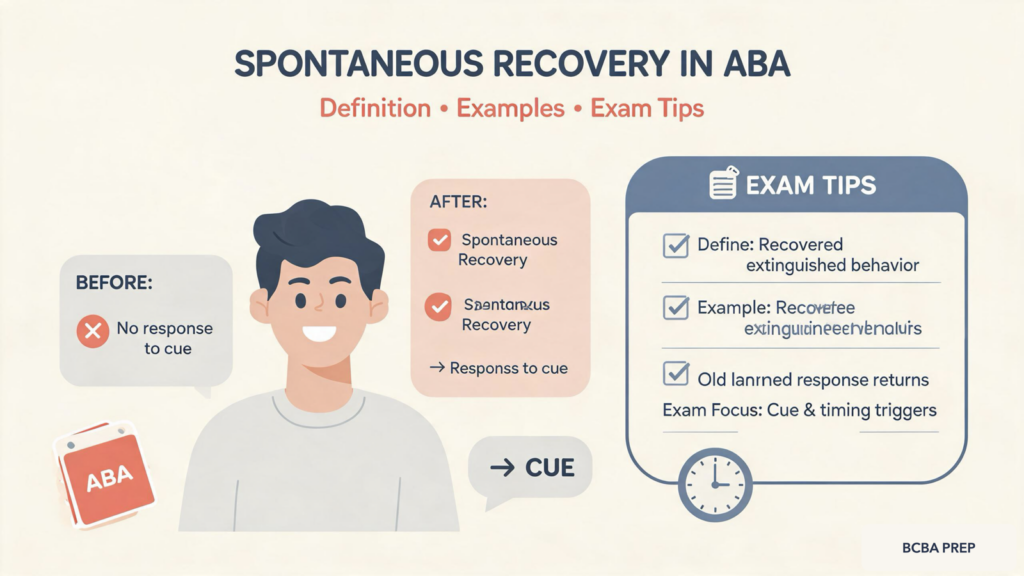
What Is Spontaneous Recovery?
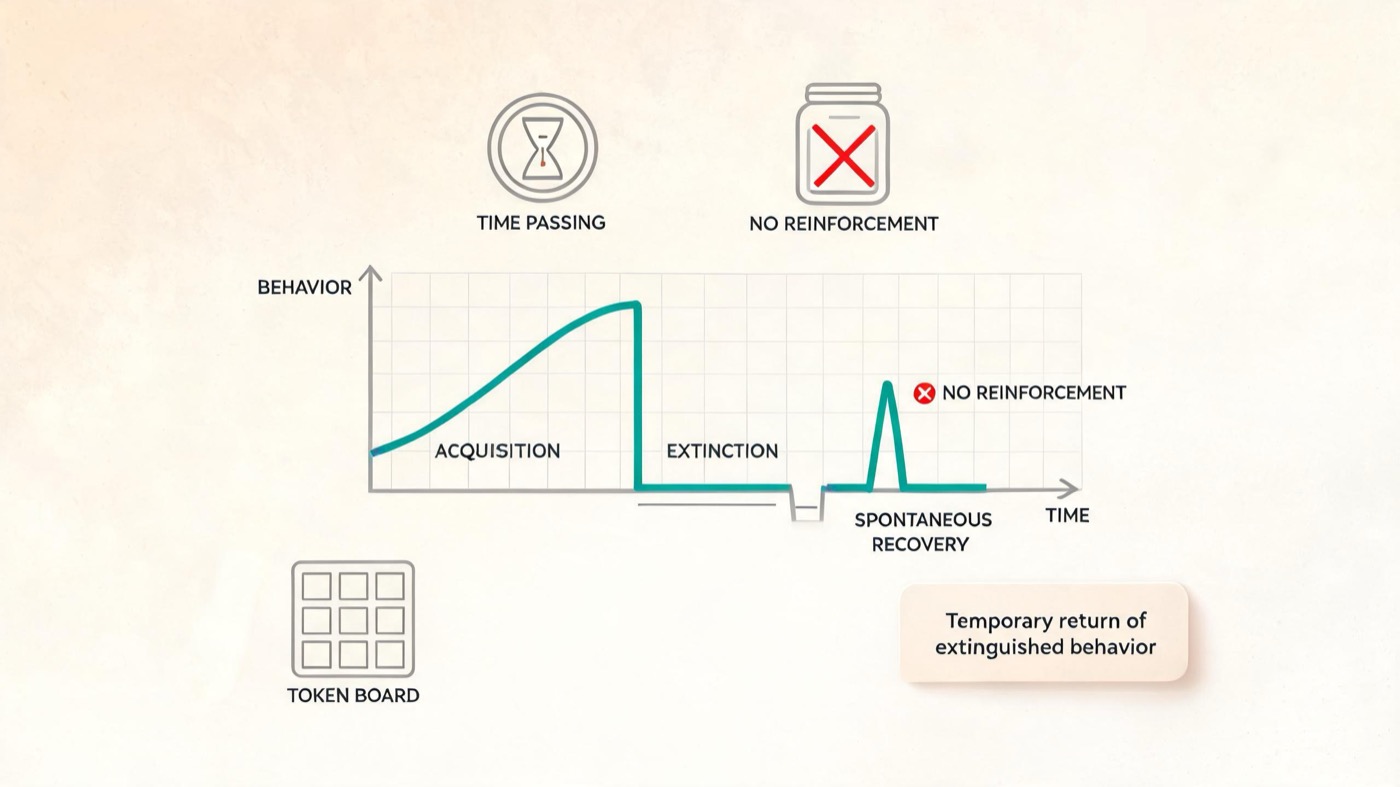
Spontaneous recovery ABA refers to the temporary reappearance of a previously extinguished behavior after a period of time has passed. Picture a graph: after extinction, the behavior drops to near zero. Then, without any reinforcement, a single instance occurs again. That brief spike is spontaneous recovery. It is a natural byproduct of the extinction process, not a sign that the behavior has returned permanently. In operant conditioning, extinction weakens a behavior by withholding reinforcement. However, the behavior is not erased; it can re-emerge under certain conditions. Spontaneous recovery is one such condition.
Table of Contents
- What Is Spontaneous Recovery?
- Spontaneous Recovery: ABA Examples with ABC Analysis
- Spontaneous Recovery on the BCBA Exam: What to Expect
- Summary: Spontaneous Recovery in ABA
Spontaneous Recovery in Operant Conditioning
In the context of operant behavior, spontaneous recovery occurs when the individual has been on extinction for a period, then after a break (e.g., overnight, weekend) the behavior briefly reappears. Notably, this reappearance is usually at a lower frequency and intensity than before extinction. The graph would show a decreasing trend during extinction, a pause (no sessions), and then a small upward blip at the start of the next session. This blip typically extinguishes quickly if reinforcement remains withheld.
Why It Occurs: A Behavioral Perspective
From a radical behavioral standpoint, spontaneous recovery is not due to memory or hope. Instead, it reflects the historical context of reinforcement. The passage of time alters the environmental context, making it slightly different from the pure extinction context. This change can momentarily reinstate the behavior. The longer the break, the more likely a small recovery. However, the effect is temporary and diminishes with repeated extinction sessions.
Spontaneous Recovery: ABA Examples with ABC Analysis
Understanding spontaneous recovery is easier with real-world examples. Below are two scenarios with ABC (Antecedent-Behavior-Consequence) data and hypothesized functions.
Example 1: Decreasing Tangible-Maintained Behavior
Setting: A child with autism requests candy by saying ‘candy please.’ Previously, this request was reinforced by receiving candy. After implementing extinction (no candy for requests), the child stops asking. After a weekend break, on Monday morning, the child says ‘candy please’ three times before the school day starts. The behavior is the same, the function (access to tangible) is unchanged, but spontaneous recovery is occurring. If the behavior analyst continues to withhold candy, the requests quickly stop again.
- Antecedent: Child sees candy jar on kitchen counter.
- Behavior: Child says ‘candy please’ (mand).
- Consequence: No candy given (extinction).
- Function: Tangible (access to candy).
Example 2: Attention-Maintained Behavior in a Classroom
A student raises his hand excessively to get the teacher’s attention. The teacher implements extinction by ignoring the raised hand for two weeks. The behavior drops to near zero. After a long weekend, on Tuesday the student raises his hand repeatedly during math class. The teacher continues to ignore (extinction), and the behavior reduces within the same session. This is another classic spontaneous recovery ABA example.
- Antecedent: Teacher is busy with other students.
- Behavior: Student raises hand and calls out ‘teacher!’
- Consequence: Teacher does not respond (extinction).
- Function: Attention (access to teacher interaction).
Hypothesized Functions and Implications
In both examples, the reinforcing function remains the same. Spontaneous recovery does not change the function; the behavior reappears because the previous reinforcement history is still present. The key implication for practitioners: do not assume the behavior has increased permanently. Continue to implement extinction consistently, and the recovery will extinguish. This is crucial for maintaining treatment fidelity.
Spontaneous Recovery on the BCBA Exam: What to Expect
On the BCBA exam, you will encounter questions that test your ability to discriminate spontaneous recovery from other behavioral concepts like resurgence and renewal. Below are common exam traps and a quick checklist.
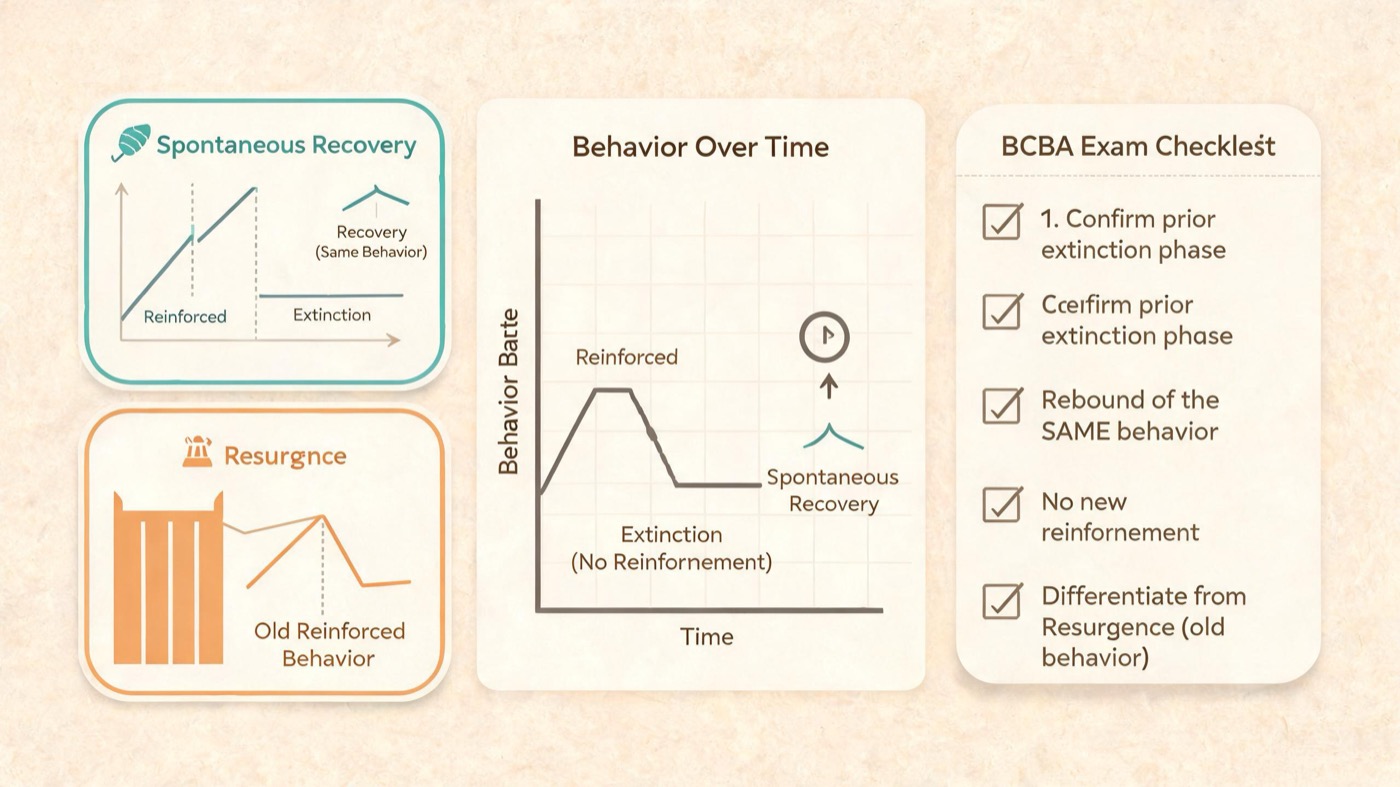
Distinguishing Spontaneous Recovery from Resurgence
Resurgence is the reappearance of a previously reinforced behavior when a more recent behavior is placed on extinction. For example, if a child mands for candy (Behavior A), then is taught to request with a picture card (Behavior B), and then the picture card is put on extinction, the child may return to the old mand (Behavior A). In contrast, spontaneous recovery involves only one target behavior that was extinguished. The key difference: resurgence involves two behaviors (old and new), while spontaneous recovery involves one behavior that reappears after time passes. Exam scenarios often ask: ‘After a break from extinction, the behavior briefly returns. Is this resurgence or spontaneous recovery?’ If extinction was only applied to one behavior and no new behavior was taught, it is spontaneous recovery.
Common Exam Traps and How to Avoid Them
One common trap is assuming that spontaneous recovery means the behavior is fully restored to baseline levels. In reality, it is usually temporary and lower in magnitude. Another trap is confusing it with renewal (context change). Renewal occurs when the environment changes (e.g., from clinic to home), while spontaneous recovery happens with time passage in the same context. Watch for these distinctions in scenario-based questions.
Quick Checklist for Spontaneous Recovery Questions
- Has extinction been implemented consistently?
- Did a passage of time occur (e.g., weekend, holiday)?
- Is the reappearing behavior the same one that was extinguished?
- Is the behavior weaker than pre-extinction levels?
- If yes to all, the answer is spontaneous recovery.
Summary: Spontaneous Recovery in ABA
Spontaneous recovery ABA is a temporary and normal phenomenon during extinction. It is a brief return of an extinguished behavior after a time delay. On the BCBA exam, be ready to distinguish it from resurgence and renewal using the checklist above. Continue implementing extinction and monitor the behavior; spontaneous recovery will extinguish quickly. For more BCBA exam tips, visit our BCBA exam prep guide. Also reference the BACB website for official task list details.



