
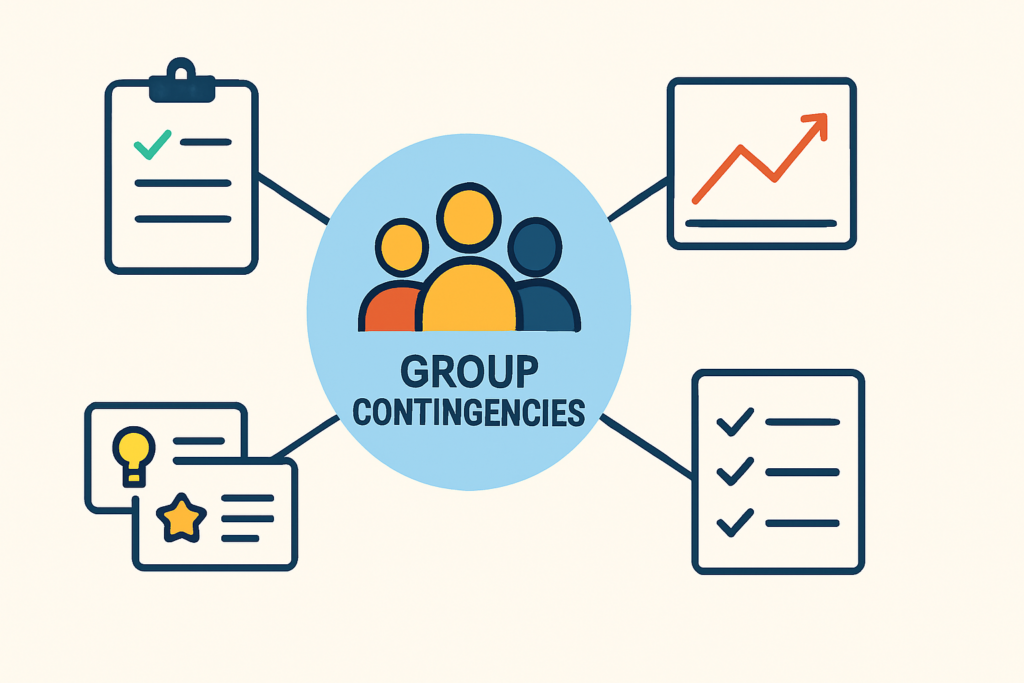
The 3 Types of Group Contingencies
A group contingency applies a consequence to a group based on behavior. There are three types:
- Independent. The same contingency is in place for everyone, but reinforcement depends on each individual’s own behavior (each person earns based on their own performance).
- Interdependent. The whole group must meet a criterion for anyone to earn reinforcement. The Good Behavior Game is the classic example.
- Dependent (“hero” procedure). The group’s reinforcement depends on the behavior of one (or a few) selected members — that person becomes the “hero” for the group.
Exam tip: Independent = your own behavior; Interdependent = everyone together; Dependent = it rides on one person (the hero).
Group Contingencies ABA: What Are Group Contingencies in Applied Behavior Analysis?
In applied behavior analysis, a group contingency refers to a systematic arrangement where consequences for a group are determined by the behavior of one or more members. This powerful intervention strategy leverages social dynamics to influence behavior across multiple individuals simultaneously.
Table of Contents
- Group Contingencies ABA: What Are Group Contingencies in Applied Behavior Analysis?
- Group Contingency Examples: From Classroom to Clinic
- Group Contingencies on the BCBA Exam: What to Expect
- Key Takeaways and Next Steps for Mastery
The BACB Task List specifically addresses group contingencies as an important component of behavior-change procedures that candidates must understand for certification.
Defining the Group Contingency
A group contingency is not merely a description of group behavior but an active intervention approach. The defining feature is that a common consequence is applied based on specific behavioral criteria met by group members. This differs from individual contingencies where each person’s consequences depend solely on their own behavior.
The Three Core Types: Independent, Dependent, Interdependent
Understanding the distinctions between these three types is crucial for both clinical practice and exam success:
- Independent Group Contingency: Each individual receives consequences based solely on their own behavior. The ‘group’ aspect is only in the shared setting, not the contingency itself.
- Dependent Group Contingency: The entire group receives consequences based on the behavior of one individual or a small subset. This creates powerful peer-mediated effects.
- Interdependent Group Contingency: The group receives consequences only when all members meet the behavioral criterion. This promotes cooperation and mutual accountability.
Video Study: Group Contingencies
Watch: Group Contingencies Explained | 6th ed. | BCBA Exam Prep
Use this lesson as a visual study companion, then return to the definitions and examples below to apply the same concept to BCBA® exam questions.
Prefer a second pass? Open this lesson on YouTube.
Group Contingency Examples: From Classroom to Clinic
Let’s examine practical applications of each contingency type with detailed ABC analysis and hypothesized functions.
Example 1: The Independent Group Contingency (Good Behavior Game)
In an elementary classroom, the teacher implements a point system: ‘If you complete your independent work quietly, you earn a point for yourself.’
- Antecedent: Teacher presents independent work materials
- Behavior: Individual student works quietly without disruptions
- Consequence: Point awarded to that specific student
The hypothesized function of behavior is access to tangible reinforcement (points exchangeable for prizes) and possibly social reinforcement through peer approval. Note this is NOT a true ‘group’ contingency in the technical sense—a common exam trap.
Example 2: The Dependent Group Contingency (Hero Procedure)
A middle school homeroom experiences chronic tardiness. The teacher announces: ‘If the class monitor is in his seat when the bell rings, the whole class gets 5 minutes of free time.’
- Antecedent: Bell about to ring, teacher states contingency
- Behavior: Class monitor arrives and sits before bell
- Consequence: Free time for entire class
The hypothesized function is peer-mediated positive reinforcement, where classmates encourage the monitor’s promptness. This approach requires careful ethical consideration regarding potential peer pressure and fairness.
Example 3: The Interdependent Group Contingency (Team Challenge)
In a social skills group for adolescents, the therapist sets a team goal: ‘If every member of the team uses a ‘joining’ statement during the activity, the team wins a prize.’
- Antecedent: Activity instruction with clear behavioral expectation
- Behavior: All members emit target social skill during session
- Consequence: Prize awarded to entire team
The function is positive reinforcement through shared tangible rewards and social praise. While this promotes cooperation, practitioners must monitor for potential ‘free rider’ problems or scapegoating of less skilled members.
Group Contingencies on the BCBA Exam: What to Expect
The BCBA examination tests your ability to identify, analyze, and apply group contingencies appropriately. Questions typically focus on application and analysis rather than simple recall.
Common Exam Question Formats and Traps
Expect these question formats:
- Identifying the type of contingency from a clinical vignette
- Selecting the most appropriate contingency for a given scenario
- Analyzing potential side effects and ethical considerations
Watch for these common traps:
- Confusing ‘group setting’ with ‘group contingency’
- Misidentifying independent contingencies as group contingencies
- Overlooking ethical pitfalls in dependent contingencies
- Failing to consider social validity and client dignity
Quick-Reference Checklist for Exam Scenarios
Use this mental checklist when analyzing exam questions:
- Is the consequence delivered to a group or individuals?
- What determines consequence delivery? (One person = Dependent; Everyone = Interdependent; Individual’s own behavior = Independent)
- Are there ethical red flags like excessive peer pressure or lack of individualization?
- Does the intervention align with evidence-based practice principles?
- Consider whether differential reinforcement might be more appropriate
Key Takeaways and Next Steps for Mastery
Mastering group contingencies requires understanding both the technical definitions and practical applications. Remember that independent group contingencies are technically not true group contingencies, while dependent and interdependent contingencies leverage social dynamics for behavior change.
For exam preparation, practice identifying contingencies in various scenarios and consider both the behavioral principles and ethical implications. Review the ethics guidelines related to group interventions and explore how these contingencies fit within comprehensive behavior intervention plans.
To deepen your understanding, consult the BACB Ethics Code regarding group interventions and review research on peer-mediated interventions in behavior analysis literature.
Consistent practice with scenario-based questions will help you recognize patterns and apply these concepts effectively on the BCBA exam and in clinical practice.
Test yourself on behavior-change procedures
Practice with a free, full-length BCBA mock exam — real exam-style questions, instant scoring, and answer explanations.
Frequently Asked Questions
What are the three types of group contingencies?
Independent, interdependent, and dependent (also called the hero procedure).
What is an example of an interdependent group contingency?
The Good Behavior Game, where the whole group must meet a criterion for everyone to earn the reward.
What is the hero procedure?
A dependent group contingency in which the group’s reinforcement depends on the behavior of one or a few selected members.
References
- Cooper, J. O., Heron, T. E., & Heward, W. L. (2020). Applied Behavior Analysis (3rd ed.). Pearson.
- Behavior Analyst Certification Board — BACB.com.
Next step for BCBA exam prep
Turn this topic into exam-day practice
Use this topic as a focused review, then test it in exam-style conditions with a free mock before deciding whether five full-length mocks are the right next step.
Start the Free BCBA Mock Exam
Continue with Five Full-Length Mocks — $99
Review the included materials and access details before ordering. No pass guarantee is implied.



