
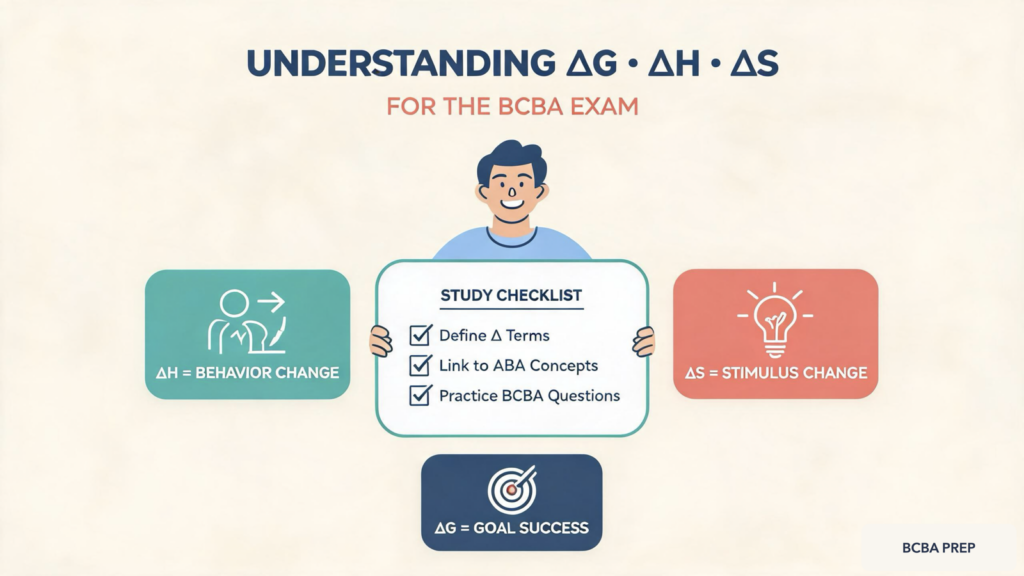
What Is Delta G H S? Breaking Down Gibbs Free Energy
In thermodynamics, delta G (Gibbs free energy change) determines whether a process occurs spontaneously. For the BCBA exam, this concept maps onto behavior change: interventions that make the desired behavior 'energetically favorable' are more likely to happen without excessive prompting.
Practice this concept
If S-delta examples feel tricky, work through BCBA stimulus control questions before a full mock.
Table of Contents
- What Is Delta G H S? Breaking Down Gibbs Free Energy
- Delta G H S in ABA: Worked Examples
- Exam Relevance: How BCBA Questions Test These Concepts
- Common Misconceptions and Traps to Avoid
- Quick Checklist for Delta G H S on the BCBA Exam
- Final Summary
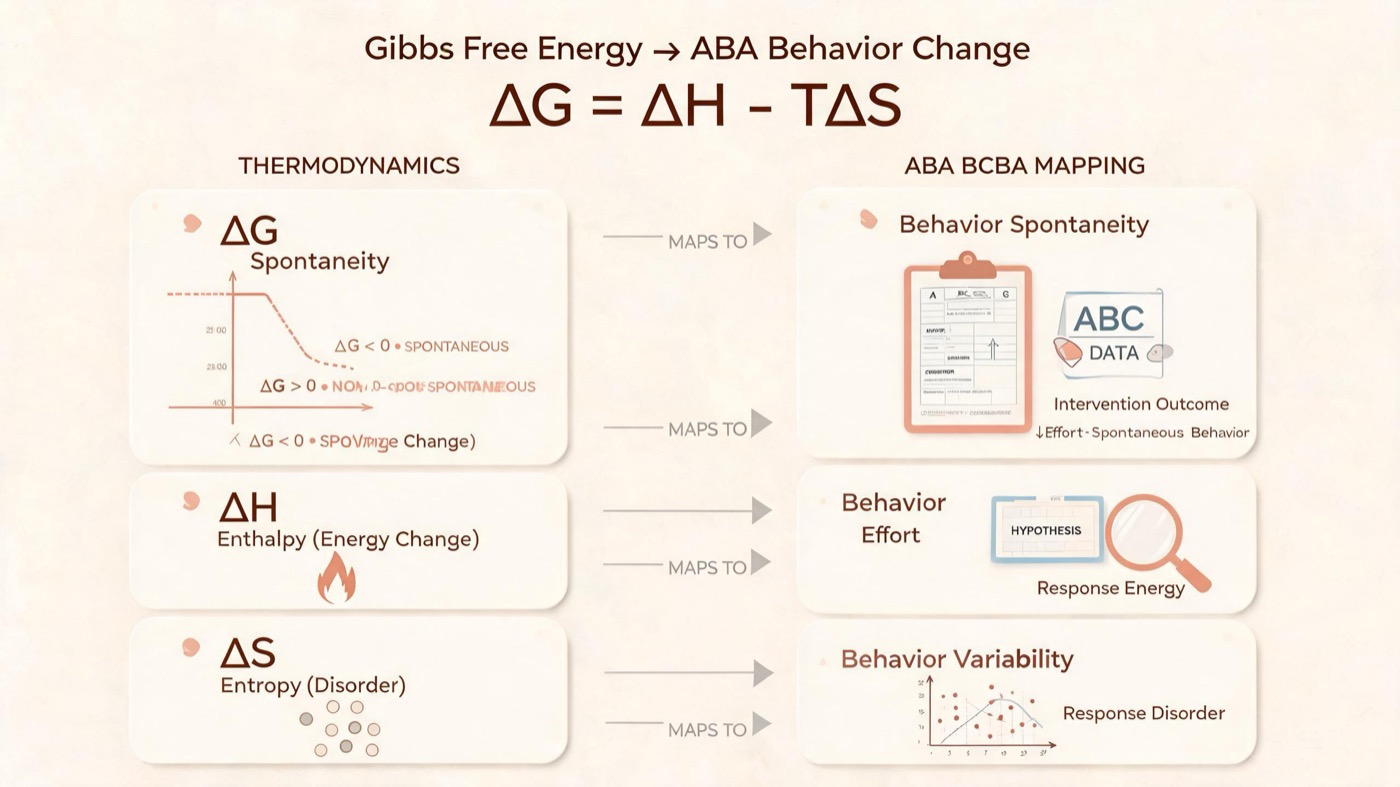
Delta G is calculated as ΔG = ΔH – TΔS. In behavioral terms, enthalpy (H) represents the internal 'energy state' of the organism—how easy or effortful a behavior feels. Entropy (S) is the degree of variability or disorder in behavior. A negative ΔG means the behavior is likely to occur spontaneously.
Enthalpy (H) and Entropy (S) in Behavioral Terms
Enthalpy in ABA can be thought of as the overall 'cost' of engaging in a behavior. For example, a high-effort task like cleaning a room has high enthalpy (energy required). Entropy relates to the variability of behavior—more entropy means more possible responses. When a child has many available behaviors (high entropy), the target behavior must have a lower delta G to compete.
How Delta G Determines Motivation to Change
A negative delta G indicates that the behavior change is thermodynamically spontaneous—given the right antecedents, the behavior is likely to occur without coercion. This aligns with reinforcement: when a behavior leads to a valued consequence (like attention or escape), the delta G becomes negative, increasing the probability of that behavior. For BCBA candidates, understanding this helps in designing interventions that naturally 'pull' behavior toward the desired outcome.
Delta G H S in ABA: Worked Examples
Here are three concrete ABA examples connecting delta G, H, and S to common behavioral functions. Each example includes an ABC contingency.
Example 1: Reducing Tantrums
Antecedent: Parent says no to a request. Behavior: Child screams and cries. Consequence: Parent gives attention. Hypothesized function: Positive reinforcement (attention). Here, the enthalpy (effort) of tantruming is moderate, but the entropy (variability) is low—the child has learned that tantruming reliably produces attention. The delta G for tantruming is negative because the consequence outweighs the effort. To reduce tantrums, we must increase the delta G for tantruming (make it less favorable) while decreasing the delta G for an appropriate alternative, such as asking nicely.
Example 2: Increasing Task Initiation
Antecedent: Teacher says, 'Please start your worksheet.' Behavior: Student begins writing. Consequence: Teacher praises and gives a sticker. Hypothesized function: Positive reinforcement (praise/tangible). The enthalpy for initiating is initially high (effort to switch tasks), but the praise and sticker lower the perceived cost. The entropy (available alternatives like daydreaming) is high, but the reinforcement makes the delta G for task initiation negative. Over time, the behavior becomes more automatic (lower enthalpy).
Example 3: Eliminating Self-Injury
Antecedent: Parent presents a difficult demand. Behavior: Child hits own head. Consequence: Demand is removed. Hypothesized function: Negative reinforcement (escape). Self-injurious behavior (SIB) has a very negative delta G because the escape is immediate and powerful, despite high physical cost. The entropy (other escape behaviors) may be low if SIB is the most efficient. Intervention involves teaching a functionally equivalent alternative (e.g., requesting a break) with an even more negative delta G, making the alternative more 'spontaneous' than SIB.
Example 4: Increasing Peer Interaction
Antecedent: Peer approaches during recess. Behavior: Child initiates conversation. Consequence: Peer responds positively and they play together. Hypothesized function: Positive reinforcement (social). The delta G for approaching peers may initially be positive (high enthalpy due to social anxiety). By gradually shaping approach behavior and pairing peer interaction with preferred activities, the enthalpy decreases, and the entropy of alternative solitary behaviors is reduced. The delta G becomes negative, making social initiation more likely.
Exam Relevance: How BCBA Questions Test These Concepts
BCBA exam questions often present clinical scenarios and ask which intervention is most likely to produce spontaneous behavior change. You might be asked to identify when a negative delta G is present or to choose an intervention that lowers the ΔH (effort) or increases ΔS (variability) to favor the desired behavior. Common question formats include:
- Given a client's behavior, which factor (H or S) is most influencing delta G?
- Which intervention would make a behavior more 'spontaneous' (negative delta G)?
- How does increasing entropy (offering choices) affect the likelihood of a target behavior?
For example, a question might describe a child who refuses to do homework (high enthalpy). The answer might involve reducing task difficulty (lowering H) or providing choices (increasing S). Understanding the delta G framework helps you reason beyond memorized strategies. For more exam strategies, check our BCBA test strategies guide.
Common Misconceptions and Traps to Avoid
Many candidates confuse delta G with simple probability. Here are two major traps:
Confusing Spontaneity with Likelihood
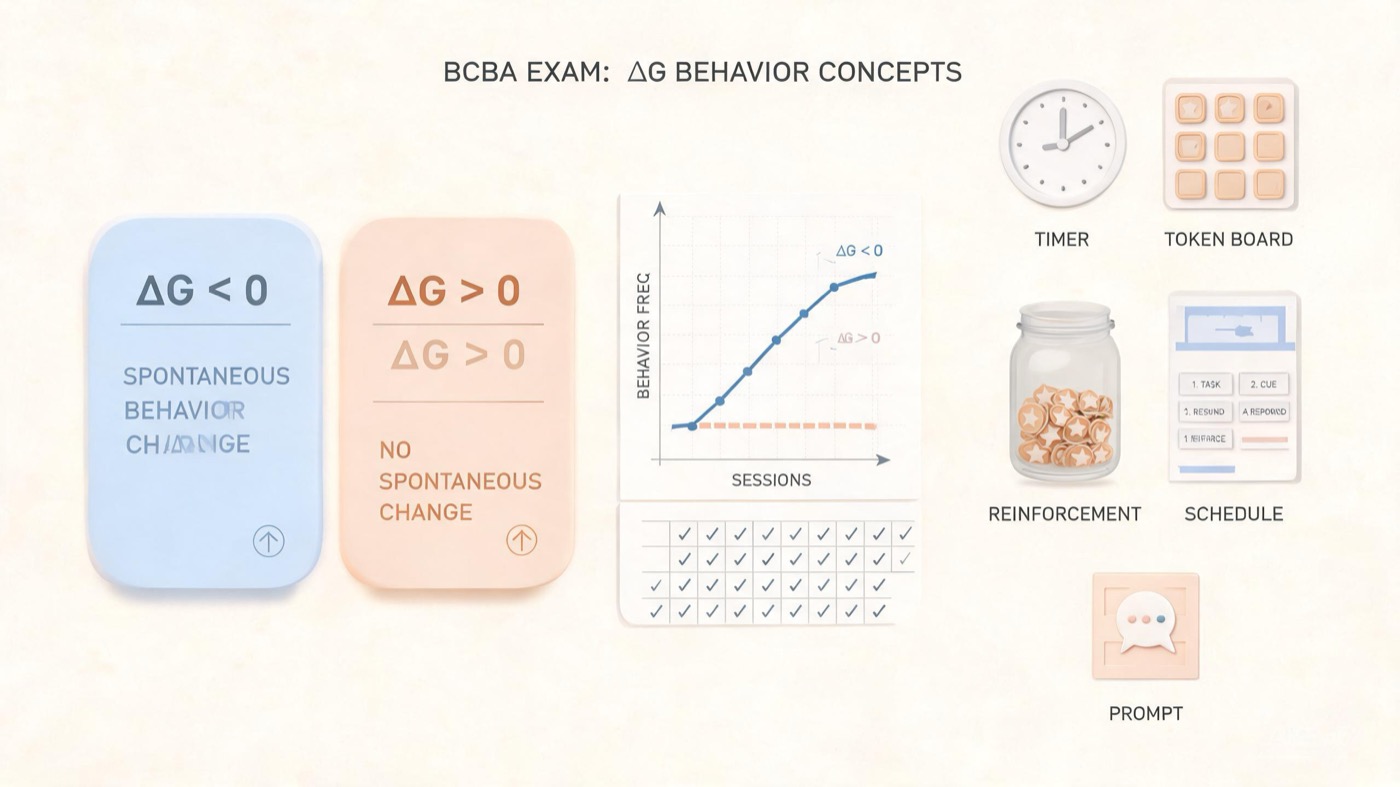
A negative delta G means a behavior is spontaneous (can occur without external force), but it does not guarantee a high probability. Other factors, like competing contingencies, may still suppress the behavior. For example, a child may have a negative delta G for stealing candy (spontaneous), but if punishment is likely, the actual probability may be low. The exam may ask you to distinguish between 'thermodynamically possible' and 'likely under current conditions.'
Ignoring Temperature Dependence
The temperature (T) in the delta G equation is often overlooked. In behavioral terms, T can represent the 'arousal level' or 'motivational state' of the client. A high T amplifies the contribution of entropy (S). For instance, a client who is highly motivated (high T) may show more variable behavior (high S), making it easier to introduce a new response. Conversely, low T reduces the impact of S, making high-effort behaviors (high H) less likely. Exam questions may ask how changing motivational conditions (like satiation/deprivation) affects delta G.
Quick Checklist for Delta G H S on the BCBA Exam
Use this checklist when analyzing behavior-change scenarios:
- Identify the behavior and its hypothesized function.
- Estimate the enthalpy (H): How much effort or discomfort does the behavior require?
- Estimate the entropy (S): How many alternative behaviors are available? Is the environment highly variable?
- Consider the temperature (T): What is the client's current motivational state (e.g., deprivation, arousal)?
- Determine delta G: Is the behavior spontaneously likely? If not, which term (H or S) can be changed to make delta G negative?
- Design intervention: Lower H (e.g., task analysis, prompting) or increase S (e.g., provide choices, vary reinforcers).
This framework will help you approach exam questions systematically. For further study, review the positive reinforcement and negative reinforcement pages, which relate closely to delta G. Also check the BACB website for official materials and PubMed for behavior-analytic research on motivation.
Final Summary
Understanding delta G, H, and S gives you a powerful lens for predicting behavior change. A negative delta G indicates spontaneous behavior, which is the goal of effective interventions. By manipulating enthalpy (effort) and entropy (variability) within the client's motivational context, you can design interventions that 'naturally' shift behavior toward desired outcomes. On the BCBA exam, apply this framework to choose the most efficient and effective strategies. Master these concepts, and you will approach questions with greater confidence.



