
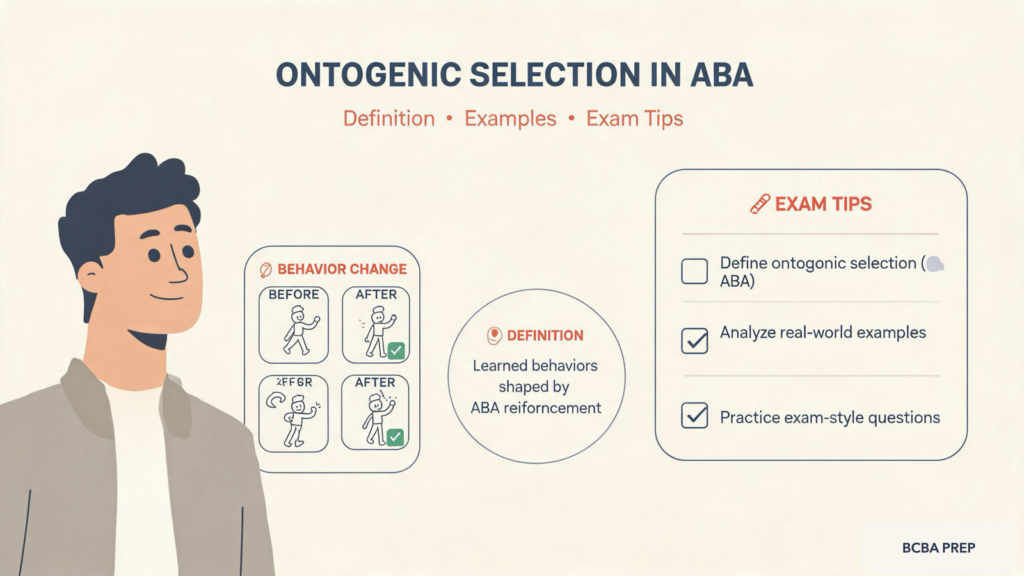
What Is Ontogenic in Behavior Analysis?
In behavior analysis, ontogenic selection refers to the process by which an individual’s behavior is shaped by consequences experienced during their lifetime. It is one of three units of selection, alongside phylogenic (species-level) and cultural selection. Understanding ontogenic selection is essential for the BCBA exam because it explains how learned behaviors develop and persist.
Table of Contents
- What Is Ontogenic in Behavior Analysis?
- Ontogenic in Action: Two Worked ABA Examples
- Why Ontogenic Matters on the BCBA Exam
- Final Summary: Ontogenic Selection and the BCBA
Ontogenic vs. Phylogenic Selection
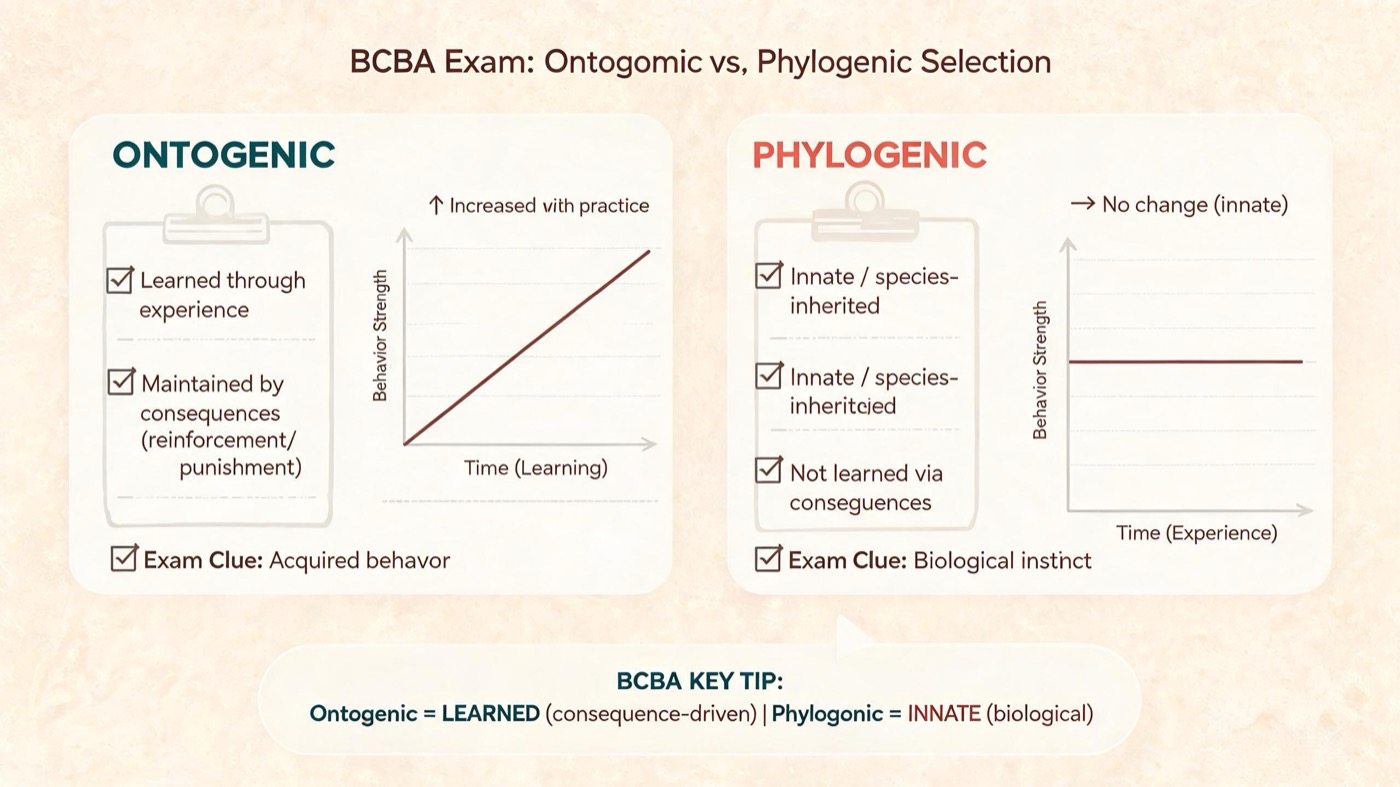
Phylogenic selection describes behaviors that evolved over generations due to survival value, such as reflex responses or innate fixed action patterns. In contrast, ontogenic selection involves behaviors acquired through individual learning history, specifically via operant conditioning—a behavior is strengthened or weakened by its consequences.
A key distinction: phylogenic behaviors are typically unlearned and biologically adaptive (e.g., blinking at a puff of air), while ontogenic behaviors are learned and depend on reinforcement history. On the exam, if a behavior is maintained by its consequences (e.g., a child screams to gain attention), it is likely ontogenic. If it appears automatic or species-typical (e.g., newborn rooting), consider phylogenic.
Ontogenic in Action: Two Worked ABA Examples
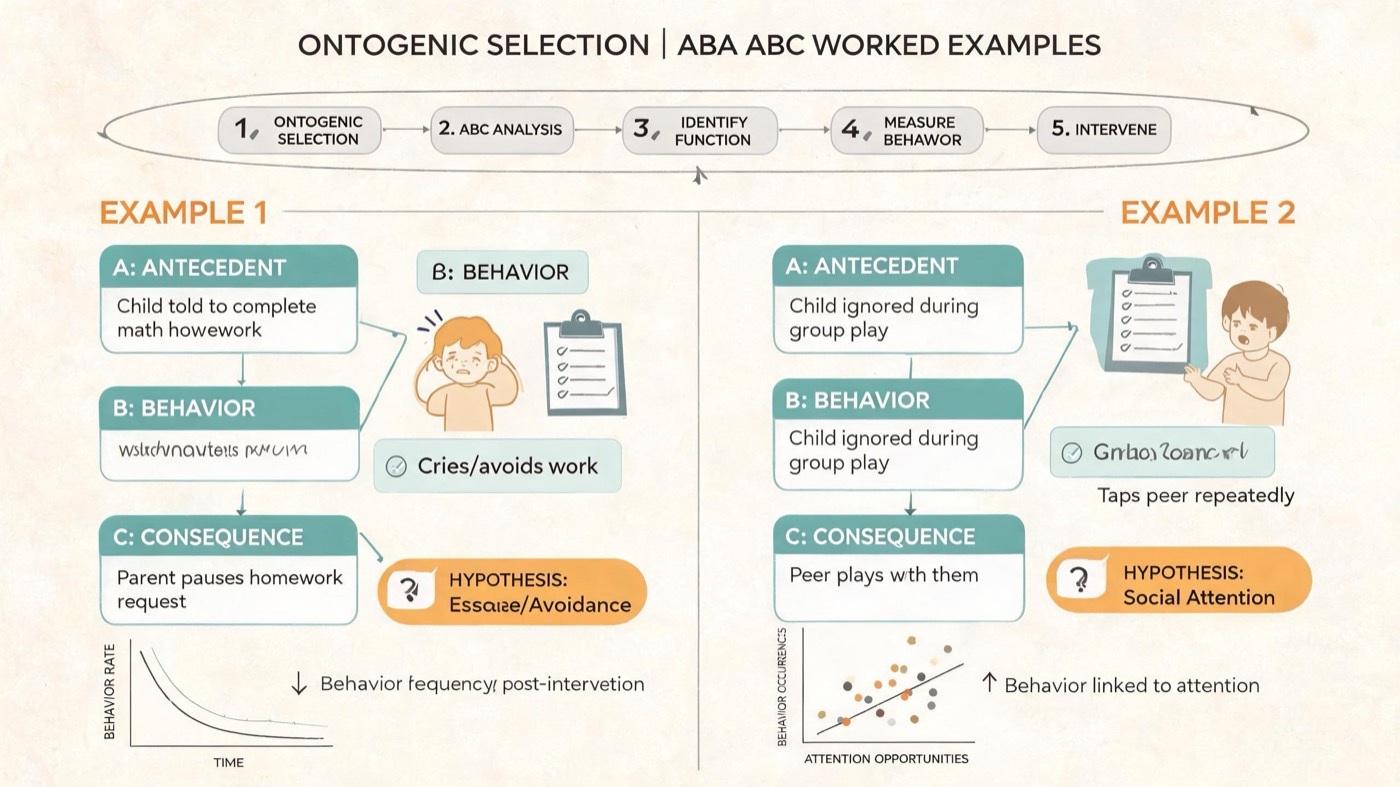
Applying ontogenic selection to real-world scenarios helps solidify the concept. Below are two examples using the ABC (antecedent-behavior-consequence) model, each with a hypothesized function.
Example 1: Escape-Motivated Disruption
- Antecedent: Teacher presents a difficult math worksheet to a student.
- Behavior: Student throws the worksheet on the floor and shouts, ‘I can’t do this!’
- Consequence: Teacher removes the worksheet and lets the student take a break.
- Hypothesized function: The behavior is maintained by negative reinforcement in the form of escape from task demands. The consequence of escaping a non-preferred activity strengthens the disruptive behavior for future similar situations.
Example 2: Attention-Seeking Vocalizations
- Antecedent: A parent is on a phone call, not attending to the child.
- Behavior: Child loudly calls out ‘Mom! Mom!’ repeatedly.
- Consequence: Parent pauses the call and says, ‘What is it? I am on the phone.’
- Hypothesized function: The behavior is maintained by positive reinforcement in the form of social attention. Even though the attention is reprimanding, it serves as reinforcement for the child, increasing future instances of loud vocalizations when the parent is busy.
In both examples, the behavior is a product of ontogenic selection: it emerged from repeated pairings of behavior and consequence within the individual’s history.
Example 3: Automatic Reinforcement (Sensory Stimulation)
- Antecedent: No immediate environmental demands or social presence.
- Behavior: A child repeatedly flaps hands in front of their eyes.
- Consequence: The behavior produces visual sensory stimulation (e.g., flickering light patterns).
- Hypothesized function: The behavior is maintained by automatic positive reinforcement (direct sensory consequence). The stimulation itself is reinforcing, independent of social mediation, making this a clear ontogenic selection example—a consequence within the individual’s body.
Why Ontogenic Matters on the BCBA Exam
The BCBA exam often tests your ability to differentiate ontogenic from phylogenic selection, and to identify which consequences maintain a behavior. Candidates who confuse these two may incorrectly attribute biological causes to learned behaviors, or vice versa.
Common Exam Traps with Ontogenic Items
- Trap 1: Mistaking ontogenic for phylogenic when a behavior has a biological component. For example, a child who avoids loud noises might display both a reflexive startle (phylogenic) and a learned escape response (ontogenic). The exam may describe the learned avoidance; focus on the consequence—did the child learn to escape because it worked before? That is ontogenic.
- Trap 2: Overlooking automatic reinforcement. Behaviors that produce sensory consequences (e.g., rocking, humming) are often mislabeled as ‘non-functional.’ However, they are maintained by automatic reinforcement, which is a valid ontogenic selection process. On the exam, consider all possible consequences, including internal sensory feedback.
- Trap 3: Confusing ontogenic selection with cultural selection. Cultural selection involves behavior change due to the practices of a group, often passed down across generations. Ontogenic selection is strictly within an individual’s lifetime. If the scenario describes a client adopting a new behavior because peers model it, consider both social reinforcement (ontogenic) and cultural norms—but the immediate consequence is still ontogenic.
Quick Checklist for Ontogenic Questions
When you encounter a scenario on the BCBA exam, run through this checklist to decide if the behavior is maintained by ontogenic selection:
- Is the behavior learned? That is, did it emerge after repeated exposure to consequences?
- Is the behavior maintained by consequences? If removal of the consequence reduces the behavior, it is likely operant.
- Does the behavior vary across individuals? Learned behaviors often differ based on personal history.
- Is there a clear ABC contingency? Identify the antecedent, behavior, and consequence that follows.
- Is the function social (attention, escape, tangible) or automatic (sensory)? Both are ontogenic.
If you answered ‘yes’ to the first two, the behavior is most likely ontogenic. This distinction is critical for designing effective behavior intervention plans.
Final Summary: Ontogenic Selection and the BCBA
Ontogenic selection is a cornerstone of applied behavior analysis. It reminds us that most clinically relevant behaviors are learned through interaction with the environment. The BCBA exam will ask you to identify units of selection, analyze ABC contingencies, and avoid confusing ontogenic with phylogenic or cultural processes. Use the checklist above for any scenario-based question. For deeper review, explore our guide to radical behaviorism and functions of behavior. Additionally, the BACB provides official resources to reinforce these concepts. Mastery of ontogenic selection will sharpen your clinical judgment and boost your exam performance.



