

Contriving motivation ABA means deliberately arranging a relevant condition that changes the value of a consequence and makes a related response more likely. In practice, a BCBA may arrange a brief, meaningful reason for a learner to request help, ask for information, continue an activity, or use a communication response that is otherwise unlikely to occur at that moment.
Table of Contents
- What Does Contriving Motivation ABA Mean?
- How Do Establishing and Abolishing Operations Change Behavior?
- How Is a Motivating Operation Different From an SD?
- How Do You Contrive Motivation Without Forcing Behavior?
- What Are Examples of Contrived Motivation in ABA?
- Should You Capture or Contrive Motivation?
- What Data and Generalization Checks Matter?
- What Are the Ethical Boundaries?
- What Are the BCBA Exam Traps?
- Frequently Asked Questions
- Sources for Further Study
- Take the Free BCBA Mock Exam
“Contrive” means planned or arranged. It does not mean tricking a learner, forcing distress, or withholding basic needs. The behavior analyst still defines the target response, protects assent and dignity, delivers a relevant consequence, and checks whether the skill occurs outside the arranged setup. This guide explains the concept for BCBA study and planning; it is not a universal clinical protocol.
What Does Contriving Motivation ABA Mean?
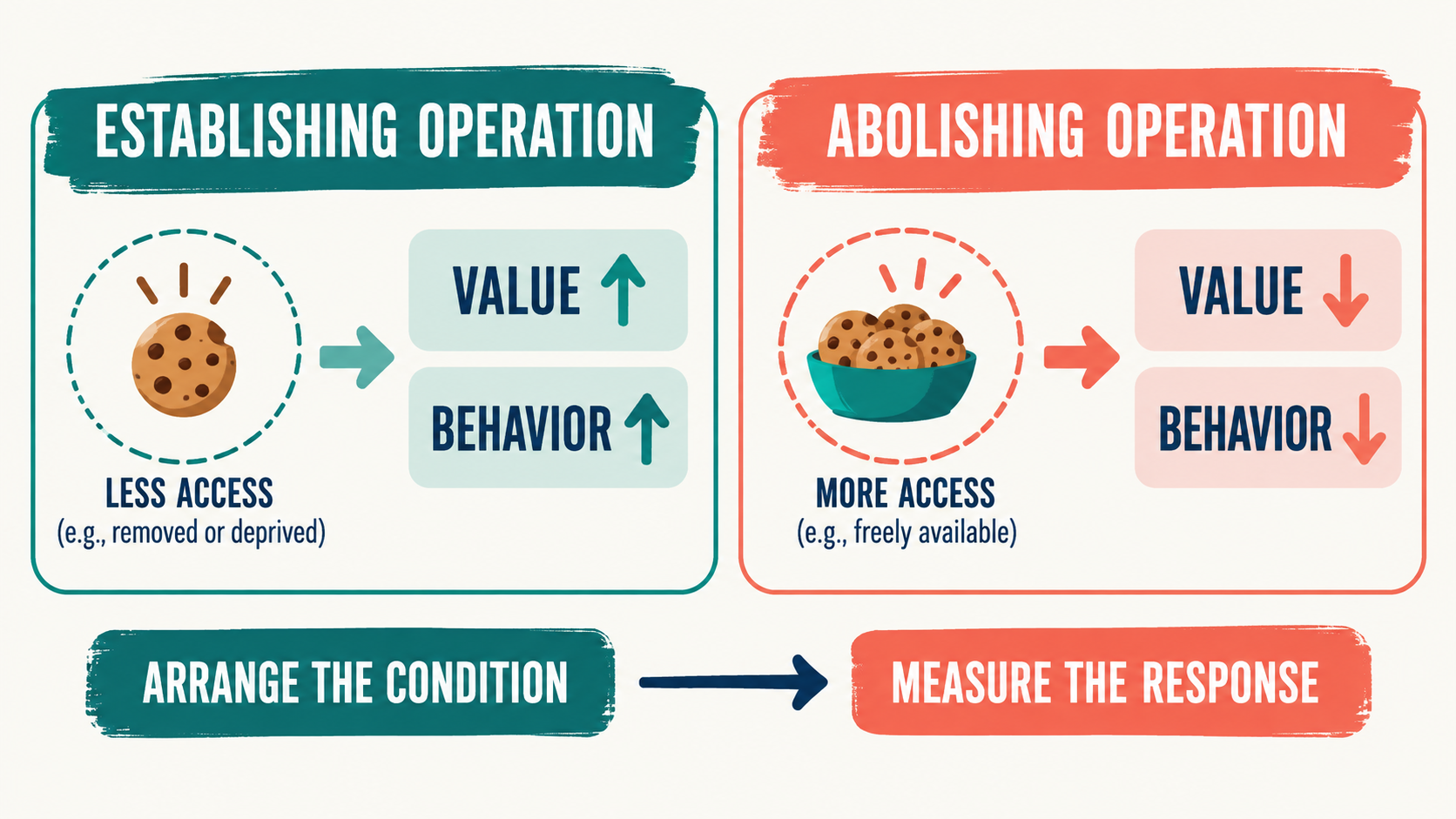
Motivating operations, or MOs, are antecedent events that temporarily alter how valuable a consequence is and change the momentary likelihood of behavior that has produced that consequence before. Contriving motivation means arranging one of those relevant conditions instead of waiting for it to appear by chance. The arrangement should make the target response useful and observable, not manufacture frustration for its own sake.
For example, a preferred activity may pause at a natural point, leaving a reasonable opportunity to request “more,” “help,” or “open.” A necessary material may be visible while one safe piece is unavailable, creating a reason to request information or assistance. The response should have a practical, relevant consequence and an accessible communication form.
The phrase is common in mand instruction because a mand is controlled by an MO and followed by a consequence specific to the request. If the outcome has little current value, the learner may have little reason to emit the mand. Use preference information and current behavior to arrange a brief opportunity, then fade the arrangement as the response contacts natural reinforcement.
The current BCBA Test Content Outline places motivating operations, discriminative stimuli, verbal behavior, reinforcement, and generalization in the study context. On an exam, identify which variable the question is asking about instead of treating every arranged event as “motivation.”
How Do Establishing and Abolishing Operations Change Behavior?
An establishing operation (EO) increases the current value of a consequence and evokes behavior that has produced that consequence. An abolishing operation (AO) decreases the current value of a consequence and reduces the momentary likelihood of behavior that has produced it. Modern texts often use the broader term MO, with EO and AO describing the direction of the value-altering effect.
Use the two effects together when reading a scenario. Limited recent access may increase the value of an activity, while long unrestricted access may reduce it. The MO changes value and evokes or abolishes behavior; it does not itself deliver the consequence.
| Concept | Value effect | Behavior effect | Exam cue |
|---|---|---|---|
| EO | The consequence is temporarily more valuable. | Behavior that previously produced it is more likely right now. | Ask what became valuable and which response has produced it. |
| AO | The consequence is temporarily less valuable. | Behavior that previously produced it is less likely right now. | Look for satiation, free access, or another condition reducing value. |
How Is a Motivating Operation Different From an SD?
A motivating operation and a discriminative stimulus can both appear before a response, but they do different work. An MO changes the value of a consequence and evokes or abolishes behavior. An SD signals that a consequence is available for a response because that response has been reinforced in the presence of the stimulus before. The consequence itself follows the response; it is not the MO or the SD.
| Variable | Main question | Example in a request routine |
|---|---|---|
| MO | Is the consequence more or less valuable right now? | The paused activity or missing information creates a relevant reason to request. |
| SD | Is reinforcement available for this response in this setting? | A communication partner or visible request system signals that an appropriate request can contact the outcome. |
| Consequence | What follows the response and changes future responding? | The relevant item, help, information, or activity continuation follows the appropriate request. |
A useful exam sequence is: value, availability, response, consequence. First identify what makes the outcome valuable, then ask whether the situation signals that the outcome is available, then name the response, and finally identify what follows it. This prevents the common mistake of labeling the visible item or the therapist’s instruction as the MO without analyzing its effect.
How Do You Contrive Motivation Without Forcing Behavior?
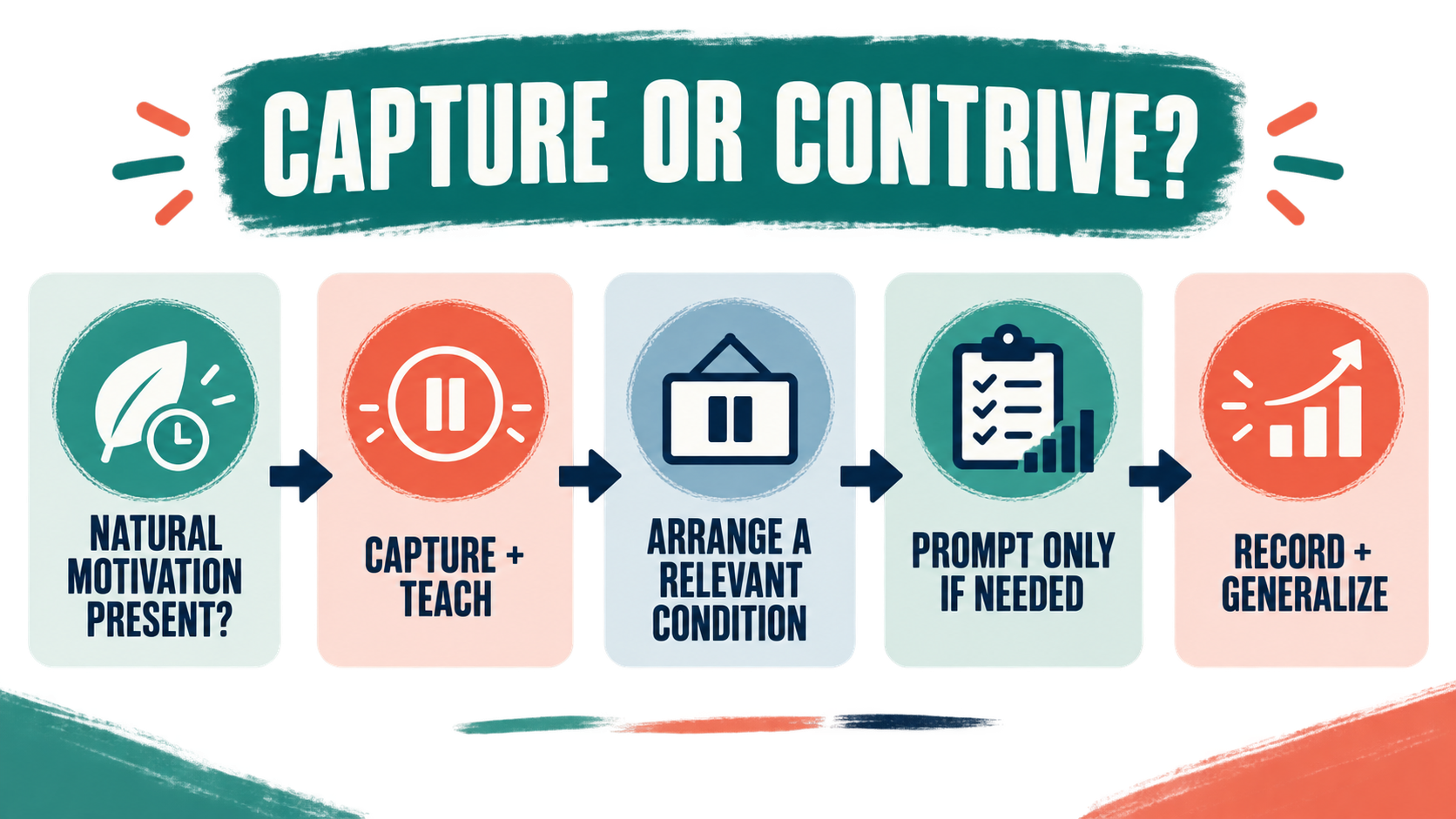
A responsible arrangement is brief, relevant, measurable, and easy to end. The goal is to increase a meaningful opportunity, not to create a crisis that produces a response. Use the following study sequence when a question asks how to contrive motivation:
- Define the target before arranging anything. Specify the response in observable terms. “Communicates appropriately” is too broad; “hands over the request card for help” or “asks where the item is” is more useful for data and decision-making.
- Identify the consequence and its current value. Use preference information, recent access, choice, and the learner’s behavior. Do not assume an item is reinforcing merely because it was preferred yesterday or because an adult selected it.
- Arrange the smallest relevant change. Pause an activity at a natural point, place a needed material visibly but safely out of immediate reach, or create a genuine information gap. Avoid removing food, water, medication, comfort, communication access, or other necessities to manufacture motivation.
- Make the response possible. Ensure the learner has a known response form and an accessible communication system. If a prompt is needed, use the least intrusive prompt appropriate to the plan and fade it according to data.
- Deliver the relevant consequence. When the response occurs, provide the requested outcome when it is available and safe. A generic reward may not demonstrate that the mand contacted its specific consequence.
- Record what actually happened. Note the arranged condition, response latency, independent or prompted response, prompt level, consequence, and any signs that the arrangement was too difficult or not meaningful.
- Plan a transfer check. Test the response with different materials, people, settings, and naturally occurring motivation. One contrived condition is not proof of generalization.
This sequence is different from simply withholding a preferred item until the learner complies. The ethical and instructional question is whether the arrangement creates a useful communication or skill-building opportunity while preserving choice, assent, safety, and access to appropriate alternatives.
What Are Examples of Contrived Motivation in ABA?
The examples below are concept illustrations, not plug-and-play treatment programs. The same arrangement can function differently for different learners, so identify the actual consequence and measure the learner’s response rather than relying on labels.
| Teaching target | Possible arrangement | What to analyze |
|---|---|---|
| Mand for help | Offer a safe activity that requires one manageable assistance step, then pause before the next step. | Was help actually valuable? Did the response produce help, and was the pause brief enough to protect dignity? |
| Mand for information | Place a preferred item in a known location while arranging a safe, genuine information gap. | Does the learner ask the information question under the relevant MO, rather than echoing a prompt? |
| Choice or tolerance | Present a small, meaningful choice or a gradual, agreed-upon change with a clear way to request a break. | Did the arrangement increase an adaptive response, or did it create avoidable distress and confound the measurement? |
Should You Capture or Contrive Motivation?
Capture motivation when the relevant event is already occurring naturally and the learner has a meaningful reason to respond. Contrive motivation when the event is too rare, unpredictable, or difficult to observe for the teaching or assessment question. Neither label is automatically better. Captured opportunities can show natural use; contrived opportunities can increase practice opportunities and clarify what variable is being arranged.
Do not confuse a contrived motivating operation with a contrived opportunity. The motivating operation is the value-altering variable. The opportunity is the larger arranged moment in which the target response can occur. An arranged opportunity may include an MO, an SD, a prompt, and a consequence, but those components are not synonyms.
Do not confuse either term with natural environment teaching (NET). NET describes a broader teaching arrangement using meaningful activities and naturally relevant consequences. A planned MO can occur inside a naturalistic session, but calling the whole session “NET” does not identify which antecedent variable changed the value of the consequence.
What Data and Generalization Checks Matter?
Data should answer the programming question. If the question is whether the learner requests help when an assistance need is present, record the opportunity, the independent response, the prompt level, the response latency, and whether help followed. If the question is whether a mand is controlled by a specific MO, compare responding when the relevant condition is present with responding when the value is low, while following the approved plan and safeguards.
Separate independent responding from prompted responding. A high percentage of prompted mands does not show the same skill as independent manding. Also separate acquisition from generalization: the learner may respond in the teaching arrangement but not with a new person, material, setting, or naturally occurring event.
- Arrangement: What condition was changed, and was the change actually present?
- Response: What exactly counted, and did the response match the target?
- Prompt: Was the response independent, gesturally prompted, verbally prompted, modeled, or physically assisted?
- Consequence: Did the specific requested outcome follow when it was available?
- Transfer: Did the skill occur with natural motivation rather than only under the arranged condition?
What Are the Ethical Boundaries?
Contriving motivation is not permission to create deprivation, distress, or dependence. The current BACB Ethics Code should frame decisions about benefit, dignity, competence, risk, informed participation, and least-restrictive practice. A real case also requires the responsible supervisor’s plan, organizational procedures, caregiver or client collaboration when applicable, and current medical or safety guidance.
- Do not remove necessities or use pain, fear, humiliation, or prolonged frustration to evoke a response.
- Keep the arrangement proportionate to the instructional question and easy to stop.
- Provide an accessible communication response and honor an appropriate request for a break or different option.
- Do not treat a preferred item as a universal reinforcer; preference and value can change.
- Review data for signs that the arrangement is producing problem behavior, prompt dependence, or an artificial response pattern.
What Are the BCBA Exam Traps?
When a vignette asks about contriving motivation ABA, use this short decision rule:
- Name the consequence that may become more or less valuable.
- Identify the EO or AO effect: did value and the related behavior increase or decrease?
- Separate that effect from the SD, which signals availability of reinforcement.
- Identify the response and the specific consequence that follows it.
- Check whether the answer protects choice, dignity, safety, and generalization.
The most common distractor is an answer that labels the visible item, instruction, or prompt as the MO without describing how the antecedent changed consequence value. Another is an answer that recommends withholding a necessity or creating distress when a smaller, relevant arrangement would answer the teaching question. For extra practice with measurement and behavior-change distinctions, use the free BCBA mock exam as a practice resource. It is not official BACB content and does not guarantee an exam result.
Frequently Asked Questions
What does “contriving motivation” mean in ABA?: It means deliberately arranging a relevant antecedent condition that changes the value of a consequence and makes a related response more likely. The arrangement should be purposeful, safe, and connected to a measurable teaching or assessment question.
Is contriving motivation the same as withholding reinforcement?: No. Contriving an MO changes the conditions that affect value and responding. Reinforcement is the consequence delivered after behavior. A responsible arrangement does not require withholding necessities or creating unnecessary distress.
What is the difference between an EO and an AO?: An EO temporarily increases the value of a consequence and evokes behavior that has produced it. An AO temporarily decreases the value of a consequence and reduces that behavior. Both are motivating-operation effects.
How do I know whether an arrangement worked?: Use data that separate independent from prompted responding and identify the arranged condition, response, consequence, and transfer across people, settings, materials, or natural opportunities. A response in one setup alone is not proof of generalization.
Sources for Further Study
- BACB BCBA Test Content Outline — current certification-study scope.
- A Tutorial on the Concept of the Motivating Operation and its Importance to Application — peer-reviewed conceptual tutorial.
- A Clinical Tutorial on Methods to Capture and Contrive Establishing Operations to Teach Mands — recent peer-reviewed tutorial.
- Manipulation of Motivating Operations and Use of a Script-Fading Procedure — applied mand-training study.
- Contriving Transitive Conditioned Establishing Operations — applied conditioned-MO study.
Take the Free BCBA Mock Exam
If you want a low-pressure way to check your recall, use the free practice resource below. Take the Free BCBA Mock Exam



