
When do behavior analysts begin their ethical training? For a BCBA-style study question, the direct answer is usually during graduate-level behavior-analytic coursework. But that answer needs context. Ethical foundations can develop earlier, formal training continues through supervised fieldwork, certification does not end the learning process, and ongoing professional development is part of maintaining competence. The best answer depends on whether the question asks about first exposure, formal credential-specific coursework, or continuing practice.
Table of Contents
- When Do Behavior Analysts Begin Their Ethical Training?
- Ethical Training Is a Continuum
- What Formal Coursework Teaches
- How Fieldwork Turns Ethics Into Behavior
- Why Certification Does Not End Ethical Training
- Common BCBA Exam Traps
- How to Handle 2027 Requirement Changes
- How to Study the Question
- Ethical Training FAQ
- Quick Review Checklist
- Take the Free BCBA Mock Exam
This is an educational BCBA study guide, not legal or ethics advice for a specific case. Use the current BACB Ethics Code resources, the handbook that applies to your pathway, supervisor guidance, and applicable law when making a real professional decision. Table of Contents
When Do Behavior Analysts Begin Their Ethical Training?
If the question is asking when a future BCBA begins formal behavior-analytic ethical training, select graduate school or graduate-level behavior-analytic coursework when that is the available option. The BCBA pathway requires coursework that covers the Ethics Code, code-enforcement mechanisms, and professionalism. That makes graduate coursework the clearest answer to the credential-specific multiple-choice question.
Do not turn that exam answer into the claim that no ethical learning happens before graduate school. People can learn honesty, respect, privacy, responsibility, and professional conduct in earlier education and life. The more precise distinction is this: early values are a foundation; formal behavior-analytic ethics coursework teaches the profession’s standards, role boundaries, decision procedures, and responsibilities; supervised practice teaches how to apply them when facts conflict.
Certification is also not the starting line for ethics. The BACB Ethics Code applies to the professional responsibilities of BCBA and BCaBA certificants and applicants, and ethics content appears in the education and supervision ecosystem before a person receives the credential. A person cannot ethically postpone learning the Code until after passing the exam and then treat the credential as permission to start.
Ethical Training Is a Continuum
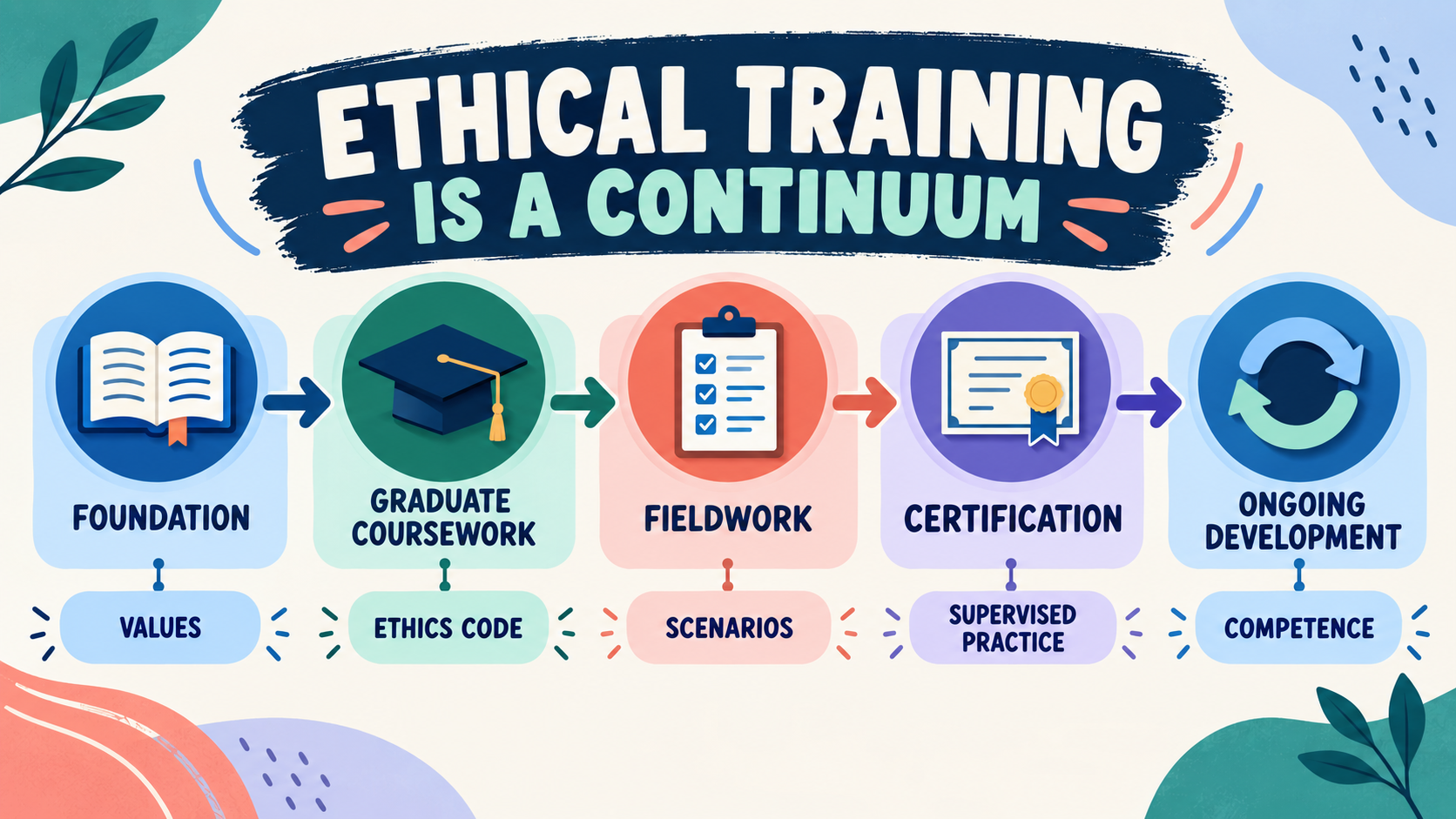
Use the continuum below to keep similar-looking answer choices separate. The exact requirements depend on the credential and current handbook, but the learning logic is stable: build a foundation, study the profession’s standards, practice decisions under supervision, and keep competence current.
| Stage | What is learned | How to read it on an exam |
|---|---|---|
| Early foundation | General ideas such as respect, honesty, responsibility, privacy, and harm avoidance | This is ethical development, not yet the full BACB-specific training answer. |
| Formal coursework | The Ethics Code, professionalism, role boundaries, enforcement processes, and behavior-analytic decision making | For the BCBA question, this usually points to graduate school. |
| Supervised fieldwork | Applying standards to consent, confidentiality, competence, documentation, supervision, and client welfare | Choose the response that protects the client and follows the supervisor and current Code. |
| Certification | Demonstrating eligibility and examination readiness; accepting professional responsibilities | Certification verifies a stage of qualification; it does not end ethical training. |
| Ongoing development | Reading, consultation, supervision, training, additional coursework, and updating competence | When the stem involves a new population or procedure, check competence and seek training or consultation. |
What Formal Coursework Teaches
The current BCBA Handbook describes behavior-analytic coursework that includes ethics, the Ethics Code, code-enforcement mechanisms, and professionalism. For the Pathway 2 coursework structure described in the handbook, ethics content is organized as a substantial freestanding course area rather than a casual paragraph hidden inside another class. That matters because ethical reasoning needs repeated instruction, examples, feedback, and application.
A useful ethics course does more than ask students to memorize section numbers. It teaches how to identify the parties affected by a decision, define the professional role, protect confidentiality, obtain and document consent or assent when relevant, practice within competence, manage conflicts, respond to risk, supervise responsibly, and communicate accurately. It also teaches what to do when the right next step is consultation, referral, documentation, or escalation rather than immediate intervention.
The Code is a professional decision framework, not a collection of magic words. A candidate who knows the phrase “client welfare” but ignores the facts of the scenario may still choose the wrong answer. The BCBA exam expects you to connect the ethical standard to the sequence of action: clarify the issue, gather necessary information, protect the client, consult when appropriate, document accurately, and follow the applicable reporting or enforcement process.
How Fieldwork Turns Ethics Into Behavior
Coursework provides concepts; fieldwork creates opportunities to practice them under supervision. The BACB’s supervision and training resources show why supervision is not only an hours-counting requirement. A trainee must learn how to accept feedback, document work, stay within assigned responsibilities, protect records, communicate with stakeholders, and ask for help before acting outside competence.
For exam questions, look for the difference between an ethical intention and an ethical action. “I want to help” is not enough if the person lacks training for the procedure. “My supervisor told me to do it” is not enough if the action creates obvious risk or conflicts with current standards. The safest answer usually makes the professional responsibility visible: pause when necessary, consult the appropriate person, use the current Code, document facts rather than speculation, and protect the client from avoidable harm.
Fieldwork is also where cultural and contextual variables become concrete. A technically familiar plan may be impractical, inaccessible, or unacceptable in the learner’s setting. Ethical training therefore includes listening, checking contextual fit, considering stakeholder priorities, and reviewing whether the service is actually helping the person. This does not mean treating every preference as a veto; it means making the decision transparent, respectful, evidence-informed, and open to revision.
Why Certification Does Not End Ethical Training
The BACB Ethics Code’s competence expectations include ongoing professional development. The Code identifies activities such as relevant reading, conferences, workshops, coursework, coaching, consultation, supervision, mentorship, and maintaining appropriate credentials. In other words, “I passed the exam” is not an ethical defense for using an unfamiliar procedure years later without study or consultation.
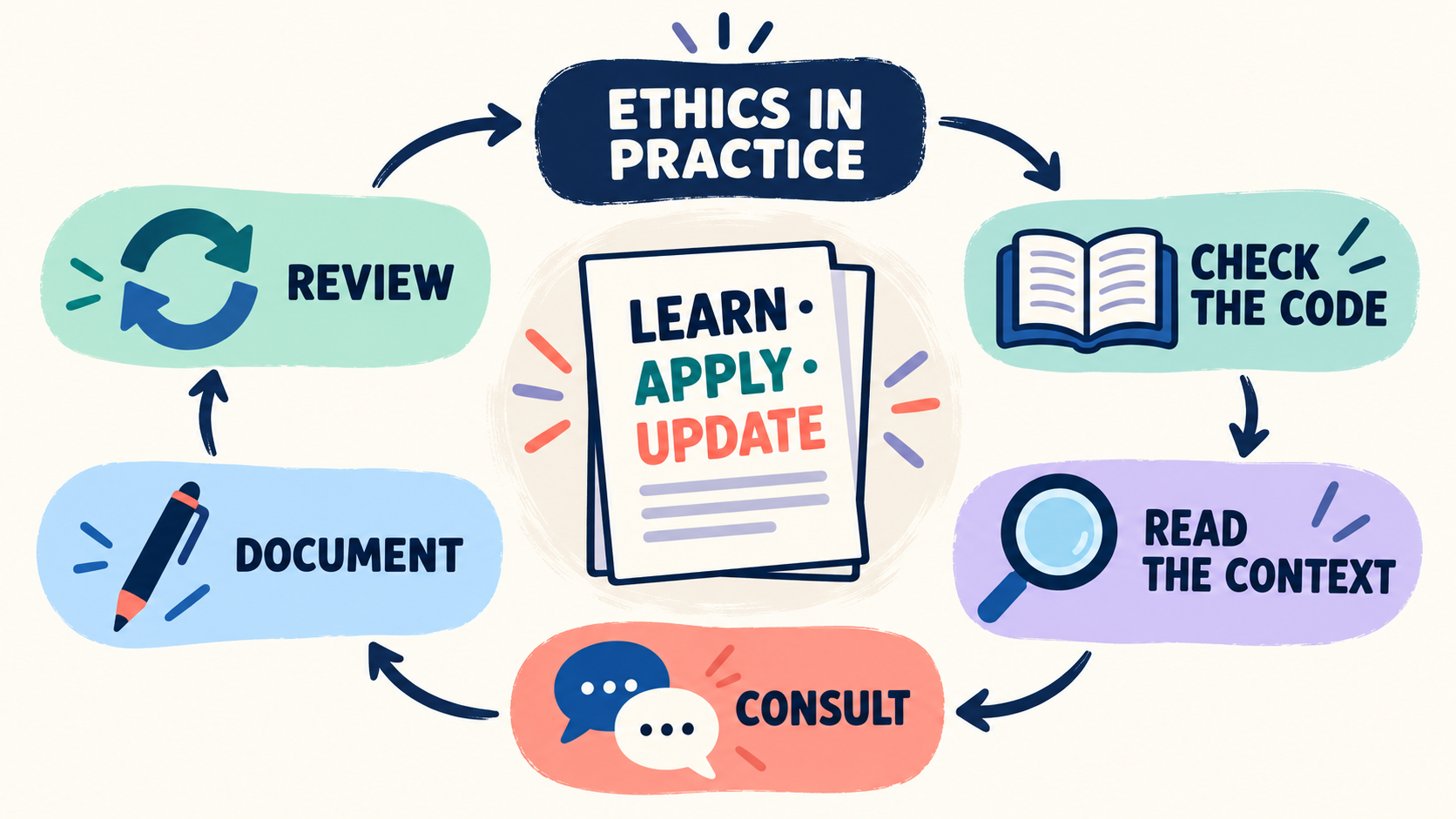
Ethical training continues because roles, populations, technologies, laws, and professional guidance change. A BCBA moving into a new population or procedure should identify the gap, obtain appropriate study or supervised experience, consult a competent professional, or refer or transition the service when needed. The same logic applies when a code or handbook changes: the practitioner must update the decision rule instead of relying on a remembered version. Think of the process as a short loop:
- Check the Code: locate the current standard and definitions.
- Read the context: identify client welfare, consent, privacy, role, competence, and risk facts.
- Consult: use supervision, legal advice, or another appropriate resource when the issue exceeds your role or competence.
- Document: record relevant facts, decisions, communication, and follow-up without altering data or inventing certainty.
- Review: monitor whether the decision protected the client and whether another action is needed.
Common BCBA Exam Traps
| Wording in the question | Best interpretation |
|---|---|
| When does formal ethical training begin for a future BCBA? | Graduate-level behavior-analytic coursework, while recognizing that earlier foundations and later application also matter. |
| When does a behavior analyst become responsible for ethical conduct? | Do not wait for the certificate. Professional roles, training activities, client contact, and applicable Code or institutional rules determine the responsibility. |
| Does certification complete ethics training? | No. Certification marks qualification; competence must be maintained through continuing development and practice within scope. |
| Can a supervisor’s instruction justify any action? | No. Clarify the instruction, protect the client, follow the current Code, and use consultation or escalation when risk or competence is a concern. |
| Is ethics only one section of the BCBA exam? | Ethics is a named content area, but ethical reasoning can affect assessment, intervention, supervision, documentation, and communication questions. |
How to Handle 2027 Requirement Changes
The BACB’s 2027 BCBA Requirements page should be treated as the source of truth for transition rules, eligibility pathways, coursework, fieldwork, and supervisor details. Do not assume that a 2027 eligibility change means ethical training starts later or disappears from the pathway. Separate the question into two parts: which requirements apply to your application date, and what ethical competence the role requires.
When a handbook version changes, save the date and identify the document that governs your case. A study guide can explain the logic, but it cannot replace the official handbook, application instructions, or the current Ethics Code. This is especially important when an answer choice uses absolute words such as “only,” “never,” or “after certification.”
How to Study the Question
Start with the one-sentence answer: formal BCBA-specific ethical training begins in graduate-level behavior-analytic coursework, then continues through supervised practice and professional development. Next, practice changing one word in the stem:
- “Formal coursework” points to the education pathway.
- “First ethical foundation” may point earlier than graduate school.
- “Apply an ethical standard in a case” points to context, sequence, competence, and client welfare.
- “Maintain competence” points to continuing education, consultation, supervision, and updated resources.
After each practice item, explain why the tempting alternatives are weaker. This is more useful than memorizing that one quiz page says “graduate school.” If you want a mixed scenario baseline, try the free BCBA mock exam, then record whether each missed question was a knowledge gap, a wording gap, an application gap, or a failure to identify the ethical sequence.
Ethical Training FAQ
Is the answer always graduate school?: No. Graduate school is the best direct answer when the question asks about formal BCBA-specific ethical training. Ethical development can begin earlier, and other credentials have different education pathways. Read the credential and the wording before choosing.
Do BCaBA candidates begin ethical training at the same stage?: Not necessarily. BCaBA certification is an undergraduate-level pathway, so the formal coursework stage may occur during undergraduate behavior-analytic education. Use the current BCaBA Handbook rather than importing BCBA pathway details into a BCaBA question.
Does an RBT’s 40-hour training replace ongoing ethics learning?: No. Entry-level training is a starting point for the role and its responsibilities. RBTs must follow the applicable RBT Ethics Code, supervision requirements, employer policies, and ongoing development expectations.
Why is ethical training tested beyond the ethics domain?: Because ethics changes how a practitioner selects an assessment, describes a goal, implements an intervention, delegates work, handles data, communicates with families, and responds to risk. Scenario questions often test the ethical sequence without naming it as an “ethics question.”
Bottom line: for the common BCBA study question, choose graduate-level coursework for formal ethical training. The fuller professional answer is a continuum: foundations can begin earlier, coursework teaches the Code and professional standards, fieldwork builds supervised judgment, certification does not end learning, and ongoing development keeps competence current.
Quick Review Checklist
Use this final checklist to turn when do behavior analysts begin their into exam-ready reasoning. The goal is not to memorize a label in isolation; it is to identify the relevant evidence and explain why the best answer fits the scenario. Key ideas to review:
- State the central definition or decision point for when do behavior analysts begin their in your own words.
- Identify the detail that makes when do behavior analysts begin their different from its closest related ABA term.
- Separate the observable facts in a scenario from assumptions that are not supported by the facts.
- Write one example and one nonexample so you can recognize the concept in a new setting.
Exam application checks:
- Ask what the question is actually requesting before comparing the answer choices.
- Mark the antecedent, response, consequence, or other evidence that supports the selected answer.
- Look for a distractor that describes a related process but does not answer the specific question.
Final self-check:
- Explain how you would verify the interpretation with clear observations or data.
- Change one detail in the scenario and decide whether your answer should change.
- Give a one-sentence rationale that a supervisor or study partner could evaluate.
Take the Free BCBA Mock Exam
If you want a low-pressure way to check your recall, use the free practice resource below. Take the Free BCBA Mock Exam



