
Episodic severity ABA is an episode-level measure of the intensity or gravity of a behavioral incident. Instead of asking only how often a behavior happened or how many total minutes it lasted, the analyst asks what happened within each defined episode: how intense it became, how severe the peak was, or how quickly the episode resolved.
Table of Contents
- What Does Episodic Severity ABA Mean?
- Why Is Episodic Severity a Dependent Variable?
- How Is Episodic Severity Different From Frequency and Duration?
- How Do You Measure Episodic Severity?
- What Are Non-Graphic Examples of Episode-Level Measurement?
- How Is Severity Different From Function or Injury?
- What Makes Episodic Severity Data Useful?
- What Are the Ethical Boundaries?
- What Are the BCBA Exam Traps?
- Frequently Asked Questions
- Sources for Further Study
- Quick Review Checklist
- Take the Free BCBA Mock Exam
The word episodic means “with respect to an episode.” It does not mean intermittent. The concept was proposed by LaVigna and Willis as an additional dependent variable for challenging behavior. It is useful for BCBA study because it forces a precise distinction among frequency, duration, intensity, function, and physical injury. It is not a diagnosis, a universal BACB scoring scale, or a substitute for an approved safety plan.
What Does Episodic Severity ABA Mean?
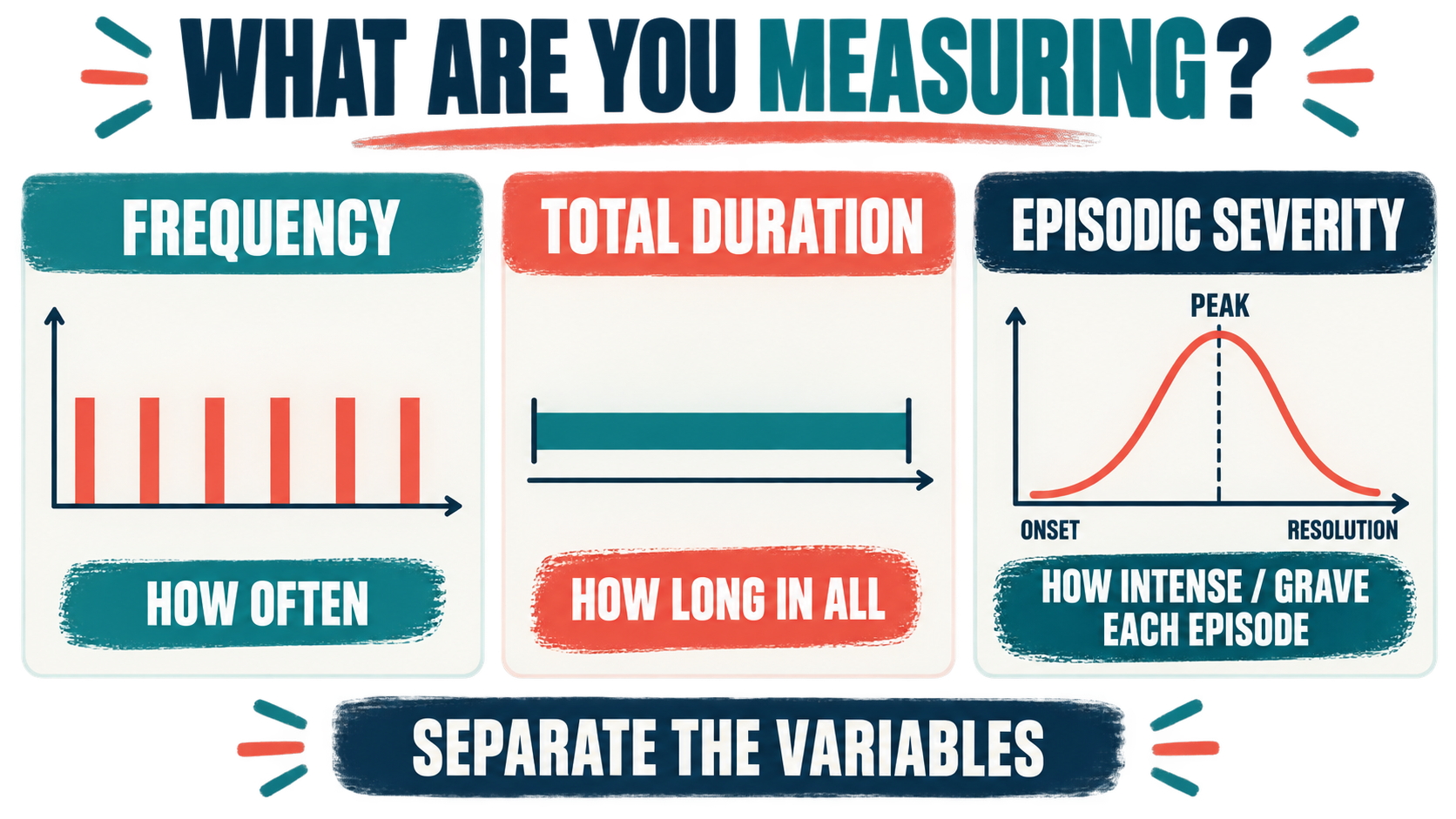
Episodic severity is the measured intensity or gravity of a particular behavioral incident. The analyst first defines what counts as an episode, then selects an observable dimension that represents its severity. Depending on the behavior and purpose of the plan, that dimension might be the highest level reached, the time required for the episode to resolve, the duration of the episode, or another operationally defined feature.
For example, two days may contain the same number of episodes, but the episodes may not be equivalent. On one day, each episode may be brief and resolve with a taught communication response. On another day, the same count may include longer episodes, faster escalation, or a higher level on a defined rating system. A frequency count alone would hide that difference. Episodic severity makes the within-episode distinction visible.
The measure must be tied to observable behavior, not a global judgment such as “the person was out of control.” A useful definition identifies the topography, the episode boundary, the selected severity dimension, and the scoring rule. The score should describe what was observed; it should not become a label for the person.
The original LaVigna and Willis article presents episodic severity as an additional dependent variable in behavior analysis. That source is the conceptual anchor for this topic. The current BCBA Test Content Outline should be used for current certification scope; do not claim that it mandates one particular episodic-severity scale.
Why Is Episodic Severity a Dependent Variable?
In an applied behavior-analytic evaluation, the dependent variable is the behavior or outcome being measured to determine whether a plan is associated with meaningful change. Frequency, rate, duration, latency, percentage, and other measures answer different questions. Episodic severity adds another possible question: How serious was each behavioral episode, and did the episode-level outcome change?
This matters when a plan reduces the number of episodes but the remaining episodes are still long or intense, or when the number of episodes changes very little but each episode resolves more quickly. A socially meaningful plan may need to consider both the occurrence of behavior and what happens during an occurrence. A measure that captures only count can miss that outcome.
Episode-level measurement also supports better conversations among the team. “Severity improved” is not enough unless the team can explain what was scored. Did the average duration per episode change? Did the highest category become less frequent? Did the time from onset to resolution decrease? These are different findings and should not be blended without a stated rule.
How Is Episodic Severity Different From Frequency and Duration?
These measures can be collected together, but they should not be treated as interchangeable. The table below uses simple study language. A real plan must define the exact response, observation period, and scoring system.
| Measure | Main question | What it may miss |
|---|---|---|
| Frequency or rate | How many times did the defined response occur? | Whether episodes were brief, prolonged, mild, or intense. |
| Total duration | How much time was spent in the behavior across the observation period? | How the time was distributed across separate episodes. |
| Episodic severity | How intense or grave was each defined episode? | The total number of episodes or the behavior’s maintaining variables. |
A simple example shows why the distinction matters. Four episodes lasting two minutes each produce eight total minutes. Four episodes lasting two minutes each could still differ in peak level or resolution pattern. The total duration is identical, but the episode-level outcome may not be. Conversely, a lower severity rating does not automatically mean the behavior occurred less often.
How Do You Measure Episodic Severity?
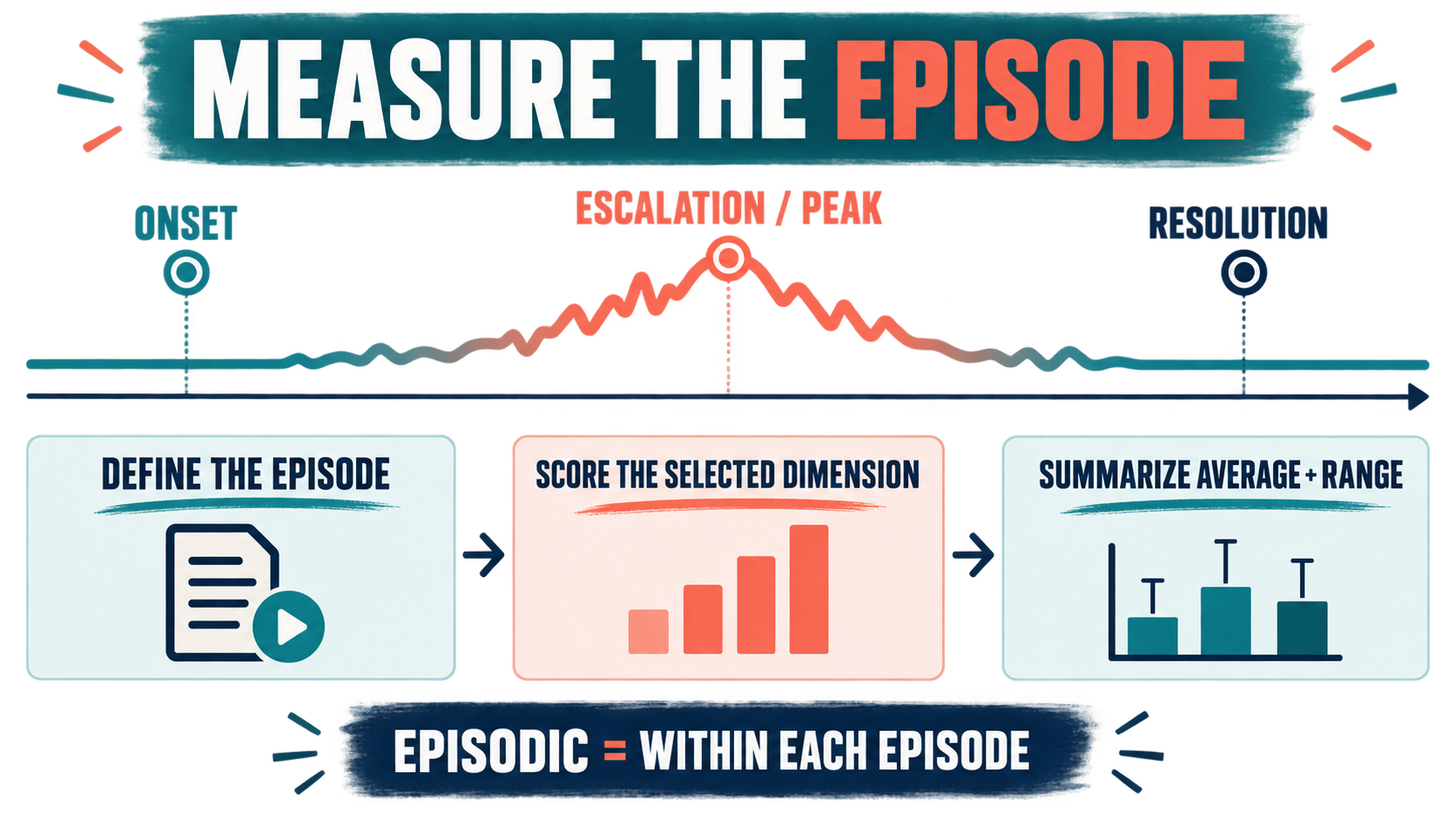
Start with the measurement question, then define the episode before choosing a score. The following workflow is a study framework, not a universal clinical form:
- Define the target topography. State exactly which observable response belongs in the episode. Avoid broad labels such as “meltdown” unless the plan defines the component behaviors and their boundaries.
- Define onset and offset. Specify the observable event that starts an episode and the period of calm or criteria that ends it. Without a boundary, one long event may be counted as several episodes or several events may be merged.
- Select one severity dimension. Choose the feature that answers the question: a defined intensity category, duration per episode, time to resolution, highest observable level, or another defensible measure. Do not switch dimensions halfway through the series.
- Write the scoring rule. If categories are used, describe what makes an episode a 1, 2, or 3 using observable anchors. A number without anchors is a preference or impression, not a reliable measurement system.
- Record the episode consistently. Note the start, selected score, relevant duration or resolution time, and context required by the plan. Keep the record separate from assumptions about why the behavior occurred.
- Summarize the distribution. Depending on the question, report the average severity and range, the proportion of episodes in each category, or another prespecified summary. The summary must state the denominator and observation period.
“Episodic” does not mean that the analyst should wait for a severe event or create one for measurement. Use the least risky observation and documentation process that answers the question. If behavior presents an immediate safety or medical concern, follow the responsible setting’s current emergency and clinical procedures rather than treating the situation as a data-collection exercise.
What Are Non-Graphic Examples of Episode-Level Measurement?
Examples should clarify the measurement logic without showing or describing graphic injury. The same behavior can require different measurement dimensions in different cases, so the analyst must state what the score means.
| Scenario | Possible episode-level measure | Interpretation caution |
|---|---|---|
| Vocal escalation episodes | A defined intensity category or time from onset to calm. | Volume, duration, and intensity are not automatically the same variable. |
| Property-disruption episodes | A category anchored to the observable level of disruption and the episode’s resolution time. | The category must not depend on an observer’s frustration or a vague word such as “bad.” |
| Repeated escape episodes | The duration or highest defined episode level, recorded separately from episode count. | Severity does not identify whether escape, attention, tangible access, or automatic variables maintain behavior. |
How Is Severity Different From Function or Injury?
Severity and function answer different questions. Severity describes the episode’s observable intensity or gravity. A functional assessment addresses variables related to why behavior occurs and what consequences may maintain it. A severe episode is not automatically attention-maintained, escape-maintained, tangible-maintained, or automatically reinforced. Function must be assessed from relevant data.
Episodic severity and physical injury also answer different questions. The SIT Scale, for example, is designed to describe characteristics of self-injury such as location, number, type, and severity of tissue damage. That is not the same as measuring the intensity or resolution of a behavioral episode. A behavior can be highly disruptive without producing tissue injury, and an injury measure cannot by itself establish behavioral function.
Do not turn either measure into a diagnosis or a global risk label. A score is meaningful only within its definitions, observer training, setting, and purpose. When multiple domains matter, report them separately instead of adding unrelated numbers into one “severity” total.
What Makes Episodic Severity Data Useful?
Good episode-level data are operational, reliable, and socially meaningful. Two trained observers should be able to apply the episode boundary and scoring anchors without guessing. When the measure is important to a treatment or evaluation decision, the team should plan observer training, feedback, and an appropriate reliability check.
- Operational definition: the episode has observable onset, offset, and scoring anchors.
- Consistent dimension: the record does not silently switch from intensity to duration or injury.
- Distribution: average, range, category counts, or another summary is reported with its denominator and period.
- Context: the score is interpreted alongside frequency, duration, setting, and relevant antecedent-consequence data.
- Social validity: the team asks whether the measured change improves the person’s safety, participation, communication, or quality of life.
The IABA positive-practices training resource distinguishes immediate reduction in episodic severity from longer-term proactive support. That distinction is useful for study: a short-term change during an episode and a future change in the probability of behavior are not necessarily the same outcome.
What Are the Ethical Boundaries?
Measurement should not increase risk. The current BACB Ethics Code provides the professional frame for competence, benefit, dignity, privacy, and risk management. Do not provoke a dangerous episode just to obtain a severity score, delay needed medical attention, or publish identifiable descriptions of a person’s crisis.
For a real case, follow the responsible supervisor’s approved plan and the setting’s current safety, medical, incident-reporting, and consent procedures. This article is a BCBA study guide to measurement logic, not crisis-management training.
What Are the BCBA Exam Traps?
When a question presents episodic severity ABA, use this sequence:
- Identify the episode boundary: what starts and ends one event?
- Name the selected severity dimension: intensity, gravity, duration per episode, peak level, or time to resolution.
- Separate the measure from frequency, total duration, function, diagnosis, and physical injury.
- Check whether the scoring anchors are observable and reliable.
- Look for a socially meaningful outcome rather than a number with no clinical purpose.
The most common distractor is “frequency.” Frequency counts episodes; it does not describe how serious each episode became. Another distractor is “function.” Function explains behavioral relations; severity describes an outcome. For additional practice separating measurement concepts, the free BCBA mock exam can provide study scenarios. It is not official BACB content and does not guarantee an exam result.
Frequently Asked Questions
What does episodic severity mean in ABA?: It means the measured intensity or gravity of a defined behavioral episode. The analyst identifies the episode boundary and scores a stated dimension rather than relying on a global judgment. Is episodic severity the same as frequency?: No. Frequency asks how many episodes occurred. Episodic severity asks how intense or grave each episode was. Both may be useful, but one cannot replace the other.
Is episodic severity a BACB-required scale?: No universal scale should be assumed. The concept can support measurement study, but the current BACB materials should be checked for certification scope and the actual plan must specify its own operational definitions and scoring rules.
Is episodic severity the same as the SIT Scale?: No. The SIT Scale concerns characteristics of self-injury and tissue damage. Episodic severity concerns the intensity or gravity of a behavioral incident. They answer different measurement questions.
Sources for Further Study
- Episodic Severity: An Overlooked Dependent Variable — primary conceptual article.
- Positive Behavior Support and Additional Measures — government docket context.
- BACB BCBA Test Content Outline — current certification-study scope.
- Positive Practices in Behavior Support Training — positive-support context.
Quick Review Checklist
Use this final checklist to turn episodic severity aba into exam-ready reasoning. The goal is not to memorize a label in isolation; it is to identify the relevant evidence and explain why the best answer fits the scenario. Key ideas to review:
- State the central definition or decision point for episodic severity aba in your own words.
- Identify the detail that makes episodic severity aba different from its closest related ABA term.
- Separate the observable facts in a scenario from assumptions that are not supported by the facts.
- Write one example and one nonexample so you can recognize the concept in a new setting.
Exam application checks:
- Ask what the question is actually requesting before comparing the answer choices.
- Mark the antecedent, response, consequence, or other evidence that supports the selected answer.
- Look for a distractor that describes a related process but does not answer the specific question.
Final self-check:
- Explain how you would verify the interpretation with clear observations or data.
- Change one detail in the scenario and decide whether your answer should change.
- Give a one-sentence rationale that a supervisor or study partner could evaluate.
Take the Free BCBA Mock Exam
If you want a low-pressure way to check your recall, use the free practice resource below. Take the Free BCBA Mock Exam



