

Per opportunity recording ABA scores what happens on each valid teaching opportunity, then preserves the numerator and denominator so a BCBA can interpret independent performance, prompted performance, errors, and no responses without hiding the learning context.
Table of Contents
- What Is Per Opportunity Recording ABA?
- How Do You Calculate Opportunity Percentage?
- What Should Count as a Valid Opportunity?
- Should Prompted Correct Responses Count as Correct?
- How Is Per Opportunity Recording Different From Frequency?
- How Should You Record Trial-by-Trial Opportunity Data?
- How Do You Audit Per Opportunity Data?
- What Are Common Per Opportunity Recording Errors?
- How Does This Appear on the BCBA Exam?
- What Is the Bottom Line?
- Quick Review Checklist
- Take the Free BCBA Mock Exam
Per opportunity recording ABA is a measurement system for skills that can be presented as a series of identifiable opportunities. The teacher defines what counts as an opportunity, presents the cue or task, observes the learner’s response within a stated window, and records the outcome for that opportunity. At the end of a session, the data may be summarized as a percentage, but the trial-level record is what makes the percentage interpretable.
This distinction matters for BCBA exam questions and for real program decisions. “Eight correct out of ten” is not enough by itself. Were the eight responses independent? Were two correct only after a model? Were all ten opportunities actually presented? Did the response window stay consistent? A good data system answers those questions before someone calls a target mastered.
The BACB task-list materials place measurement selection, data display, skill acquisition, and data-based decision making within professional exam scope. The exact form and scoring rule must still be individualized by the supervising professional and the learner’s written plan.
What Is Per Opportunity Recording ABA?
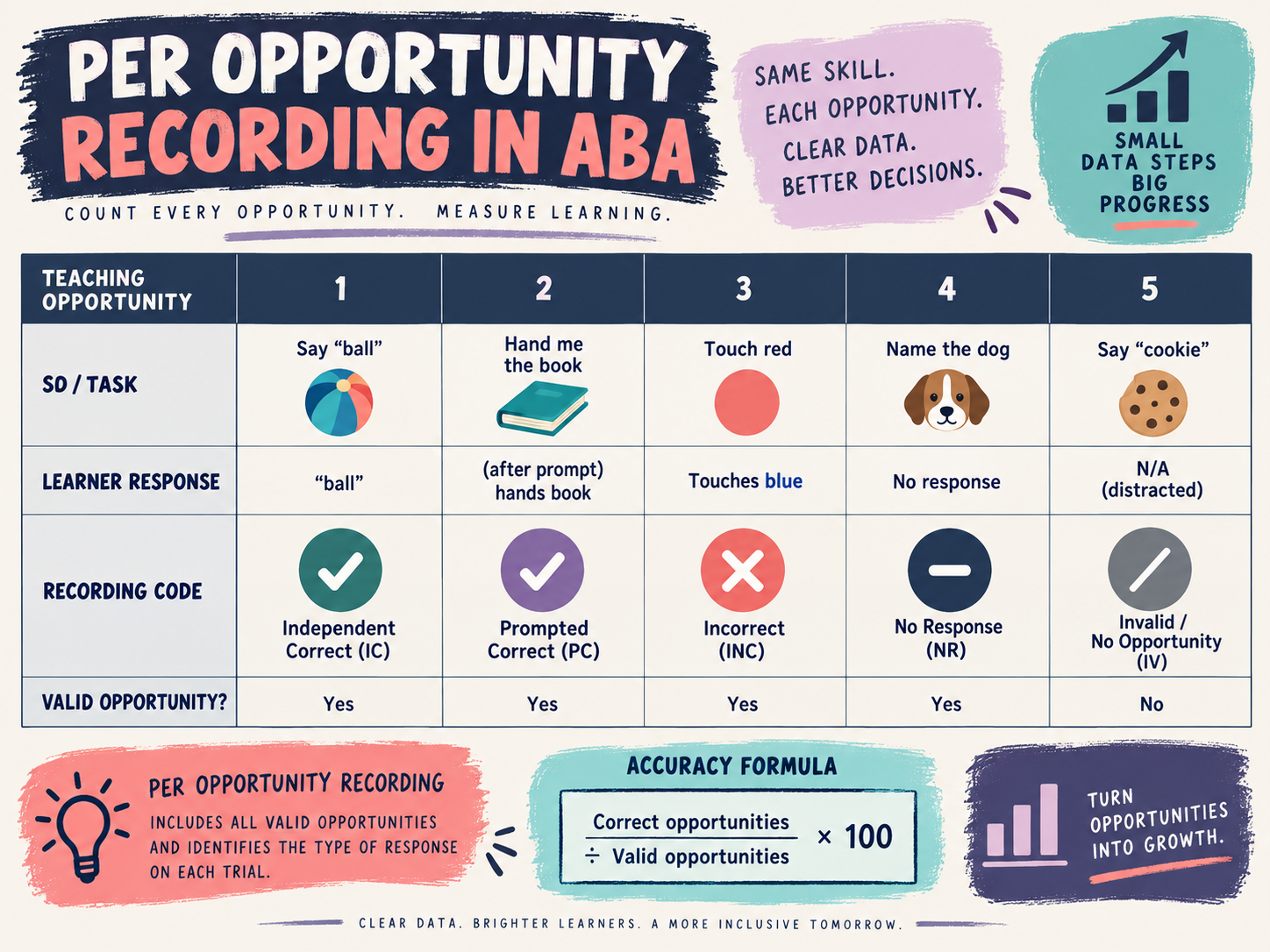
Per opportunity recording means that the unit of observation is a defined opportunity to respond. An opportunity might be “the instructor presents a picture and asks the learner to label it,” “the learner is given a chance to request help during a routine,” or “a task-analysis step is available for the learner to complete.” Each opportunity has a beginning, a response window, and a scoring rule. A typical opportunity has five parts:
- Antecedent or task: the cue, material, situation, or natural event that makes a response possible.
- Response definition: the observable action that qualifies as correct, incorrect, prompted, or absent.
- Response window: the planned amount of time allowed before the opportunity is scored.
- Prompt rule: how prompts are delivered and how prompted responses are separated from independent ones.
- Consequence and record: what follows the response and which code is entered for that opportunity.
The opportunity is not simply “time spent in therapy.” If a teacher never presents the cue, or if the materials are unavailable, there may be no valid opportunity to score. Recording a zero in that situation would make the learner look less accurate when the real problem is implementation or missing exposure.
How Do You Calculate Opportunity Percentage?
For a basic percentage-of-opportunities summary, divide the number of qualifying correct responses by the number of valid opportunities and multiply by 100. The numerator must match the definition in the program. It may include all correct responses, or it may include only independent correct responses. Percentage of opportunities = qualifying correct responses ÷ valid opportunities × 100.
Suppose a learner has 12 valid opportunities. The learner responds independently on 8, responds correctly after a prompt on 2, makes an error on 1, and does not respond on 1. Independent percentage is 8 ÷ 12 × 100 = 66.7%. If the program defines “correct” as independent or prompted correct, the broader correct percentage is 10 ÷ 12 × 100 = 83.3%. Both calculations can be accurate, but they answer different questions and should not be placed under the same label.
Keep the raw counts with the percentage. Rounding 8 out of 12 to 67% is convenient for a graph; keeping “8/12 independent” protects the denominator and allows a later reviewer to understand what changed.
What Should Count as a Valid Opportunity?
A valid opportunity is one in which the programmed cue, materials, response window, and relevant conditions were present. The definition should be written before data collection starts. For example, a labeling program might require the target picture to be visible, the instruction to be delivered once, and five seconds to be available for the learner to respond.
Do not silently count invalid conditions as incorrect learner responses. If the device fails before a communication opportunity, the material is missing, the instructor gives the answer before the response window, or a safety event stops the trial, use an agreed-upon invalid or implementation code. Record the reason so the team can decide whether to repeat the opportunity, exclude it, or address a fidelity problem.
The same rule must be applied consistently. If one staff member treats a late instruction as a valid trial and another marks it invalid, their percentages cannot be compared confidently. Operational definitions, examples, and a brief calibration check are often more valuable than a complicated app setting.
Should Prompted Correct Responses Count as Correct?
That depends on the goal and the written measurement definition. A program may track “correct with the programmed prompt” to show that a learner can complete the response with support. It may separately track “independent correct” to show transfer of stimulus control. The error is not choosing one measure; the error is calling prompted performance independent without saying so.
| Summary | Numerator | Best question answered | Common mistake |
|---|---|---|---|
| Independent percentage | Independent correct opportunities | Is the learner responding to the natural cue without a prompt? | Counting a prompted response as independent |
| Correct-with-support percentage | Independent plus qualifying prompted correct responses | Can the learner complete the response under the programmed support? | Reporting it as mastery without the prompt level |
| Error percentage | Incorrect responses, according to the scoring rule | How often does the learner respond incorrectly? | Mixing errors with no responses or invalid trials |
| Prompt-level summary | Count of opportunities at each prompt level | Is assistance becoming less intrusive over time? | Looking only at total correct responses |
How Is Per Opportunity Recording Different From Frequency?
Frequency counts how many times a behavior occurs. Per opportunity recording asks how the learner performs when a defined chance to respond is presented. If the number of opportunities changes from session to session, a raw count can be misleading. Ten requests in a session with 20 opportunities and ten requests in a session with 100 opportunities are not equivalent exposure conditions.
Rate adds a time denominator, such as responses per minute. Per opportunity percentage adds an opportunity denominator. Use the dimension that matches the behavior and the decision. A fluent conversation response that can occur continuously may be better described by rate, while a set of discrete labeling trials may be better summarized by independent percentage.
How Should You Record Trial-by-Trial Opportunity Data?
A trial-level form can use short codes, but each code needs a stable definition. One practical layout includes the date, target, opportunity number, antecedent, response code, prompt level, latency when relevant, consequence, and notes for invalid conditions. A digital form may calculate percentages automatically; it should still preserve the underlying rows rather than storing only the final percentage.
When a prompt is delivered, record whether it was planned, when it occurred, and the level required. If the prompt came before the learner had a reasonable chance to respond, the opportunity may be a prompted teaching trial rather than an independent probe. That timing affects interpretation. A score of “prompted correct” is more useful than a generic “correct” because it shows what support was necessary.
How Do You Audit Per Opportunity Data?
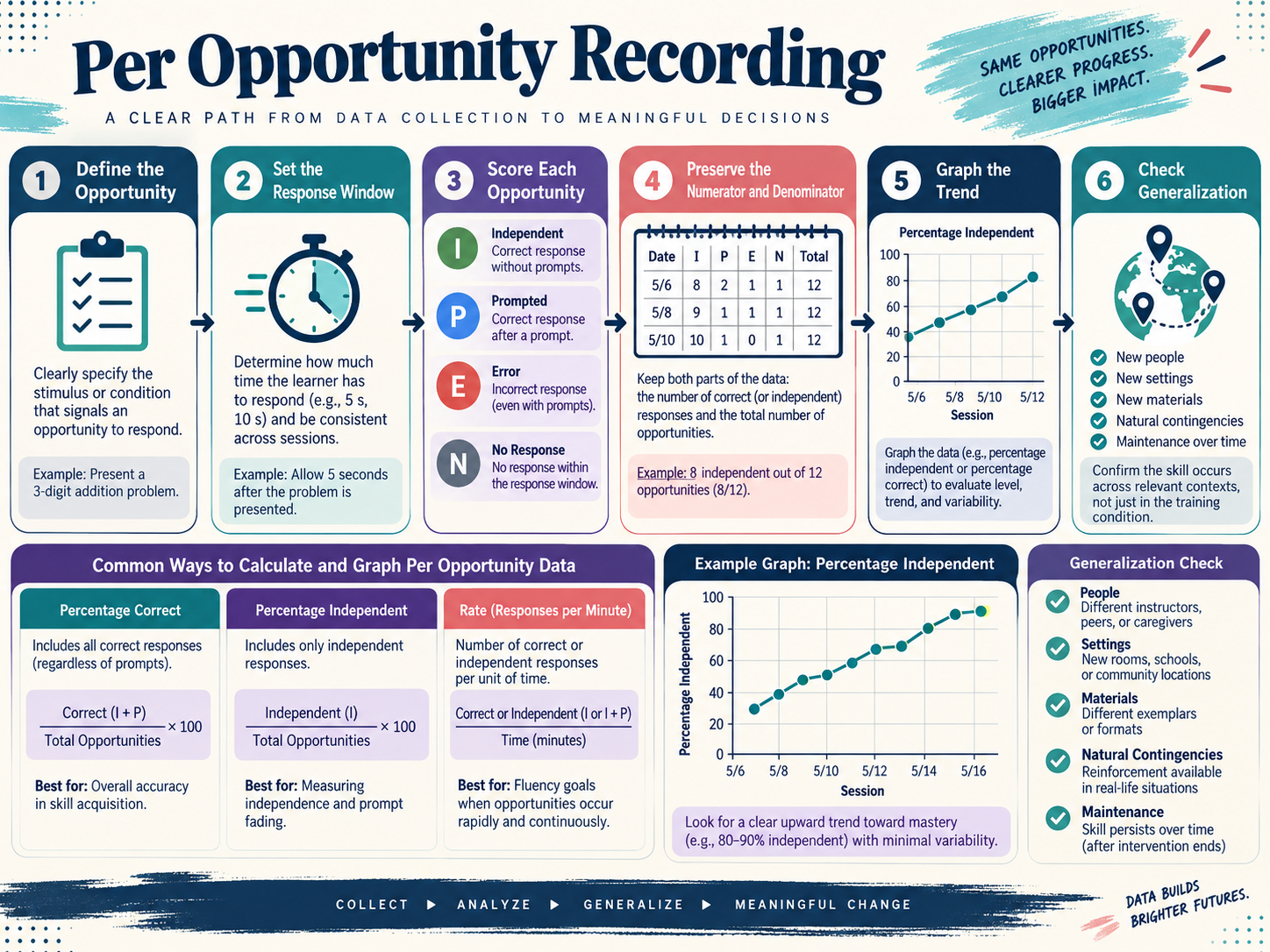
Audit the data in the same order that the opportunity occurred. First, check that the target and response definition are observable. Next, compare the number of recorded trials with the number of opportunities actually presented. Then review independent, prompted, incorrect, no-response, and invalid codes separately. Finally, examine the trend and look for changes in staff, setting, materials, prompt procedure, or opportunity density.
- Denominator audit: confirm that the total includes only valid, defined opportunities.
- Prompt audit: verify that prompt levels and prompt timing are recorded consistently.
- Response-window audit: check that staff waited the programmed amount of time before scoring no response.
- Fidelity audit: check whether the instruction, materials, consequence, and data entry matched the plan.
- Generalization audit: compare performance across people, materials, settings, and natural routines.
A rising percentage can reflect true learning, but it can also reflect easier targets, more frequent prompts, fewer opportunities, or a changed denominator. A falling percentage can reflect skill loss, more difficult examples, longer response windows, or an implementation problem. Look at the records behind the graph before changing an intervention.
What Are Common Per Opportunity Recording Errors?
- Changing the denominator after the fact: exclude or include trials without recording why.
- Using “correct” as a single undifferentiated code: independent and prompted learning disappear into one number.
- Counting practice repeats as new opportunities: a correction trial may not be equivalent to a fresh teaching opportunity.
- Failing to code no response: no response, error, and invalid condition can lead to different decisions.
- Graphing a percentage without exposure: a 100% point based on one trial should not be read like a 90% point based on 20 trials.
- Ignoring generalization: high table accuracy may not show that the skill occurs in the routine where it matters.
How Does This Appear on the BCBA Exam?
On an exam question, identify the dimension and denominator first. “Correct responses divided by opportunities” points to percentage of opportunities. “Responses per minute” points to rate. “The first response after the instruction, before a prompt” points to an independent trial rule. If the question describes prompted and unprompted responses separately, do not combine them unless the question explicitly asks for overall correct-with-support performance.
Also notice whether the scenario asks for measurement or for a treatment decision. A percentage is a summary; it does not automatically establish mastery or prove that an intervention caused change. A BCBA should use the operational definition, the measurement system’s validity, the learner’s assent and dignity, and the full pattern of data when making decisions.
What Is the Bottom Line?
Per opportunity recording ABA turns each valid chance to respond into interpretable data. Define the opportunity, response window, and scoring rules before collection. Preserve independent and prompted outcomes, keep the numerator and denominator visible, and inspect fidelity and generalization before treating a percentage as progress.
If you want another structured review of measurement, prompting, and BCBA exam concepts, use the free BCBA mock exam. Practice can help you recognize the correct denominator and distinguish independent performance from performance that still depends on support; it does not replace supervision or an individualized clinical plan.
For targeted review, use our per opportunity recording ABA practice questions to apply the concept in exam-style scenarios.
Quick Review Checklist
Use this final checklist to turn per opportunity recording ABA into exam-ready reasoning. The goal is not to memorize a label in isolation; it is to identify the relevant evidence and explain why the best answer fits the scenario. Key ideas to review:
- State the central definition or decision point for per opportunity recording ABA in your own words.
- Identify the detail that makes per opportunity recording ABA different from its closest related ABA term.
- Separate the observable facts in a scenario from assumptions that are not supported by the facts.
- Write one example and one nonexample so you can recognize the concept in a new setting.
Exam application checks:
- Ask what the question is actually requesting before comparing the answer choices.
- Mark the antecedent, response, consequence, or other evidence that supports the selected answer.
- Look for a distractor that describes a related process but does not answer the specific question.
Final self-check:
- Explain how you would verify the interpretation with clear observations or data.
- Change one detail in the scenario and decide whether your answer should change.
- Give a one-sentence rationale that a supervisor or study partner could evaluate.
Take the Free BCBA Mock Exam
When you are ready to apply the idea, use the free practice resource below for additional feedback. Take the Free BCBA Mock Exam



