
Who issues BCBA certification? The Behavior Analyst Certification Board (BACB) issues the Board Certified Behavior Analyst (BCBA) certification. A state licensing board may issue a separate behavior-analyst license, and a payer or employer may require credentialing, but those are not the same as the national BCBA certification.
Table of Contents
- Who Issues BCBA Certification?
- What Does the BACB Do?
- How Is Certification Different From Licensure?
- Who Does Not Issue BCBA Certification?
- How Do the Main Credentialing Roles Compare?
- What Does BCBA Certification Prove?
- Do You Need a State License After BCBA Certification?
- How Can You Verify the Issuer and Your Status?
- BCBA Issuer FAQ
- Quick Review Checklist
- Take the Free BCBA Mock Exam
This distinction matters when you are comparing programs, applying for jobs, answering a licensure question, or explaining what a BCBA credential means to a client or family. “Who issues it?” is only the first question. You also need to ask what the credential proves, where it can be used, and whether a separate state license is required. This guide uses current information from the BACB About page, the BCBA Handbook, and BACB’s certification resources. It explains the credentialing boundary; it is not legal advice about a particular state. Table of Contents
Who Issues BCBA Certification?
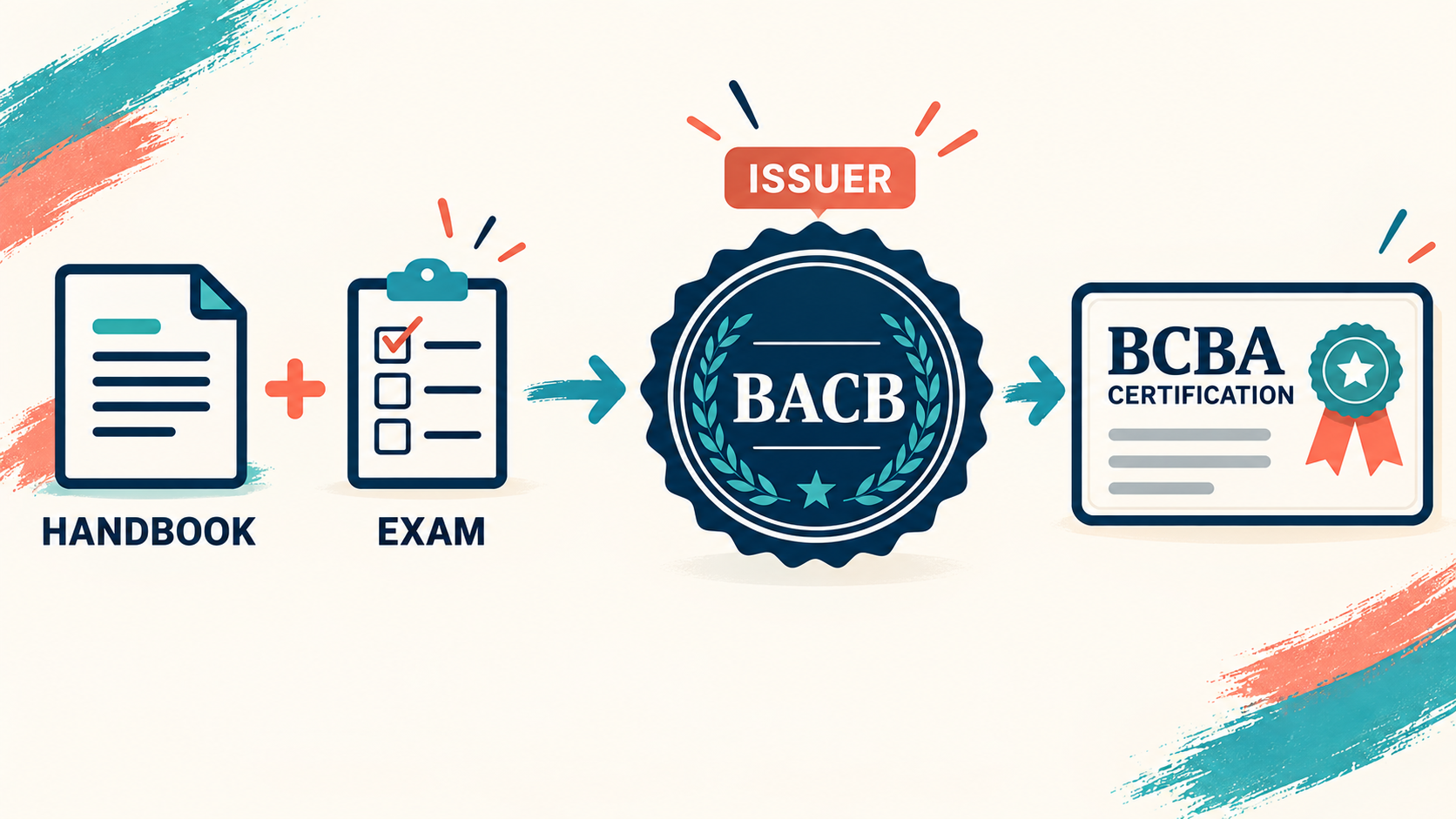
The Behavior Analyst Certification Board, Inc. (BACB) issues BCBA certification. The BCBA is a graduate-level professional certification in behavior analysis. The BACB sets eligibility requirements, administers or oversees the certification examination, maintains certification standards, publishes handbooks and ethics requirements, and records certificant status.
That answer is different from saying that a university, employer, state agency, insurance company, or test center issues the credential. Those organizations may play an important role in the pathway. A university may award a degree. A supervisor may verify fieldwork. Pearson VUE may deliver the examination. A state board may issue a license. But the organization that grants the BCBA certification itself is the BACB.
If a question asks “who issues BCBA certification?” the exam-safe answer is therefore BACB. If it asks who issues permission to practice in a regulated state, the answer may be a state licensing authority. Read the noun after “issues”: certification and licensure are separate credentials.
What Does the BACB Do?
The BACB operates certification programs for behavior-analytic professionals. Its public materials describe the board as a nonprofit corporation established to meet professional certification needs and to promote standards that protect consumers of behavior-analytic services. For the BCBA pathway, the BACB’s role includes several connected responsibilities:
- Defines eligibility: The current handbook describes education, behavior-analytic content, supervised fieldwork, and examination requirements.
- Sets examination content: The BACB publishes the BCBA Handbook and examination information so candidates can understand the current format and rules.
- Maintains certification standards: Certificants must follow applicable maintenance and ethics requirements after initial certification.
- Verifies certificant status: The BACB provides resources that help consumers and organizations verify whether a person holds certification and whether reportable disciplinary information is associated with the record.
- Protects the certification mark: The BCBA title and marks are connected to certification status, not merely to a degree or a job title.
The BACB is not the same thing as a state department of health, education, or professional regulation. Its certification can be nationally recognized, but the legal permission to practice depends on the law and rules where services are provided.
How Is Certification Different From Licensure?
Certification and licensure can work together, but they answer different questions. Certification asks whether an individual has met standards set by a professional credentialing organization. Licensure asks whether a government or authorized regulatory body permits that person to practice a regulated profession in a particular jurisdiction.
Many states use BCBA certification as one requirement for a behavior-analyst license. That does not mean the BACB issued the license. It means the state has chosen to recognize or require the national certification within its own legal framework. The state may add application forms, fees, background checks, jurisprudence requirements, continuing education rules, supervision rules, or scope-of-practice limits.
The safest practical sentence is: the BACB issues the BCBA certification; a state authority may issue a separate license. Whether both are required depends on the state, setting, employer, and payer. Check the current state rules instead of assuming that certification alone gives legal authorization everywhere.
Who Does Not Issue BCBA Certification?
Several organizations appear in the BCBA pathway but are not the issuer of the certification:
- A university: It may award a master’s degree or graduate certificate. A degree can be part of eligibility, but it is not a BCBA certification.
- An ABAI- or APBA-related program: Program accreditation or recognition can help a candidate meet a pathway requirement. It does not make the program the individual certification issuer.
- A fieldwork supervisor: A qualified supervisor may oversee and verify fieldwork. The supervisor does not grant the BCBA credential.
- Pearson VUE: Pearson VUE delivers the examination and manages appointment logistics. It does not issue BCBA certification.
- A state licensing board: It may issue an LBA or equivalent license. It does not issue the national BCBA certification.
- An employer or insurance payer: It may credential, enroll, or contract with a provider. That administrative approval is not BACB certification.
These distinctions prevent a common error: treating every approval in the professional pathway as if it were the same credential. A person may have a graduate degree, BACB certification, a state license, and payer enrollment at the same time. Each status comes from a different source and can have a different renewal date.
How Do the Main Credentialing Roles Compare?
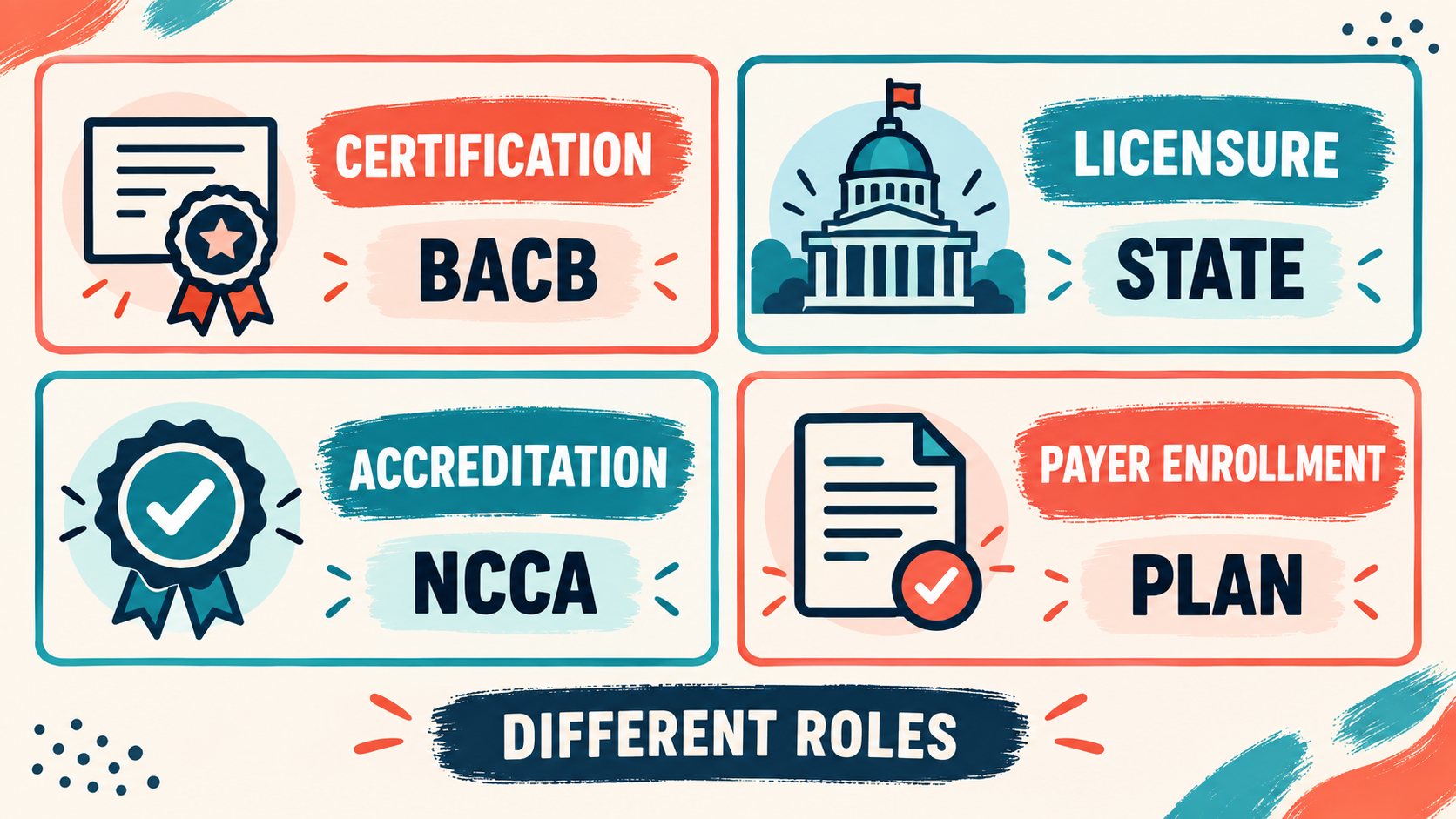
Use this comparison when a job posting, application, or exam question uses “certified,” “licensed,” “accredited,” and “credentialed” as if they were interchangeable.
| Status or approval | Who issues or controls it? | What it generally means |
|---|---|---|
| BCBA certification | Behavior Analyst Certification Board (BACB) | The individual met the BACB’s certification requirements and maintains the credential under BACB rules. |
| State behavior-analyst license | State licensing board or authorized government agency | The person meets that jurisdiction’s legal requirements to practice within the license’s scope. |
| Program accreditation | An accrediting organization or recognized accrediting body | A program or certification scheme met the accreditor’s standards; it is not an individual BCBA certificate. |
| Payer enrollment or employer credentialing | The payer, network, employer, or contracting organization | The organization approved the provider for a contract, network, job, or billing relationship. |
NCCA accreditation is another useful example. The BACB explains that its certification programs are accredited by the National Commission for Certifying Agencies. That accreditation supports the quality and review of the certification program; it does not mean NCCA issues individual BCBA certifications.
What Does BCBA Certification Prove?
BCBA certification indicates that the person has met the BACB’s requirements for the credential, including the applicable education, supervised fieldwork, and examination pathway. It also places the certificant under BACB maintenance and ethics expectations. It is evidence of a professional certification standard, not a promise that every service, treatment decision, or employment arrangement is appropriate in every context.
Certification should also not be confused with a clinical diagnosis, a guarantee of outcomes, or a substitute for checking state law. A family choosing services may reasonably ask for the person’s certification status, state license if required, role on the treatment team, supervisor relationship, and experience with the relevant client and goals.
For a candidate, the practical meaning is that studying for the exam is one part of a larger credentialing pathway. The current handbook and BACB pages control the requirements. A university advertisement, social-media post, or old study guide may describe an earlier pathway and should not override the current official source.
Do You Need a State License After BCBA Certification?
Sometimes. The answer depends on where you work and what services you provide. Many jurisdictions regulate behavior analysis through state licensure or title-protection rules. Some employers, school systems, Medicaid programs, and commercial payers also impose their own requirements.
Do not infer that a state license is unnecessary just because the BACB issued your certification. Conversely, do not infer that a state license is the same as BCBA certification. Review the state board’s current rules, confirm which license category applies, and ask the employer or payer what enrollment or credentialing documents it requires.
The separation is especially important when you move. Your BACB certification status and your state license may have different renewal cycles, fees, continuing education rules, and address requirements. Keep a separate tracking checklist for the national certification, state license, and payer or employer enrollment.
How Can You Verify the Issuer and Your Status?
Use this short verification sequence:
- Read the exact credential name. “BCBA certification” points to the BACB; “licensed behavior analyst” points to a state authority.
- Check the issuing organization. Use BACB’s official resources for certification and the relevant state board for licensure.
- Confirm status and expiration. A person may have earned a credential in the past but not hold it in current good standing.
- Separate certification from enrollment. A payer directory entry or employer approval does not replace verification of BCBA status.
- Use current documents. Requirements and jurisdictional rules can change, especially around the 2027 BACB transition.
If you are preparing for the certification examination, the free BCBA mock exam can be a practice checkpoint after you have confirmed the current official requirements. It is not issued by the BACB and cannot grant certification.
BCBA Issuer FAQ
Does a university issue BCBA certification?: No. A university may award a degree or deliver qualifying coursework. The BACB issues the BCBA certification after the candidate meets the applicable requirements. Does Pearson VUE issue the BCBA credential?: No. Pearson VUE delivers the examination and manages scheduling. The BACB is the certification issuer. Is the BACB a state licensing board?: No. The BACB operates a professional certification program. A state board or government agency may separately regulate or license behavior analysts in its jurisdiction. Does NCCA issue BCBA certification?: No. NCCA accreditation applies to a certification program. The BACB issues the individual BCBA certification.
Is BCBA-D a separate certification issuer?: No. BCBA-D is a designation associated with BCBA certification, not a separate certification that changes who issues the credential. Review the current BACB Handbook for the designation’s requirements and limits.
The direct answer to “who issues BCBA certification?” is the Behavior Analyst Certification Board, or BACB. Keep that answer separate from the state board that may issue a license, the accreditor that reviews a program, and the payer or employer that approves a contract. That distinction makes application decisions, exam questions, and professional verification much clearer.
Quick Review Checklist
Use this final checklist to turn who issues bcba certification into exam-ready reasoning. The goal is not to memorize a label in isolation; it is to identify the relevant evidence and explain why the best answer fits the scenario. Key ideas to review:
- State the central definition or decision point for who issues bcba certification in your own words.
- Identify the detail that makes who issues bcba certification different from its closest related ABA term.
- Separate the observable facts in a scenario from assumptions that are not supported by the facts.
- Write one example and one nonexample so you can recognize the concept in a new setting.
Exam application checks:
- Ask what the question is actually requesting before comparing the answer choices.
- Mark the antecedent, response, consequence, or other evidence that supports the selected answer.
- Look for a distractor that describes a related process but does not answer the specific question.
Final self-check:
- Explain how you would verify the interpretation with clear observations or data.
- Change one detail in the scenario and decide whether your answer should change.
- Give a one-sentence rationale that a supervisor or study partner could evaluate.
Take the Free BCBA Mock Exam
If you want a low-pressure way to check your recall, use the free practice resource below. Take the Free BCBA Mock Exam



