

This contingency shaped behavior ABA guide focuses on behavior influenced by direct contact with consequences across a person’s history. The learner does not have to state a rule or follow an instruction for the behavior to change. The key exam move is to trace what happened after the response and how that history affected later responding.
Table of Contents
- Contingency Shaped Behavior ABA: What Direct Contact Means
- Trace the Behavior History Before Naming It
- Work Through a Contingency-Shaped Behavior Example
- Compare the Evidence With Rule-Governed Behavior
- Avoid Mixed-Case Exam Traps
- Practice the Distinction With a Retrieval Loop
- Quick Review Checklist
- Take the Free BCBA Mock Exam
That does not mean every behavior followed by a consequence is automatically contingency-shaped. A scenario may include both direct consequences and a stated rule. The correct answer depends on the evidence the question gives you. This guide shows how to identify the history, compare it with rule-governed behavior, and avoid the shortcuts that make these questions difficult.
Contingency Shaped Behavior ABA: What Direct Contact Means
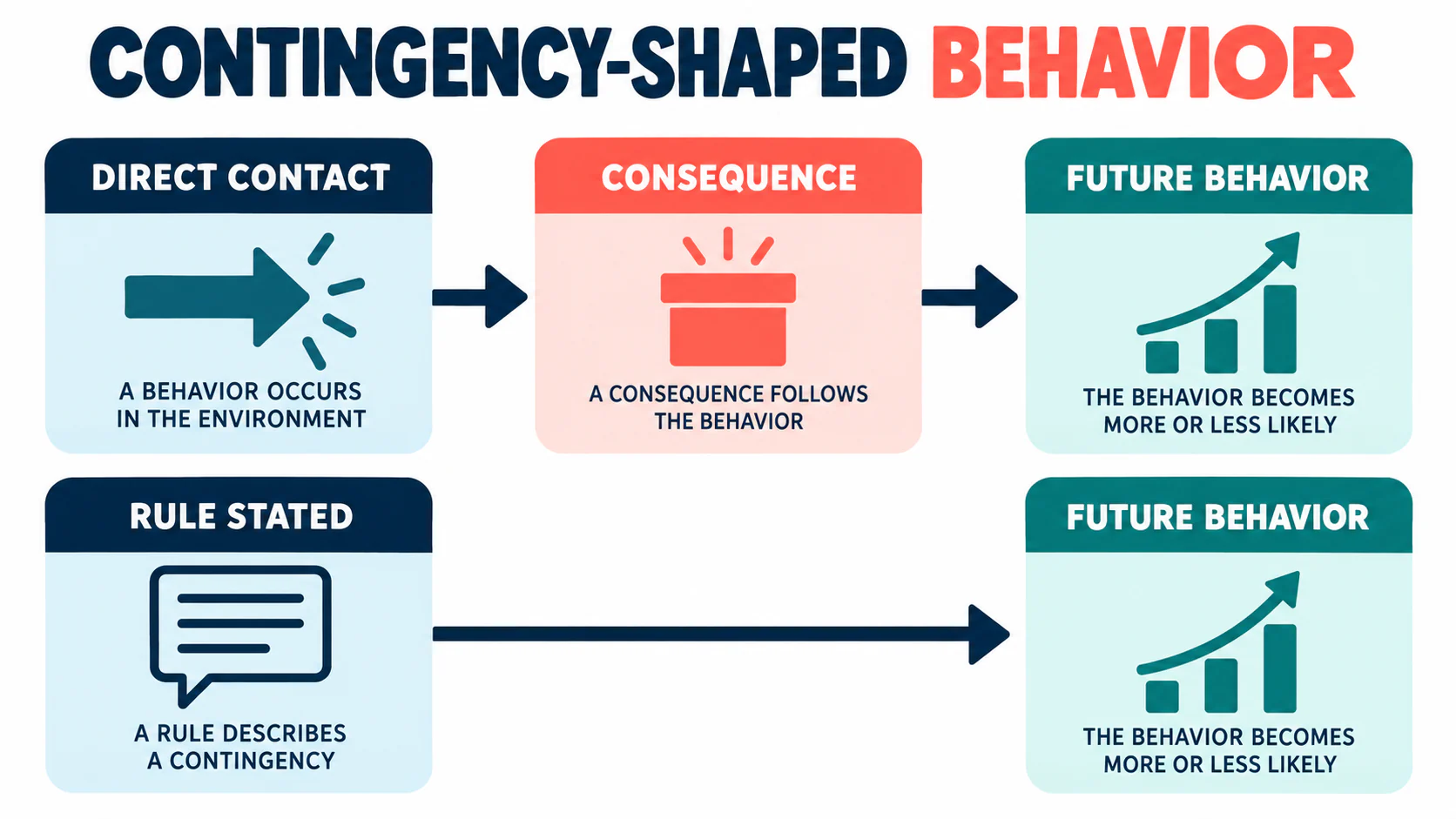
“Shaped by contingencies” describes a behavioral history, not a personality type. The learner responds, contacts a consequence, and the pattern of responding changes over repeated opportunities. The learner may eventually describe the pattern in words, but the defining clue is the direct interaction with the consequences rather than the presence of a verbal instruction alone.
For example, a learner tries several ways to open a difficult container. One response produces the result and becomes more likely in similar situations. The important analysis is not that the learner “figured it out” in a casual sense. It is that the response contacted a consequence and the future probability changed.
A rule can also enter the picture later. Once someone says, “Turn the lid counterclockwise and it opens,” the learner may respond under rule control even before trying the action. The same person can have both histories at different times or in the same broader task.
Trace the Behavior History Before Naming It
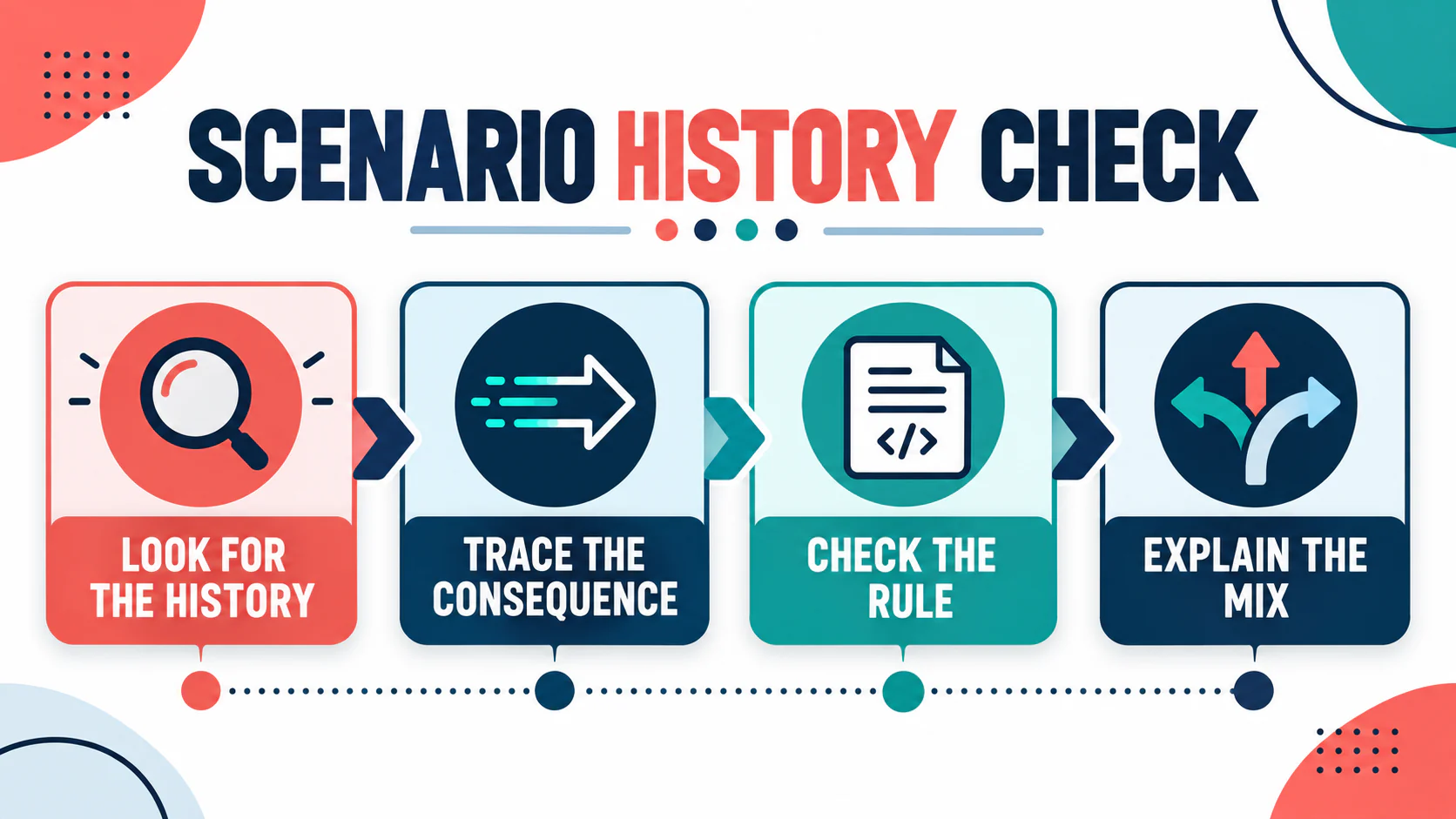
Use four questions when a BCBA exam scenario asks whether behavior is contingency-shaped:
- What was the response? State the observable action instead of using a label such as “understood” or “was motivated.”
- What happened immediately after it? Identify the consequence described in the scenario, not the consequence you assume would be preferred.
- What changed later? Look for increased, decreased, faster, more persistent, or differently allocated responding across opportunities.
- Was a rule doing the work? Check whether the person followed a statement, instruction, promise, warning, or self-generated description before contacting the outcome.
If the scenario does not provide enough history, do not invent one. Choose the answer that acknowledges what must be assessed or measured, or identify the distinction the question actually supplies. A direct consequence in one trial does not prove a complete behavioral history by itself.
Work Through a Contingency-Shaped Behavior Example
Imagine that a learner is using a communication device. During several opportunities, the learner selects a request icon, and access to the requested item follows. Across sessions, the learner selects the icon more often and begins to select it sooner. The scenario gives you a response, a consequence, and a later pattern. Those details support a contingency-shaped interpretation.
| Scenario element | What to identify | Why it matters |
|---|---|---|
| Response | Selecting the request icon. | Defines what changed rather than using a mentalistic label. |
| Consequence | Access to the requested item follows. | Shows direct contact with an outcome after the response. |
| Later pattern | More frequent and faster selections. | Shows a future behavior change consistent with the history described. |
| Rule check | No instruction is described as the controlling cue. | Leaves direct contact with the consequence as the central clue. |
Now change one fact. Suppose the learner selects the icon because a teacher says, “If you touch the request icon, you will get the item,” and the learner follows that statement before ever contacting the outcome. The answer may now involve rule-governed behavior. If the scenario later includes repeated direct contact that changes responding, both histories may matter. Do not force a false either-or when the facts describe a mixed case.
Compare the Evidence With Rule-Governed Behavior
The fastest comparison is not “which behavior looks more independent?” It is “what history is controlling the response in this situation?” A rule can be accurate or inaccurate, followed immediately or later, and stated by another person or generated by the learner. A contingency-shaped pattern can be complex and verbally described after the fact. The labels depend on the functional relation described.
| Question | Contingency-shaped clue | Rule-governed clue |
|---|---|---|
| What changes responding? | Direct contact with consequences over opportunities. | A stated rule or verbal description affects responding. |
| What should you trace? | Response, consequence, and later pattern. | Rule, response, and the consequences that may maintain rule following. |
| What is the exam trap? | Calling any learning “rule governed” because the learner can talk. | Calling any successful response contingency-shaped without the history. |
Avoid Mixed-Case Exam Traps
- Outcome-only reasoning: a preferred item after a response does not prove the entire history unless the scenario describes the later effect.
- Language-only reasoning: a learner can describe a behavior that was originally shaped by direct consequences.
- Independence-only reasoning: responding without a prompt is not the same as responding without rule control.
- One-trial reasoning: a single consequence can be part of a contingency, but the question may require a history or a demonstrated change.
- Forced dichotomy: direct contact and rule control can both appear in a longer learning history.
When an answer choice uses a confident label but the scenario does not supply the relevant history, look for the option that recommends examining antecedents, consequences, verbal stimuli, and repeated responding. Functional analysis begins with evidence, not with a label that sounds sophisticated.
Practice the Distinction With a Retrieval Loop
Use a small four-column study note: scenario cue, response, consequence or rule, and later behavior pattern. Fill it in before looking at the answer. Then say out loud why the evidence supports contingency-shaped behavior, rule-governed behavior, both, or an insufficient-information answer.
- Underline the fact that describes direct contact with an outcome.
- Circle any statement, instruction, warning, or promise that could function as a rule.
- Write the future behavior change the scenario actually reports.
- Explain why the strongest alternative label does not fit the available history.
- Review the current BCBA Test Content Outline when you need to place the concept within the exam boundary.
After working through the distinction, try the Free BCBA Mock Exam as diagnostic practice. Review whether your missed answer came from ignoring the rule, ignoring the direct consequence, or assuming a history the scenario never supplied. Use the result to guide study—not as a guarantee of certification. What is contingency-shaped behavior in ABA?: It is behavior influenced by direct contact with consequences across a history of responding. Identify the response, what followed, and the later pattern before applying the label.
Is contingency-shaped behavior the opposite of rule-governed behavior?: They describe different sources of behavioral control, but a person can have both histories. Read the scenario for direct consequences and stated rules rather than forcing a simple category.
What is the best BCBA exam clue?: Trace what the person contacted and what changed later. If a verbal statement is controlling the response, rule-governed behavior may be relevant; if the scenario emphasizes direct consequences, contingency-shaped behavior may be the better fit. For targeted review, use our contingency shaped behavior aba practice questions to apply the concept in exam-style scenarios.
Quick Review Checklist
Use this final checklist to turn contingency shaped behavior aba into exam-ready reasoning. The goal is not to memorize a label in isolation; it is to identify the relevant evidence and explain why the best answer fits the scenario. Key ideas to review:
- State the central definition or decision point for contingency shaped behavior aba in your own words.
- Identify the detail that makes contingency shaped behavior aba different from its closest related ABA term.
- Separate the observable facts in a scenario from assumptions that are not supported by the facts.
- Write one example and one nonexample so you can recognize the concept in a new setting.
Exam application checks:
- Ask what the question is actually requesting before comparing the answer choices.
- Mark the antecedent, response, consequence, or other evidence that supports the selected answer.
- Look for a distractor that describes a related process but does not answer the specific question.
Final self-check:
- Explain how you would verify the interpretation with clear observations or data.
- Change one detail in the scenario and decide whether your answer should change.
- Give a one-sentence rationale that a supervisor or study partner could evaluate.
Take the Free BCBA Mock Exam
When you are ready to apply the idea, use the free practice resource below for additional feedback. Take the Free BCBA Mock Exam



