
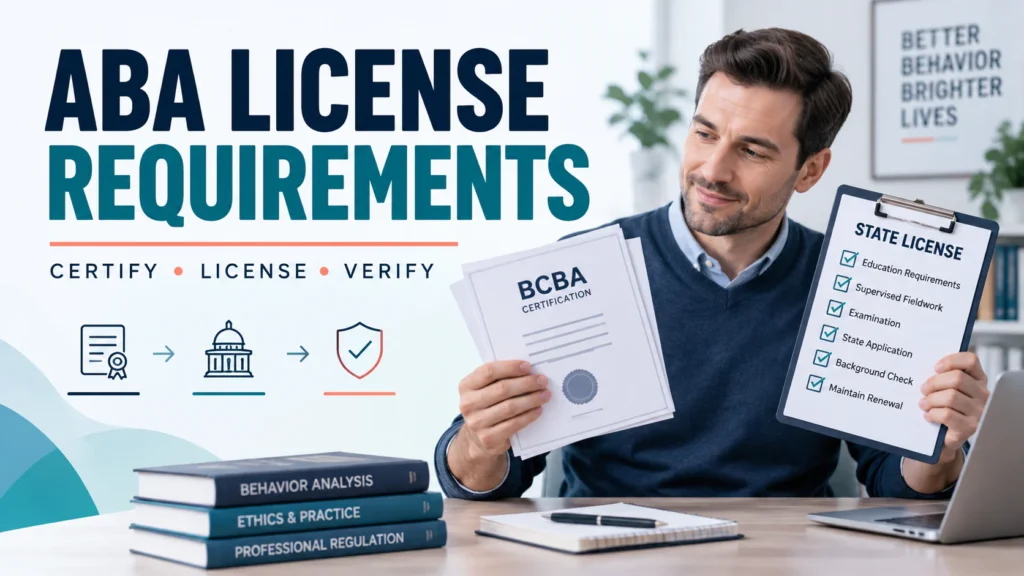
ABA license requirements are not controlled by one universal checklist. A candidate may need to verify a national BCBA certification, a state license or registration, and separate employer or payer credentialing. Those layers can depend on one another, but they are not interchangeable.
Table of Contents
- ABA License Requirements: Start With the Three Layers
- Who Controls Which Rule?
- Documents and Dates to Save
- A Five-Step ABA License Verification Workflow
- Confirm Scope Before You Practice
- Turn Credentialing Into the Next Action
- Quick Review Checklist
- Take the Free BCBA Mock Exam
This guide gives you a practical way to map the authority before you apply or practice. It does not provide legal advice and it cannot determine a state-specific answer without the state, setting, role, and current regulator information. Use the current BACB and state sources as the final authority, then save the evidence and dates you relied on.
ABA License Requirements: Start With the Three Layers
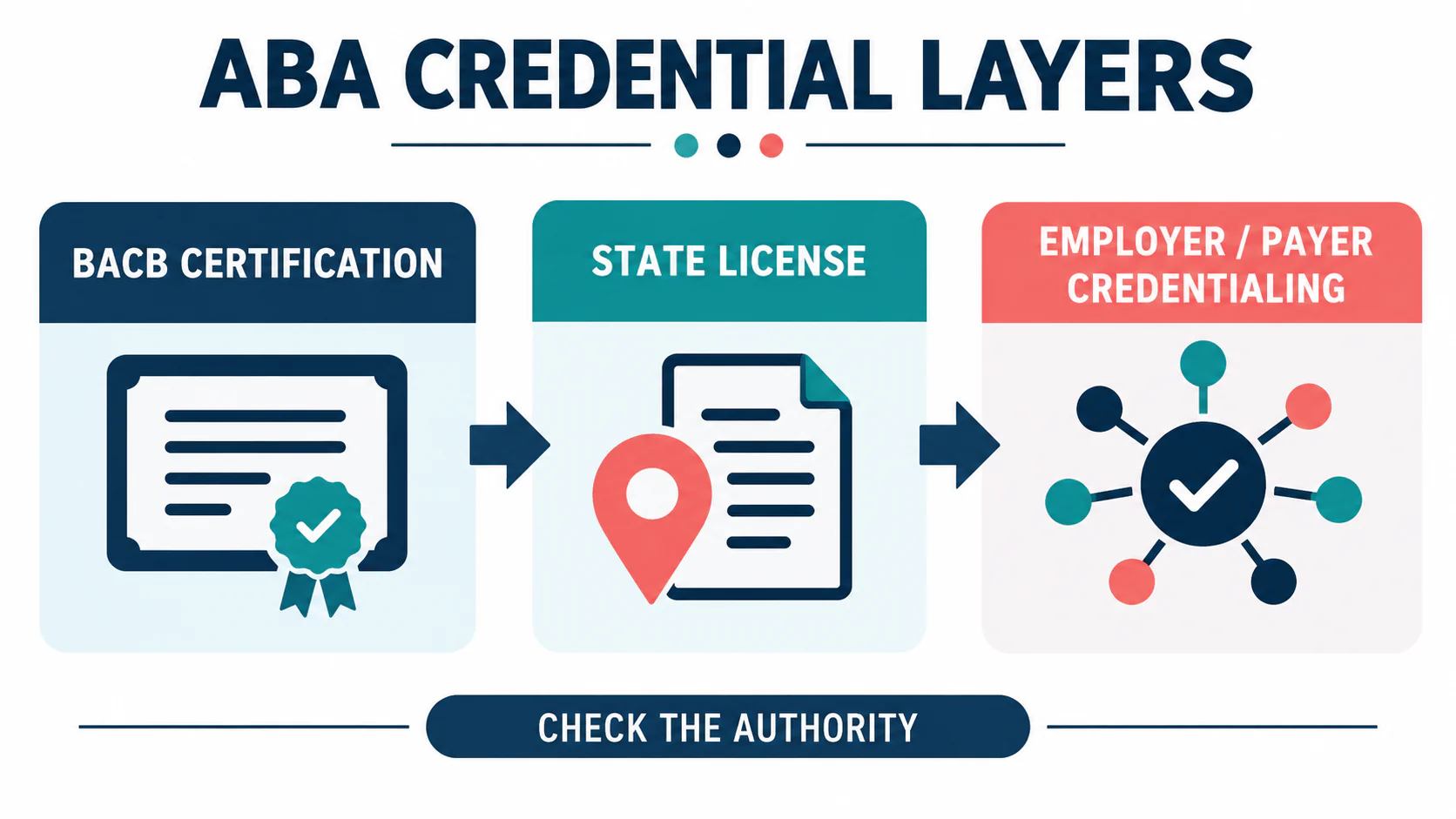
When someone says “I need an ABA license,” ask what they are trying to do. They may mean they want to become a BCBA, they may already hold the certification and need authorization in a state, or they may be preparing to join a provider network. Each question has a different owner.
- BACB certification: the national credentialing process has its own eligibility, application, examination, and maintenance requirements.
- State authorization: a state board or licensing agency may regulate who can use a title or provide services in that jurisdiction.
- Employer or payer credentialing: an organization or insurer may require additional documents, enrollment, supervision information, or contracts before services can begin.
Do not infer the second or third layer from the first. Passing a certification examination does not automatically answer whether a state license is required, and holding a state license does not automatically enroll you with every payer. The safest workflow names the authority before it names the form.
Who Controls Which Rule?
Use the current BACB BCBA certification information and BCBA Handbook for the national certification path. Then locate the official licensing or regulatory agency for the state where the service will be delivered. Finally, ask the employer or payer for its current credentialing checklist.
| Layer | Authority to check | Evidence to save | Common mistake |
|---|---|---|---|
| Certification | BACB | Current handbook, eligibility evidence, application record, examination information. | Treating a study provider’s checklist as the official rule. |
| State authorization | State board, department, or licensing agency | Statute or rule, application form, license status, renewal date. | Assuming another state’s rule applies. |
| Credentialing | Employer, group practice, or payer | Enrollment confirmation, contract, taxonomy or provider documents, effective date. | Starting services before the network or employer confirms status. |
Documents and Dates to Save
Credentialing problems often happen because someone remembers the rule but cannot show which version they used. Create a small folder for each jurisdiction or role. Save the official page as a link, record the access date, and keep the email or confirmation that answers your specific question.
For certification, keep the current BACB handbook and your application or examination records. For state authorization, save the regulator’s rule, the exact license type, the scope or title language, and the renewal or continuing-education information. For employer or payer credentialing, save the checklist, submission date, missing-item notice, approval date, and effective date.
Do not assume a document is current because it has a professional logo. Check the page date, version label, and issuing authority. A commercial article can explain the vocabulary, but it cannot replace the current rule that controls your practice location.
A Five-Step ABA License Verification Workflow
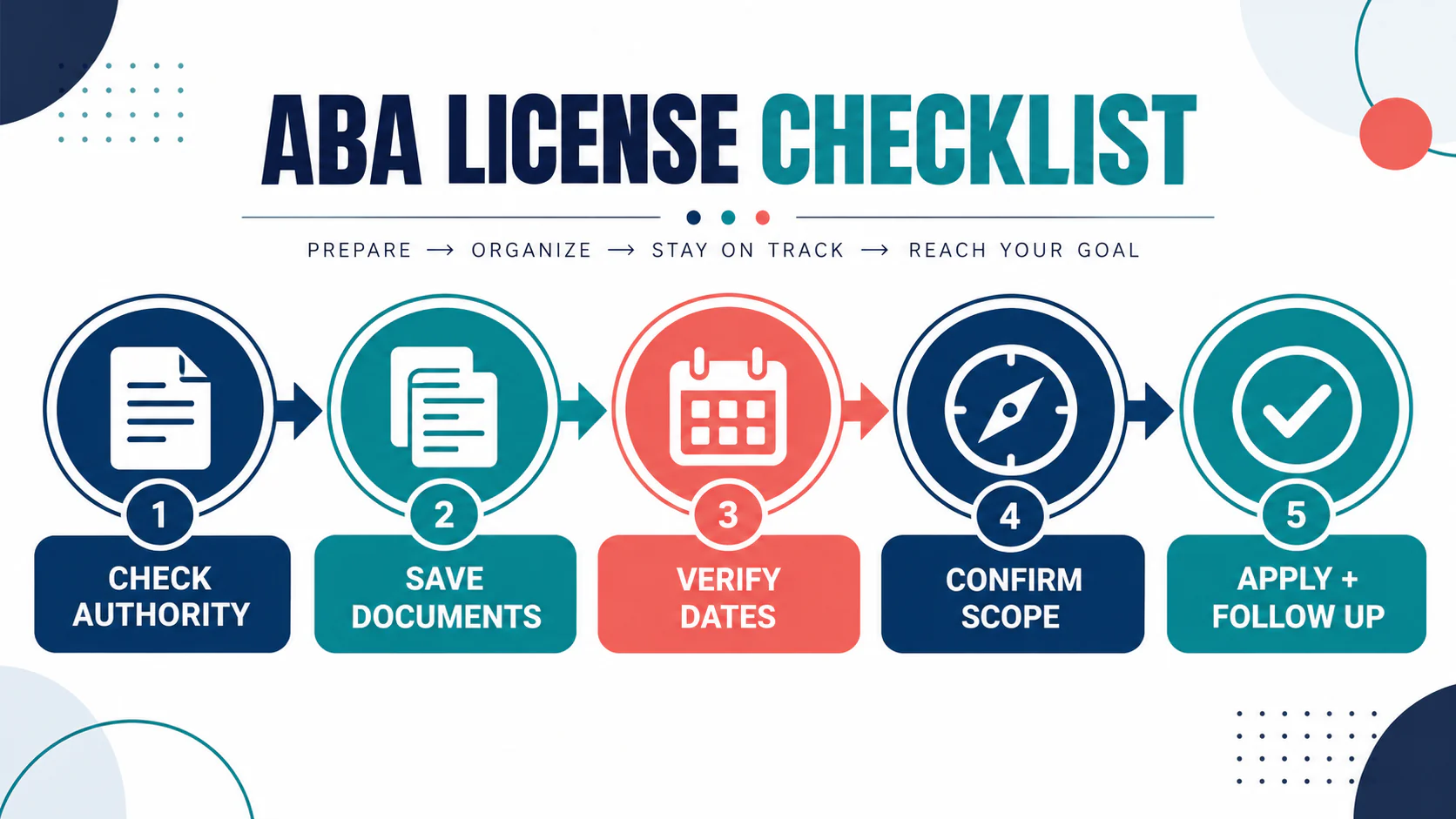
- Check the activity: write down the title you will use, the services you will provide, the population, the physical or telehealth location, and whether you are employed or contracting.
- Name the authority: decide whether the question belongs to BACB, a state regulator, an employer, a payer, or more than one.
- Find the current source: start with the official page, not a search snippet. Read the definition, exemption, supervision, renewal, and effective-date sections that apply.
- Save the evidence: record the exact requirement, URL, version or access date, and any confirmation number or email.
- Confirm before practice: ask the authority or credentialing contact to clarify unresolved conflicts in writing before you represent yourself as authorized or bill for services.
This sequence creates a conversion opportunity without turning the article into a hard sell. A reader who knows which layer is missing can choose the next product or support: certification study, state application help, employer documentation, or payer enrollment.
Confirm Scope Before You Practice
Authorization is not the same as competence. Even after a document is approved, a professional must work within training, supervision, ethical obligations, organizational policy, and applicable law. The current BACB ethics resources are a useful professional boundary; a license does not make every intervention, record, or representation appropriate. Ask five practical scope questions:
- Does the credential authorize the title and service I plan to provide?
- Does the state rule apply to this setting, location, or telehealth arrangement?
- Does my employer or payer require a separate enrollment before billing or service delivery?
- Do I have the competence and supervision needed for this case?
- What must be reviewed again before renewal, relocation, or a change in role?
If any answer is unclear, stop at the verification step. It is better to delay a representation or claim while the authority confirms the rule than to correct a credentialing error after services, billing, or public marketing has already begun.
Turn Credentialing Into the Next Action
Use a two-track plan. Track one is credential verification: identify the authority, save the current rule, submit the documents, and confirm the effective date. Track two is exam readiness: map the BCBA Test Content Outline, practice the concepts, and review missed questions. The tracks support each other, but one does not replace the other.
After you verify which layer you are preparing for, try the Free BCBA Mock Exam as a diagnostic study step. Use your result to decide which exam domains need work; do not treat a practice score as a license, eligibility decision, or guarantee of certification. Are ABA license requirements the same in every state?: No. State authorization, titles, exemptions, supervision rules, and renewal requirements can differ. Check the official regulator for the state and activity involved.
Does BCBA certification automatically create a state license?: No. Certification and state authorization are separate layers. A state may use the BCBA credential as part of its process, but the state authority controls its own license or registration rule.
What should I do if a website and the regulator disagree?: Use the current regulator or BACB source for the layer it controls, save the conflicting page, and request clarification from the responsible authority before applying or practicing.
Quick Review Checklist
Use this final checklist to turn aba license requirements into exam-ready reasoning. The goal is not to memorize a label in isolation; it is to identify the relevant evidence and explain why the best answer fits the scenario. Key ideas to review:
- State the central definition or decision point for aba license requirements in your own words.
- Identify the detail that makes aba license requirements different from its closest related ABA term.
- Separate the observable facts in a scenario from assumptions that are not supported by the facts.
- Write one example and one nonexample so you can recognize the concept in a new setting.
Exam application checks:
- Ask what the question is actually requesting before comparing the answer choices.
- Mark the antecedent, response, consequence, or other evidence that supports the selected answer.
- Look for a distractor that describes a related process but does not answer the specific question.
Final self-check:
- Explain how you would verify the interpretation with clear observations or data.
- Change one detail in the scenario and decide whether your answer should change.
- Give a one-sentence rationale that a supervisor or study partner could evaluate.
Take the Free BCBA Mock Exam
When you are ready to apply the idea, use the free practice resource below for additional feedback. Take the Free BCBA Mock Exam



