
If you are asking what can I do as a BCBA, start with the responsibility you want to own—not just the job title you want to search. BCBAs may assess behavior, design and evaluate interventions, supervise staff, analyze data, train caregivers or teams, and collaborate across settings. The exact work depends on the population, employer, state authorization, payer rules, and your competence.
Table of Contents
- What Can I Do as a BCBA? Start With the Responsibility
- Compare Four BCBA Work Settings
- Map the Core Responsibility Pathway
- Check Certification, Authorization, and Competence
- Choose One Career Action and One Study Action
- Quick Review Checklist
- Take the Free BCBA Mock Exam
This guide turns the broad career question into a decision map. It compares settings, separates national certification from local authorization, and helps you choose one experience and one study action. It is career planning, not a promise that a credential authorizes every service or that one practice score predicts certification.
What Can I Do as a BCBA? Start With the Responsibility
A BCBA role is not one fixed daily schedule. One practitioner may spend most of the week analyzing data and coaching a team. Another may conduct assessments, write plans, train caregivers, supervise RBTs or trainees, and coordinate with other professionals. The common thread is applied behavior analysis within the person’s scope, setting, supervision structure, and professional obligations. To narrow the choice, ask which decision you want to make:
- Do I want direct clinical work? Look for assessment, intervention design, observation, data review, and caregiver or staff coaching.
- Do I want team leadership? Look for supervision, training systems, quality review, scheduling, and feedback structures.
- Do I want education or consultation? Look for school collaboration, classroom support, teacher training, and functional behavior planning.
- Do I want research or program development? Look for measurement, experimental design, outcomes, training, and implementation evaluation.
Compare Four BCBA Work Settings
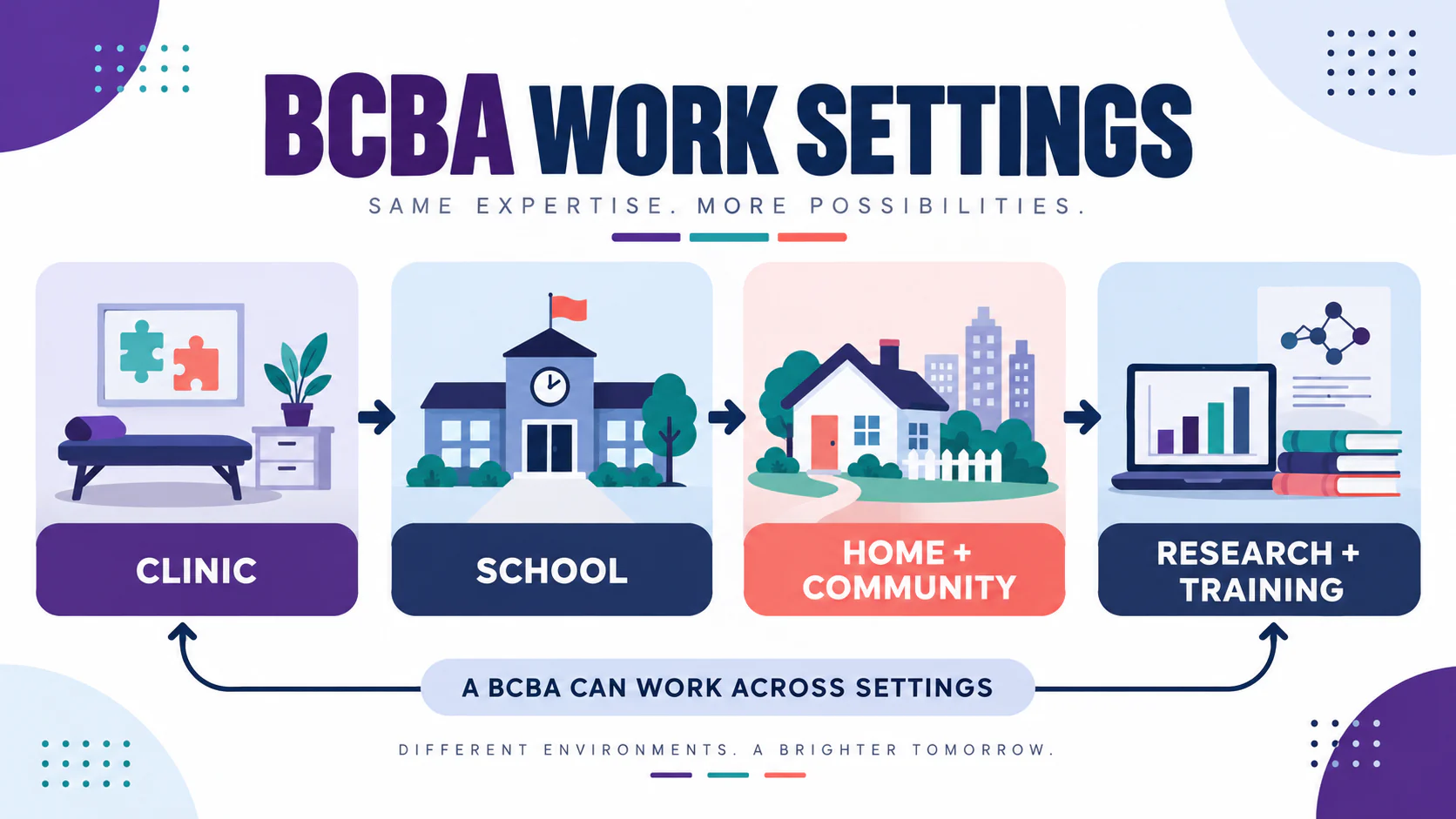
The setting changes who asks the question, which data are available, and how collaboration happens. It does not remove the need for assessment, ethical judgment, accurate documentation, or competence. The paths can overlap, so treat them as responsibility patterns rather than permanent labels.
| Setting | Common responsibility pattern | Question to ask before choosing |
|---|---|---|
| Clinic or center | Assessment, treatment planning, staff supervision, caregiver coaching, and outcome review. | How much direct observation and case ownership will I have? |
| School | Functional behavior assessment, classroom supports, teacher collaboration, and data-based plan review. | How are educational goals, consent, team roles, and records coordinated? |
| Home or community | Caregiver training, generalization, routines, communication, and coordination across environments. | Will the plan fit the family’s priorities, context, and available support? |
| Research or training | Measurement, implementation fidelity, program evaluation, instruction, and professional development. | Which design, data, supervision, and communication skills must I strengthen? |
Map the Core Responsibility Pathway
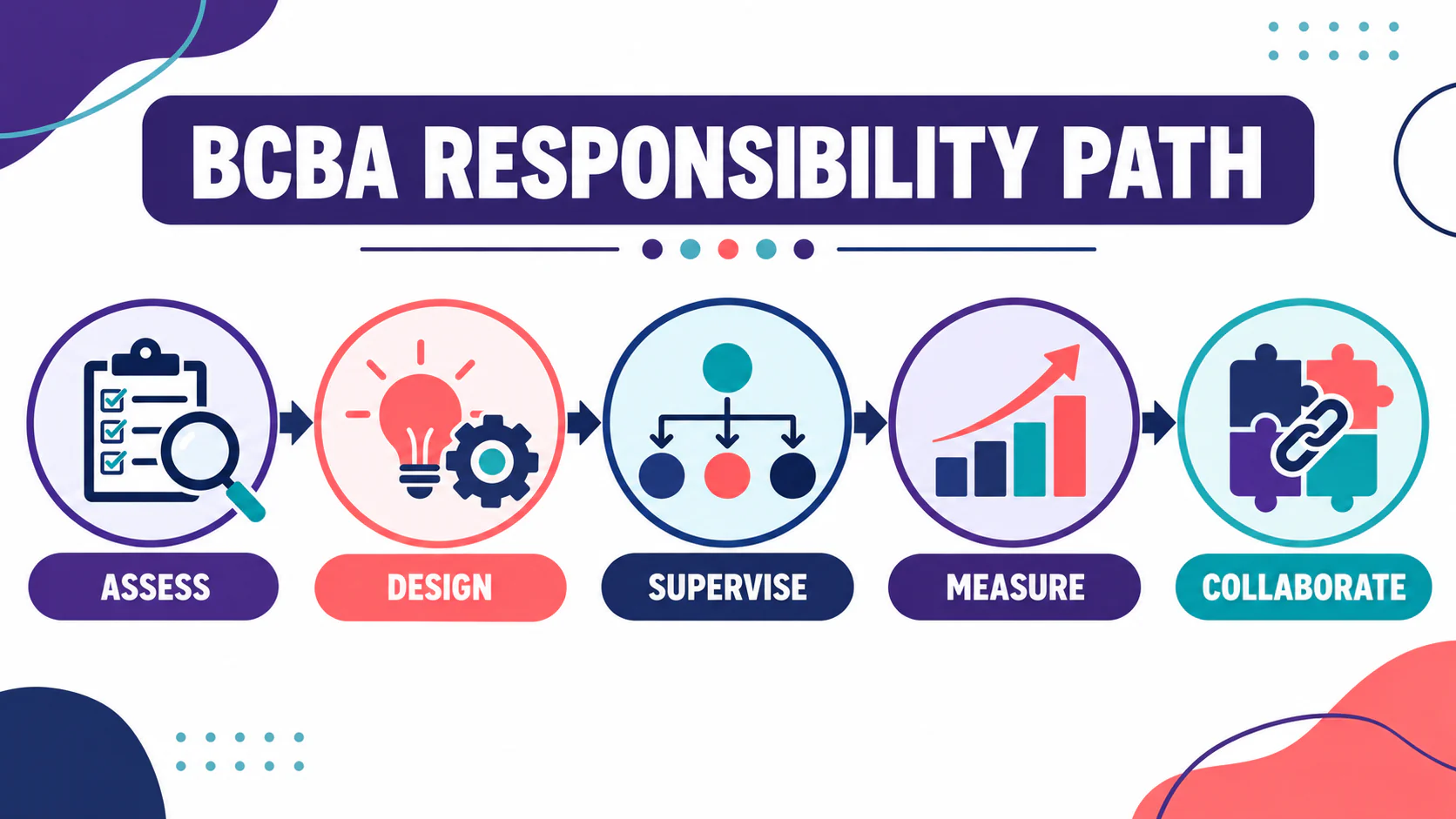
- Assess: define the concern, gather relevant information, and identify what the data can and cannot show.
- Design: select goals, measurement, teaching or intervention procedures, and decision rules that fit the person and context.
- Supervise: train, observe, give feedback, and evaluate whether the team can implement the plan accurately.
- Measure: review data, look for meaningful change, detect poor fidelity or confounds, and adjust when evidence supports it.
- Collaborate: communicate with caregivers, educators, employers, and other professionals while protecting dignity, privacy, and role clarity.
A career path becomes clearer when you identify which step you want to practice most. If you enjoy measurement, look for roles with graph review and program evaluation. If you enjoy teaching teams, ask about supervision quality and feedback time. If you prefer collaboration, ask how the organization includes families and other providers in decisions.
Check Certification, Authorization, and Competence
The current BACB BCBA resource is the place to verify the national certification path. A state board may separately control authorization to practice or use a title. An employer or payer may add credentialing steps. Finally, an individual’s competence and supervision determine whether a particular case or procedure is appropriate.
| Question | Who or what controls it? | What to do |
|---|---|---|
| Can I earn the BCBA credential? | BACB requirements and current handbook. | Map eligibility, fieldwork, application, and exam preparation. |
| Can I practice in this location? | State regulator, setting, and applicable law. | Verify license, registration, title, and renewal rules. |
| Can I take this case? | Competence, supervision, ethics, employer, and client needs. | Assess fit, consult, train, refer, or decline when appropriate. |
Do not let an attractive job description answer all three questions. A job title does not prove authorization, and authorization does not prove competence for every procedure or population.
Choose One Career Action and One Study Action
- Choose one setting: clinic, school, home/community, research/training, or another setting you can name precisely.
- Choose one responsibility: assessment, design, supervision, measurement, or collaboration.
- Ask one evidence question: what data, supervision, or training would show that you can perform that responsibility?
- Schedule one experience: an informational interview, observation, supervised practice, course, or case-review exercise.
- Practice one exam domain: use a scenario that requires the same responsibility and explain why each distractor is weaker.
Use the Free BCBA Mock Exam as a diagnostic practice step after choosing the responsibility you want to strengthen. A missed question about measurement, assessment, intervention, ethics, or supervision can become a specific study task. Treat the result as feedback, not as a guarantee of certification or a substitute for supervised experience.
What jobs can I do as a BCBA?: Possible work includes clinical services, school consultation, caregiver or staff training, supervision, program evaluation, research, and leadership. The actual duties depend on the employer, setting, authorization, and competence.
Can a BCBA work outside autism services?: Behavior analysis can be applied in multiple populations and settings, but the professional must have the relevant competence, authorization, supervision, and ethical fit. Do not treat a credential as permission to work outside your preparation.
What should I study if I am choosing a BCBA career path?: Study the responsibility you want to perform: measurement and data decisions, assessment, intervention, ethics, supervision, and collaboration. Then practice scenarios that require you to explain the evidence and next step. For targeted review, use our what can i do as a bcba practice questions to apply the concept in exam-style scenarios.
Quick Review Checklist
Use this final checklist to turn what can i do as a bcba into exam-ready reasoning. The goal is not to memorize a label in isolation; it is to identify the relevant evidence and explain why the best answer fits the scenario. Key ideas to review:
- State the central definition or decision point for what can i do as a bcba in your own words.
- Identify the detail that makes what can i do as a bcba different from its closest related ABA term.
- Separate the observable facts in a scenario from assumptions that are not supported by the facts.
- Write one example and one nonexample so you can recognize the concept in a new setting.
Exam application checks:
- Ask what the question is actually requesting before comparing the answer choices.
- Mark the antecedent, response, consequence, or other evidence that supports the selected answer.
- Look for a distractor that describes a related process but does not answer the specific question.
Final self-check:
- Explain how you would verify the interpretation with clear observations or data.
- Change one detail in the scenario and decide whether your answer should change.
- Give a one-sentence rationale that a supervisor or study partner could evaluate.
Take the Free BCBA Mock Exam
When you are ready to apply the idea, use the free practice resource below for additional feedback. Take the Free BCBA Mock Exam



