
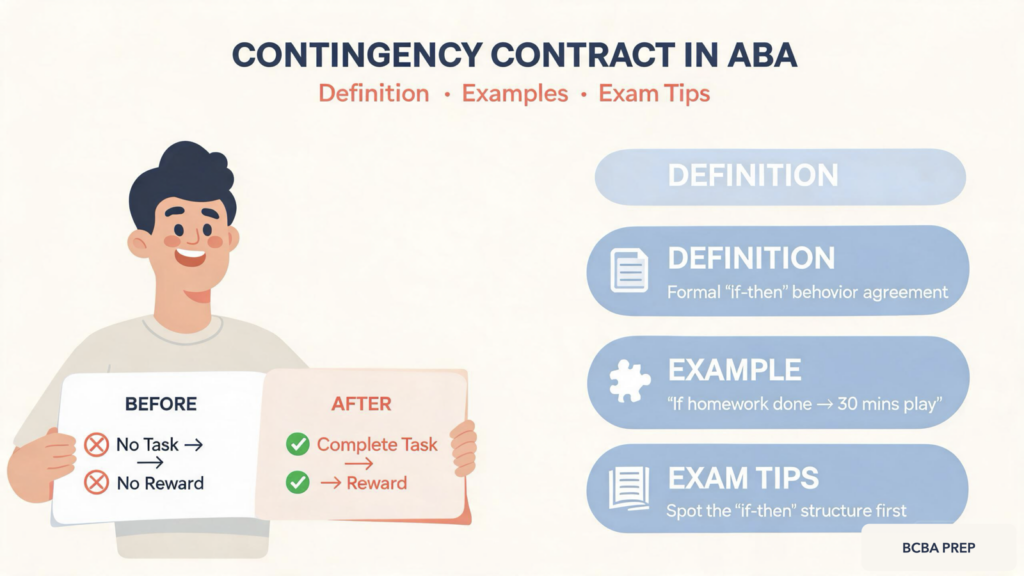
What is a Contingency Contract in ABA?
A contingency contract is a written agreement between a behavior analyst (or teacher/parent) and a learner that specifies a target behavior, the conditions under which it must occur, and the consequence that follows. It is a powerful tool for behavior change because it makes expectations and rewards explicit before the behavior occurs.
Table of Contents
- What is a Contingency Contract in ABA?
- Example 1: Increasing Homework Completion (Access to Tangible)
- Example 2: Reducing Verbal Outbursts (Escape Function)
- Example 3: Peer Sharing in Classroom (Social Positive Reinforcement)
- Example 4: Increasing On-Task Behavior During Independent Work (Attention Function)
- Exam Tips: How to Spot Contingency Contract Questions
- Quick Implementation Checklist
- Final Summary
Contracts are individualized, negotiated with the learner, and rely on the principle of positive reinforcement. They differ from token economies, which often use a group-wide token board with predetermined exchange rates. In a contract, the reward is directly linked to a specific task and recorded by the learner or practitioner.
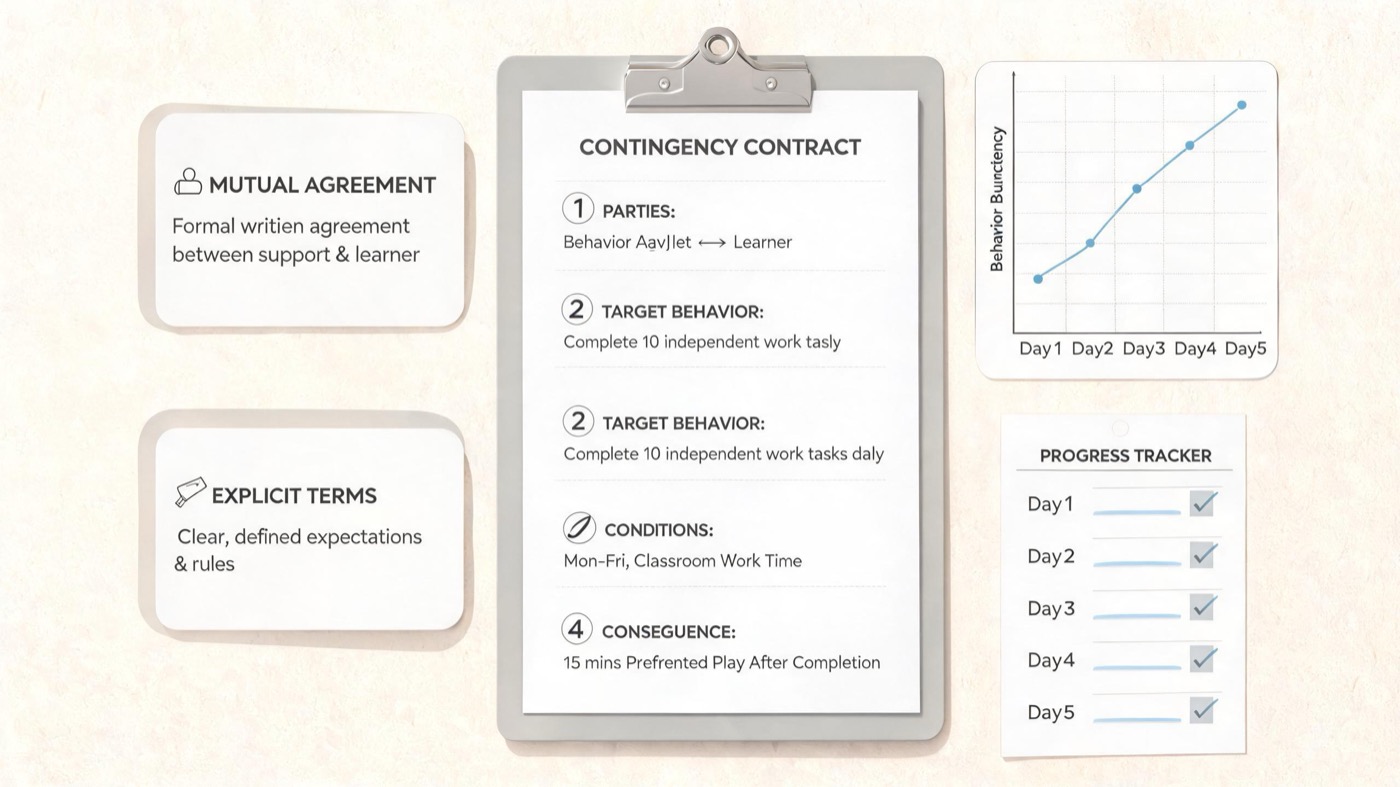
Key Components of a Contingency Contract
Every effective contingency contract must include three essential elements: task, reward, and record. These components are often written in simple language that the learner can understand.
- Task – the specific behavior to be performed (e.g., ‘Complete 4 of 5 math problems independently’).
- Reward – the reinforcing consequence delivered after the task is completed (e.g., ’15 minutes of iPad time’).
- Record – a way to track progress, such as a checklist, sticker chart, or signature log.
How Contingency Contracts Differ from Token Economies
While both are behavioral interventions, contingency contracts and token economies have distinct features. Contracts are typically individualized and negotiated, while token economies often apply to a group. Contracts require a written document signed by both parties; token economies use a token board. Contracts allow the learner to choose the reward within limits, increasing buy-in. Token economies rely on a predetermined menu of back-up reinforcers and may not be as flexible.
Example 1: Increasing Homework Completion (Access to Tangible)
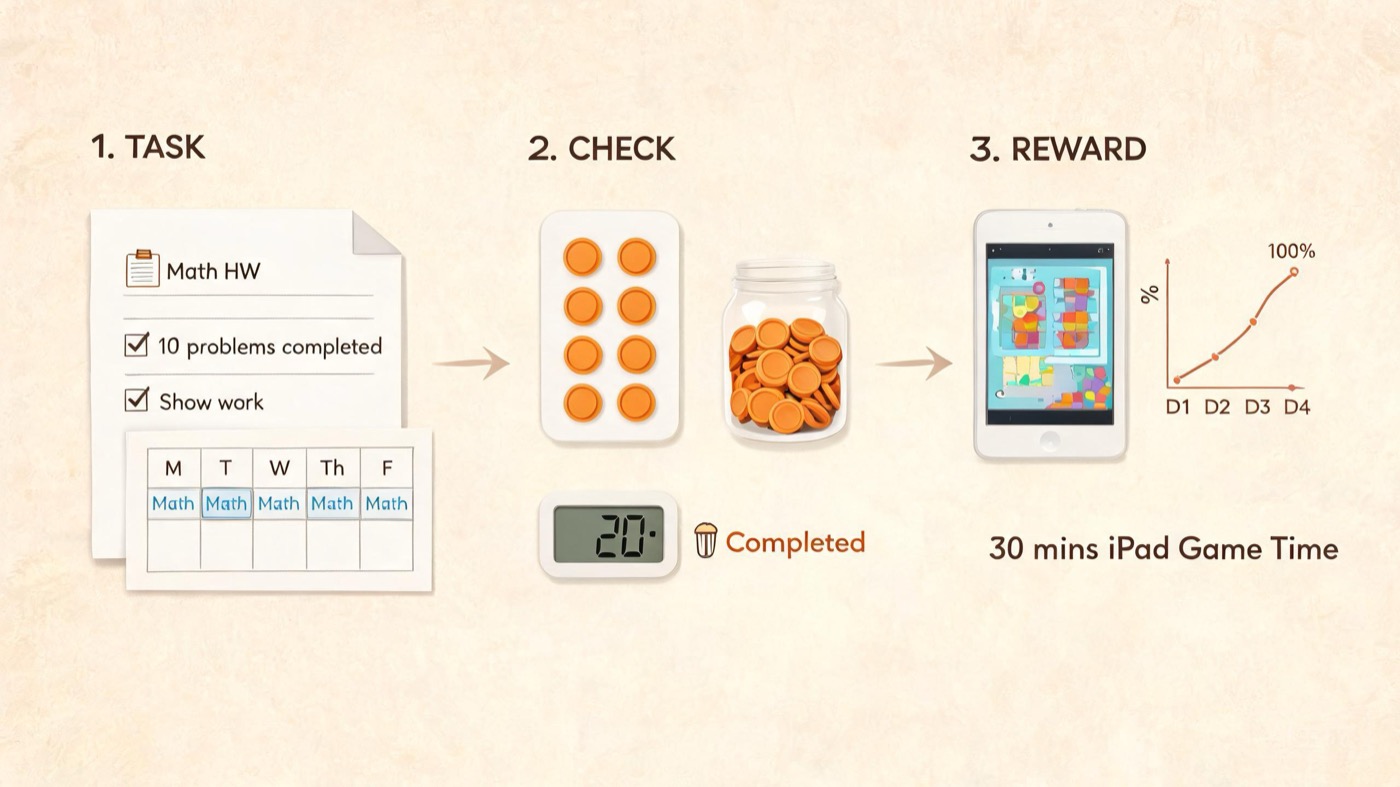
In this scenario, a student avoids math homework but loves iPad games. A contingency contract can leverage access to the iPad as a reward for completing homework. The contract specifies a clear task, a measurable criterion, and an immediate consequence.
ABC Analysis
- Antecedent: Teacher provides a math worksheet with 5 problems.
- Behavior: Student completes at least 4 of 5 problems correctly within 15 minutes.
- Consequence: Student earns 15 minutes of iPad time immediately after showing the completed work.
Exam Relevance
Notice that the contract makes the consequence explicit before the behavior occurs. This is a critical feature: the contract itself serves as an antecedent (a rule) that signals the availability of reinforcement. On the BCBA exam, you may be asked to identify whether a contract is being implemented with integrity. Common exam questions might ask: ‘What component is missing if the student demands a different reward?’ or ‘Why is the contract ineffective if the teacher forgets to record progress?’
Example 2: Reducing Verbal Outbursts (Escape Function)
When a behavior is maintained by escape from a task, a contract can provide an alternative way to earn a break without engaging in problem behavior. In this example, a student with autism frequently yells during difficult tasks. The contract targets a reduction in outbursts by rewarding a break after calm behavior.
ABC Analysis
- Antecedent: Teacher presents a challenging writing task.
- Behavior: Student has 2 or fewer verbal outbursts during the 20-minute session.
- Consequence: Student earns a 5-minute break to a quiet area with a preferred activity.
Trap to Avoid
A common error is to allow escape even after the student engages in outbursts. If the contract states that a break is earned only after 2 or fewer outbursts, but the teacher gives a break after 3 outbursts, the contract loses its integrity. The reinforcing consequence must be delivered only when the criterion is met, otherwise the problem behavior may be inadvertently strengthened.
Example 3: Peer Sharing in Classroom (Social Positive Reinforcement)
For behaviors maintained by social attention, the reward in a contingency contract can be a social activity or praise. In this example, a preschool child rarely shares toys; the function is access to teacher attention. The contract includes a simple sticker chart as a visual record.
ABC Analysis
- Antecedent: A peer approaches and asks to play with a toy the child is using.
- Behavior: Child shares a toy (hands it over or takes turns) at least twice during a 10-minute play period.
- Consequence: Teacher immediately praises the child (e.g., ‘Great sharing!’), and the child receives a sticker on the contract chart.
Common Pitfall
Before implementing the contract, conduct a preference assessment to confirm that the reward is truly reinforcing. If the child does not value praise or stickers, the contract will not change behavior. An effective contract must match the reward to the function of the target behavior.
Example 4: Increasing On-Task Behavior During Independent Work (Attention Function)
Consider a student who frequently calls out to gain the teacher’s attention during silent reading. The contract shifts the contingency so that attention is delivered for on-task behavior, not for disruptions.
- Antecedent: Teacher begins a 15-minute independent reading period.
- Behavior: Student remains reading quietly for at least 10 consecutive minutes without calling out.
- Consequence: Teacher comes over, gives a high-five, and says ‘You worked so quietly!’ Then the student can choose a 2-minute conversation with a friend.
This example illustrates how a contingency contract can rearrange the environment to make appropriate behavior more reinforcing than problem behavior. On the exam, look for vignettes where a specific antecedent-behavior-consequence chain is written down and signed by both parties.
Exam Tips: How to Spot Contingency Contract Questions
BCBA exam questions often embed contingency contracts in vignettes about classroom behavior, parent training, or self-management. To identify a contract, look for a written document that specifies who agrees to do what and what they will earn. The following cues can help you recognize contract-based scenarios.
Typical Question Wording
- ‘A teacher writes a contract with a student that states…’
- ‘A behavior analyst helps a client create a self-contract that includes a reward for…’
- ‘Which of the following is an essential component of a contingency contract?’
Three Most Common Exam Traps
- Confusing contract with token system – A token economy uses conditioned reinforcers (tokens) exchanged later; a contract delivers the primary reinforcer directly or immediately after the task. If the vignette mentions tokens or a token board, it’s not a pure contract.
- Evaluating effectiveness without checking integrity – Many questions ask ‘Why did the contract fail?’ The answer often involves the reward not being delivered on time, or the task criterion changing without renegotiation. Check if the contract was implemented as written.
- Assuming reward must be tangible – Contingency contracts can use any form of positive reinforcement: escape (break), attention (praise), or tangible (snack). The function of behavior determines the appropriate reward.
Quick Implementation Checklist
Use this checklist when designing or evaluating a contingency contract during practice or on the exam. It covers the key steps to ensure the contract is likely to be effective.
- Define the target behavior in observable, measurable terms.
- Collaborate with the learner to choose a reward that is motivating and accessible.
- Write the contract in clear, simple language and have both parties sign it.
- Set a realistic criterion that ensures the learner can experience success.
- Include a recording system (e.g., checklist, chart) to track progress visually.
- Deliver the reward immediately after the behavior meets the criterion.
- Monitor implementation and renegotiate if the contract is not working after several days.
For more on behavioral interventions, see our guide on behavior contracts in ABA and review the four functions of behavior. Additionally, the BACB’s Ethics Code emphasizes obtaining informed consent and using least restrictive procedures when implementing contingency contracts.
Final Summary
A contingency contract is a written agreement specifying a task, a reward, and a record. It differs from token economies in its individualization and direct contingency. The BCBA exam tests your ability to identify contract components, recognize common traps (confusion with token systems, integrity failures, and reward mismatches), and apply behavior analysis principles. Use the checklist above to quickly evaluate any contract scenario you encounter. With practice, you’ll be able to spot a contingency contract question at a glance.
Complete BCBA Exam Prep
Turn this topic into exam-day practice
Practice concepts in context with five full-length 6th Edition mock exams, two bonus practice exams, a 6th Edition study guide, and key-term flashcards—all in one $120 USD package.
Get the $120 All-in-One Prep Pack
Review everything included on the product page before ordering. No pass guarantee is implied.



