
How the Multiple Baseline Design Works
A multiple baseline design introduces the intervention to one baseline at a time, in a staggered sequence, across several behaviors, settings, or people.
- Baseline logic: each tier keeps collecting baseline data until the intervention is applied to it.
- Experimental control: demonstrated when each baseline changes only when (and not before) the intervention reaches it — making coincidence an unlikely explanation.
- Three types: across behaviors, across settings, and across subjects.
- Best for: behaviors that should not be reversed (irreversible learning, or for ethical reasons).
Exam tip: the proof is the staggered change tier by tier. Compare with the multielement and changing criterion designs.
What is a Multiple Baseline Design?
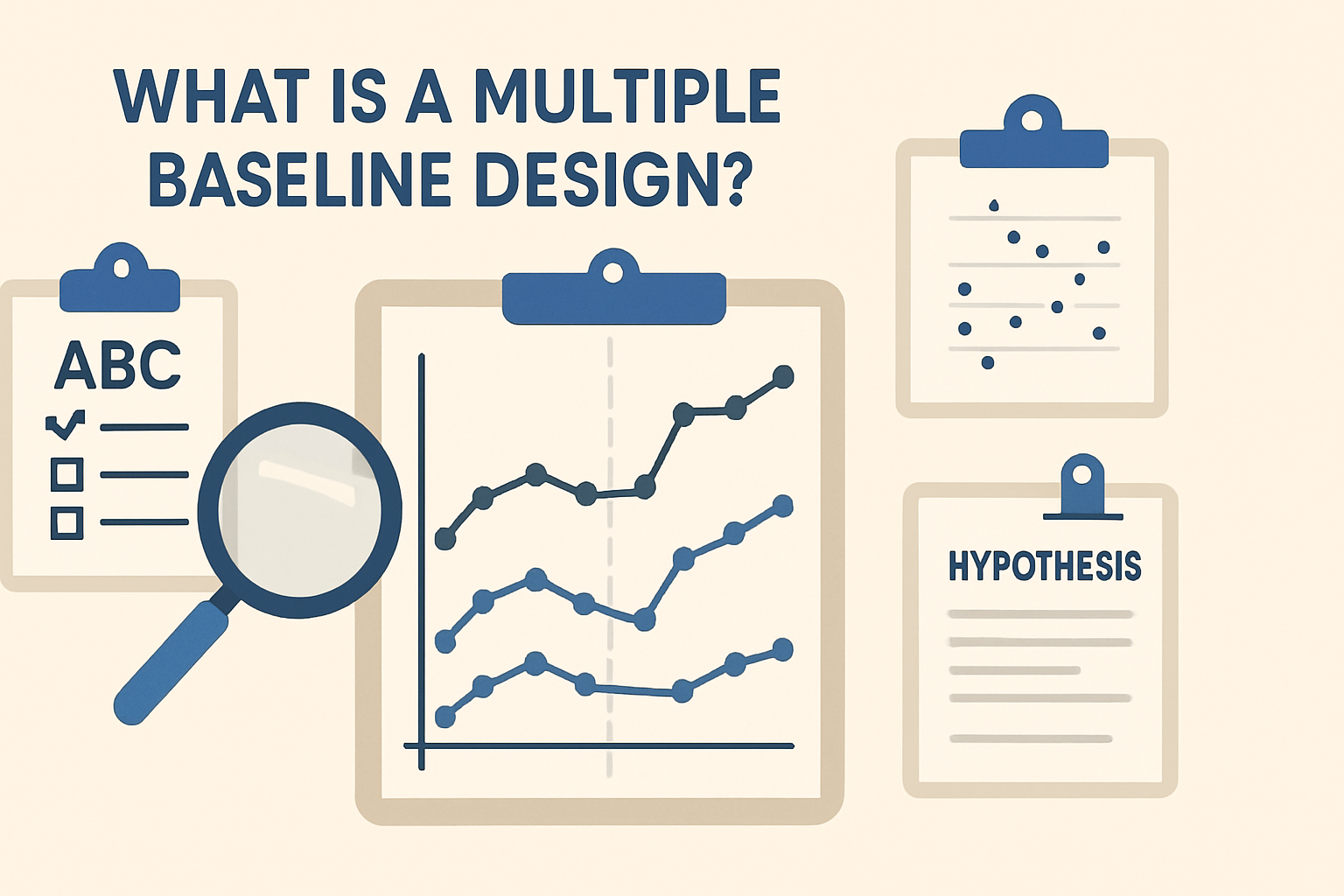
A multiple baseline design is a single-subject experimental design that demonstrates experimental control by introducing an intervention at different times across multiple baselines. This approach is particularly valuable when a reversal design would be impractical or unethical.
Table of Contents
- What is a Multiple Baseline Design?
- Multiple Baseline Design in Practice: ABA Examples
- Exam Focus: Interpreting Graphs and Avoiding Common Traps
- Quick Checklist for Multiple Baseline Mastery
The design relies on three key elements to establish functional relationships between variables.
The Core Logic: Prediction, Verification, and Replication
The fundamental logic of this design involves three sequential demonstrations. First, prediction occurs when stable baselines across tiers suggest future performance patterns. Second, verification happens when the intervention produces change only in the tier where it’s introduced. Third, replication is achieved when the same pattern repeats across additional tiers.
This staggered approach contrasts sharply with reversal designs, which require withdrawing interventions to demonstrate control. Multiple baseline designs are often preferred when behavior change should be maintained once established.
Key Variations: Across Behaviors, Settings, and Subjects
Multiple baseline designs come in three primary variations, each serving different research questions:
- Across behaviors: The most common exam variation targets different behaviors in the same individual. This approach demonstrates that the intervention specifically affects targeted behaviors rather than producing global change.
- Across settings: This variation applies the intervention to the same behavior across different environments. It’s particularly useful for assessing generalization and contextual influences on behavior.
- Across subjects: This approach involves multiple participants exhibiting similar behaviors. The intervention is staggered across individuals to demonstrate its effectiveness beyond a single case.
On the BCBA exam, across behaviors appears most frequently, but you should be prepared to identify all three variations.
Multiple Baseline Design in Practice: ABA Examples
Understanding theoretical concepts is essential, but applying them to real scenarios solidifies your exam readiness. Let’s examine two practical examples with clear data patterns.
Example 1: Reducing Elopement Across Three School Settings
Consider a student whose elopement behavior is maintained by escape from academic demands. Baseline data shows high rates in three settings: hallway transitions (8 instances per session), cafeteria line (6 instances), and playground entry (7 instances).
The intervention involves implementing differential reinforcement of alternative behavior (DRA) with a visual schedule. The procedure is introduced sequentially:
- Week 1-3: Baseline continues across all three settings
- Week 4: Intervention begins in hallway only (elopement drops to 2 instances)
- Week 6: Intervention extends to cafeteria (elopement drops to 1 instance)
- Week 8: Intervention reaches playground (elopement drops to 0 instances)
The staggered reduction demonstrates experimental control because change occurs only when and where the intervention is applied.
Example 2: Increasing Manding Across Three Verbal Operants
A client with limited verbal behavior shows baseline mand rates of 2 per hour for preferred items, 1 per hour for actions, and 0 per hour for breaks. The hypothesized function is access to tangibles and activities.
The intervention uses a time-delay prompting procedure introduced across three verbal operants:
- Baseline phase: Consistent low rates across all mand types
- Tier 1: Intervention starts with item mands (rate increases to 8 per hour)
- Tier 2: Two weeks later, action mand intervention begins (rate increases to 6 per hour)
- Tier 3: After another two weeks, break mand intervention starts (rate increases to 5 per hour)
This across-behaviors design shows the intervention’s specific effects on targeted verbal operants rather than general increases in all communication.
Exam Focus: Interpreting Graphs and Avoiding Common Traps
BCBA exam questions often present graphs requiring careful analysis. Developing a systematic approach to graph interpretation is crucial for success.
How to Read a Multiple Baseline Graph on the Exam
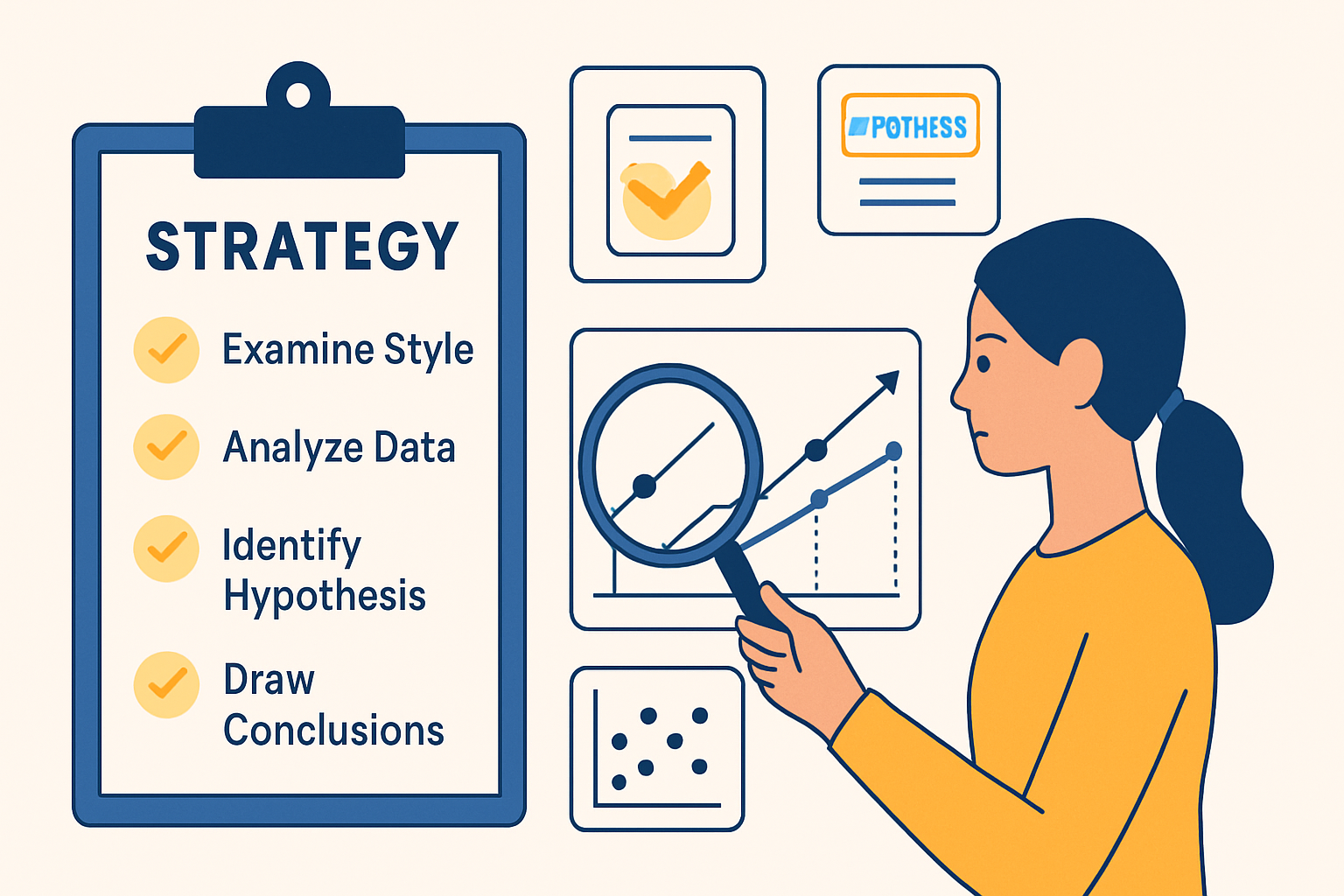
Follow this four-step strategy when encountering graph-based questions:
- Step 1: Identify the design. Look for multiple tiers with staggered intervention lines. Confirm it’s not a changing criterion or reversal design.
- Step 2: Check for staggered change. Verify that behavior change occurs only when intervention begins in each tier, not before.
- Step 3: Assess baseline stability. Examine whether baselines show consistent patterns before intervention. Unstable baselines weaken experimental control.
- Step 4: Determine experimental control. Look for clear changes in both level and trend that coincide with intervention introduction.
Remember that effective multiple baseline designs show replication of effect across at least three tiers. For more on graphing and visual analysis, see our guide on graphing and visual analysis.
Frequent Exam Mistakes and How to Avoid Them
Several common traps can derail even well-prepared candidates:
- Confusing with changing criterion: Multiple baseline uses different behaviors/settings/subjects; changing criterion uses progressively more difficult criteria for the same behavior.
- Misidentifying the independent variable: Remember that the staggered introduction timing IS the independent variable manipulation, not just the intervention itself.
- Overlooking unstable baselines: If baselines show significant variability or trends before intervention, experimental control is questionable.
- Missing lack of replication: If change occurs in only one or two tiers, the design fails to demonstrate adequate replication.
- Ignoring carryover effects: Watch for changes in untreated tiers that might indicate generalization or other confounding variables.
These mistakes often appear as tempting distractors in multiple-choice questions. For more on experimental designs, review our single-subject experimental designs guide.
Quick Checklist for Multiple Baseline Mastery
Use this concise summary for last-minute review before your exam:
- Confirm three or more tiers (behaviors, settings, or subjects)
- Verify staggered intervention introduction across tiers
- Check for stable baselines before each intervention phase
- Look for clear changes in level and trend coinciding with intervention
- Ensure replication of effect across all tiers
- Differentiate from changing criterion designs (different criteria vs. different tiers)
- Identify the independent variable as the staggered timing of intervention
- Recognize when experimental control is weak (unstable baselines, lack of staggered change)
This design represents one of several single-subject experimental designs you must master. According to the BACB 6th Edition Task List, understanding these designs is essential for evaluating intervention effectiveness.
Multiple baseline designs offer powerful evidence for behavior change while maintaining ethical standards. By mastering the core logic, practical applications, and common exam traps, you’ll be well-prepared to tackle related questions on your BCBA exam. Remember that successful implementation requires careful planning of baseline stability and staggered intervention timing to demonstrate clear experimental control.
Test yourself on experimental design
Practice with a free, full-length BCBA mock exam — real exam-style questions, instant scoring, and answer explanations.
Frequently Asked Questions
How does a multiple baseline design show experimental control?
By staggering the intervention so each baseline changes only when the intervention is applied to it — if all change at their own start point, the intervention (not chance) is the cause.
What are the three types of multiple baseline design?
Across behaviors, across settings, and across subjects.
When is a multiple baseline design preferred over a reversal design?
When the behavior cannot or should not be reversed — for example, an acquired skill, or when withdrawing a beneficial intervention would be unethical.
References
- Cooper, J. O., Heron, T. E., & Heward, W. L. (2020). Applied Behavior Analysis (3rd ed.). Pearson.
- Behavior Analyst Certification Board — BACB.com 6th Edition Task List.
Complete BCBA Exam Prep
Turn this topic into exam-day practice
Practice concepts in context with five full-length 6th Edition mock exams, two bonus practice exams, a 6th Edition study guide, and key-term flashcards—all in one $120 USD package.
Get the $120 All-in-One Prep Pack
Review everything included on the product page before ordering. No pass guarantee is implied.



