ABA Terms

Graphing and Visual Analysis in ABA: Level, Trend, Variability and Common BCBA® Exam ErrorsGemini_Generated_Image_atgfqdatgfqdatgf_compressed

Graphing and Visual Analysis in ABA: Level, Trend, Variability and Common BCBA® Exam Errors

Graphing and Visual Analysis in ABA: Level, Trend, Variability and Common BCBA® Exam Errors By BCBA Mock Exam Introduction Graphs are the primary way BCBAs make decisions—and the BCBA® exam expects you to be fluent in reading them. On test day, you won’t be asked to do complex statistics. Instead, you’ll be asked to: Visually […]

Graphing and Visual Analysis in ABA: Level, Trend, Variability and Common BCBA® Exam Errors Read More »

Functional Analysis vs Descriptive Assessment (BCBA Guide)Indirect Assessment in ABA Study Cover

Functional Analysis vs Descriptive Assessment (BCBA Guide)

Indirect assessment in ABA gathers behavior information from sources other than direct observation as the behavior occurs. Sources include interviews, questionnaires, rating scales, record reviews, and reports from caregivers, teachers, or clients. The information helps form a hypothesis and decide what to observe next. Indirect assessment is useful but limited: a report is not direct

Functional Analysis vs Descriptive Assessment (BCBA Guide) Read More »

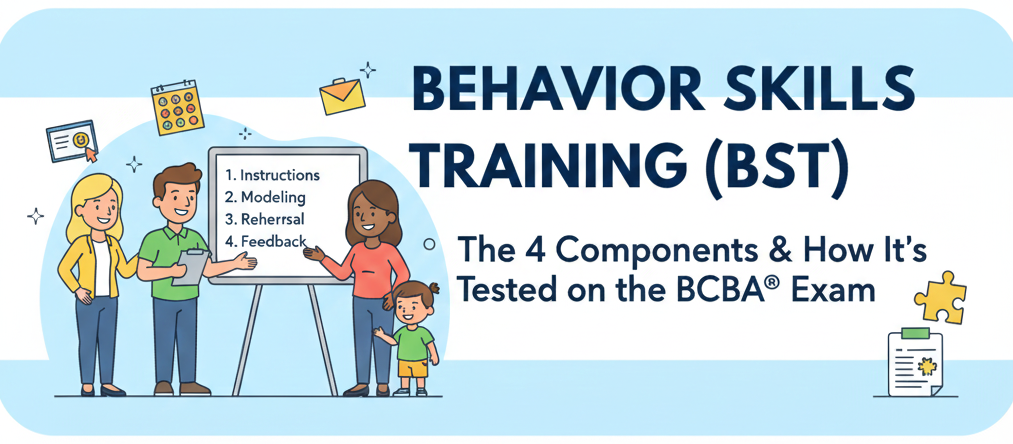
Behavior Skills Training (BST): The 4 Components and How It’s Tested on the BCBA® ExamGemini_Generated_Image_3my8pf3my8pf3my8

Behavior Skills Training (BST): The 4 Components and How It’s Tested on the BCBA® Exam

Behavior Skills Training (BST): The 4 Components and How It’s Tested on the BCBA® Exam By BCBA Mock Exam Introduction Behavior Skills Training (BST) is one of the most practical, high-utility concepts you’ll see on the BCBA® exam—and in real life. BST is frequently used to train: Parents and caregivers Teachers and classroom staff RBTs

Behavior Skills Training (BST): The 4 Components and How It’s Tested on the BCBA® Exam Read More »

Verbal Operants (Mand, Tact, Echoic, Intraverbal): A Practical Guide for Exam and Clinical UseGemini_Generated_Image_5zj2t25zj2t25zj2_compressed

Verbal Operants (Mand, Tact, Echoic, Intraverbal): A Practical Guide for Exam and Clinical Use

Verbal Operants (Mand, Tact, Echoic, Intraverbal): A Practical Guide for Exam and Clinical Use By BCBA Mock Exam Introduction Verbal Operants (Mand, Tact, Echoic, Intraverbal) are a foundational ABA topic that keeps showing up on the BCBA® exam and in real clinical work. If you only memorize the definitions of mand, tact, echoic, and intraverbal,

Verbal Operants (Mand, Tact, Echoic, Intraverbal): A Practical Guide for Exam and Clinical Use Read More »

Generalization and Maintenance: Programming for Success and Passing Related BCBA® QuestionsGemini_Generated_Image_2gmcj62gmcj62gmc_compressed

Generalization and Maintenance: Programming for Success and Passing Related BCBA® Questions

Generalization and Maintenance: Programming for Success and Passing Related BCBA® Questions By BCBA Mock Exam Introduction Generalization and maintenance are where real behavior change either succeeds or quietly falls apart. For the BCBA® exam, you’re not just expected to define these terms—you’re expected to: Recognize when a program has failed to promote generalization or maintenance

Generalization and Maintenance: Programming for Success and Passing Related BCBA® Questions Read More »

Automatic Reinforcement: How to Recognize It in Real Life and on the BCBA® ExamGemini_Generated_Image_5s7aw05s7aw05s7a_compressed

Automatic Reinforcement: How to Recognize It in Real Life and on the BCBA® Exam

Automatic Reinforcement: How to Recognize It in Real Life and on the BCBA® Exam By BCBA Mock Exam Introduction Automatic reinforcement is one of those concepts that feels abstract in textbooks—but it shows up often on the BCBA® exam, especially in questions about stereotypy, self-stimulatory behavior, self-injury, and why some behaviors persist even when no

Automatic Reinforcement: How to Recognize It in Real Life and on the BCBA® Exam Read More »

Extinction ABA: Definition, Examples & Exam TrapsOperant Extinction in ABA Cover

Extinction ABA: Definition, Examples & Exam Traps

Operant extinction in ABA is a process in which behavior decreases because its maintaining reinforcer is no longer delivered after the response. The response may still occur; identify the consequence before deciding what to withhold. Extinction differs from ignoring, punishment, blocking, or removing an item. If whining has produced tablet access, extinction stops delivering the

Extinction ABA: Definition, Examples & Exam Traps Read More »

Preference Assessments in ABA: MSWO, Paired Choice, Free Operant and How They Appear on the ExamGemini_Generated_Image_asp2rsasp2rsasp2_compressed

Preference Assessments in ABA: MSWO, Paired Choice, Free Operant and How They Appear on the Exam

Preference Assessments in ABA: MSWO, Paired Choice, Free Operant and How They Appear on the Exam By BCBA Mock Exam Introduction Preference assessments are a core tool in ABA and a frequent topic on the BCBA® exam. You’ll see them in questions about: Identifying potential reinforcers Designing treatment or teaching plans Evaluating why an intervention

Preference Assessments in ABA: MSWO, Paired Choice, Free Operant and How They Appear on the Exam Read More »

Differential Reinforcement in ABA: DRA, DRO, DRI, DRL, DRHGemini_Generated_Image_ao1kh5ao1kh5ao1k_compressed

Differential Reinforcement in ABA: DRA, DRO, DRI, DRL, DRH

Quick answer: Differential reinforcement reinforces one class of behavior while withholding reinforcement for another. The main types are DRA (alternative), DRI (incompatible), DRO (other/absence), DRL (low rates), and DRH (high rates). FCT is a common DRA application. Introduction to Differential Reinforcement ABA If you’re preparing for the BCBA® exam, you’ll see differential reinforcement ABA concepts

Differential Reinforcement in ABA: DRA, DRO, DRI, DRL, DRH Read More »

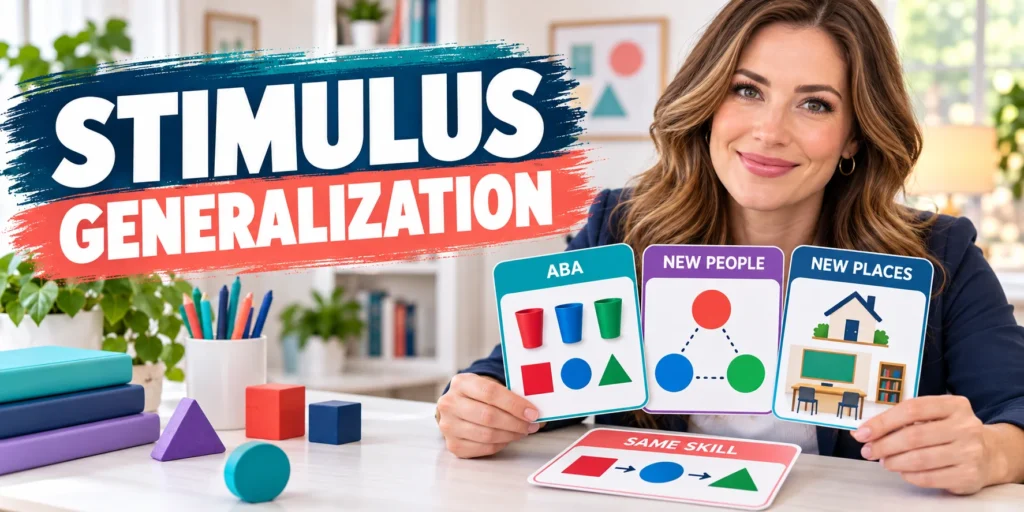
Stimulus Generalization in ABA: Definition, Examples, and Exam TipsStimulus Generalization in ABA

Stimulus Generalization in ABA: Definition, Examples, and Exam Tips

A practical BCBA study guide to stimulus generalization in ABA: definition, examples, response generalization, stimulus discrimination, programming strategies, and transfer probes. If you need the short answer, stimulus generalization occurs when a learned response happens in the presence of new stimuli that share relevant features with the stimuli used during teaching. The response is transferred

Stimulus Generalization in ABA: Definition, Examples, and Exam Tips Read More »