

A case-based guide to choosing rate or duration in ABA when the behavior, observation window, and decision question do not line up neatly. If you are comparing rate vs duration ABA, start with the question you need the data to answer. Rate tells you how often a countable behavior occurs per unit of time. Duration tells you how long the behavior occurs. Neither measure is automatically better. The correct choice depends on whether the clinical problem is repeated events, time engaged, session length, episode boundaries, or some combination of those features.
Table of Contents
- Rate vs Duration ABA: The One-Sentence Difference
- How to Calculate Rate and Duration
- A Decision Matrix for ABA Cases
- Why the Denominator Changes the Story
- When Both Measures Are Useful
- Common BCBA Exam Traps
- A Repeatable Measurement-Selection Workflow
- Frequently Asked Questions
- Quick Review Checklist
- Take the Free BCBA Mock Exam
- References
Short answer: choose rate when the important feature is the pace of discrete responses and observation periods may differ. Choose duration when the important feature is how long a behavior or episode lasts. If a behavior can happen often and last a long time, collect both only when each measure answers a different decision question.
Rate vs Duration ABA: The One-Sentence Difference
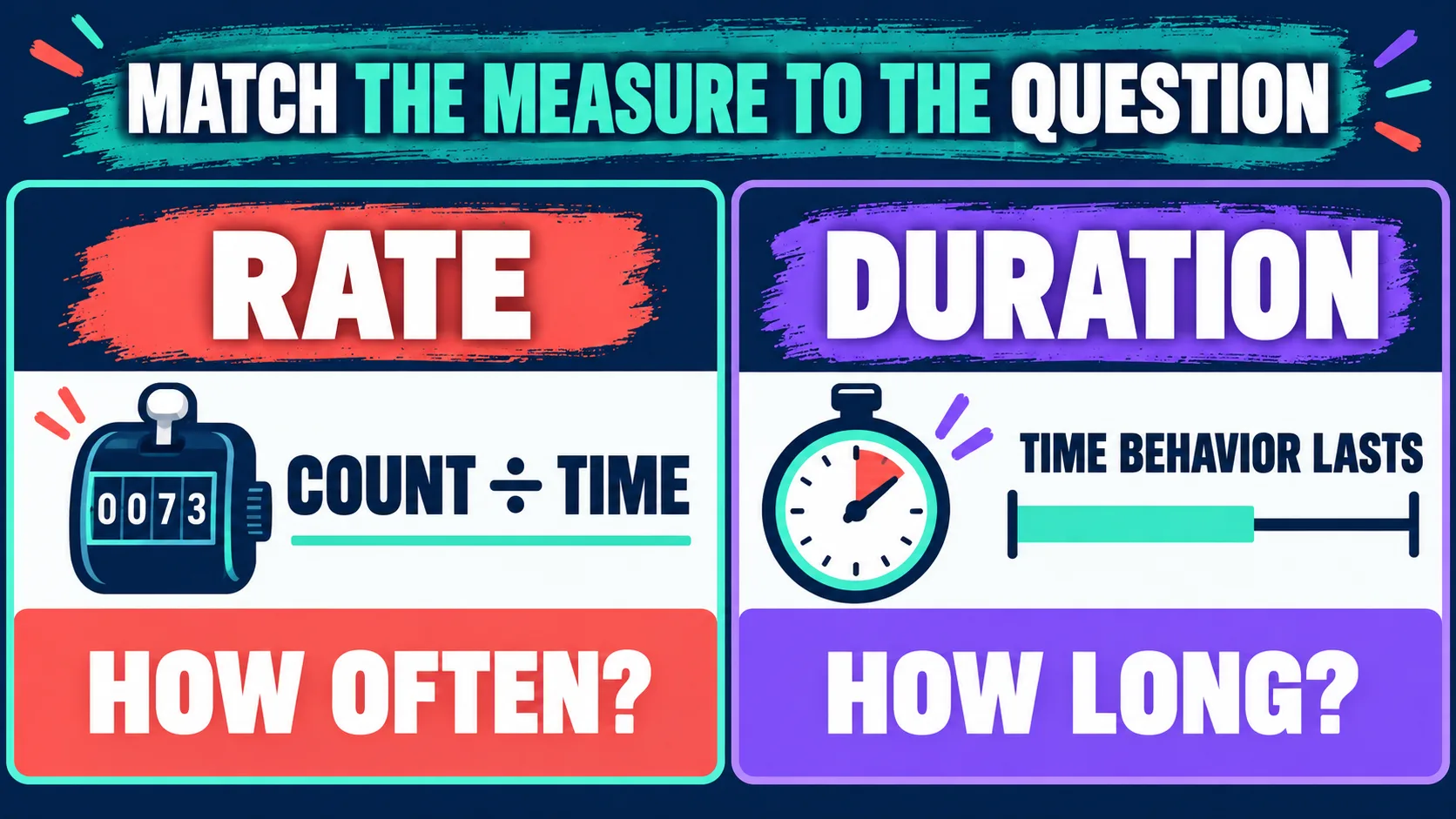
Rate is a ratio: the number of responses divided by the observation time. Duration is a time measure: the amount of time a behavior occurs, either for one episode, across several episodes, or as a proportion of the observation period. Both are direct measures when the behavior is operationally defined and the observer knows what counts as an onset and offset.
| Measure | Question it answers | Best fit |
|---|---|---|
| Rate | How often did a countable response occur relative to the time observed? | Discrete events such as requests, responses, attempts, or episodes with clear boundaries. |
| Duration | How long did the behavior occur? | Sustained behavior, engagement, crying, on-task behavior, or episodes whose length matters more than their count. |
Do not decide from the label alone. “Aggression,” “task refusal,” and “off-task behavior” can be measured in different ways depending on the operational definition and the decision the team must make. The measurement should preserve the feature that matters for treatment evaluation.
How to Calculate Rate and Duration
For rate, divide the count by the observation time and state the unit. If a learner makes 12 requests during a 30-minute observation, the rate is 12 ÷ 30 = 0.40 responses per minute. You could also report 24 responses per hour, but do not switch units without saying so.
For duration, record the elapsed time from the defined onset to the defined offset. If a task-refusal episode lasts 8 minutes, the episode duration is 8 minutes. If three episodes last 2, 3, and 4 minutes, total duration is 9 minutes; mean duration per episode is 3 minutes. If the team needs a session comparison, duration can also be expressed as a percentage of the observation window.
| Example data | Calculation | Interpretation |
|---|---|---|
| 12 responses in 30 minutes | 12 ÷ 30 = 0.40 per minute | A rate comparison is appropriate if the target is response pace. |
| One episode from minute 10 to minute 18 | 18 − 10 = 8 minutes | Duration captures how long that episode continued. |
| Three episodes lasting 2, 3, and 4 minutes | Total = 9 minutes; mean = 3 minutes | Report which duration summary you used; total and mean answer different questions. |
| 18 minutes of behavior in a 30-minute session | 18 ÷ 30 × 100 = 60% | Percentage of session time communicates exposure when session lengths vary. |
A frequent measurement error is reporting “10 instances” without the observation time. Scholarly discussion of frequency and rate in ABA warns that an isolated count can hide the denominator. For exam questions and clinical notes, write the count and time or calculate the rate so another reader can interpret the result.
A Decision Matrix for ABA Cases
Use the following decision sequence: first identify the behavior’s critical dimension, then check whether the observer can define episodes reliably, and finally ask whether session length or opportunity count changes from one observation to the next.
| Case clue | First measure to consider | Why |
|---|---|---|
| The target is brief and clearly countable, and sessions are different lengths. | Rate | The time denominator lets you compare pace across unequal observations. |
| The main concern is time engaged, time crying, or length of an episode. | Duration | Counting episodes could miss a meaningful change in how long each episode lasts. |
| The behavior has unclear onset or offset, but each response is countable. | Rate, after refining the definition | Do not invent duration boundaries that observers cannot apply consistently. |
| The behavior can happen frequently and also occupy long episodes. | Rate plus duration | The two measures describe different dimensions; use both only when both decisions matter. |
| The number of opportunities is fixed but the response is correct or incorrect. | Consider percentage or trials-based measures | Rate versus duration may not answer the skill-acquisition question. |
This matrix is not a substitute for an operational definition. If different observers disagree about when an episode begins or ends, the problem may be the definition or training rather than the choice between rate and duration. Clarify the target before adding a more complicated calculation.
Why the Denominator Changes the Story
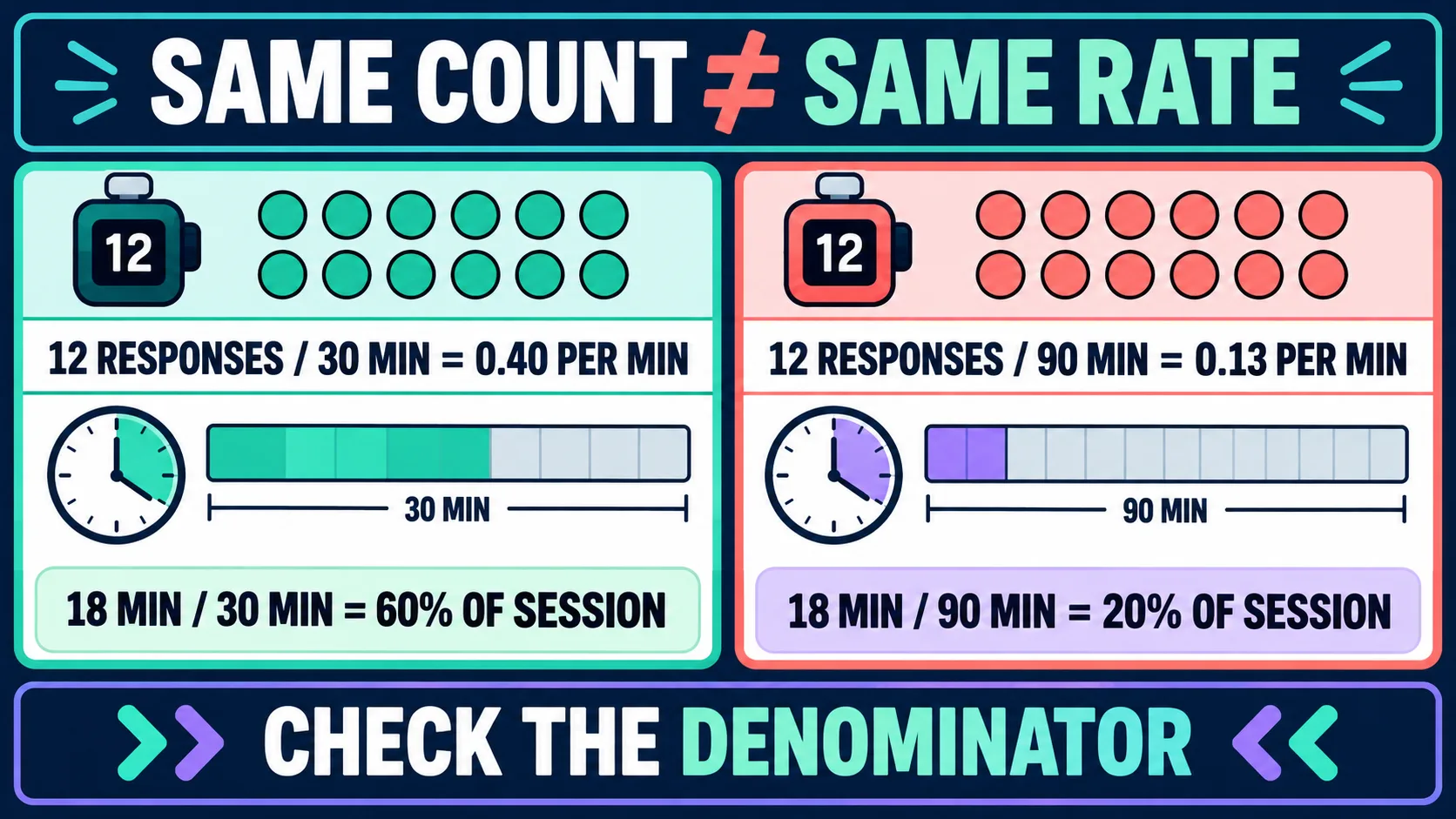
Suppose two sessions each contain 12 responses. In a 30-minute session, the rate is 0.40 per minute. In a 90-minute session, the rate is 0.13 per minute. The raw count is identical, but the pace is not. This is why a simple count can create a misleading comparison when observation windows differ.
Now consider 18 minutes of the same behavior. In a 30-minute session it occupies 60% of the observation; in a 90-minute session it occupies 20%. Total duration is identical, but the proportion of time is different. If the practical question is “How much of the available session did this behavior consume?” report duration as a percentage or state the observation window alongside total minutes.
Do not turn every duration measure into a rate. Rate describes event pace. Duration proportion describes time allocation. They can move in opposite directions: a learner might engage in fewer episodes while each episode becomes longer. The treatment decision depends on which change matters.
When Both Measures Are Useful
Collect both measures when the intervention could change frequency and episode length in different ways. For example, a tantrum plan might reduce the number of tantrums but accidentally make each tantrum longer. Rate would show the first change; duration would reveal the second. Conversely, an intervention could leave episode count unchanged while shortening episodes enough to improve classroom access.
When both measures are collected, decide in advance how each will be used. One can be the primary outcome and the other a safety or quality check. Avoid reporting a long list of measures with no decision rule. More data are not automatically better if the team cannot interpret them consistently.
- Primary question: define the outcome that determines whether the intervention continues.
- Secondary check: choose a second measure only if it could change the decision.
- Same observation frame: record start and stop times so both measures have a defensible denominator.
- Same behavior definition: keep the event and episode rules stable across observers and phases.
Common BCBA Exam Traps
Trap 1: treating rate and duration as synonyms. Rate is about how often; duration is about how long. A response can occur at a high rate but last only a moment, or occur at a low rate and last for a long time. Trap 2: using a raw count when sessions differ. If the question gives different observation times, calculate count divided by time. State the unit and keep the denominator visible. Trap 3: choosing duration because a behavior is “serious.” Seriousness does not determine the measure. The critical dimension and the decision question do. Trap 4: ignoring onset and offset. Duration requires a defensible start and stop rule. If those boundaries are vague, refine the operational definition before collecting duration data. Trap 5: assuming a lower rate proves a better outcome. Check duration, intensity, injury risk, replacement behavior, and context. A single measure cannot establish meaningful improvement by itself.
A Repeatable Measurement-Selection Workflow
Use this six-step process when a BCBA-style vignette asks which measurement is most appropriate:
- Underline the behavior’s critical dimension. Is the question about how often, how long, how quickly, or how accurately?
- Check the episode boundary. Can an observer identify one response and its end, or is the behavior continuous or sustained?
- Check the observation window. If the time differs, preserve it in the rate calculation or duration percentage.
- Match the measure to the decision. Choose the simplest direct measure that will change programming or interpretation.
- Test for a close alternative. Ask whether rate, duration, latency, percentage, or interval data would answer the question more directly.
- State the unit. Write responses per minute, minutes per episode, total minutes, or percent of session rather than a bare number.
For additional practice, review the site’s frequency-versus-rate measurement guide and duration recording guide after you understand this selection workflow. Those pages cover the neighboring concepts; this article is designed to make the measurement choice in a scenario.
Ready to practice the decision instead of memorizing another definition? Try the Free BCBA Mock Exam and look for the clue that tells you which dimension the question is testing. The practice set is for exam preparation and is not BACB approval.
Frequently Asked Questions
What is the difference between rate and duration in ABA?: Rate is the number of responses per unit of time. Duration is the amount of time a behavior occurs. Rate answers “how often relative to time?” while duration answers “how long?”
Should I use rate or frequency in ABA?: Follow the terminology used in the question and make the time base explicit. A count without an observation interval is not comparable to a count collected over a different interval. When the task is comparison across unequal observation windows, calculate rate and state the unit.
Can rate and duration be collected for the same behavior?: Yes, when they answer different questions. Rate can show the pace of episodes, while duration can show the length or time burden of those episodes. Define the decision rule before collecting both.
Which measure is better for tantrums?: It depends on the target dimension. If the main concern is how often tantrums begin, rate may be appropriate. If the main concern is how long they disrupt instruction, duration may be more informative. Some plans monitor both.
Why does session length matter?: Equal counts do not mean equal rates when observation times differ. Report the time base or divide count by time. For duration, total minutes should be interpreted with the observation window, and a percentage may be useful when session lengths vary.
Final takeaway: choose the measure that preserves the behavior’s critical dimension. Use rate for countable events when pace and observation time matter; use duration when time engaged or episode length matters; use both only when both dimensions can change the decision. The strongest BCBA answer is the one that connects the measure, the operational definition, the denominator, and the purpose.
Quick Review Checklist
Use this final checklist to turn rate vs duration aba into exam-ready reasoning. The goal is not to memorize a label in isolation; it is to identify the relevant evidence and explain why the best answer fits the scenario. Key ideas to review:
- State the central definition or decision point for rate vs duration aba in your own words.
- Identify the detail that makes rate vs duration aba different from its closest related ABA term.
- Separate the observable facts in a scenario from assumptions that are not supported by the facts.
- Write one example and one nonexample so you can recognize the concept in a new setting.
Exam application checks:
- Ask what the question is actually requesting before comparing the answer choices.
- Mark the antecedent, response, consequence, or other evidence that supports the selected answer.
- Look for a distractor that describes a related process but does not answer the specific question.
Final self-check:
- Explain how you would verify the interpretation with clear observations or data.
- Change one detail in the scenario and decide whether your answer should change.
- Give a one-sentence rationale that a supervisor or study partner could evaluate.
Take the Free BCBA Mock Exam
When you are ready to apply the idea, use the free practice resource below for additional feedback. Take the Free BCBA Mock Exam
References
- On Terms: Frequency and Rate in Applied Behavior Analysis
- Behavior Analyst Certification Board: Task Lists
- Discontinuous Measurement in Applied Behavior Analysis



