ABA Terms

Radical Behaviorism in ABA: Definition, Private Events & BCBA Exam Tipsradical-behaviorism-cover

Radical Behaviorism in ABA: Definition, Private Events & BCBA Exam Tips

Radical behaviorism in ABA is the philosophy that places public behavior and private events within the same natural science of behavior. It does not deny thoughts, feelings, or sensations. Instead, it asks how environmental history, current context, and consequences relate to behavior without treating an unmeasured inner trait as the final cause. The BCBA® exam […]

Radical Behaviorism in ABA: Definition, Private Events & BCBA Exam Tips Read More »
Schedules of Reinforcement ABA: Compound SchedulesGemini_Generated_Image_nk3plknk3plknk3p_compressed

Schedules of Reinforcement ABA: Compound Schedules

  If you’re preparing for the BCBA® exam, you’ll see schedules of reinforcement ABA concepts everywhere: task-list items, mock exam vignettes, and real clinical decision-making in applied behavior analysis (ABA). But the moment the exam starts talking about multiple, mixed, chained, tandem, concurrent, alternative, or conjunctive schedules of reinforcement, things get fuzzy. The reality: compound

Schedules of Reinforcement ABA: Compound Schedules Read More »

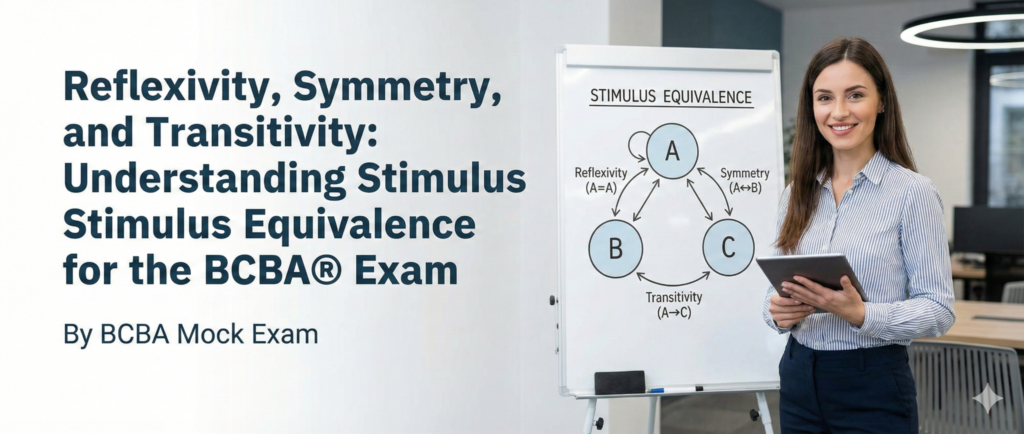
Reflexivity, Symmetry, and Transitivity: Understanding Stimulus Equivalence for the BCBA® ExamGemini_Generated_Image_2nv9cq2nv9cq2nv9_compressed

Reflexivity, Symmetry, and Transitivity: Understanding Stimulus Equivalence for the BCBA® Exam

Reflexivity, Symmetry, and Transitivity: Understanding Stimulus Equivalence for the BCBA® Exam By BCBA Mock Exam “Stimulus equivalence” is one of those BCBA® exam topics that feels abstract at first — lots of A’s, B’s, C’s, arrows and matching tasks. But once you really understand reflexivity, symmetry, and transitivity, you’ll see that the exam is mainly

Reflexivity, Symmetry, and Transitivity: Understanding Stimulus Equivalence for the BCBA® Exam Read More »

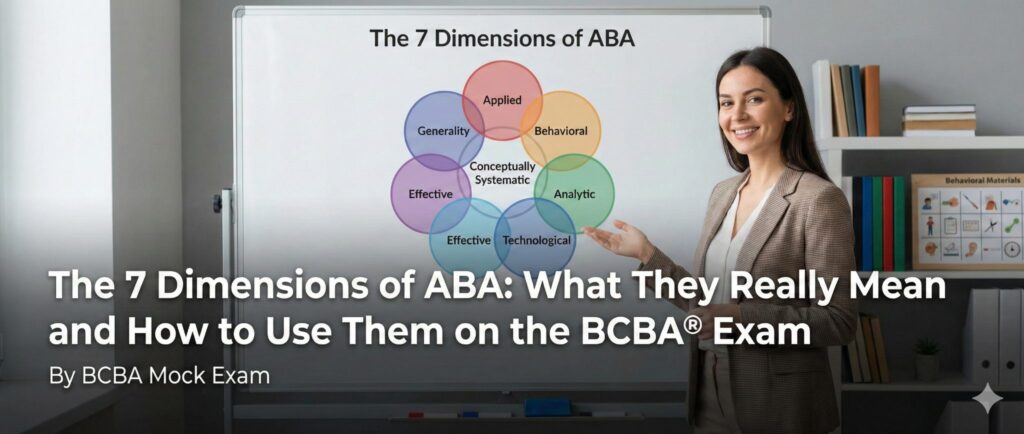
The 7 Dimensions of ABA: What They Really Mean and How to Use Them on the BCBA® Examdimensions_header_compressed

The 7 Dimensions of ABA: What They Really Mean and How to Use Them on the BCBA® Exam

The 7 Dimensions of ABA: What They Really Mean and How to Use Them on the BCBA® Exam By BCBA Mock Exam If you’re studying for the BCBA® exam, you probably already memorized the list: Applied, Behavioral, Analytic, Technological, Conceptually Systematic, Effective, Generality. But the exam doesn’t just test if you can recite those seven

The 7 Dimensions of ABA: What They Really Mean and How to Use Them on the BCBA® Exam Read More »

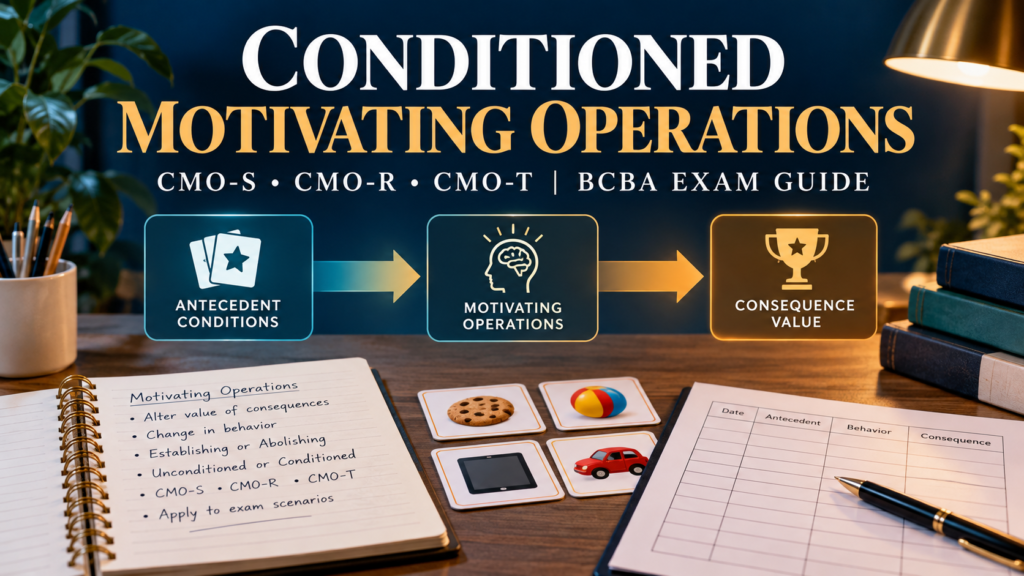
Conditioned Motivating Operations in ABA CMO-S CMO-R CMO-T & BCBA Exam Tipscmo-types-cover

Conditioned Motivating Operations in ABA CMO-S CMO-R CMO-T & BCBA Exam Tips

Conditioned motivating operations (CMOs) are learned environmental events that change the effectiveness of another stimulus, object, or event as a reinforcer or punisher and alter the current probability of behavior related to that consequence. On the BCBA exam, CMO questions are usually testing whether you can identify what consequence value changed, what learning history made

Conditioned Motivating Operations in ABA CMO-S CMO-R CMO-T & BCBA Exam Tips Read More »

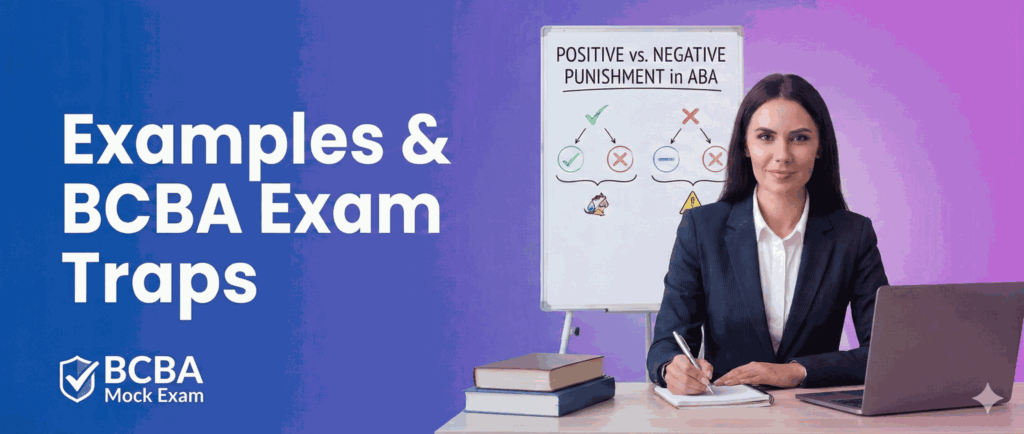
Positive vs Negative Punishment in ABA: Examples & BCBA Exam Trapspunishment_header_compressed

Positive vs Negative Punishment in ABA: Examples & BCBA Exam Traps

Positive vs Negative Punishment in ABA: Examples & BCBA Exam Traps By BCBA Mock Exam “Punishment” is one of those words that sounds simple in everyday language, but on the BCBA® exam it has a very specific, technical meaning. Many candidates make mistakes because they: Confuse punishment with negative reinforcement Focus on the client’s emotional

Positive vs Negative Punishment in ABA: Examples & BCBA Exam Traps Read More »