
Short answer: there is not one universal BCBS ABA authorization form that works for every member in every state. Blue Cross Blue Shield plans are issued through independent licensees, and the correct form depends on the member’s state, benefit product, request type, and submission channel. Use the official provider page for the specific plan shown on the insurance card, then verify the form version before entering clinical or billing information.
Table of Contents
- What a BCBS ABA Authorization Form Actually Does
- Find the Correct State and Plan Version First
- Build the Evidence Packet Before You Type
- Choose Initial, Continuation, or Extension Carefully
- Submit, Record, and Follow Up
- Common Problems That Delay a BCBS ABA Request
- Frequently Asked Questions
- Quick Review Checklist
- Take the Free BCBA Mock Exam
This guide helps you find the right form, separate an authorization request from an approval, prepare a clean evidence packet, and record what happened after submission. It is not an official BCBS form, a coverage determination, or a promise that a request will be approved. If the plan’s current form or portal instructions differ from this overview, the plan instructions control.
Start from the payer’s own resources. For examples, Blue Cross NC maintains a provider forms and documents index; BlueCross BlueShield of Tennessee lists separate ABA request documents on its provider forms page; and Blue Cross and Blue Shield of Illinois maintains a provider forms index. These examples show why the exact state and product matter.
What a BCBS ABA Authorization Form Actually Does
An ABA authorization form is a request for the plan to review specified services for a particular member, provider, time period, and treatment context. It is not the same as an insurance card, an eligibility check, a benefit guarantee, a provider contract, or the final authorization notice. A complete request can still require utilization review, benefit verification, medical-necessity review, or additional records.
| Item | What it answers | What it does not prove |
|---|---|---|
| Eligibility check | Is the member enrolled under the plan on the relevant date? | That ABA is covered or that a requested number of hours will be approved. |
| Authorization request form | What service, provider, dates, and clinical information should the plan review? | That the request has been approved merely because it was submitted. |
| Authorization decision | What the plan approved, modified, pended, or denied for the stated period. | That future dates, other providers, or another BCBS licensee follow the same decision. |
The first practical rule is simple: treat the form as a controlled handoff. The member record, provider record, clinical packet, requested services, and submission confirmation should all point to the same plan and date range. Do not use a generic PDF saved months ago just because its title looks familiar.
Find the Correct State and Plan Version First
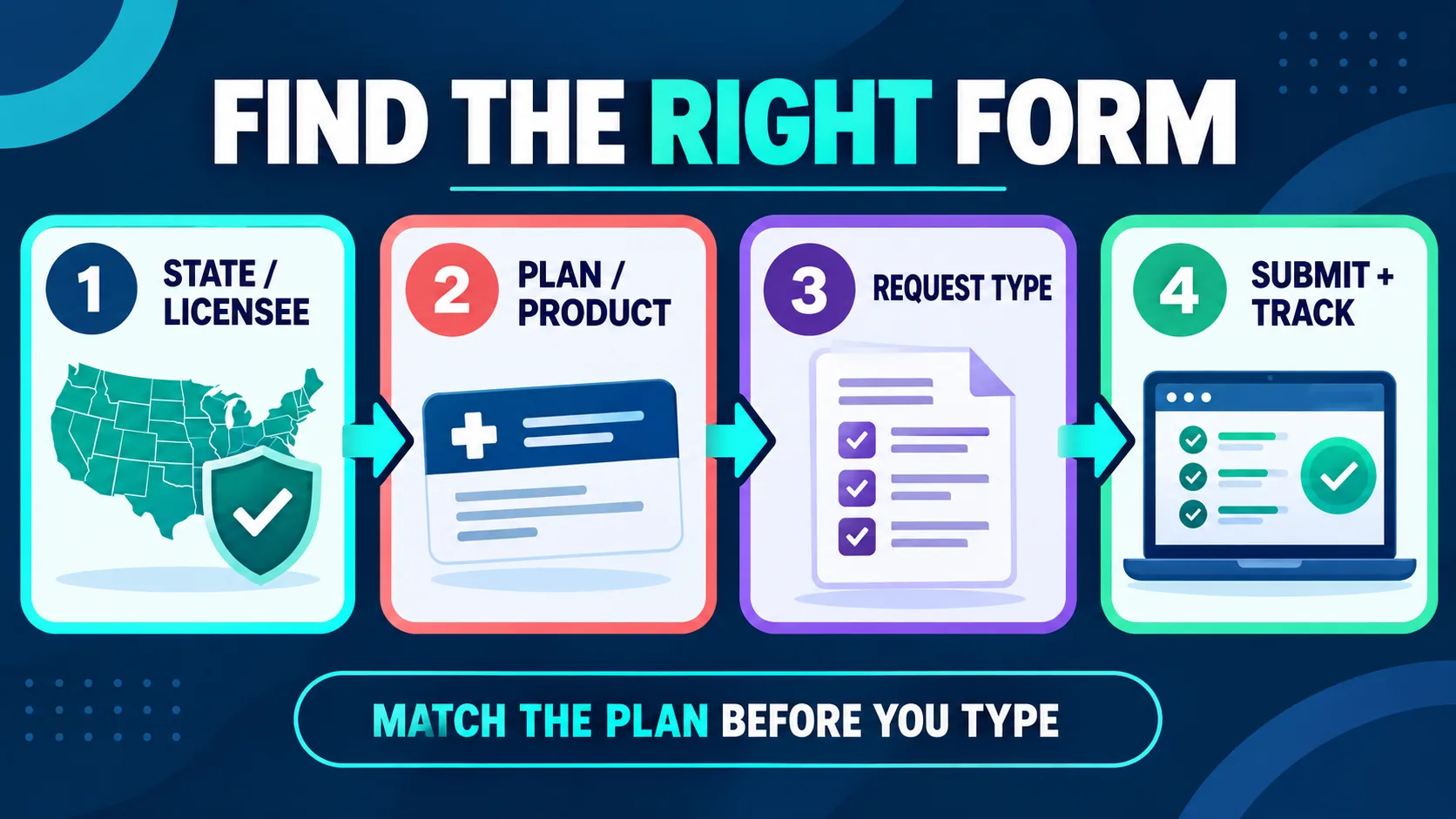
Before you fill in a single field, make a five-part identification note. This takes less time than correcting a request that was sent to the wrong licensee.
- Read the insurance card. Record the exact BCBS licensee, member or subscriber identifier, product name, and the state or network shown on the card. “BCBS” by itself is not enough to choose a form.
- Identify the product. Commercial, Federal Employee Program, Medicare Advantage, Medicaid, and other products can use different forms or portals even within a similar geographic area.
- Open the official provider resource. Search the licensee’s provider site for “ABA,” “applied behavior analysis,” “adaptive behavioral treatment,” “behavioral health,” or “prior authorization.” Prefer the page linked from the payer’s own domain.
- Match the request type. Check whether the page distinguishes an initial assessment, initial treatment, continuation, extension, concurrent review, or another request. Do not choose a form based only on the word “ABA.”
- Check the current route. Look for the effective date, portal requirement, fax or electronic-submission instructions, required attachments, and any product-specific note printed on the form.
Official examples illustrate the variation. Blue Cross NC’s request materials distinguish initial and extension requests and direct providers to submit the form with supporting clinical records. BCBS of Tennessee lists both an ABA Therapy Services Request Form and an ABA Initiation and Continuation Request Form. BCBS of Michigan’s prior-authorization page points providers to a portal or global request route and separates current ABA policy documents by date of service. These are not interchangeable national instructions; they are signals to inspect the licensee and product route that actually applies.
Build the Evidence Packet Before You Type
Make a checklist from the current form and the plan’s instructions. Keep the packet limited to what the plan requests and use the secure submission method. A common set of fields looks like this, but the exact form wins:
| Evidence group | Typical information to verify | Pre-submission check |
|---|---|---|
| Member | Name, date of birth, plan or member ID, subscriber details, and the diagnosis information the form requests. | Every identifier matches the plan record and the requested service period. |
| Provider and group | Rendering provider, supervising BCBA or other qualified professional, NPI, tax or group information, address, and contact details when requested. | Credentials, locations, and payer enrollment details are current and consistent. |
| Clinical packet | Diagnostic evaluation, standardized assessment, treatment plan, progress information, and requested medical or clinical records. | The attachment covers the date range and answers the prompts on the current form. |
| Requested services | Start and end dates, service intensity, hours or units, procedure codes, setting, and request reason if the form asks for them. | Dates, units, code descriptions, and the treatment plan tell the same story. |
| Prior authorization context | Existing authorization number, prior period, progress report, or change in provider or service mix when applicable. | A continuation request is tied to the correct prior authorization rather than treated as a new case. |
For a concrete example, the official BCBS North Dakota ABA request form includes patient, diagnosis, diagnostic-evaluator, supervising-provider, NPI, service-date, and requested-hours fields. The official BCBS Illinois ABA clinical service request includes provider qualifications, requested service intensity, codes, and treatment history. Blue Cross NC’s form instructions describe different supporting material for initial and extension requests. Use these examples to understand the shape of a packet, not to copy fields into another plan’s form.
Keep an internal submission log with the form version, date downloaded, person who completed it, attachment names, submission channel, confirmation number, and follow-up date. Do not put unnecessary client identifiers into a general spreadsheet or send records through an unapproved channel.
Choose Initial, Continuation, or Extension Carefully
The wording varies by licensee, but the distinction usually changes what evidence the reviewer expects. If the form offers a more specific option, use that option and follow its definition.
| Request type | Typical purpose | Evidence to emphasize |
|---|---|---|
| Initial | First request for an assessment or treatment episode under the relevant plan and provider. | Diagnostic evaluation, baseline assessment, treatment plan, provider details, and requested starting date. |
| Continuation or concurrent | Ongoing services after an earlier authorization period. | Prior authorization reference, progress data, current goals, hours used, and reason continued or modified services are requested. |
| Extension or reauthorization | A plan-specific extension of an existing request or authorization period. | The current reassessment or progress material and the exact date range the plan asks you to extend. |
Do not assume that a new provider automatically makes a request “initial,” or that a new form automatically creates a new benefit period. Ask the plan or the designated provider contact when the definitions are unclear. A wrong request type can make an otherwise complete packet difficult to match to the reviewer’s workflow.
Submit, Record, and Follow Up
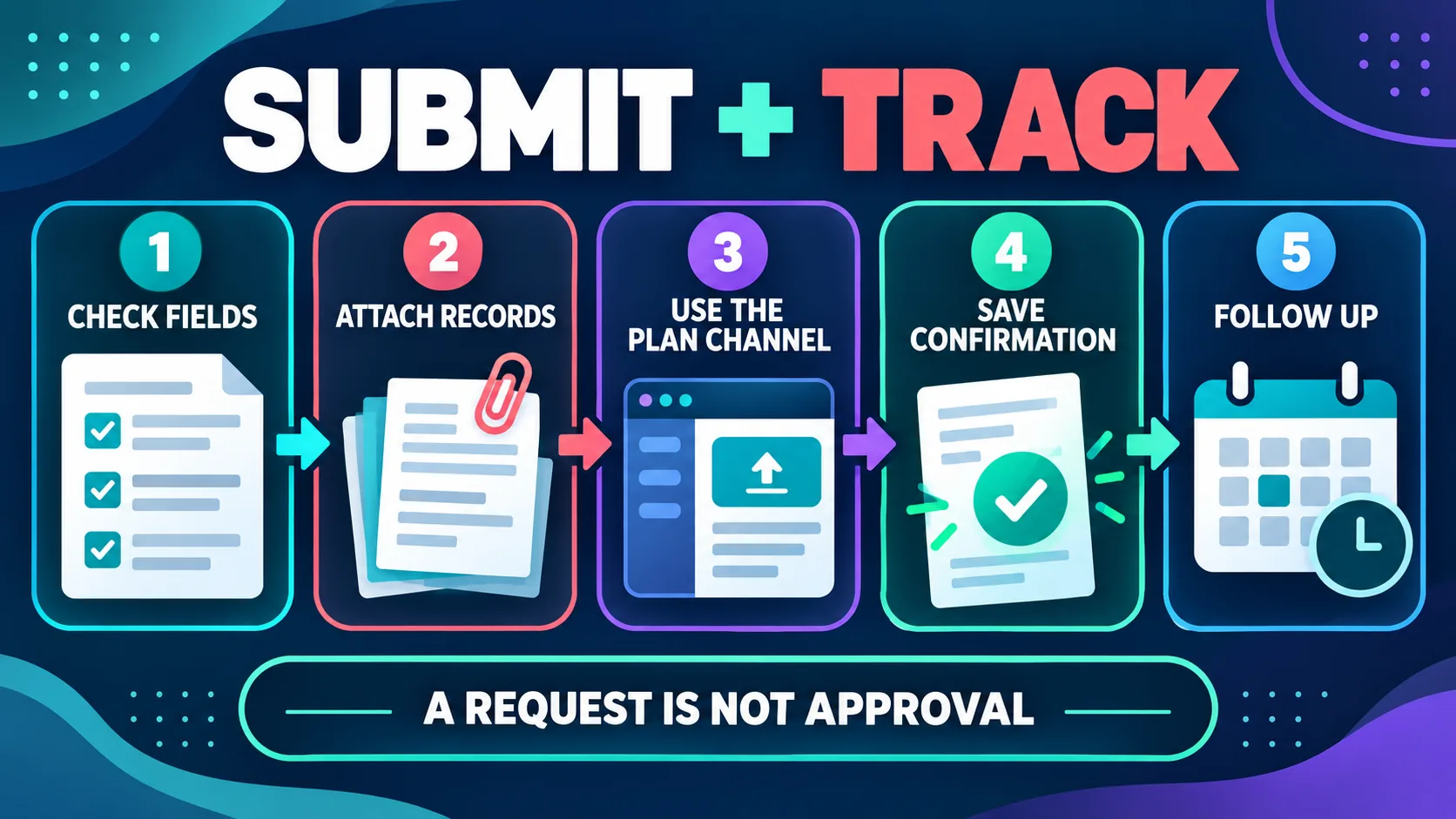
Use a short, repeatable handoff after the form is complete:
- Run a field check. Compare the member ID, provider identifiers, dates, requested hours or units, diagnosis information, and signature fields against the source records.
- Run an attachment check. Confirm that every required report is attached, readable, within the requested date range, and named clearly. Keep the submitted copy unchanged.
- Use the required channel. Submit through the payer’s provider portal, electronic route, or fax/mail method stated on the current plan materials. A method used by one BCBS licensee may be invalid for another.
- Save confirmation. Record the date, time, confirmation or case number, destination, form version, and person responsible for follow-up.
- Track the response. If the request is pended for more information, answer the exact question and keep the new confirmation with the original packet. If it is modified or denied, read the plan’s current notice and appeal or reconsideration instructions.
Submission is not approval. Even an accurate request can be affected by eligibility, benefit exclusions, network status, plan rules, clinical review, or missing information. Avoid promising a family or provider that services are covered simply because a form was accepted by a portal.
Keep professional and record-accuracy questions separate from payer instructions. When a BCBA or ABA provider is responsible for preparing records, the current BACB Ethics Code and ethics information is the appropriate official reference for ethical boundaries; it does not replace the member’s plan policy or the form’s submission instructions.
For BCBA candidates who are using payer workflows as professional-study practice, keep the certification study task separate from the authorization decision. After you finish reviewing the form process, use our free BCBA mock exam practice as a study checkpoint. It is not an official BACB product, payer policy, or coverage guarantee.
Common Problems That Delay a BCBS ABA Request
- Wrong licensee: the form belongs to a different state, network, or independent BCBS company.
- Wrong product: a commercial form is used for Medicare Advantage, FEP, Medicaid, or another product with different instructions.
- Old PDF: a saved copy is missing a new field, effective date, portal requirement, or attachment rule.
- Unmatched dates: the request start date, treatment plan, progress report, and prior authorization period do not align.
- Missing credentials or signatures: provider, supervising professional, group, or attestation fields are incomplete.
- No proof of submission: the team cannot tell which version was sent, when it was sent, or where the response should be checked.
Frequently Asked Questions
Is there one national BCBS ABA authorization form?: No. The correct form is tied to the relevant BCBS licensee, state, benefit product, and request type. Start with the provider resources for the plan on the member’s card.
Does submitting a BCBS ABA form mean the services are approved?: No. The form starts a review. Eligibility, benefits, network status, clinical review, plan limits, and other rules can still affect the decision. Wait for the plan’s written authorization or other official response.
What if I cannot find an ABA form on the payer website?: Use the plan’s provider portal or prior-authorization contact shown in its official materials and ask which current ABA request route applies. Do not download a form from another state or assume that a general behavioral-health form is sufficient.
How do I know whether to use an initial or continuation form?: Read the definitions on the current plan form and match the request to the actual episode and prior authorization. Initial requests usually establish a new assessment or treatment request; continuation or extension requests usually require information about the prior period and current progress.
What should I keep after submitting?: Keep the submitted form, attachment list, form version, confirmation or case number, submission date, follow-up notes, and the plan’s response. Store them securely and follow the applicable privacy, record-retention, and organizational policies.
Bottom line: treat “BCBS ABA authorization form” as a search starting point, not as the name of one universal document. Identify the exact licensee and product, use the current official form, match the request type, submit the requested evidence through the required channel, and record the response before assuming anything about coverage. For targeted review, use our bcbs aba authorization form practice questions to apply the concept in exam-style scenarios.
Quick Review Checklist
Use this final checklist to turn bcbs aba authorization form into exam-ready reasoning. The goal is not to memorize a label in isolation; it is to identify the relevant evidence and explain why the best answer fits the scenario. Key ideas to review:
- State the central definition or decision point for bcbs aba authorization form in your own words.
- Identify the detail that makes bcbs aba authorization form different from its closest related ABA term.
- Separate the observable facts in a scenario from assumptions that are not supported by the facts.
- Write one example and one nonexample so you can recognize the concept in a new setting.
Exam application checks:
- Ask what the question is actually requesting before comparing the answer choices.
- Mark the antecedent, response, consequence, or other evidence that supports the selected answer.
- Look for a distractor that describes a related process but does not answer the specific question.
Final self-check:
- Explain how you would verify the interpretation with clear observations or data.
- Change one detail in the scenario and decide whether your answer should change.
- Give a one-sentence rationale that a supervisor or study partner could evaluate.
Take the Free BCBA Mock Exam
If you want a low-pressure way to check your recall, use the free practice resource below. Take the Free BCBA Mock Exam



