

If you searched for BCBA fieldwork audit log, start with the most important distinction: the audit log is not the same thing as the documentation system you maintain throughout fieldwork. The BACB provides an audit log and the audited time period when it selects fieldwork for review. Your job is to use your original records, signed forms, supervision contract, and documentation system to complete that request accurately and on time.
Table of Contents
- BCBA Fieldwork Audit Log: What It Is and What It Is Not
- Build the Evidence Packet Before You Fill the Log
- Reconcile the Audited Period Month by Month
- Document Corrections Without Erasing the Trail
- A Safe Response Sequence After the BACB Email
- Frequently Asked Questions
- Quick Review Checklist
- Take the Free BCBA Mock Exam
This guide is a preparation workflow, not the official BACB form and not a substitute for the audit email or current handbook. It shows how to organize the evidence, reconcile each audited month, record adjustments without erasing history, and separate administrative compliance from BCBA exam preparation.
Use the current BACB fieldwork documentation FAQs, the BCBA Handbook, and the BACB supervisor fieldwork checklist as the authoritative source set. If those sources and your audit email differ on a detail, follow the audit email and ask BACB for clarification.
BCBA Fieldwork Audit Log: What It Is and What It Is Not
The BACB’s current fieldwork FAQ says that candidates should keep fieldwork documents organized and up to date in anticipation of an audit. If you are audited, the BACB provides an audit log and identifies the time period being audited. That wording matters: you should not invent a replacement “official audit log” from a random spreadsheet, and you should not assume that your normal tracker is the document BACB wants returned.
| Record | Primary purpose | How it relates to an audit |
|---|---|---|
| Documentation system | Ongoing session-level record of fieldwork activities, dates, times, categories, supervision, and summaries. | Source evidence used to reconstruct and support the requested period. |
| M-FVFs and F-FVFs | Signed monthly and final attestations for the applicable fieldwork experience. | Numbers and signatures should reconcile with the audit response. |
| BACB audit log | The audit-specific form supplied with the audit request for the stated time period. | Complete and return exactly as directed in the audit initiation email. |
| Supervision contract | Defines the supervisory relationship, responsibilities, and applicable experience. | May be requested to verify who supervised what and when. |
Think of the audit log as a requested reporting layer, not a replacement for the records that created the numbers. If the audit email asks for additional documents, follow that email even when the list differs from a general checklist. The request itself controls what you submit.
Build the Evidence Packet Before You Fill the Log
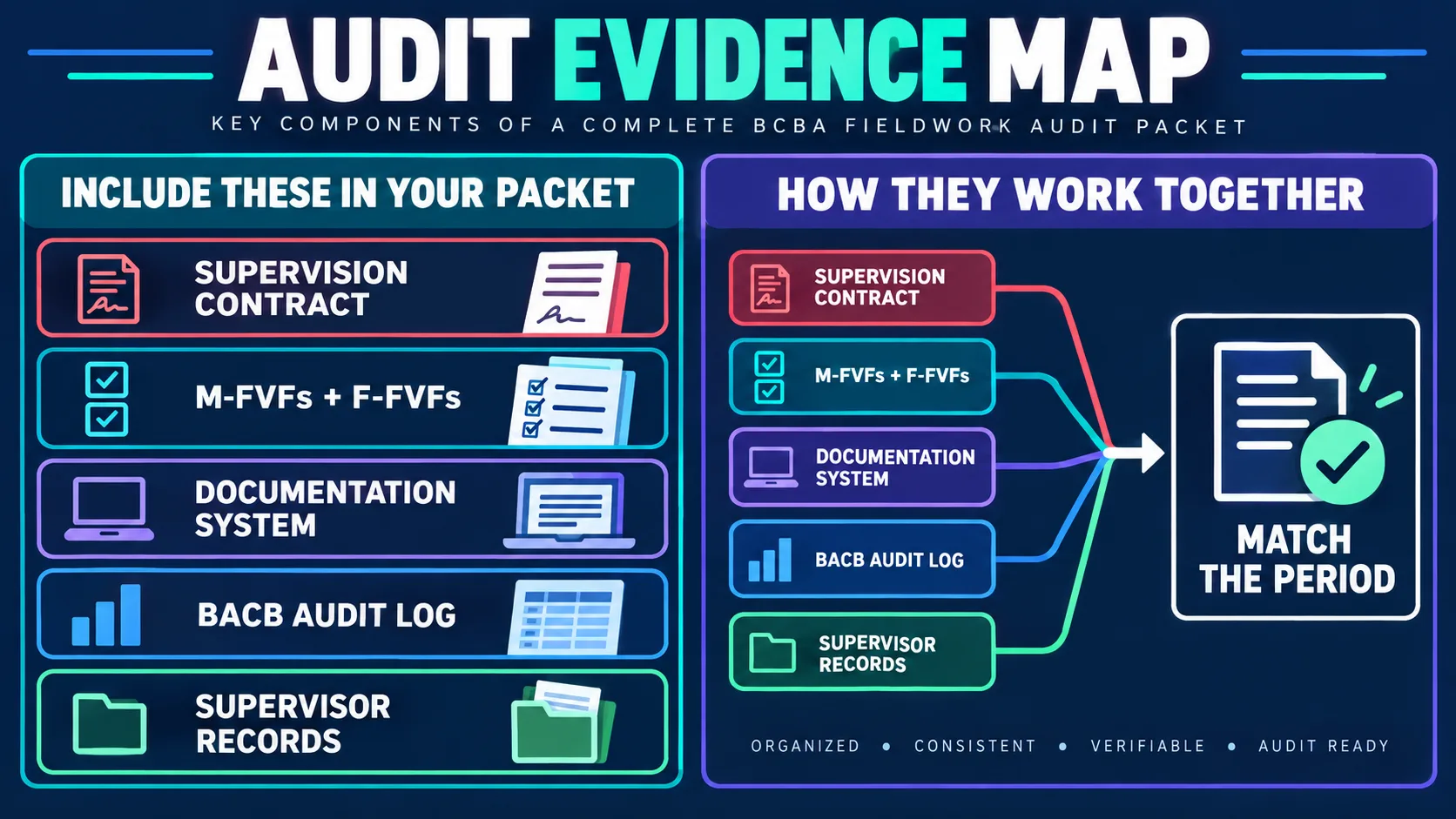
Before entering numbers, create a read-only working folder for the audited period. Keep the original records unchanged and make a separate reconciliation copy for notes. The BACB supervisor checklist emphasizes a secure, accessible documentation system, regular accuracy checks, and retention of relevant documents for seven years. Those practices make the audit response easier without turning a last-minute reconstruction into a guessing exercise. Start with the audit initiation email and write down four boundaries:
- Who: the trainee, supervisors, consulting supervisor if applicable, and any organization or experience covered by the request.
- When: the first and last month or date range named by BACB. Do not silently expand or shorten it.
- What: the exact files or fields requested, including whether BACB wants the audit log, M-FVFs, F-FVFs, the documentation system, contracts, or other supervisor records.
- When due: the response deadline and submission method stated in the email. The handbook describes a typical 14-day response window, but your audit email is the controlling instruction.
Then gather the source set. A clean packet usually has the signed supervision contract for each applicable relationship, the M-FVFs and F-FVFs, the detailed documentation system, supervisor and consulting-supervisor records when relevant, and any correction notes that explain why a number changed. Do not submit more personal or client-identifying information than BACB requests; use the secure method and redaction instructions provided by the board.
Reconcile the Audited Period Month by Month
Do not begin by copying the grand total from your tracker into the audit log. Reconcile one month at a time, because a total can look correct while one month fails its own supervision, observation, fieldwork-type, or documentation requirements.
| Reconciliation pass | Compare | Question to answer |
|---|---|---|
| 1. Date and relationship | Documentation rows, contract dates, supervisor names, M-FVF month. | Is every row inside the audited period and attached to the correct supervisory relationship? |
| 2. Actual hours | Session records, restricted/unrestricted totals, form totals. | Do the hours match the records, without adding a weighted estimate to the actual-hours field? |
| 3. Supervision and observation | Supervision contacts, individual/group categories, observation minutes, signatures. | Can the monthly totals be traced to dated evidence and the applicable requirement version? |
| 4. Adjustments | Original total, reduced or adjusted eligible total, correction note. | Is every adjustment explainable, dated, and supported by the original record? |
Use a simple reconciliation sheet with one row per audited month and separate columns for each number BACB requests. Keep actual accrued hours separate from any planning conversion you use to estimate progress toward a combined fieldwork requirement. If your records use both supervised and concentrated fieldwork, do not apply a conversion multiplier to fields that ask for actual hours. The current BACB materials distinguish actual documentation from planning calculations.
When a month does not qualify under the rules that apply to the experience, document the reduction instead of silently “fixing” the total. Ask your supervisor or BACB for clarification when the audit email or current handbook leaves a field ambiguous. A defensible response shows how you reached the number; it does not merely make the numbers look tidy.
Document Corrections Without Erasing the Trail
Corrections are not automatically evidence of misconduct. The risk comes from changing a record without preserving what changed, when it changed, who reviewed it, and why. Keep the original row or file, then add a correction entry or a separate change log that points back to it.
| Correction field | Example of a useful entry | Avoid |
|---|---|---|
| Original reference | May 2026, source row 184, M-FVF page 3. | A replacement total with no link to the original. |
| What changed | Two hours moved from restricted to unrestricted after supervisor review of the activity description. | “Fixed” or “updated” without a reason. |
| Date and reviewer | June 8, 2026; reviewed with the signing supervisor. | Backdating a correction to the session date. |
| Effect on totals | Monthly eligible total reduced from 118 to 116 actual hours; form updated under the applicable correction process. | Changing the total without checking the form and accumulated totals. |
Never create a cleaner-looking history by deleting original records. Preserve version history, signed copies, and emails that explain a correction. If a form needs modification, use the current BACB instructions for timing, initials, signatures, and supporting documentation. If you cannot reconstruct a field confidently, identify the uncertainty and ask the appropriate supervisor or BACB rather than filling it with an assumption.
A Safe Response Sequence After the BACB Email
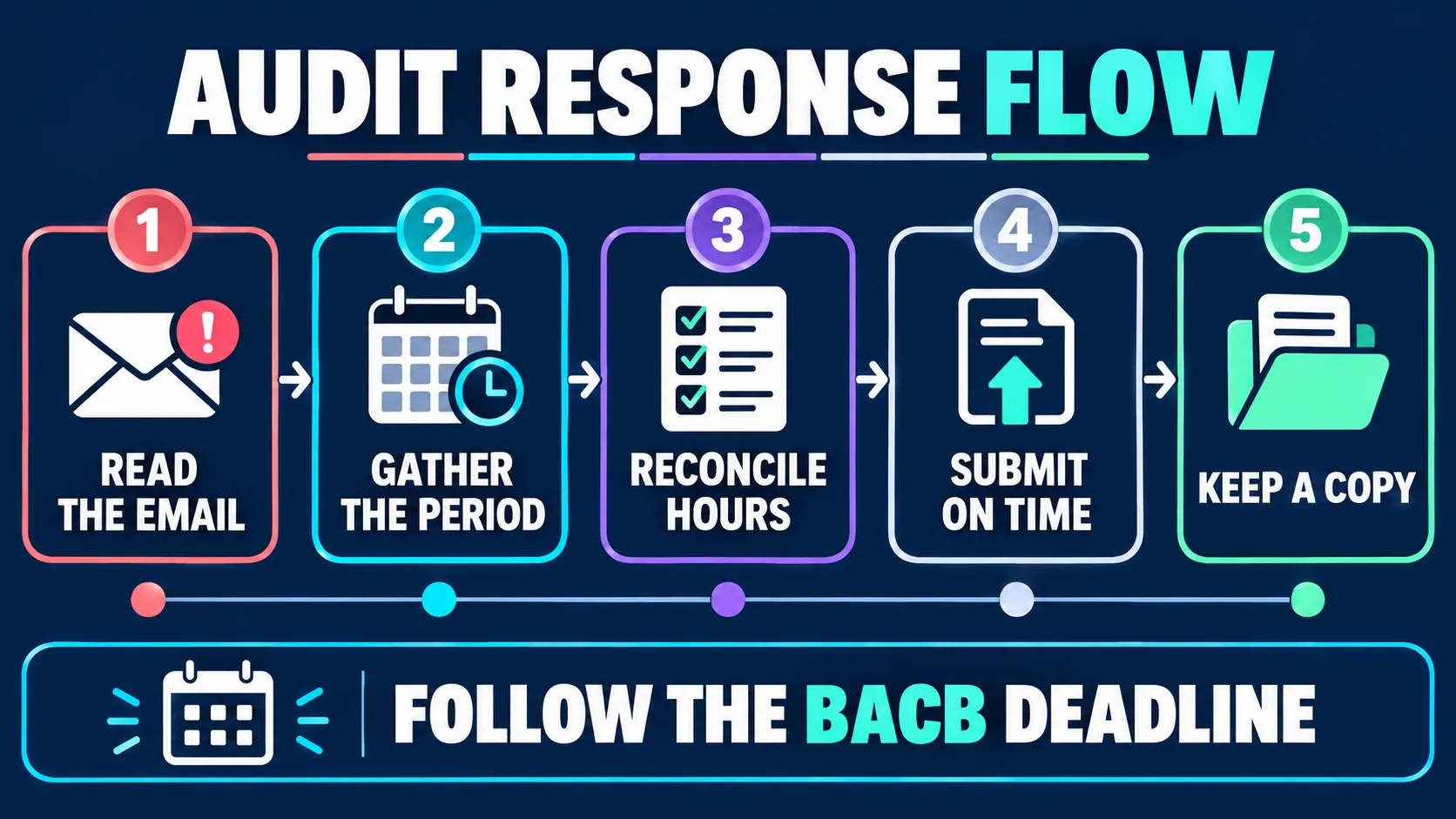
Once the evidence is assembled, use a controlled sequence:
- Read the request twice. Save the original email and highlight the period, required files, deadline, and submission channel.
- Freeze the source set. Make a copy for reconciliation; do not edit originals while calculating totals.
- Map the months. List every month in the audit period and mark the applicable supervisor, fieldwork type, forms, and documentation source.
- Reconcile the numbers. Compare actual records with M-FVFs/F-FVFs and note every reduction, correction, or missing item.
- Complete the BACB audit log. Use the board-provided file and its instructions; do not substitute your own tracker unless BACB specifically asks for it.
- Review with the right people. Ask each relevant supervisor to verify the information they attested to, and resolve discrepancies before submitting.
- Submit and preserve proof. Use the required method before the deadline, save the submitted files and confirmation, and keep the complete response packet with the original records.
This is an administrative compliance workflow, not a reason to rebuild your entire BCBA study plan. Finish the evidence response first. After the audit packet is stable, return to the current TCO and exam preparation separately. Mixing audit anxiety with exam content review makes it harder to see which problem you are actually solving.
Once your fieldwork records are organized, keep your exam preparation on its own track. Use our free BCBA mock exam practice as a separate readiness checkpoint. It is independent study support, not BACB audit advice or an eligibility decision.
Frequently Asked Questions
Does BACB provide the BCBA fieldwork audit log?: The BACB’s current fieldwork FAQ says that if you are audited, BACB provides an audit log and identifies the time period being audited. Use the file and instructions included with your audit request.
Is the audit log the same as my fieldwork tracker?: No. Your tracker or documentation system is an ongoing source record. The audit log is an audit-specific reporting document supplied for the requested period. Use the source system to support the audit log rather than treating the tracker as an automatic substitute.
How much time do I have to respond?: Follow the deadline in your BACB audit initiation email. The current handbook describes a typical 14-day response window, but an individual request controls. Late or missing information can affect the compliance determination.
Should I delete an incorrect fieldwork entry?: Do not erase the history. Preserve the original record, document the correction and reason, involve the appropriate supervisor, and follow the current BACB instructions for modifying a verification form or responding to the audit.
Bottom line: keep the original fieldwork evidence, treat the BACB audit log as a separate requested document, reconcile the named months one at a time, preserve correction history, and submit exactly what the audit email requests by its deadline. For targeted review, use our bcba fieldwork audit log practice questions to apply the concept in exam-style scenarios.
Quick Review Checklist
Use this final checklist to turn bcba fieldwork audit log into exam-ready reasoning. The goal is not to memorize a label in isolation; it is to identify the relevant evidence and explain why the best answer fits the scenario. Key ideas to review:
- State the central definition or decision point for bcba fieldwork audit log in your own words.
- Identify the detail that makes bcba fieldwork audit log different from its closest related ABA term.
- Separate the observable facts in a scenario from assumptions that are not supported by the facts.
- Write one example and one nonexample so you can recognize the concept in a new setting.
Exam application checks:
- Ask what the question is actually requesting before comparing the answer choices.
- Mark the antecedent, response, consequence, or other evidence that supports the selected answer.
- Look for a distractor that describes a related process but does not answer the specific question.
Final self-check:
- Explain how you would verify the interpretation with clear observations or data.
- Change one detail in the scenario and decide whether your answer should change.
- Give a one-sentence rationale that a supervisor or study partner could evaluate.
Take the Free BCBA Mock Exam
If you want a low-pressure way to check your recall, use the free practice resource below. Take the Free BCBA Mock Exam



