

Can BCBA work remotely? Yes, many BCBAs perform some work by telehealth or from a home office, including data review, caregiver training, program writing, supervision, meetings, and documentation. But “remote” does not mean “location-free.” The client’s location, state licensing rules, payer policy, employer requirements, privacy safeguards, and clinical needs can all determine whether a service is allowed and payable.
Table of Contents
- Can BCBA Work Remotely?
- What Remote BCBA Work Can Include
- Why Remote Does Not Mean Location-Free
- Client Location, State Rules, and Payer Policy
- Remote BCBA Supervision and Fieldwork
- Privacy, Documentation, and Clinical Quality
- How to Evaluate a Remote BCBA Role
- Remote BCBA Work FAQ
- Take the Free BCBA Mock Exam
The safest answer is not a universal yes or no. A BCBA may be able to work remotely in one role and need in-person coverage in another. This guide separates certification from authorization to practice, explains which duties are commonly remote or hybrid, and gives candidates a checklist for evaluating a remote BCBA job or fieldwork arrangement. It is educational information, not legal, licensing, billing, or individualized clinical advice. Table of Contents
Can BCBA Work Remotely?
Yes, but the form of remote work matters. A BCBA might work fully remotely for an administrative, consultation, training, or documentation role; provide telehealth services to a client with an appropriate caregiver or technician; or work in a hybrid model that combines virtual supervision with in-person observation. The same job title can hide very different expectations.
The BACB’s BCBA resources describe BCBAs as independent practitioners who may provide behavior-analytic services and supervise RBTs, BCaBAs, and other professionals. That certification description does not itself grant permission to deliver every service across every state by video. Practice is also shaped by applicable law, professional ethics, employer policy, client needs, and the payer that funds the service. A useful distinction is:
- Remote work: where the BCBA performs a job task, such as analyzing data or writing a program.
- Telehealth service: where a behavior-analytic service is delivered through a remote technology platform.
- Remote supervision: where a supervisor observes, coaches, or meets with a trainee or service team remotely.
- Fully remote practice: a broad claim that almost all duties can be performed without in-person access, which is not automatically realistic.
When someone asks whether a BCBA can work remotely, the first follow-up should be: remote for which task, with a client in which location, under which license and payer? That question prevents a job advertisement’s flexible wording from being mistaken for a universal practice rule.
What Remote BCBA Work Can Include
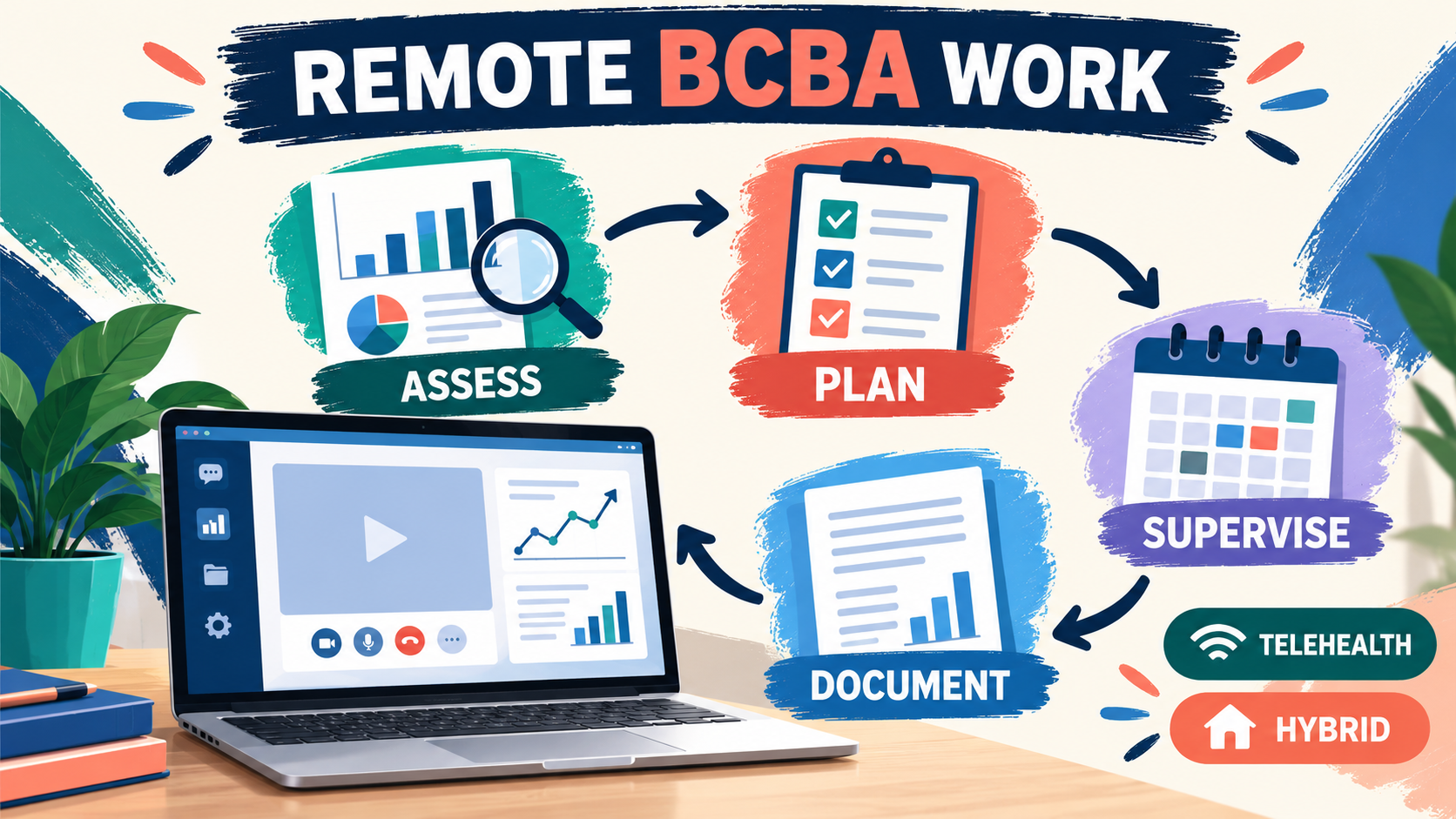
Remote and hybrid roles often combine clinical judgment with communication, documentation, and supervision. The proportion depends on the employer and population. Commonly remote-capable tasks can include the following, provided the BCBA is competent, authorized, and able to collect enough information to make a sound decision:
- Reviewing graphs, session notes, treatment-integrity data, and progress summaries.
- Writing or revising goals, teaching procedures, behavior plans, and caregiver materials.
- Meeting with caregivers, teachers, technicians, or interdisciplinary team members.
- Training staff through modeling, rehearsal, feedback, and follow-up observation.
- Providing consultation about data systems, program implementation, and problem-solving.
- Supervising some services or fieldwork when the arrangement meets applicable requirements.
- Completing documentation, utilization-review materials, and quality-assurance tasks.
Remote work is strongest when the task is information-rich and the BCBA can verify what is happening. For example, graph review can be remote if the data are accurate, timely, and connected to clearly defined procedures. A caregiver-training session can be remote if the caregiver can participate, the environment is suitable, and the BCBA can observe enough of the relevant interaction to give meaningful feedback.
Some jobs advertised as “remote” are actually hybrid. The BCBA may write programs from home but travel for intake, direct observation, crisis support, caregiver coaching, or reassessment. Hybrid work is not a failed version of remote work; it may be the clinically responsible way to combine access and observation.
Why Remote Does Not Mean Location-Free
Remote services still happen in a real legal and clinical setting. If the client is in State A and the BCBA is sitting in State B, both locations may matter. The state where the client receives services may regulate the activity, and a payer may impose additional rules about provider location, telehealth modality, credentialing, codes, consent, or documentation. The organization may also require the BCBA to be physically available within a response area.
Do not assume that a BCBA certification replaces a state license when a state requires one. Do not assume that a service is billable because it can be technically delivered by video. Do not assume that a remote assessment is equivalent to an in-person assessment when the behavior, environment, safety risk, or available informant requires direct access.
Clinical fit matters too. Remote care may be reasonable for caregiver coaching or data review but insufficient for a situation requiring direct observation, environmental manipulation, safety assessment, or immediate crisis response. The BCBA must be able to identify when remote delivery is not adequate and arrange a safer or more valid alternative.
The BACB ethics resources emphasize client and consumer protection. A remote arrangement should preserve competent service, confidentiality, informed consent, assent when applicable, accurate documentation, and access to needed support. Convenience for the provider is not enough to justify a modality.
Client Location, State Rules, and Payer Policy
Before accepting a remote BCBA role, identify the rules that apply to the client or service recipient, not only the address on the BCBA’s home office. The exact answer varies by state, service, payer, employer, and client population. Use the relevant state licensing board, payer manual, employer compliance team, and current BACB guidance rather than relying on a social-media post or a job listing.
| Question to verify | Why it matters | Who should confirm it |
|---|---|---|
| Where is the client during service? | Client location can determine licensure, telehealth, and payer rules. | BCBA, employer compliance team, and applicable state board. |
| Is this direct service, supervision, consultation, or documentation? | Different tasks may have different competency, observation, and billing requirements. | Supervisor, employer, and payer policy owner. |
| Does the payer allow this modality and code? | A service can be clinically possible but not payable under a particular plan. | Payer or funder, not only the recruiting manager. |
| What happens if remote observation is inadequate? | A safe fallback protects the client and the validity of clinical decisions. | BCBA clinical lead and the service team. |
| How are privacy and consent handled? | Video, records, and observers create confidentiality and consent obligations. | Employer privacy/compliance lead and responsible BCBA. |
This table is a decision framework, not a state-by-state legal answer. A company that says “we work nationwide” still needs a compliant process for each state and payer it serves.
Remote BCBA Supervision and Fieldwork
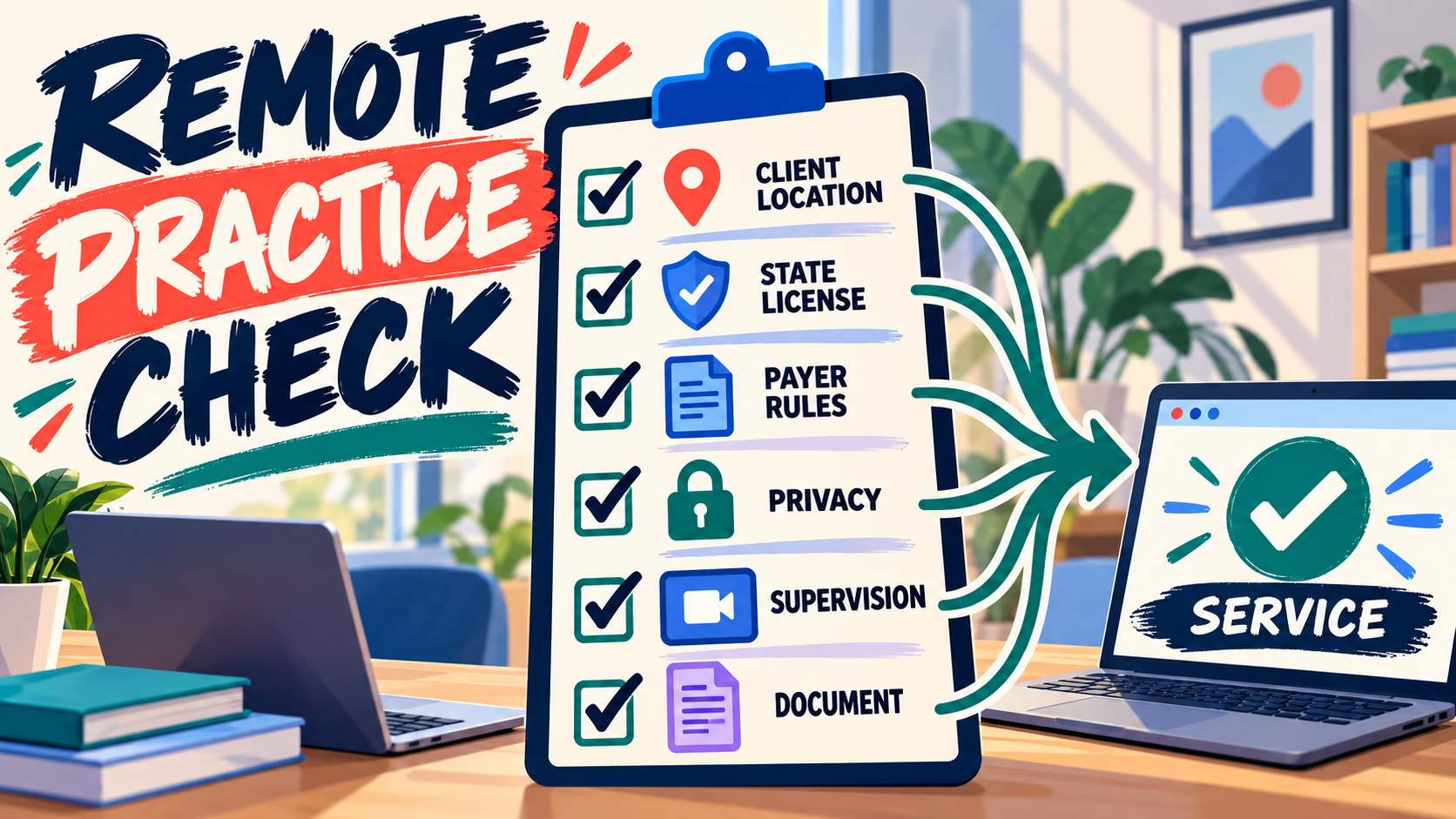
Remote supervision is especially important for people accruing experience hours. The BACB’s fieldwork materials discuss remote-supervision considerations, but remote does not mean simulated work. The fieldwork must involve real clients and must be documented in the manner required by the applicable handbook and forms.
The BACB has explained that remote supervision may be limited when the supervisor does not already know and oversee the clients. The client should know about and agree to remote observation or another virtual activity during treatment, and state licensing rules may require the supervisor to hold a license where the service is provided. These details can change with the current requirements, so a trainee should confirm them before counting hours.
A good remote fieldwork arrangement has a written contract, a clear observation plan, reliable technology, protected records, feedback that is specific enough to improve performance, and a process for in-person contact when remote observation cannot answer the clinical question. The trainee should know who is responsible for the client, what activities count, how supervision contacts are recorded, and what happens if the connection fails.
- Confirm that the supervisor is qualified for the credential and arrangement.
- Confirm that the client and relevant caregivers consent to the remote observation or meeting.
- Document dates, times, activities, supervision type, feedback, and follow-up actions.
- Check whether restricted and unrestricted activities are being classified correctly.
- Escalate questions about state licensing, forms, or eligibility to the supervisor and BACB resources.
Remote supervision should build a competent behavior analyst, not merely produce a spreadsheet of hours. If the trainee is never exposed to direct assessment, team coordination, clinical observation, or feedback in the settings where behavior occurs, the experience may be too narrow even if meetings happen regularly.
Privacy, Documentation, and Clinical Quality
Working from home does not lower professional responsibilities. Use an employer-approved platform, private workspace, secure device, appropriate access controls, and a defined process for storing or deleting recordings. Do not assume that a consumer video app, personal email, or shared home screen is acceptable for protected client information.
Documentation should show what was observed, what data supported the decision, who participated, what feedback was given, and what will happen next. Avoid notes that simply say “telehealth went well.” A reviewer should be able to understand the service, the client’s response, the barrier or decision, and the follow-up without inventing details. Quality checks for a remote session can include:
- Was the target behavior or skill defined well enough to observe?
- Could the BCBA see or hear the relevant context, or was information filtered through an unreliable connection?
- Did the caregiver or technician understand the instruction and demonstrate the procedure?
- Were data collected consistently, and were limitations recorded?
- Was an in-person or local response needed for safety, assessment validity, or client preference?
Remote work is not a shortcut around clinical uncertainty. If the BCBA cannot answer the question with the available evidence, the next action may be to gather better data, arrange a direct observation, consult a qualified professional, or pause a change until the situation is safe and clear.
How to Evaluate a Remote BCBA Role
Ask for specifics before accepting an offer. “Remote” can mean a laptop-based clinical role, a hybrid caseload, remote supervision of technicians, or a position that expects the BCBA to travel when cases need direct observation. Clarify the role in writing.
- Identify the service: Ask whether the role is assessment, caregiver training, supervision, consultation, program writing, direct treatment, or a mix.
- Map the geography: Ask where clients live, where the BCBA must be licensed, and whether cross-state or out-of-country work is permitted.
- Check the payer: Ask who confirms telehealth coverage, codes, authorization, and documentation requirements.
- Check the clinical fallback: Ask who provides in-person coverage for safety, direct observation, intake, or a service that cannot be validly delivered online.
- Check the workload: Ask about caseload, expected response time, travel, supervision duties, technology, and paid documentation time.
- Check the support: Ask who handles compliance questions, training, peer consultation, and technology failures.
Be cautious when a role promises “work from anywhere” but will not identify the client states, payer model, supervision structure, or privacy platform. A strong employer should be able to explain how remote services are authorized and how clinical quality is monitored.
The BACB supervision and training resources are useful for comparing a job’s supervision responsibilities with official expectations. If you are still preparing for certification, build exam readiness separately from job-location assumptions. The free BCBA mock exam practice can help you rehearse scenario decisions, but it is independent study support and not a license or employment guarantee.
Remote BCBA Work FAQ
Can a BCBA work completely from home?: Sometimes, depending on the role and the service. Data review, writing, meetings, consultation, and some supervision may be remote-capable. Direct observation, safety assessment, intake, and payer or state rules may require in-person work. “Fully remote” should be verified task by task.
Can a BCBA work remotely with clients in another state?: It depends on the client’s location, the state’s licensing and telehealth rules, the payer, and the employer. Certification alone is not a universal permission to practice across state lines. Confirm the arrangement with the responsible compliance and licensing resources before providing services.
Can remote supervision count toward BCBA fieldwork?: Some remote supervision arrangements may count when they meet the current BACB requirements, involve real clients, protect consent and privacy, and satisfy applicable state rules. A trainee should review the current handbook, contract, forms, and supervisor guidance before counting hours.
Is remote BCBA work the same as telehealth?: No. A BCBA can work remotely on documentation or data analysis without delivering telehealth to a client. Telehealth is the delivery method for a service; remote work is a broader description of where a job task occurs.
What should I ask a remote BCBA employer?: Ask which tasks are remote, where clients are located, who verifies licenses and payer rules, how in-person needs are handled, what technology is approved, how supervision is documented, and whether travel is expected. The answers are more valuable than the word “remote” in the job title.
So, can BCBA work remotely? Yes, but good remote practice is structured, location-aware, privacy-protected, and clinically accountable. Treat the work arrangement as a chain of checks—client location, authorization, competence, observation, privacy, supervision, and documentation—not as a promise that every BCBA duty can be moved onto a screen. For targeted review, use our can bcba work remotely practice questions to apply the concept in exam-style scenarios.
Take the Free BCBA Mock Exam
If you want a low-pressure way to check your recall, use the free practice resource below. Take the Free BCBA Mock Exam



