

BCBA research-design reasoning and practice A comparison question ABA prompt asks you to identify what is being compared, what outcome is measured, and what conclusion the design can support. The fastest route to the best answer is not to memorize the word “comparison.” First name the options, the dependent variable, the relevant independent variable, and the feature that makes the options meaningfully different.
Table of Contents
- What a Comparison Question ABA Prompt Is Asking
- How to Identify the Variables Before Comparing
- How Comparison Questions Differ From Nearby Designs
- A Comparison-Question Reasoning Matrix
- How to Work Through an Original ABA Scenario
- Common Comparison-Question Traps
- A Focused Study Routine for Comparison Questions
- Comparison Question ABA FAQ
- Take the Free BCBA Mock Exam
Use the current BCBA Test Content Outline to check the scope of research-design concepts, and use the current BCBA Handbook for official examination guidance. The practice examples below are original study examples, not official BACB questions, and a third-party mock score does not establish eligibility or guarantee a passing result.
What a Comparison Question ABA Prompt Is Asking
Comparison questions are built around a contrast. The prompt may ask which treatment produces a larger change, which condition shows a higher level of responding, which measurement is more appropriate, or which design lets you compare two procedures. The surface details can change, but the reasoning task is usually the same: find the comparison that matters and avoid answering a nearby question.
Start by rewriting the prompt in one sentence: “The question compares option A and option B on outcome Y under condition Z.” If you cannot fill in those blanks, you are not ready to evaluate the answer choices. A choice that defines a term correctly may still be wrong if it does not answer the specific comparison in the stem.
- Name the options: identify the procedures, conditions, settings, levels, or components being contrasted.
- Name the outcome: locate the measured behavior and its dimension, such as rate, duration, latency, or percentage.
- Find the controlling difference: ask what changed between the options and what was held constant.
- Limit the conclusion: choose the interpretation supported by the data and design, not the broadest-sounding claim.
How to Identify the Variables Before Comparing
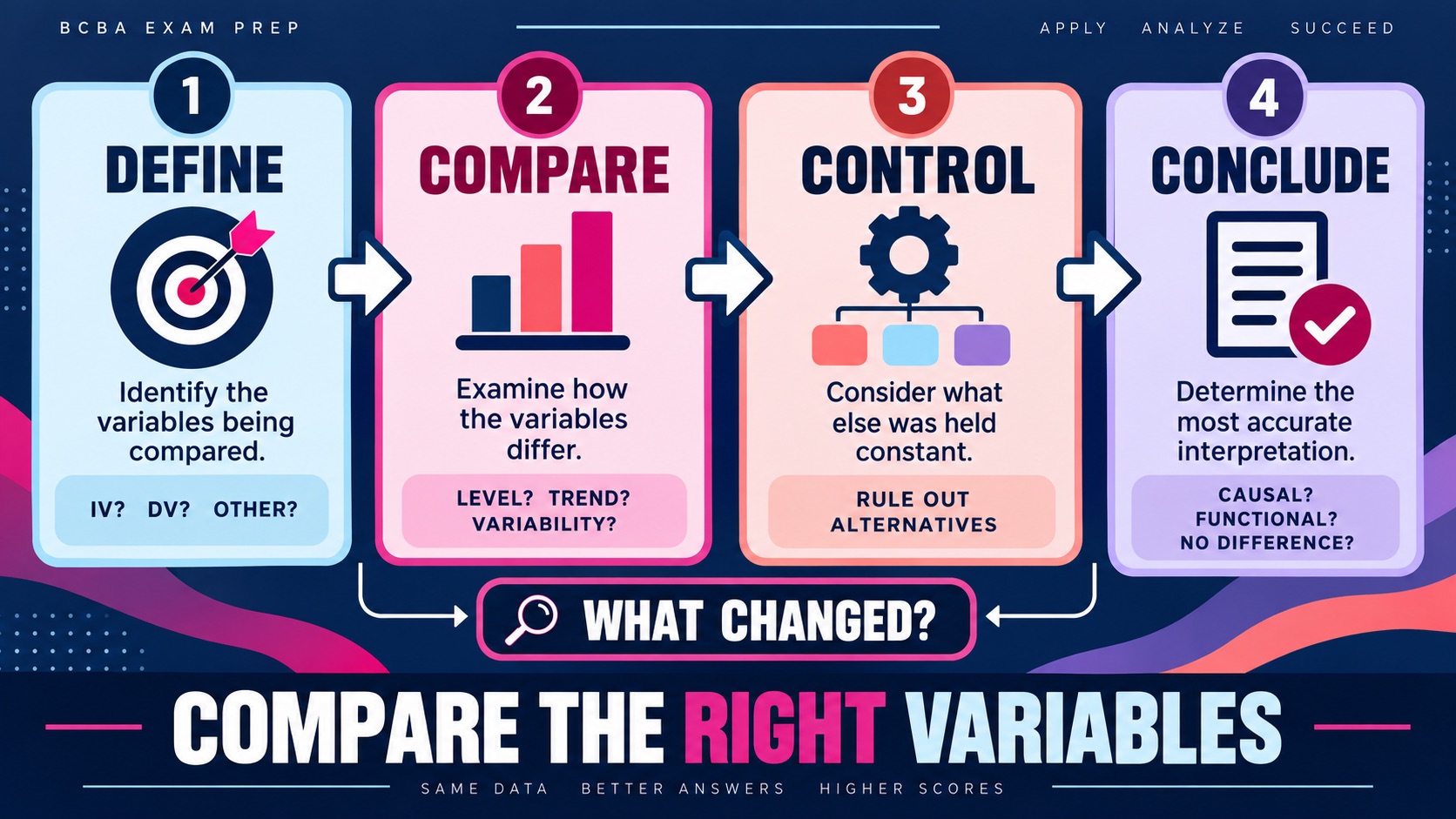
The independent variable is the condition, procedure, or value deliberately arranged by the researcher. The dependent variable is the behavior or outcome measured. In a comparison question, the answer may depend on a third detail: whether the comparison changes the treatment package, one component, the intensity of the same intervention, or the context in which the intervention is used. Use a short “before the answer” scan:
- Underline the action or condition that differs between the options.
- Circle the behavior and the measurement dimension that represent the outcome.
- Mark any words that describe a level, component, dose, setting, or sequence.
- Ask whether the prompt seeks a difference, a relation, a functional effect, or a best measurement.
- Reject choices that answer a different question, even when their definition is accurate.
For example, suppose a stem compares a token-only condition with a token-plus-praise package and measures the percentage of independent responses. The outcome is independent responding. The meaningful comparison is the treatment package, not the number of tokens earned. If the question asks which component accounts for the difference, the task has moved toward a component analysis rather than a simple comparison of two packages.
How Comparison Questions Differ From Nearby Designs
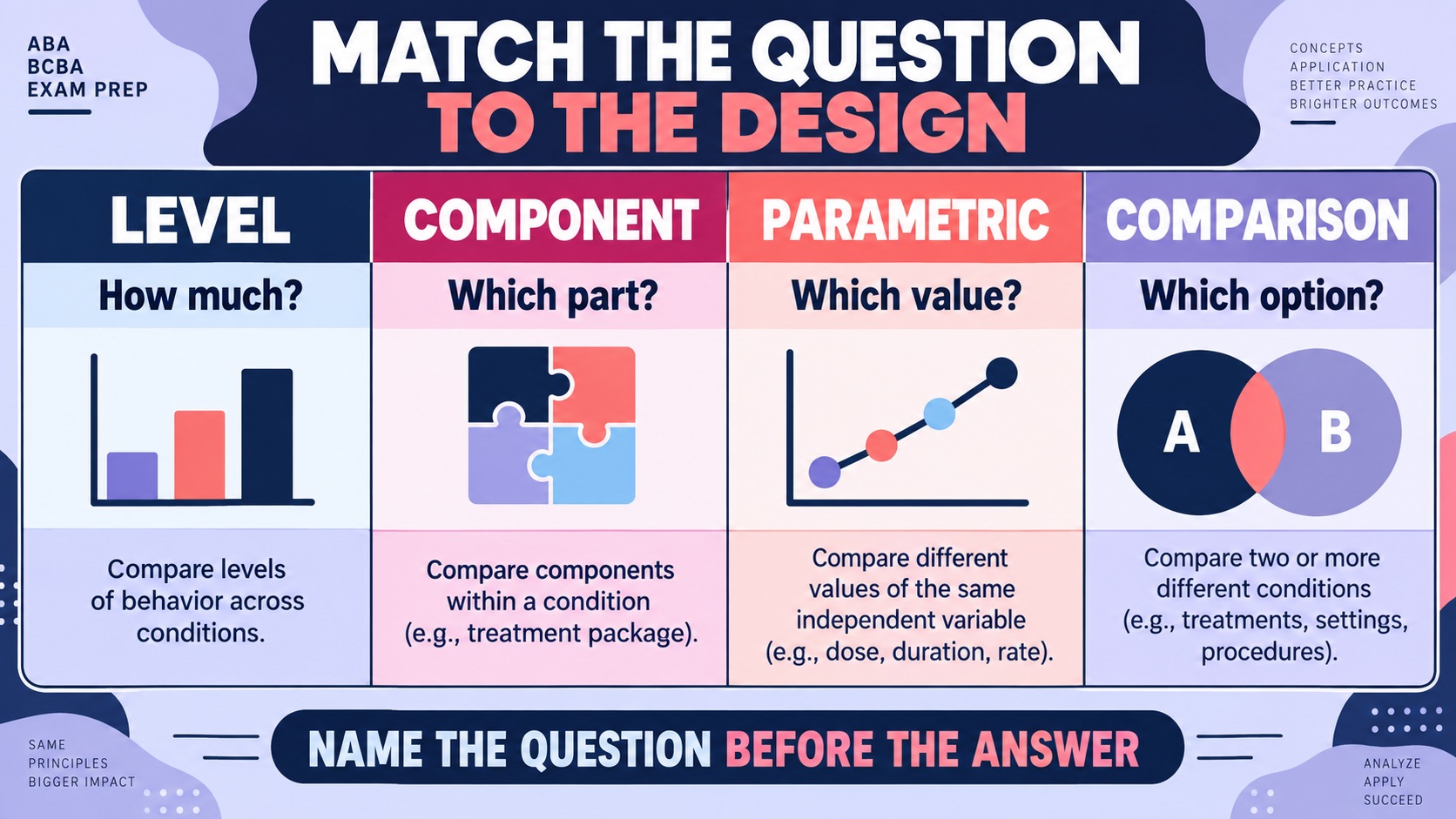
Many wrong answers come from confusing the comparison with the research question behind it. A comparison can appear in several designs, but the wording tells you what the investigator wants to learn. “Which option is better?” is different from “Does changing the value change responding?” and both are different from “Which part of this package is necessary?”
| Question family | What changes | What the learner should ask |
|---|---|---|
| Comparison | Two or more procedures, conditions, or options. | Which option produces the relevant difference on the measured outcome? |
| Parametric | Different values of the same variable. | How does changing the level, dose, rate, or duration affect responding? |
| Component | Parts of a treatment package. | Which part is necessary, useful, or responsible for the package effect? |
| Demonstration | The intervention is introduced with control and replication logic. | Does the arrangement demonstrate a functional relation? |
The labels are not a substitute for reading the stem. A multiple-treatment comparison may demonstrate a functional relation, and a parametric analysis still compares conditions. The question is which feature the item makes central. Look for the researcher’s decision, not just a familiar design name.
A Comparison-Question Reasoning Matrix
When an answer choice feels plausible, compare it with the stem using four checks. This keeps you from choosing the option that merely repeats a definition.
- Target: Does the choice address the exact behavior or outcome named in the question?
- Contrast: Does it explain the difference between the options rather than describe one option alone?
- Control: Does it account for alternative explanations or a change in the arrangement?
- Conclusion: Does it stay within what the comparison and data can support?
A strong answer often contains a small but decisive qualifier. “The percentage of independent responses was higher in the token-plus-praise condition” is more defensible than “token-plus-praise is the best treatment.” The first describes the measured comparison. The second adds a universal claim about every learner, setting, and outcome.
How to Work Through an Original ABA Scenario
Imagine a learner practices functional communication under two conditions. In Condition A, the learner receives a visual prompt and praise after an independent request. In Condition B, the learner receives the same visual prompt, praise, and a brief preferred-item check after the request. The analyst records the percentage of opportunities with an independent request across repeated sessions.
First, the dependent variable is the percentage of independent requests. Next, the key comparison is the additional preferred-item check in Condition B. The visual prompt and praise are common features, so they do not explain the difference between the two conditions by themselves. If Condition B produces a higher and consistent level of independent requests under the stated arrangement, the narrow conclusion is that the two conditions differed on that measured outcome. It is not automatically proof that the added check will be best in every context or that it is the only active mechanism.
If the question asks which condition is associated with the higher response level, answer from the data. If it asks which component may account for the difference, identify the added check and note that a component analysis would be needed to isolate necessity. If it asks whether the design demonstrates a functional relation, inspect the control and replication logic rather than treating one higher mean as sufficient evidence.
Common Comparison-Question Traps
Comparison questions reward precision. Watch for these recurring traps:
- Comparing labels instead of variables: “Treatment A” and “Treatment B” mean little until you identify how they differ.
- Ignoring measurement: the preferred option can change when the outcome changes from rate to latency or from accuracy to duration.
- Confusing more with better: a higher value is not automatically clinically or socially preferable.
- Overreading a graph: a visual difference may suggest a pattern without proving why it occurred.
- Choosing a broad conclusion: answer choices that claim the procedure works everywhere often exceed the described evidence.
- Missing a component: a package comparison can hide a component question when one condition adds only one element.
A Focused Study Routine for Comparison Questions
Use a short, repeatable routine instead of collecting an unlimited number of similar questions:
- Classify: write “comparison,” “parametric,” “component,” or “demonstration” before looking at the answer.
- Map: list the IV, DV, measurement dimension, and common features.
- Contrast: state the one controlling difference in plain language.
- Decide: choose the answer that matches the question’s requested conclusion.
- Explain: write why the nearest distractor answers a different question.
- Transfer: change the behavior, setting, or measurement and solve a new version.
Keep an error log with one line for the error type: variable identification, measurement, design classification, distractor discrimination, or conclusion scope. If you miss three items for the same reason, study the reasoning rule rather than simply adding three more cards. Then use mixed practice to check whether the rule transfers away from the original wording.
When you are ready to test that transfer, try the free BCBA mock exam for comparison question ABA practice. Treat the result as an unofficial practice signal. Review both correct and incorrect answers, and use the error pattern to choose your next study action.
Comparison Question ABA FAQ
What is the first thing to identify in a comparison question?: Identify the options being compared and the measured outcome. Then name the one feature that differs between the options. This prevents you from answering a nearby question about a definition or a single condition.
Is every question with two conditions a comparison question?: No. Two conditions may be used to compare different treatments, different values of one variable, parts of a treatment package, or an intervention and a control condition. Read the purpose of the contrast and the conclusion the prompt requests.
How should I use a comparison question in BCBA exam practice?: Classify the question, map the IV and DV, state the controlling difference, choose the narrow supported conclusion, and explain why the closest distractor answers a different question. Then practice the same reasoning with changed surface details.
Take the Free BCBA Mock Exam
When you are ready to apply the idea, use the free practice resource below for additional feedback. Take the Free BCBA Mock Exam



