
Medicaid ABA reimbursement rates are not one national number. The amount attached to an ABA service can change with the state, benefit authority, CPT code, billing unit, credential tier, modifier, authorization rule, fee-for-service schedule, managed-care plan, and effective date. This guide shows how to find the controlling number and verify it before relying on it.
Table of Contents
- What Are Medicaid ABA Reimbursement Rates?
- Why Is There No Single National ABA Rate?
- How Do You Find a Current Medicaid ABA Rate?
- Which Fields Must You Capture?
- How Do FFS and Managed Care Differ?
- What Changes the Amount Paid?
- How Should You Check a 2026 Rate?
- What Are the BCBA Exam Clues?
- What Mistakes Should You Avoid?
- Medicaid ABA Reimbursement Rates FAQ
- Sources and Date Check
- Take the Free BCBA Mock Exam
People search for Medicaid ABA reimbursement rates for different reasons. A provider may be checking whether a contract is workable. A BCBA may be comparing a fee schedule with a claim or explaining why a plan pays differently from a state-published amount. A family may want to understand why a clinic says authorization or network status matters. A student may be trying to connect payment systems with ethics, documentation, and scope of practice.
What Are Medicaid ABA Reimbursement Rates?
A Medicaid ABA reimbursement rate is the amount a Medicaid program or Medicaid managed-care plan allows for a defined covered service under a particular billing rule. It is not automatically the clinician’s salary, the family’s cost, the provider’s charge, or the total amount a clinic collects. The rate usually attaches to a service code and unit, then changes according to provider credentials, setting, modifiers, authorization, and payer pathway.
The Centers for Medicare & Medicaid Services explains that states establish Medicaid provider payment rates within federal requirements and generally use fee-for-service or managed-care arrangements. CMS also maintains federal autism-service guidance and state resources. That means the safest answer to “How much does Medicaid pay for ABA?” is: identify the state, the member’s payer pathway, the exact service code, the unit, and the effective date before quoting a number.
Do not confuse coverage with payment. A state may recognize an ABA benefit or a medically necessary autism service, but that fact alone does not tell you the amount paid for a specific code. It also does not guarantee that every member, provider, setting, or managed-care plan uses the same authorization and reimbursement rule.
Why Is There No Single National ABA Rate?
Medicaid is jointly financed and administered through federal and state structures. States operate their own programs within federal requirements, define covered benefits through approved authorities, publish fee schedules or payment documents, and may contract with managed-care organizations. A state can also update its fee schedule, change an authorization rule, add a modifier, or move a service between benefit categories.
Even when two states use the same broad adaptive-behavior code, the comparison may be misleading. One schedule may show a per-15-minute amount for technician treatment. Another may show a rate for protocol modification by a qualified professional. A third may use a modifier for place of service, practitioner level, telehealth, or a special population. A managed-care contract may then pay according to its own approved arrangement rather than the number a reader found in a fee-for-service spreadsheet.
For that reason, a national “average ABA Medicaid rate” is usually a weak answer. It hides the fields that determine whether the number actually applies. A source-first article can still help by teaching you how to locate the current state document, read the row, and confirm whether the payer uses that row for the claim in question.
How Do You Find a Current Medicaid ABA Rate?
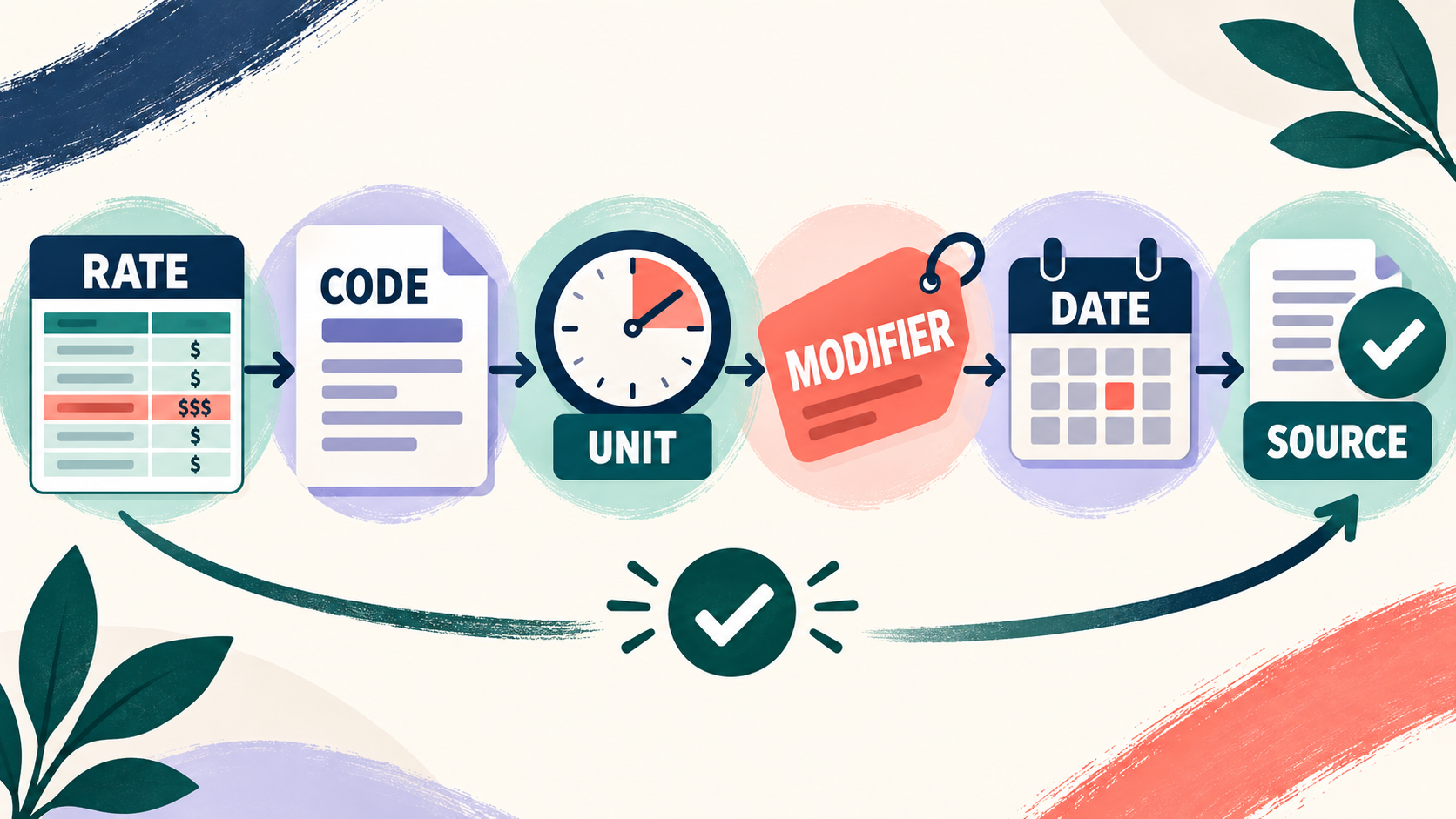
Use a short verification sequence instead of searching for a rate number alone. Start with the member’s state and plan, then identify the service and billing pathway.
- Identify the state program: Start at the state Medicaid agency website, not a random rate-list snippet. Search for the current provider fee schedule, behavior analysis manual, autism services policy, or ABA billing guide.
- Identify the payer lane: Determine whether the claim is fee-for-service or handled by a managed-care organization. Record the plan name and the network or contract context.
- Identify the service: Confirm the exact CPT or state-defined code, the description, and whether the service is assessment, treatment, protocol modification, family guidance, group treatment, or another category.
- Read the full row: Capture the unit, modifier, credential level, place of service, prior-authorization requirement, quantity limit, and effective date together.
- Confirm with the current payer source: If the plan is managed care, compare the state schedule with the plan’s provider manual, contract notice, or written rate confirmation. When the sources conflict, ask which rule controls the claim.
CMS’s public rate-transparency guidance is useful because it points readers toward publicly available fee-schedule information, but federal pages do not replace the state or plan document for a specific claim. A third-party state-rate page can help you discover a document; it should not be the final authority when an official schedule, bulletin, or contract is available.
Which Fields Must You Capture?
When you copy a rate into a spreadsheet, claim note, forecast, or study guide, copy the surrounding fields too. This prevents the most common error: carrying a valid number into the wrong context.
| Field | What to record | Why it matters |
|---|---|---|
| Code and description | The exact CPT or state code and the service wording. | Similar-sounding services may have different rates and documentation rules. |
| Unit | Per 15 minutes, hour, session, day, or another stated unit. | A per-unit amount cannot be compared with an hourly or bundled amount without conversion. |
| Credential and modifier | Provider level, modifier, place of service, and telehealth indicator when listed. | The same base code may have different allowed amounts or may not be payable for every provider. |
| Effective date | The date the row begins, ends, or changes. | A page published in 2026 may still display a row that ended in an earlier rating period. |
| Authorization and limits | Prior authorization, daily or weekly limits, documentation, and claim conditions. | A published rate does not make every unit payable. |
| Source and version | URL, file name, bulletin number, retrieval date, and update notice. | Another reviewer can reproduce the check and detect when the source changes. |
How Do FFS and Managed Care Differ?
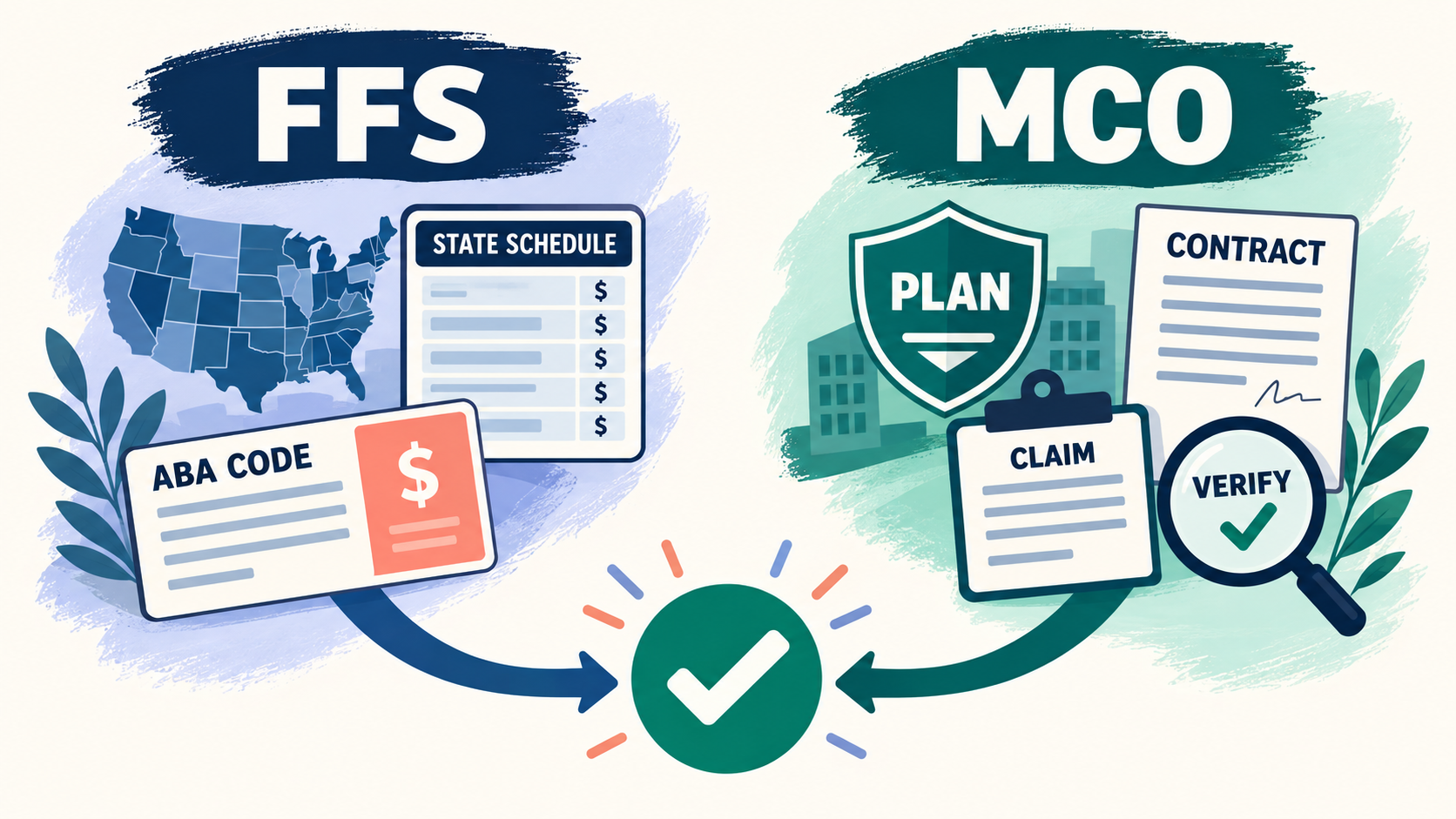
Fee-for-service (FFS) usually means the state or its claims administrator pays according to a published schedule when the service meets coverage, authorization, coding, and documentation rules. An FFS amount is still not a promise that every submitted unit will be paid. The code, modifier, provider enrollment, authorization, place of service, and claim edits still matter.
Managed care means the member receives Medicaid benefits through a contracted health plan or managed-care organization. The state may publish a baseline or require a minimum schedule, while the plan’s provider contract and manual explain how the plan administers authorization, network status, claims, edits, and payment. CMS’s managed-care rate guidance explains the rate-development side of the arrangement; it does not turn every state fee schedule into the amount every plan must pay every provider.
When a state schedule and a plan document show different amounts, do not silently choose the higher number. Check the member’s enrollment, the service date, the plan contract or bulletin, and whether the state uses a minimum fee schedule, a directed payment, or another arrangement. Ask the plan for written clarification and keep the response with the rate record.
What Changes the Amount Paid?
Four variables explain many differences between published Medicaid ABA rates. 1. Provider credential or tier: A state may distinguish a BCBA, BCaBA, technician, psychologist, or another qualified professional. The credential can affect the payable code, modifier, authorization, supervision rule, or amount. Never assume that the amount associated with a supervising BCBA applies to a technician-delivered service.
2. Service code and unit: Assessment, protocol modification, direct treatment, family guidance, and group services are not interchangeable. A rate quoted per 15-minute unit also cannot be compared directly with a per-session or bundled payment. Check whether the schedule requires a minimum time, rounds units in a particular way, or limits concurrent billing.
3. Modifier, setting, and delivery method: Place of service, telehealth, group size, location, practitioner level, and other modifiers can change the row that applies. A modifier may describe a legitimate difference in the service, not merely an optional billing preference. Use the state or plan definition rather than guessing from a code list.
4. Authorization, medical necessity, and contract terms: A rate is only one part of payment. Authorization, treatment-plan approval, provider enrollment, network status, claim submission deadlines, documentation, and medical-necessity criteria may determine whether the service is payable. Coverage rules and reimbursement rules should be tracked as separate columns in your workflow.
How Should You Check a 2026 Rate?
Use a dated rate record. For each code you care about, record the state, payer lane, source URL, document title, code, description, unit, amount, modifier, credential, effective date, end date if listed, authorization note, and the date you checked it. Add a field for “confirmed with plan” when the claim will run through managed care.
For a 2026 check, look for the newest fee schedule or provider bulletin and read the effective-date language rather than relying on the page’s publication date. CMS’s current rate-review material also shows why managed-care rating periods matter: a document can describe a rating period that does not match the service date you are investigating. If an official source is silent, mark the value as unconfirmed and ask the state agency or plan instead of filling the gap with a web estimate. A simple source hierarchy is:
- The member’s current managed-care contract, provider manual, written plan notice, or claim-specific clarification when managed care controls.
- The state Medicaid agency’s current fee schedule, ABA manual, bulletin, or approved coverage/payment document.
- Federal CMS guidance for the program framework, transparency expectations, and benefit context.
- A third-party rate database or billing article only as a discovery aid, followed by verification against the controlling source.
What Are the BCBA Exam Clues?
Medicaid reimbursement rates are not usually a reason to memorize a dollar amount for the BCBA exam. The exam-relevant skill is to separate clinical, ethical, administrative, and payer questions. The current BCBA Test Content Outline and BACB Ethics Code are better study anchors than a payer’s rate table. A reimbursement rule cannot justify selecting an ineffective target, changing a procedure outside your competence, skipping consent or assent, or documenting data inaccurately.
- If a question asks what controls payment: look for the exact service, code, unit, provider, modifier, authorization, and payer rule rather than a general “Medicaid rate.”
- If a question asks about a rate conflict: identify the controlling document and service date; do not choose based only on the higher amount.
- If a question asks about client care: clinical necessity, client welfare, ethical safeguards, competence, and accurate documentation remain the priority.
- If a question asks about data: distinguish treatment data from billing units. A paid unit does not automatically prove that a skill improved.
For additional scenario practice, the free BCBA mock exam is an independent study aid. It is not an official BACB product and does not replace the current TCO, Ethics Code, state Medicaid guidance, or payer instructions.
What Mistakes Should You Avoid?
- Copying a rate from a national table without recording the state, payer, code, unit, and effective date.
- Assuming that a state fee-for-service schedule is automatically the managed-care contract rate.
- Converting a per-15-minute amount into an hourly estimate and presenting the estimate as a guaranteed payment.
- Using a rate from a prior year because the URL or page title still appears in a search result.
- Confusing an approved benefit or medically necessary service with a guaranteed authorization or payment.
- Using reimbursement pressure to justify weak goals, unsafe procedures, incomplete notes, or inaccurate billing.
Medicaid ABA Reimbursement Rates FAQ
How much does Medicaid pay for ABA therapy? There is no single national amount. It depends on the state, code, unit, provider credential, modifiers, authorization, service date, and whether FFS or managed care controls the claim. Use the current state or plan document for the exact figure. Are Medicaid ABA rates the same in every state? No. States administer payment within federal requirements and use different schedules, benefit authorities, modifiers, and delivery arrangements. Even two states using a similar code may publish different units or credential tiers. Does an ABA Medicaid fee schedule tell me what a managed-care plan will pay? Not always. It may be a state baseline, an FFS amount, a minimum schedule, or part of a directed-payment arrangement. Confirm the member’s plan and the provider contract or written plan guidance. Where should I verify a current rate?
Start with the state Medicaid agency or the member’s managed-care plan. Record the document version and effective date. Use federal CMS pages to understand the program framework and use third-party pages only to locate, not replace, the official source.
Sources and Date Check
This article was reviewed on September 29, 2026 against CMS Medicaid resources on autism services, Medicaid financial management, documentation of access and payment rates, managed-care rate review, the CMS ABA and Medicaid FAQ, and current BACB ethics and BCBA exam materials. Rate amounts change by state, plan, code, and effective date; verify the controlling document before using this article for a claim, contract, forecast, or clinical decision.
Take the Free BCBA Mock Exam
If you want a low-pressure way to check your recall, use the free practice resource below. Take the Free BCBA Mock Exam



