
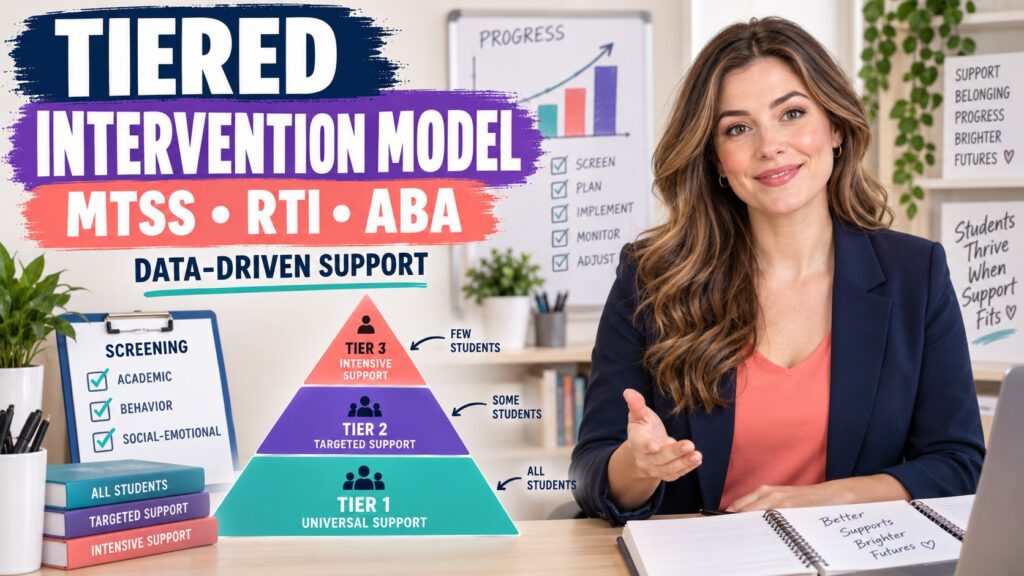
Short answer: A tier intervention model organizes academic, behavioral, social-emotional, or other support into levels of increasing intensity. Tier 1 is universal support for all learners, Tier 2 is targeted support for some learners, and Tier 3 is more intensive, individualized support for learners who need it. The team uses screening, progress data, and response to intervention to decide whether the current level is sufficient.
Table of Contents
- What is a tier intervention model?
- What are Tier 1, Tier 2, and Tier 3?
- How do MTSS, RTI, and PBIS relate?
- How does a tiered intervention decision work?
- What does the model look like in a school example?
- How is a tier model different from FBA, BIP, or supervision?
- How does the BCBA exam test tiered intervention?
- What mistakes should you avoid?
- Tier intervention model FAQ
- Take the Free BCBA Mock Exam
The phrase tier intervention model is often used interchangeably with tiered intervention model in search queries. In schools, it usually points to a framework such as multi-tiered systems of support (MTSS), response to intervention (RTI), or positive behavioral interventions and supports (PBIS). These frameworks can work together, but they are not identical, and a tier is not a diagnosis, a credential, or a guarantee that a student will qualify for special education.
Current education guidance describes MTSS as a system that aligns evidence-based supports across universal, targeted, and intensive levels. The Texas Education Agency MTSS overview explains the three levels and how MTSS can include academic, behavior, mental-health, and other supports. The Institute of Education Sciences likewise emphasizes identifying needs, matching support, and monitoring progress. This article is study support, not an individualized educational, eligibility, placement, or legal recommendation. Table of Contents
What is a tier intervention model?
A tier intervention model is a decision framework for matching support intensity to a learner’s documented need. Instead of giving every student the same intervention, a school or service team starts with a strong common foundation, adds targeted support when data show that the foundation is not enough, and considers more intensive individualized support when progress remains inadequate.
Three ideas matter. The model is a continuum, not a set of permanent labels; a learner may need Tier 2 for one skill and Tier 1 for another. Higher intensity should mean a better match, not simply more adult attention. Decisions should use meaningful learner and implementation data rather than a single difficult day.
- Universal foundation: all learners receive evidence-informed instruction, expectations, routines, and access supports.
- Targeted response: some learners receive an additional or more focused intervention for a defined need.
- Intensive match: a smaller number of learners receive individualized, frequent, or highly explicit support.
- Progress check: data are reviewed to maintain, intensify, fade, or redesign the support.
For BCBA candidates, the key phrase is data-based matching. Do not assume that Tier 3 automatically means an FBA, that Tier 2 automatically means a behavior plan, or that Tier 1 means no support. A tier model describes the level and organization of support; the actual intervention still needs a defined target, a valid measurement plan, trained implementers, and ethical oversight.
What are Tier 1, Tier 2, and Tier 3?
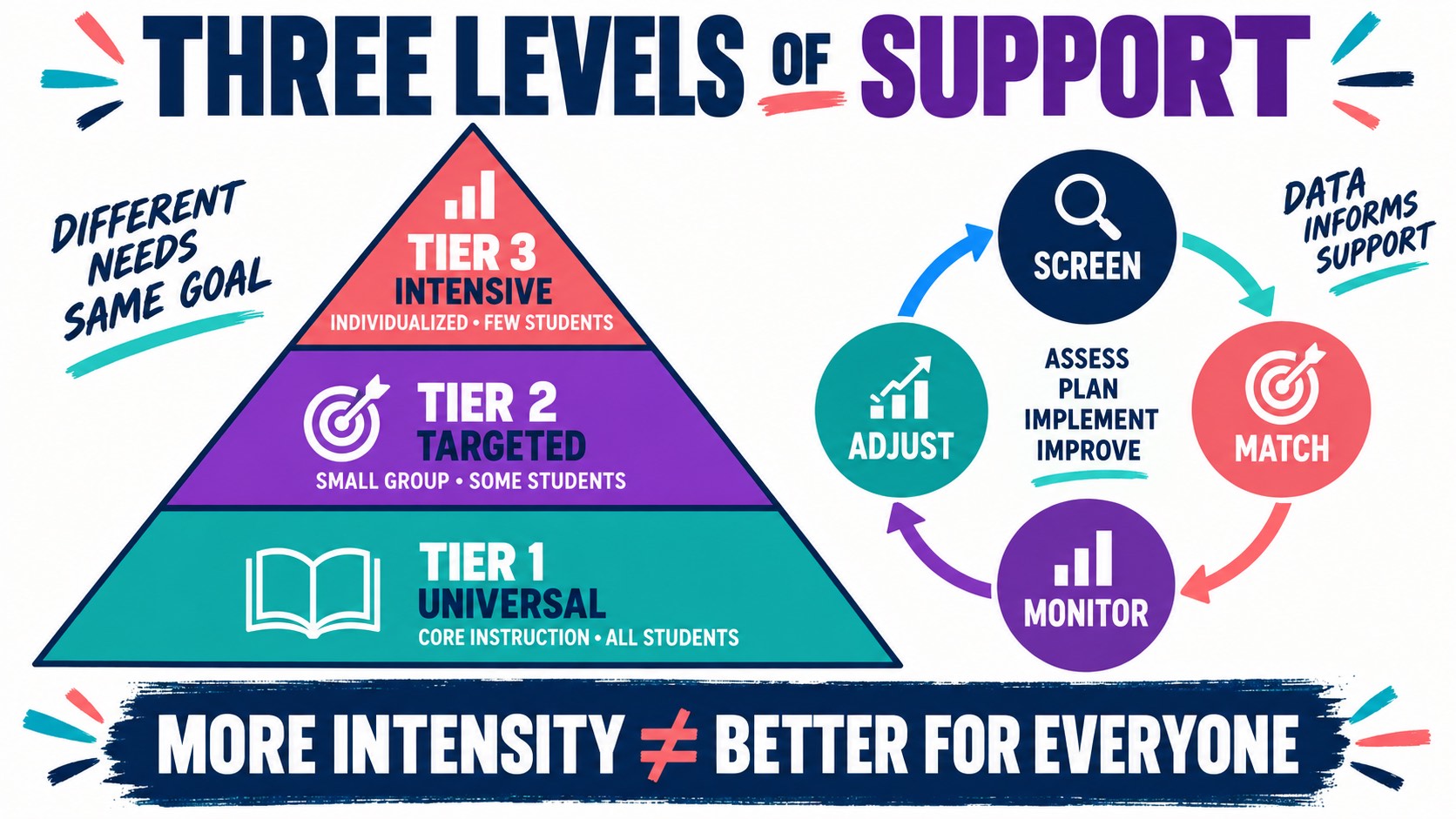
The labels are a useful shorthand, but local systems can define them differently. The common pattern is universal, targeted, and intensive. The diagram shows the logic without treating tiers as rigid categories.
| Tier | Who usually receives it? | Typical support features | What should be monitored? |
|---|---|---|---|
| Tier 1: Universal | All learners in the classroom, program, or school context. | Core instruction, predictable routines, accessible materials, clear expectations, and high-quality opportunities to respond. | Participation, skill acquisition, engagement, and whether the foundation is implemented consistently. |
| Tier 2: Targeted | Learners whose screening or progress data show that Tier 1 alone is not enough for a defined need. | Small-group instruction, brief check-in systems, extra practice, focused communication teaching, or a supplemental academic or behavior support. | The target response, dosage, fidelity, generalization, and change compared with baseline. |
| Tier 3: Intensive | Learners with persistent or significant needs that require a more individualized match. | More frequent instruction, smaller groups or one-to-one teaching, individualized goals, intensive practice, and coordinated team support. | Response over time, treatment integrity, maintenance, generalization, burden, and whether the plan should be adjusted. |
Moving to a higher tier is not punishment or failure; it may mean that the match, dosage, teaching procedure, or environment needs to change. Fading should follow stable performance, maintenance checks, and a plan for responding if the skill weakens.
Tier 1 in practice: The foundation may include explicit instruction, guided practice, feedback, accessible examples, taught expectations, predictable transitions, and reinforcement for participation. A BCBA may consult on measurement, teaching, communication, and generalization, but Tier 1 is not synonymous with ABA therapy. Tier 2 in practice: The targeted layer might add a small reading group, brief check-in, communication practice, or self-monitoring. Name the target and decision rule before starting; “needs more support” is not measurable.
Tier 3 in practice: The individualized plan might use task analysis, errorless teaching, functional communication training, individualized instruction, or a behavior plan. The tier label does not prescribe a procedure; the learner, target, setting, data, and implementer qualifications do.
How do MTSS, RTI, and PBIS relate?
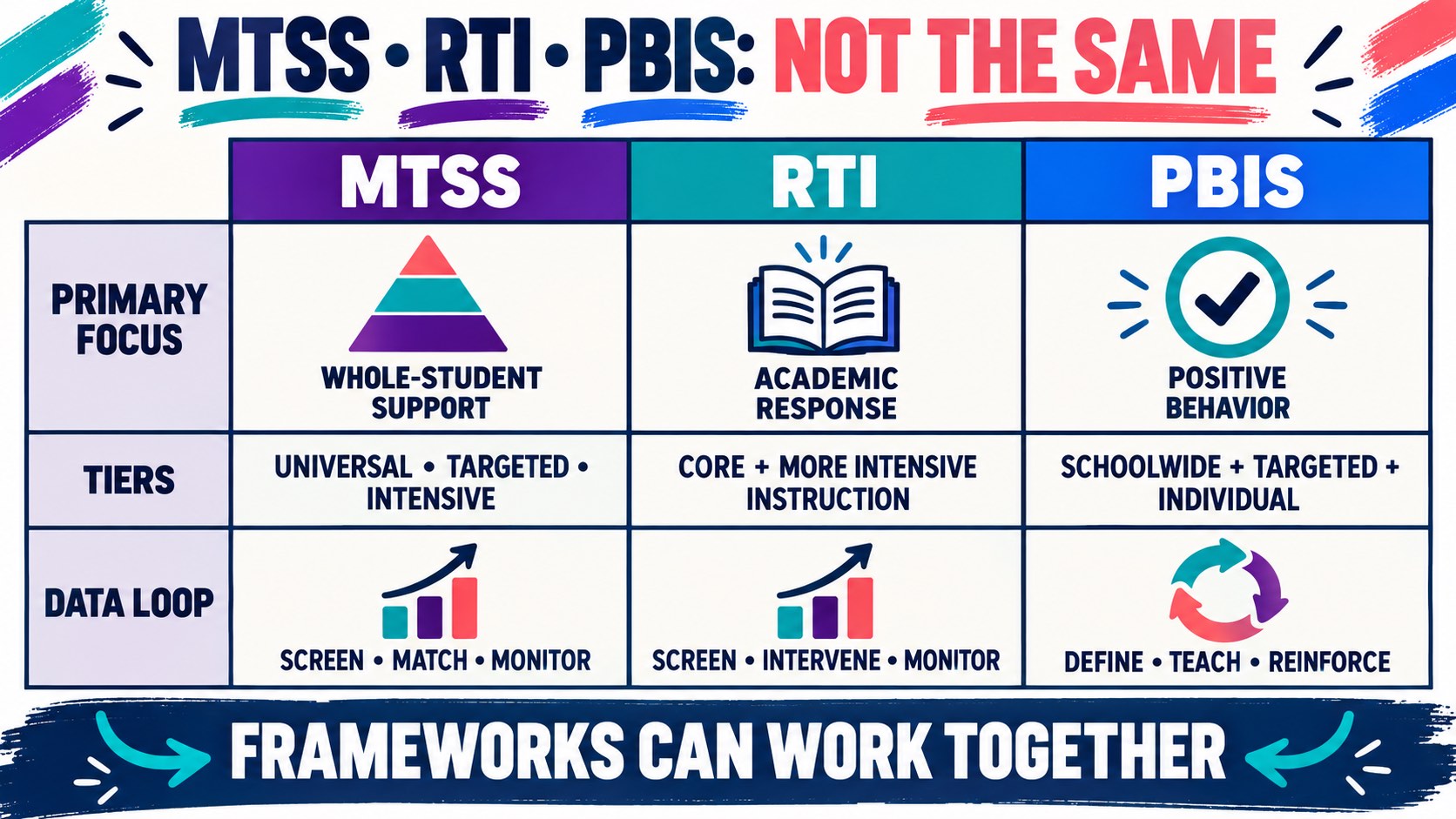
MTSS, RTI, and PBIS are related frameworks, not three names for one identical intervention. MTSS is usually the broadest umbrella for academic, behavioral, social-emotional, and other supports. RTI emphasizes response to increasingly intensive instruction, especially academic instruction. PBIS organizes positive, preventive behavior support at universal, targeted, and individualized levels.
| Framework | Primary emphasis | Typical question | How it can connect to ABA |
|---|---|---|---|
| MTSS | Whole-student prevention and support across domains. | What level of coordinated support fits the learner’s current needs? | Behavior analysis can inform observable goals, teaching, reinforcement, measurement, and implementation fidelity. |
| RTI | Response to increasingly intensive instruction or intervention. | Is the learner making adequate progress with the current instructional level? | A BCBA can apply measurement and instructional analysis without treating academic difficulty as a behavior function. |
| PBIS | Preventive, positive behavior support across schoolwide and individual levels. | What practices teach and reinforce behavior that supports safe, respectful participation? | ABA concepts such as operational definitions, reinforcement, prompting, and data review can support implementation when used within the school’s system. |
The frameworks can be coordinated: a school may use MTSS overall, RTI for academic decisions, and PBIS for behavior support. On an exam, read the target, data, and decision rule instead of choosing by acronym alone.
How does a tiered intervention decision work?
A useful tier decision follows a repeatable loop. It starts with a meaningful concern, not with a predetermined tier. The team then defines the target, checks the current environment and instruction, selects a support that matches the need, measures response, and decides what to do next.
- Screen or review current data. Look at skill performance, engagement, attendance, communication, behavior, or participation data that relate to the concern. A screening score is a signal for discussion, not a diagnosis.
- Define the target. State what the learner should do, in what context, and how success will be measured. “Improve behavior” is too broad; “begins the independent task within two minutes” is more useful.
- Check the foundation. Ask whether instruction, materials, prompts, reinforcement, opportunities to respond, and environmental supports are available and implemented as intended.
- Match the intervention. Select a validated or evidence-informed approach that addresses the target. More intensity is not a substitute for a poor match.
- Monitor response and fidelity. Review learner data and whether the intervention was delivered with enough consistency, dosage, and accuracy to interpret the outcome.
- Adjust, maintain, or fade. Continue when progress is adequate, intensify or redesign when it is not, and plan fading or generalization when the learner is successful.
For each cycle, record the target, dosage, fidelity, and generalization. Useful measures include accuracy, independent opportunities, latency, duration, frequency, and treatment integrity. The IRIS Center’s RTI overview and its guidance on initiating and discontinuing intervention show why teams need explicit tier decision rules.
What does the model look like in a school example?
Suppose a student rarely begins a multi-step writing assignment independently. The team first checks Tier 1 conditions: clear directions, manageable steps, a help response, and practice opportunities. The baseline might show independent initiation within two minutes on 2 of 10 opportunities.
If the foundation is appropriate but more support is needed, a Tier 2 plan might add a daily check-in, visual first-then cue, first-step practice, and a help response. Measure latency and independent opportunities. If performance improves in small-group practice but not the general classroom, generalization is the next decision—not an automatic move to Tier 3.
If difficulty remains significant across settings despite an adequately implemented Tier 2 plan, the team may consider a Tier 3 arrangement involving individualized instruction, task analysis, frequent feedback, communication teaching, or a function-based assessment when a defined problem behavior interferes. Support can be intensified for one routine, maintained at Tier 2 for another, and faded when independent responding is stable. The meaningful outcome is access, participation, skill use, safety, or independence—not a higher tier label.
How is a tier model different from FBA, BIP, or supervision?
These concepts may appear together in a school or ABA vignette, but they answer different questions.
| Concept | Main question | Boundary to remember |
|---|---|---|
| Tier intervention model | What level and intensity of coordinated support matches the learner’s current response? | It is a service-organization and decision framework, not one intervention procedure. |
| FBA | Which environmental variables may influence a defined behavior? | A tier decision can lead to an FBA when behavior-function questions are relevant, but Tier 3 does not automatically mean FBA. |
| BIP | What prevention, teaching, reinforcement, response, and measurement plan addresses a defined behavior goal? | A BIP can be one component of intensive support, but a tier model is broader than a BIP. |
| Pyramidal supervision | How does a qualified person train, coach, and monitor another implementer? | Its tiers describe training and oversight relationships, not student intervention intensity. |
These boundaries prevent a common exam error: universal expectations and targeted small-group instruction suggest tiered support; antecedents, consequences, and hypothesized function suggest FBA; a written prevention, teaching, reinforcement, and response package suggests BIP.
How does the BCBA exam test tiered intervention?
For an exam vignette, identify whether the team is deciding the support level, procedure, measurement, or next data-based action. Do not choose “Tier 3” because a behavior sounds serious or “FBA” simply because behavior is mentioned.
- Universal versus targeted: all learners receiving a core practice points toward Tier 1; an added small-group or individualized layer points toward a higher tier.
- Response data: adequate progress supports maintaining or fading the current level; inadequate progress may justify adjusting or intensifying support after fidelity is checked.
- Instruction versus function: slow academic progress does not by itself identify a behavior function, and a tier label does not replace functional assessment when function is the question.
- Intensity versus quality: a more intensive but poorly matched intervention is not automatically the best answer.
- System versus procedure: MTSS, RTI, and PBIS organize support; prompting, reinforcement, task analysis, FCT, and behavior plans are procedures or components that may fit within the system.
Use the site’s free BCBA mock exam to practice sorting these clues under time pressure. It is an independent practice and feedback resource, not an official BACB product, does not reproduce official exam questions, and does not guarantee certification or exam performance.
What mistakes should you avoid?
- Treating tiers as fixed labels: a learner’s support can vary by skill, setting, routine, and current response.
- Assuming Tier 3 means special education eligibility: tier placement and eligibility decisions are not interchangeable.
- Using more intensity to fix a poor match: define the target and check implementation before increasing dosage.
- Confusing MTSS with RTI or PBIS: identify the framework’s primary emphasis rather than treating all acronyms as synonyms.
- Skipping fidelity: no response data can be interpreted confidently if the intervention was not delivered as planned.
- Writing “needs support” without a measure: state the response, condition, dimension, baseline, and decision rule.
- Confusing student tiers with supervision tiers: the first organizes learner support; the second organizes training and oversight.
Tier intervention model FAQ
Is a tier intervention model the same as MTSS?: Not necessarily. MTSS is one broad framework using tiers across academic, behavior, social-emotional, and other supports. The phrase can refer more generally to any universal-to-intensive arrangement, so read the local definition.
What is the difference between Tier 2 and Tier 3?: Tier 2 is targeted support for some learners, often in a small group or supplemental format. Tier 3 is more intensive and individualized when needs persist or require a closer match. Dosage and decision rules vary by system.
Does every student move through all three tiers?: No. A learner may succeed with Tier 1, need targeted support for one goal, or receive individualized support without moving through every tier. Decisions should follow data and the local framework.
Can ABA be used in a tiered intervention model?: ABA principles can inform teaching, reinforcement, measurement, communication, generalization, and behavior support. That does not make MTSS, RTI, or PBIS an ABA credential, or every tiered intervention ABA therapy. What is the quickest way to remember the model?: Remember screen, match, monitor, adjust: define the need, match support, measure learner response and implementation, then maintain, intensify, fade, or redesign from the data.
Bottom line: A tier intervention model organizes universal, targeted, and intensive support from data. Identify the framework, target, intervention, measure, and decision rule, and keep student tiers separate from FBA, BIP, supervision, diagnosis, and credentials.
Take the Free BCBA Mock Exam
When you are ready to apply the idea, use the free practice resource below for additional feedback. Take the Free BCBA Mock Exam



