
Brian Iwata functional analysis usually refers to the experimental analysis tradition associated with Iwata and colleagues: systematically changing relevant environmental events, measuring behavior, and comparing patterns to evaluate a possible cause-and-effect relation. For BCBA exam study, the key is the logic—not memorizing a famous name as if it were a separate assessment category.
Table of Contents
- What Does Brian Iwata Functional Analysis Mean?
- What Did Iwata’s Foundational Work Add?
- How Does an Iwata-Style Functional Analysis Work?
- What Do the Common Conditions Test?
- How Do You Read Functional Analysis Data?
- How Is Functional Analysis Different from FBA?
- What Are the Main Limits and Safety Questions?
- How Does This Appear on the BCBA Exam?
- What Would the Exam Reasoning Look Like?
- Brian Iwata Functional Analysis Study Checklist
- Brian Iwata Functional Analysis FAQ
- Take the Free BCBA Mock Exam
This guide explains the research connection, common conditions, data patterns, and the difference between functional analysis, descriptive assessment, and indirect assessment. It is an educational study guide, not a clinical protocol. Functional analysis can involve serious behavior and must be designed, supervised, and adapted by qualified professionals with appropriate safety and ethical safeguards. Table of Contents
What Does Brian Iwata Functional Analysis Mean?
It is not a branded test that replaces every other form of functional behavior assessment. The phrase points to a research and clinical tradition in which a practitioner arranges controlled test conditions, records a target response, and compares the response across conditions. The purpose is to evaluate whether a specific environmental event functions as a reinforcer maintaining the behavior.
Iwata’s name is strongly associated with functional-analysis methodology because his work on self-injury helped demonstrate how experimental manipulation could move assessment beyond a plausible story. The Journal of Applied Behavior Analysis paper is commonly cited as a 1994 publication, while later clinical literature identifies it as a reprint of work originally published in 1982. That history matters: cite the paper accurately, but focus on the method it illustrates.
A useful study sentence is: functional analysis tests the relation between environmental events and behavior by arranging conditions and measuring the resulting pattern. It does not simply ask a caregiver what usually happens, and it does not infer function from the topography of behavior alone.
What Did Iwata’s Foundational Work Add?
Before an experimental analysis, a team may have several reasonable hypotheses. A person might engage in a response when demands are presented, after attention is removed, when access to an item ends, or when stimulation is unavailable. Observation and interviews can identify patterns worth testing, but they do not by themselves demonstrate that one consequence causes the response to continue.
Iwata’s contribution is best understood as a disciplined way to test those hypotheses. The analyst arranges a condition, observes the target behavior, measures it consistently, and compares the result with a control or comparison condition. When the response is reliably higher in one condition, the pattern can support a hypothesis about its maintaining consequence. It still requires interpretation, replication when appropriate, and clinical judgment.
The clinical-application paper by Iwata and Dozier describes functional analysis as an empirical demonstration of a cause-and-effect relation and discusses how the methodology can be adapted to routine clinical work. “Adapted” does not mean “casually copied.” The design must fit the individual, the behavior, the setting, and the risk.
How Does an Iwata-Style Functional Analysis Work?
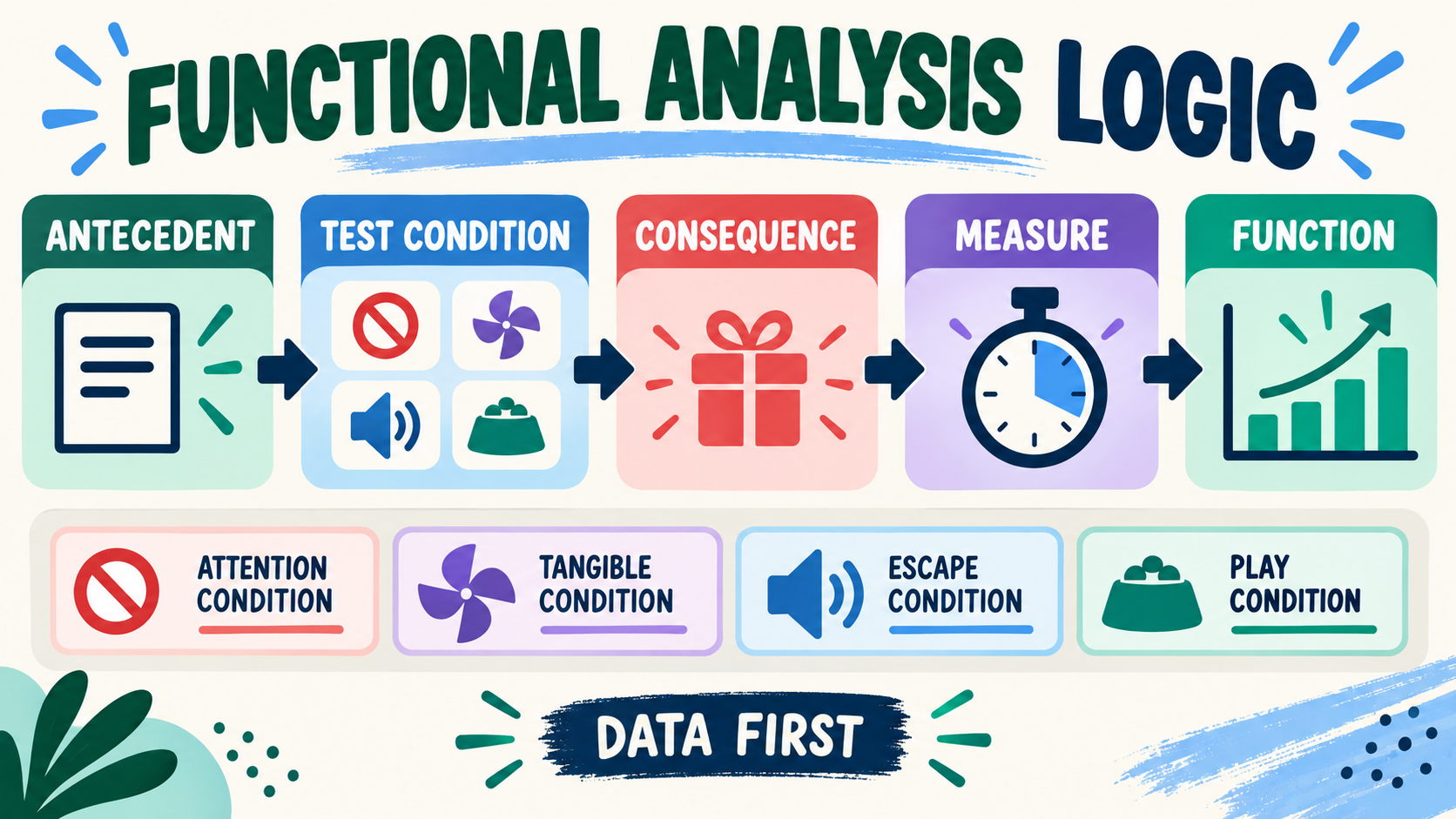
For exam purposes, track four pieces of logic:
- Define the response: State exactly what counts, how it will be measured, and what does not count.
- Arrange a condition: Present or remove a relevant event in a planned, repeatable way.
- Measure the outcome: Record rate, frequency, duration, latency, or another measure that fits the response.
- Compare conditions: Look for a differentiated and replicable pattern, not one isolated occurrence.
In a simple example, a demand condition may arrange work requirements and a consequence that ends the task after the target response. An attention condition may arrange limited attention and deliver attention after the response. A tangible condition may arrange restricted access to an item and provide access after the response. A play or control condition generally provides enriched materials and attention with few demands. The exact arrangement is individualized and should never be treated as a home experiment.
What Do the Common Conditions Test?
Condition labels are shorthand for the contingency being evaluated. They are not labels for a person, a diagnosis, or a permanent “type” of behavior.
| Condition example | What is arranged? | Exam reasoning |
|---|---|---|
| Attention | Limited attention before the response and attention after it, according to the design. | A higher response pattern can support an attention-maintained hypothesis. |
| Escape | A task or demand is presented, with a planned break or removal after the response. | The question is whether ending or delaying the task is the relevant consequence. |
| Tangible | Access to a preferred item or activity is restricted and then delivered after the response. | The response pattern is compared with other conditions before drawing a conclusion. |
| Alone or play/control | The arrangement changes depending on whether stimulation, attention, or demands are freely available. | Use the actual design details; do not assume that every “alone” or “play” label means the same thing. |
The University of Florida course material distinguishes functional or experimental analysis from descriptive and indirect approaches. That distinction is often more important than memorizing a list of condition names.
How Do You Read Functional Analysis Data?
Look for a pattern across repeated sessions or comparable observations. If responding is consistently higher in the attention condition than in the other conditions, attention is a stronger hypothesis than if one high point appears only once. If responding is highest during demands and drops when the task is removed, escape may be implicated. If all conditions produce similar levels, the result may be undifferentiated, which means the data do not clearly support one tested function.
On a BCBA question, separate what the graph shows from what the analyst may do next. A differentiated pattern is evidence about a maintaining contingency; it is not automatically a complete treatment plan. Check the y-axis, the response definition, the condition legend, the direction of the pattern, and whether replication or experimental control is demonstrated.
How Is Functional Analysis Different from FBA?
FBA is the broader assessment process. It can include record review, interviews, rating scales, direct observation, descriptive analysis, and functional analysis. A functional analysis is one experimental component within that larger decision process when the team can arrange conditions safely and ethically.
| Method | Core evidence | What it can and cannot show |
|---|---|---|
| Indirect assessment | Interview, questionnaire, or rating-scale report. | Efficient hypothesis generation; it does not experimentally demonstrate a contingency. |
| Descriptive assessment | Direct observation of naturally occurring antecedents and consequences. | Shows correlations or patterns in context; the events may be confounded. |
| Functional analysis | Planned manipulation of relevant environmental variables with measurement. | Can provide stronger evidence for a cause-and-effect relation when the design is valid and safe. |
What Are the Main Limits and Safety Questions?
Functional analysis is powerful because it changes conditions, but that same feature creates responsibility. A team must consider the severity and probability of the behavior, protective procedures, assent and communication, session termination criteria, staff competence, and whether the arrangement is clinically justified. An analysis of dangerous behavior is not a worksheet exercise.
There are also practical limits. A setting may not reproduce the natural context, a brief analysis may not capture every variable, and some patterns may remain unclear. The University of Florida research material illustrates that questions such as clinic versus home context can matter. A qualified analyst may use an adapted, brief, synthesized, or other design when it fits the case, but the label alone does not establish validity.
How Does This Appear on the BCBA Exam?
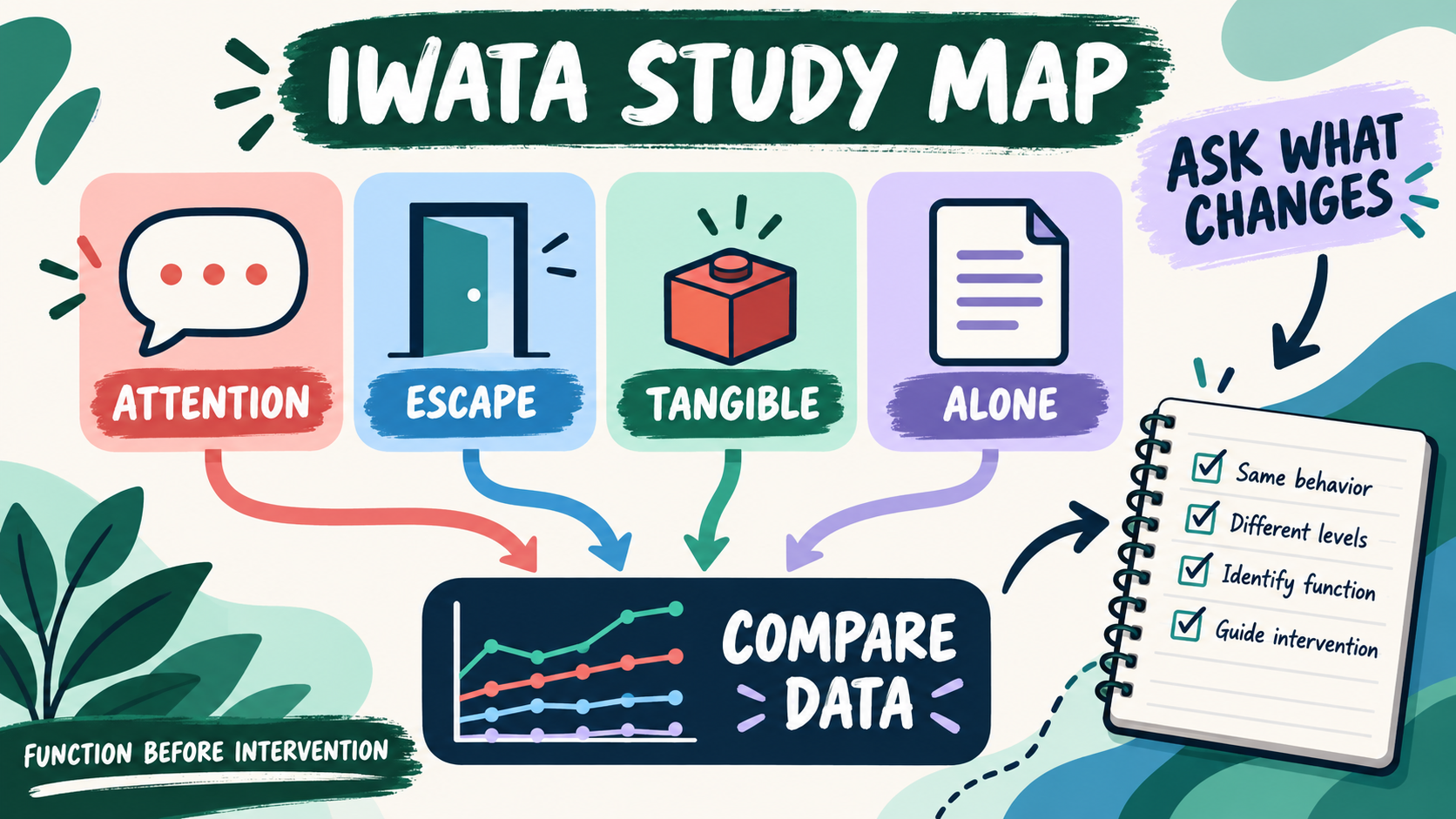
Use the question stem to identify the assessment logic:
- If the analyst asks caregivers what usually happens, think indirect assessment.
- If the analyst watches naturally occurring events without arranging them, think descriptive assessment.
- If the analyst systematically changes a consequence or condition and compares response levels, think functional analysis.
- If the stem asks for a broader process that may include interviews, observation, and experiments, think FBA.
The current BACB task-list hub links the Sixth Edition Test Content Outline effective January 1, 2025. Study the assessment and data language in the outline, then practice explaining why one method supports a stronger or weaker inference. The exam rewards matching the method to the question, not selecting “functional analysis” because it sounds more scientific.
What Would the Exam Reasoning Look Like?
Imagine a stem says that a learner engages in a response during work, and the analyst alternates demand, attention, tangible, and play conditions while recording response rate. The strongest answer will identify an experimental functional analysis. If the response rate is consistently highest during demand sessions and lower in the comparison condition, the data support an escape-related hypothesis.
Now change the stem: a teacher reports that the response usually occurs during difficult work, and a consultant reviews classroom notes. That is useful information, but it is indirect or descriptive evidence depending on what was collected. It does not become a functional analysis simply because the suspected function is escape.
Finally, avoid the common trap of jumping from “escape function” to a specific intervention without checking the question. If the item asks for the assessment method, answer the method. If it asks what the graph supports, answer the hypothesis. If it asks for an ethical or safety step, use the facts in the stem and do not assume that an untrained person should reproduce the analysis.
Brian Iwata Functional Analysis Study Checklist
Before moving to a new practice question, make sure you can:
- Define functional analysis as an experimental test of a possible cause-and-effect relation.
- Explain why Iwata’s work is connected to functional-analysis methodology.
- Distinguish functional analysis from the broader FBA process.
- Match attention, escape, tangible, and control/play arrangements to the contingency being tested.
- Recognize differentiation, replication, and an undifferentiated result on a graph.
- State one reason safety, ethics, and individualized design matter.
For more scenario practice, use the free BCBA mock exam. It is an independent study aid, not official BACB material and not a clinical assessment tool.
Brian Iwata Functional Analysis FAQ
Is Brian Iwata the inventor of functional analysis? Avoid reducing a research tradition to one person. Iwata’s work is highly associated with functional-analysis methodology, especially research on self-injury, but functional analysis has a broader scientific history and continuing development. Is functional analysis the same as an FBA? No. FBA is the broader assessment process. Functional analysis is an experimental method that may be included when the team can arrange and evaluate conditions safely.
What are the four functions in an Iwata functional analysis? Study the common attention, escape, tangible, and automatic or alone-related hypotheses, but read the actual condition description. The labels and arrangements can vary, and a condition label alone does not prove a function. What does a high rate in one condition mean? A consistent, differentiated pattern can support a hypothesis about the relevant maintaining consequence. Interpret the graph with its measurement, comparison, replication, and design details.
Can I conduct a functional analysis at home for study? No. A BCBA candidate can study the logic with examples and graphs, but should not recreate a clinical analysis, especially with dangerous behavior. Real cases require qualified supervision, safety planning, and individualized ethical judgment.
Take the Free BCBA Mock Exam
If you want a low-pressure way to check your recall, use the free practice resource below. Take the Free BCBA Mock Exam



