
What Is an Applied Behaviour Analysis Book and Why It Matters for the BCBA Exam
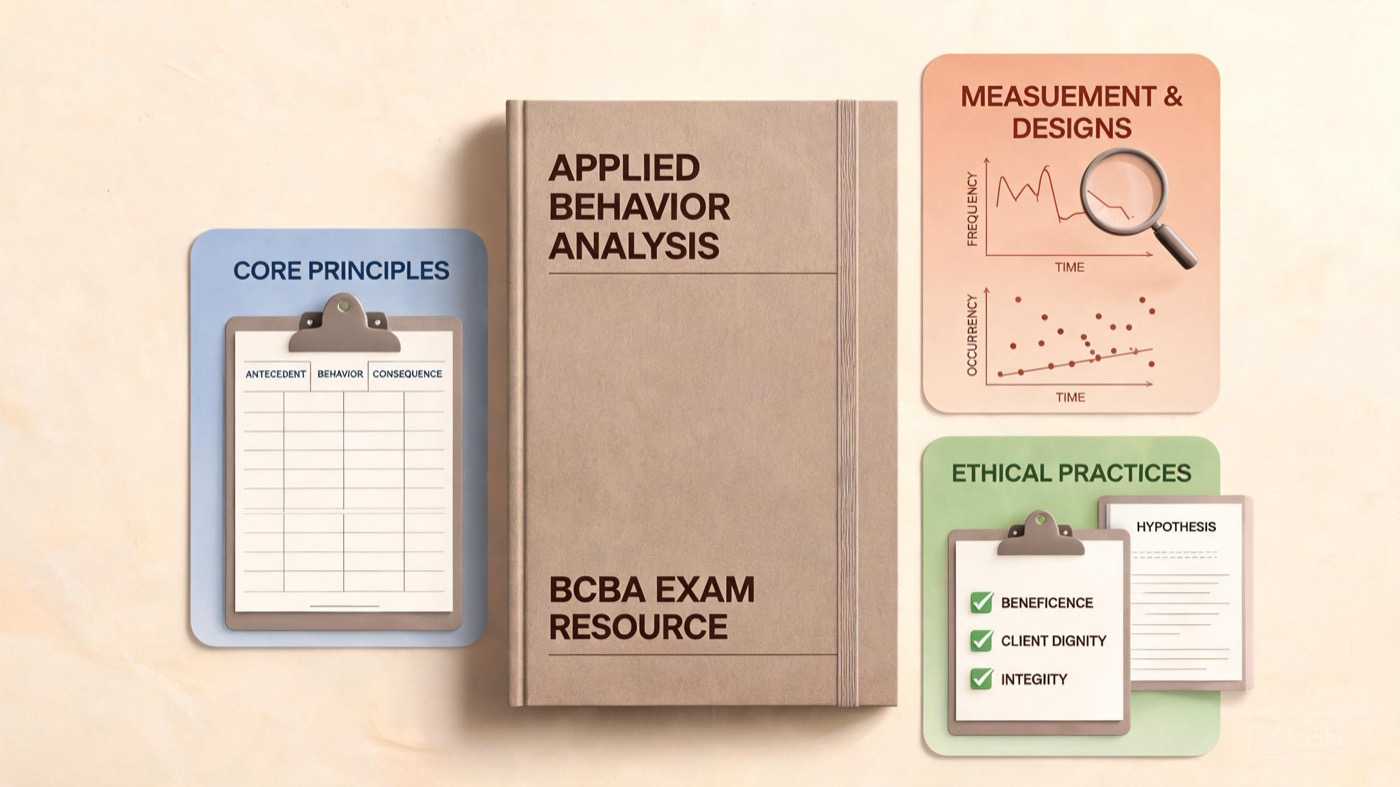
An applied behaviour analysis book is more than a textbook; it is a focused resource that explains core behavioral principles, measurement techniques, experimental designs, and ethical practices. For BCBA candidates, these books are essential because they align with the BACB Task List and provide the foundational knowledge needed to answer exam questions accurately.
Table of Contents
- What Is an Applied Behaviour Analysis Book and Why It Matters for the BCBA Exam
- Top ABA Books Compared for BCBA Exam Success
- Using ABA Books for Exam Preparation: Study Strategies and Examples
- Quick Checklist: Selecting Your Applied Behaviour Analysis Book for the BCBA Exam
- Making the Most of Your ABA Book: From Reading to Passing
Key Components of an ABA Textbook
Most reputable ABA textbooks cover several critical areas. Look for chapters on behavioral principles (reinforcement, punishment, extinction), measurement (frequency, duration, latency), experimental design (reversal, multiple baseline), and ethics. A good book also includes real-world examples that illustrate how concepts apply in clinical settings.
How ABA Books Align with BCBA Task List
The BACB Task List is the blueprint for the exam. A strong applied behaviour analysis book maps each chapter to specific task items. For instance, a section on differential reinforcement directly relates to tasks under ‘Behavior-Change Procedures.’ When reviewing a book, check if it references the Task List or includes practice questions that mirror exam formats.
Top ABA Books Compared for BCBA Exam Success
Choosing the right book can make a difference in your study efficiency. Below we compare two widely used options.
Cooper, Heron, and Heward – A Comprehensive Classic
This is the gold standard. Cooper et al. provides unparalleled depth on every topic, from basic principles to advanced concepts like equivalence-based instruction. Its strengths include thorough explanations, research citations, and alignment with the BACB task list. However, its length (over 900 pages) can be overwhelming for quick review. Use it as a primary reference for deep understanding.
Applied Behavior Analysis: Principles and Procedures in ABA – A Practical Alternative
This book is shorter and more applied. It uses clear, concise language and emphasizes real-world examples. It is excellent for candidates who want a quicker read or need to reinforce concepts before the exam. Just note that it may lack some of the theoretical depth required for complex questions. Use it for review and fluency building.
Other useful books include ‘Handbook of Applied Behavior Analysis’ for advanced topics and ‘Behavior Modification: Principles and Procedures’ by Miltenberger, which is great for practical procedures.
Using ABA Books for Exam Preparation: Study Strategies and Examples
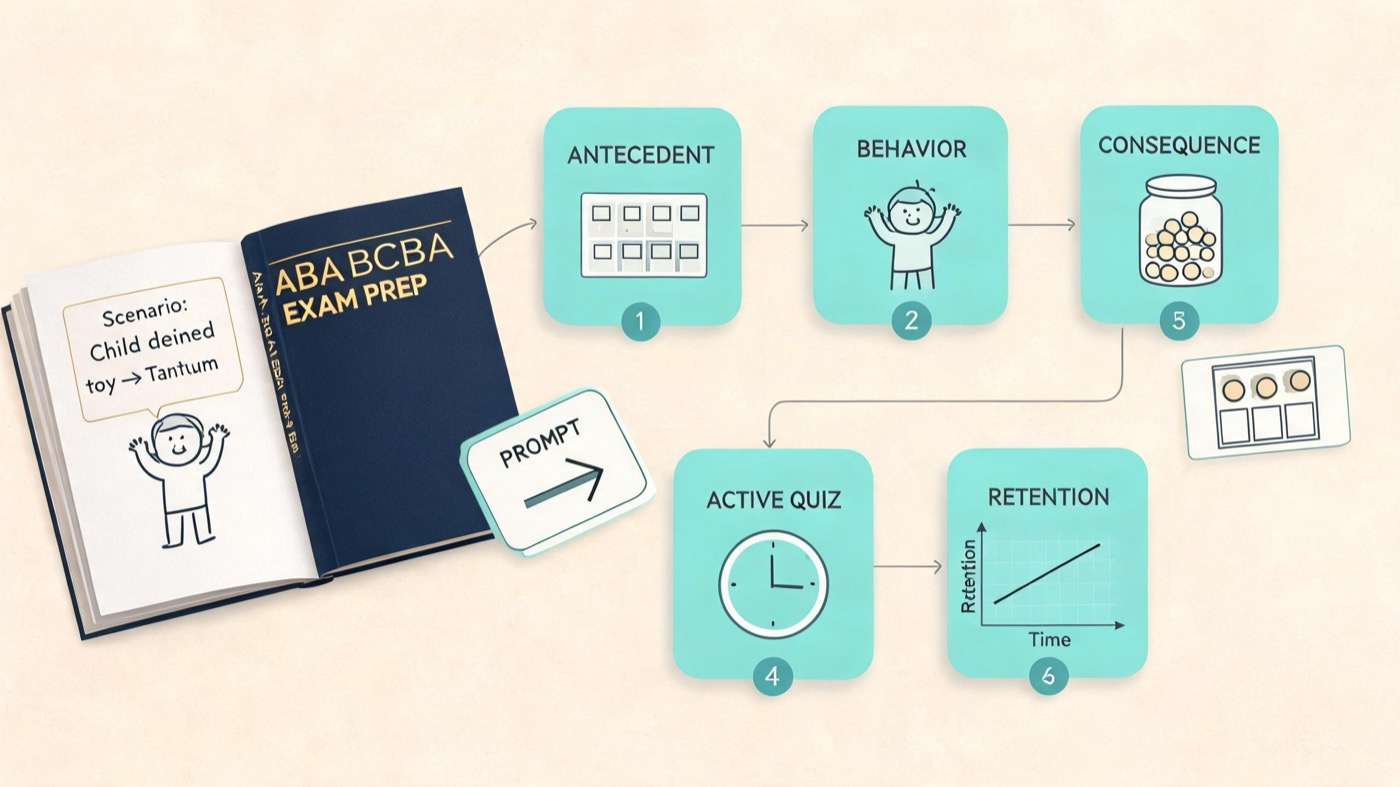
Reading passively is not enough. Active study strategies, such as completing chapter quizzes and creating concept maps, improve retention. Below is a worked example from a typical ABA book section.
Example: ABC Analysis of Tantrum Behavior
A common exam scenario involves analyzing a child’s tantrum. Using the three-term contingency:
- Antecedent: Parent denies candy at the grocery store.
- Behavior: Child cries, screams, and falls to the floor.
- Consequence: Parent gives candy to stop the noise.
The function is access to tangibles. On the exam, you might be asked to identify the function or choose an intervention. This example shows how books help you break down behaviors systematically.
Example: Escape from Task Demands
Another common ABC pattern involves escape. Consider a student who throws a worksheet when asked to solve a math problem. The antecedent is the demand, the behavior is throwing, and the consequence is removal of the task. The function here is escape from demands. Understanding these nuances prevents function confusion.
Common Exam Traps When Interpreting ABA Book Content
Many candidates misinterpret examples due to subtle differences. Watch for these traps:
- Function confusion: Mistaking attention-maintained behavior for tangible-maintained. For instance, if a child whines and receives a toy, it is tangible; if the whining results in eye contact or reprimands, it is attention.
- Multiple control: Behaviors can serve more than one function. A child might tantrum for attention in one context and for escape in another. Books often simplify to teach the concept, but exam questions may test your ability to recognize multiple control.
- Overgeneralization: Assuming that a consequence always strengthens behavior. For example, if a consequence is not reinforcing, the behavior may not increase. Always consider the individual’s history.
Quick Checklist: Selecting Your Applied Behaviour Analysis Book for the BCBA Exam
When choosing a book, use this checklist to ensure it meets your needs.
- Verify Task List alignment: Does the book reference the current BACB Task List (6th edition)?
- Check for practice questions: Are there end-of-chapter questions with answer explanations?
- Look for real examples: Does the book include case studies or ABC analyses?
- Assess readability: Is the writing style clear and easy to follow?
- Consider supplemental materials: Does it come with online quizzes, flashcards, or videos?
- Read reviews from past candidates: Look for feedback on exam relevance from BCBA passers.
By using this checklist, you can avoid buying a book that is too theoretical or outdated. For a structured study plan that integrates book study with mock exams, see our BCBA exam study framework.
Making the Most of Your ABA Book: From Reading to Passing
Your book is a tool, not a replacement for active practice. Combine book reading with mock exams and flashcards. For example, after reading a chapter on schedules of reinforcement, take a practice quiz on that topic. This interleaving improves long-term retention.
Additionally, discuss concepts with peers or join study groups. Teaching a concept from your applied behaviour analysis book to someone else is a powerful way to solidify understanding. Finally, review the BACB’s official resources and ethical guidelines, which are tested on the exam. For more details, visit the BACB website.
With the right book and a focused study strategy, you can confidently prepare for the BCBA exam. Good luck!



