
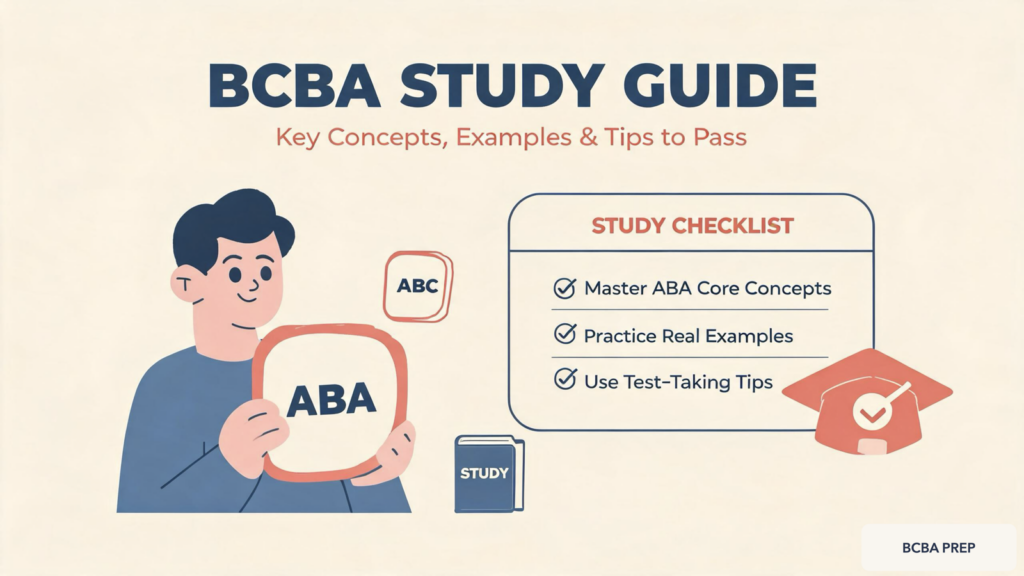
What Is the BCBA Exam? A Quick Overview
If you are preparing for the Board Certified Behavior Analyst (BCBA) exam, you likely know it is a rigorous test of your knowledge in applied behavior analysis. This BCBA study guide will help you focus on the most critical concepts and practical applications. The exam is administered by the BACB and consists of 160 multiple-choice questions covering ethics, assessment, intervention, and behavior-change procedures.
Table of Contents
- What Is the BCBA Exam? A Quick Overview
- Core Concepts Every BCBA Candidate Must Master
- BCBA Study Guide: Worked Examples from Real Exam Scenarios
- Exam Relevance: How These Concepts Appear on the Test
- Quick Checklist for Your BCBA Exam Preparation
- Final Summary: Putting It All Together
- References
Understanding the exam structure is the first step. The domains include: ethical and professional conduct, concepts and principles, assessment, intervention, and implementation. Each domain requires both conceptual knowledge and the ability to apply ABA in real-life scenarios.
Core Concepts Every BCBA Candidate Must Master
To pass the BCBA exam, you must be fluent in the foundational principles of ABA. This section covers two essential areas: defining behavior and understanding the functions of behavior.
Defining Behavior in Observable Terms
Behavior must be defined in a way that is observable and measurable. Use the dead man’s test: if a dead man can do it, it is not behavior. For example, ‘sitting still’ is not behavior because a dead man can sit still. Instead, define ‘remaining seated with back against the chair for 10 seconds’ as a behavioral definition. Operational definitions ensure inter-observer agreement.
Functions of Behavior: Escape, Attention, Tangible, Sensory
Every behavior serves one of four functions: escape from demands or aversive situations, attention from others, access to tangibles (items/activities), or sensory stimulation (automatic reinforcement). Identifying the function is critical for selecting effective interventions. For instance, if a child hits to escape math homework, the intervention should target teaching a replacement behavior (e.g., asking for a break).
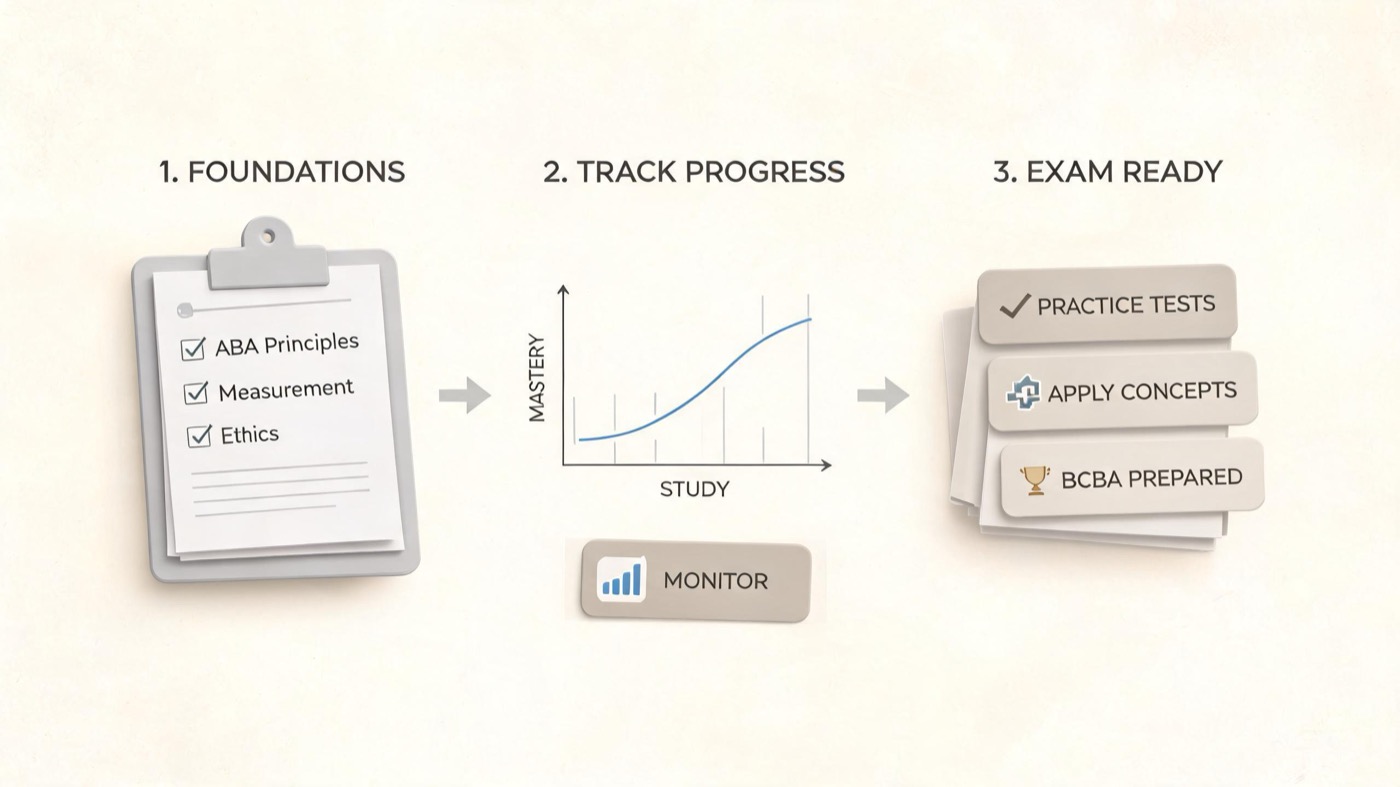
BCBA Study Guide: Worked Examples from Real Exam Scenarios
Applying concepts to real-life examples strengthens your exam performance. Below are three common ABC (Antecedent-Behavior-Consequence) scenarios with hypothesized functions.
Example 1: Escape from Demands
Antecedent: Teacher presents a worksheet to a student. Behavior: Student throws the worksheet on the floor. Consequence: Teacher removes the worksheet and says, ‘You can do it later.’ Hypothesized function: Escape from demands. The behavior is negatively reinforced by removal of the task. Intervention: Use escape extinction (do not remove the task) and teach a functional communication response (e.g., ‘I need a break’).
Example 2: Attention-Seeking Behavior
Antecedent: A child is playing alone while her mother is on the phone. Behavior: Child screams loudly. Consequence: Mother stops her call and says, ‘What is wrong?’ Hypothesized function: Attention. The behavior is positively reinforced by adult attention. Intervention: Provide non-contingent attention (NCR) on a fixed-time schedule and teach appropriate ways to request attention (e.g., tapping mother’s arm).
Example 3: Access to Tangibles
Antecedent: A teenager sees a video game controller on the shelf. Behavior: Teenager grabs the controller and refuses to return it. Consequence: Parent allows 30 minutes of game time to avoid a meltdown. Hypothesized function: Access to tangibles. The behavior is positively reinforced by gaining access. Intervention: Use functional communication training (FCT) to teach requesting the item appropriately, and implement a token economy for delayed access.
Example 4: Automatic Reinforcement
Antecedent: Individual is alone in a quiet room. Behavior: Hand-flapping for several seconds. Consequence: No social consequence; the behavior produces sensory stimulation. Hypothesized function: Automatic/sensory reinforcement. The behavior directly produces its own reinforcer. Intervention: Provide competing sensory activities (e.g., textured toys) and reinforce engagement with those activities.
Exam Relevance: How These Concepts Appear on the Test
Understanding each function is crucial because exam questions often present a scenario and ask you to identify the function or choose the best intervention. Being able to discriminate among functions is a key skill tested repeatedly.
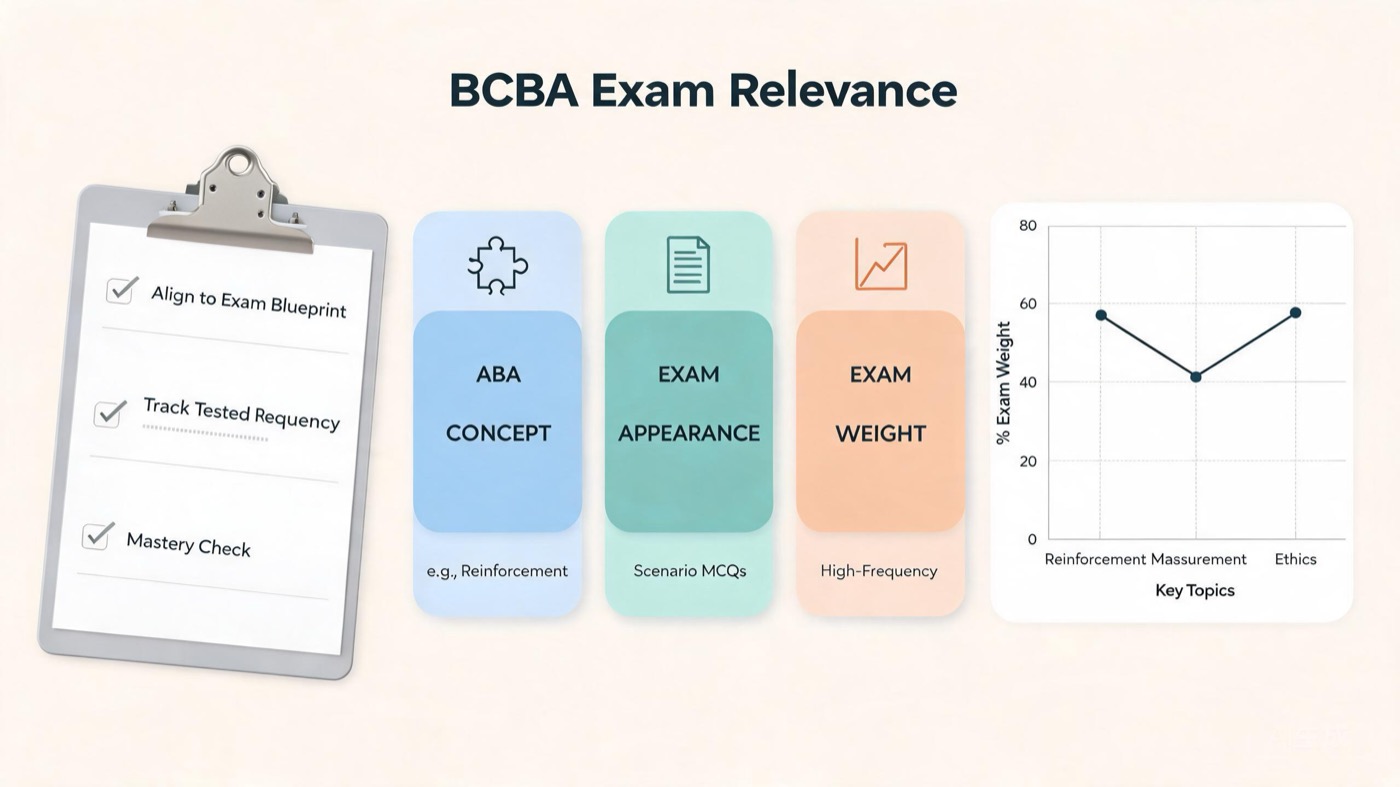
Common Exam Traps: Overgeneralizing Functions
Many candidates assume that all problem behavior is maintained by escape. However, behavior can have multiple functions or shift over time. For example, a child who initially acts out for attention may later use the same behavior to escape tasks if the attention is removed. Another trap is confusing sensory with escape: if a behavior occurs both during demands and during alone time, it might serve an automatic function. Always consider the motivating operations and consequences present.
Common Exam Trap: Ignoring Environmental Context
Sometimes the antecedent is subtle. For instance, a request delivered in a loud voice may function differently than a calm request. Pay attention to setting events and establishing operations. The exam will test your ability to identify subtle changes that alter the function.
Mastering Functional Assessment Questions
Exam questions often ask you to distinguish between indirect assessment (e.g., interviews), descriptive assessment (ABC continuous recording), and functional analysis (FA). You should know that FA is the only method that demonstrates experimental control. Be prepared to interpret graphical data from an FA to identify the function.
Quick Checklist for Your BCBA Exam Preparation
Use this checklist to track your study progress:
- Define behavior in observable, measurable terms using the dead man’s test.
- Memorize the four functions of behavior and their corresponding reinforcers.
- Practice ABC analysis with multiple scenarios until you can quickly hypothesize a function.
- Review functional assessment methods: indirect, descriptive, and functional analysis.
- Identify common exam traps like overgeneralizing functions or misreading antecedents.
- Take a free BCBA mock exam to assess your readiness.
- Review the BACB Task List (6th edition) to ensure all content areas are covered.
- Use study tools like flashcards and BCBA 6th Edition flashcards for daily review.
For a comprehensive study framework, explore our BCBA exam prep guide.
Final Summary: Putting It All Together
Mastering the BCBA exam requires conceptual understanding and practical application. This BCBA study guide provided an overview of the exam, core concepts like behavioral definitions and functions of behavior, worked examples to illustrate ABC analysis, common exam traps to avoid, and a quick checklist for your study plan. Consistently applying these strategies will build your fluency and confidence. Remember to practice with real exam-style questions and review the BACB resources. Good luck on your journey to becoming a BCBA!



