
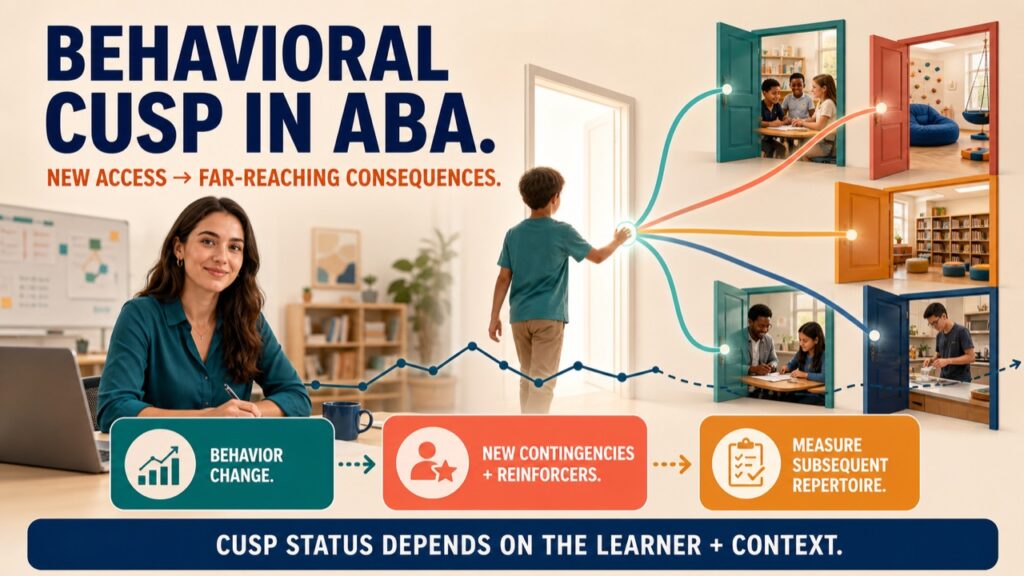
A behavioral cusp in ABA is a behavior change that brings a learner into contact with new contingencies that have consequences beyond the change itself. Rosales-Ruiz and Baer introduced the concept in 1997 to emphasize effects on the learner’s subsequent repertoire, not the behavior’s appearance or the learner’s age. A newly reliable request could function as a cusp if it opens access to people, activities, information, and further learning that were previously difficult to contact. The same request may not be a cusp for a learner who already has equally effective ways to obtain that access. Cusp status is therefore an individual, contextual, and longitudinal judgment rather than a label attached to a topography.
Table of Contents
- What Is a Behavioral Cusp in ABA?
- Criteria for Evaluating a Behavioral Cusp
- Behavioral Cusp vs. Other Concepts
- Examples of Behavioral Cusps in ABA
- Stimulus Control and Behavioral Cusps
- Common Traps When Identifying Behavioral Cusps
- Study Checklist for Behavioral Cusp
- Put Your Knowledge to the Test
- References
What Is a Behavioral Cusp in ABA?
A behavioral cusp is identified by what changes after the response enters the learner’s repertoire. It may produce access to new contingencies, new reinforcers, environments, responses, or stimulus classes, but it does not guarantee an untaught cascade or eliminate the need for instruction. Walking is a classic candidate because locomotion can contact people, objects, places, and consequences that were previously inaccessible. Pointing, reading, imitation, or using a communication device may also be candidates when the new access materially changes later learning. The analyst should measure opportunities, contacted consequences, new or expanded responses, generalization, and maintenance over time. A mastered target or an appealing developmental story alone does not demonstrate that a cusp occurred.
Criteria for Evaluating a Behavioral Cusp
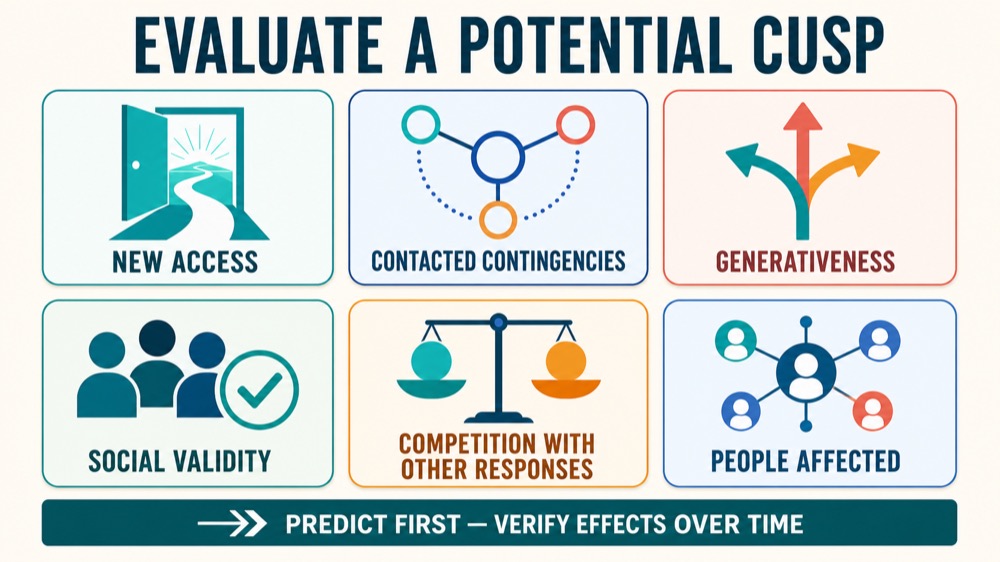
Rosales-Ruiz and Baer emphasized access to new contingencies and the pragmatic importance of the resulting change. Bosch and Fuqua’s 2001 follow-up organized a preliminary set of selection considerations: access to new reinforcers, contingencies, or environments; social validity; generativeness; competition with inappropriate responses; and the number and relative importance of people affected. These are questions for prioritizing and evaluating potential cusps, not a topography-based diagnostic checklist. The first two were drawn from the 1997 analysis, while the latter three were explicitly added in the 2001 model.
- Access to new reinforcers: Does the behavior allow the learner to contact reinforcers that were previously unavailable? For example, learning to read gives a child access to the reinforcement of stories, information, and entertainment.
- Access to new environments: Does the behavior enable the learner to enter new settings? Example: Toilet training may allow a child to attend preschool, opening up a whole new world of learning opportunities.
- Social validity: Is the target and its resulting access important to the learner and relevant stakeholders in this context? Social validity is evidence to collect, not proof that natural contingencies will maintain the response.
- Generativeness: Does the change make additional responses or stimulus relations more likely to emerge or become learnable? Asking questions may contact information that supports later learning, but new performance should be measured rather than assumed.
- Competition with inappropriate responses: Does the new response contact consequences that make an older, harmful, or less effective response less likely? A functional communication response is a candidate when its function, efficiency, and observed effects support that interpretation.
- People affected: How many people are affected, how important are those effects to the learner, and do their changed responses create additional opportunities or barriers? Count and importance are contextual considerations, not guarantees that a socially celebrated skill is a cusp.
Use the criteria to form a testable prediction, then evaluate effects. Independently operating a transit-card reader could be a cusp for one learner if it reliably enables access to transportation, work, recreation, and new social contingencies. The same response may add little new access for someone who already travels independently by another method. Record the baseline opportunity structure, the new environments or consequences actually contacted, and changes in the subsequent repertoire. Avoid calling the target a cusp solely because it is useful, age-typical, preferred by adults, or mastered to a preset percentage.
Behavioral Cusp vs. Other Concepts
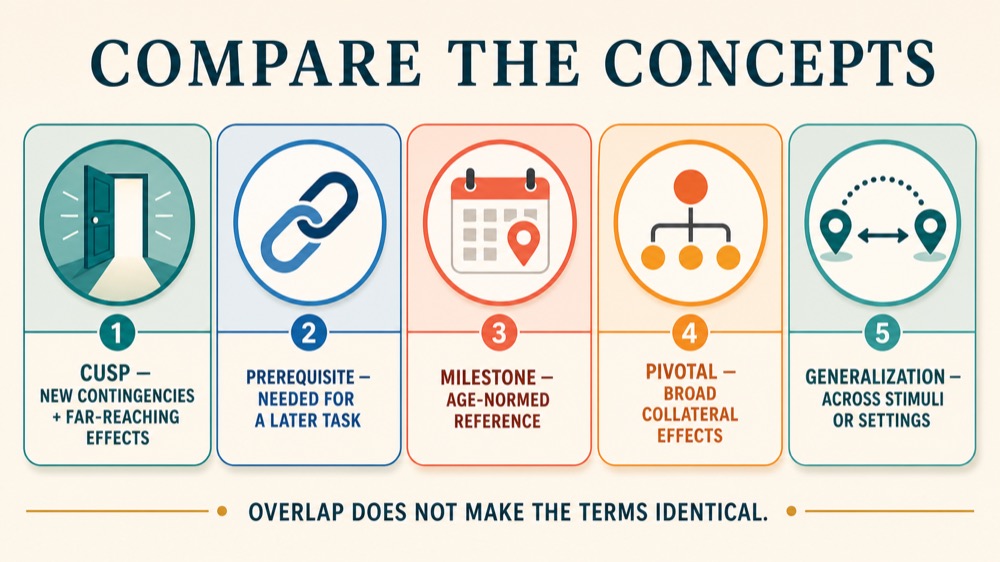
- Prerequisite skill: A prerequisite is a response needed to perform or efficiently teach a later task. Not every prerequisite opens contact with far-reaching new contingencies. For example, locating the correct icon may be required before independently using a communication system, but the icon-selection response is not automatically the cusp; its downstream effects must be evaluated.
- Developmental milestone: Milestones are age-normed skills typical for a given stage. A cusp is defined by its functional impact, not the age at which it occurs. Not every milestone is a cusp; walking is often a cusp because it grants access to new environments, but saying a few words may not be if the child already communicates effectively.
- Pivotal behavior: This label emphasizes a change associated with broad collateral effects across areas of functioning. A cusp emphasizes entry into new contingencies with far-reaching consequences. The concepts overlap in some analyses, but they are not interchangeable; classify the case from the stated definition and observed effects rather than from the size of the goal.
- Generalization outcome: Generalization refers to the occurrence of a behavior under different stimuli or settings. A cusp often involves generalization, but generalization alone does not make a cusp. The cusp is about the impact of that generalized behavior on further learning.
- Mastery criterion: Mastery criterion is a performance standard (e.g., 90% accuracy). Achieving mastery does not indicate a cusp; the behavior must also produce new access and subsequent learning.
Examples of Behavioral Cusps in ABA
- Example 1: Imitation. For a learner who rarely imitates, a reliable generalized imitation repertoire may function as a cusp if it produces measurable access to learning from models across play, self-care, school, or work routines. Additional imitation practice is not necessarily a cusp when equivalent observational-learning access is already established.
- Example 2: Using a task sequence. For an adult in job training, independently using a visual sequence could be a cusp if it enables contact with varied work tasks, coworker feedback, and additional training opportunities. Employment or social acceptance is not guaranteed. For a learner who already completes comparable sequences across settings, the same target may add no meaningful new access.
- Example 3: Self-initiation. Teaching a child to request help when stuck on a task can be a cusp if it leads to reduced frustration, increased task completion, and more independent learning. If the child already requests help effectively, further fluency training is not a cusp because it does not generate new learning pathways.
Stimulus Control and Behavioral Cusps
Stimulus control may help explain when a potential cusp response occurs, but it is neither the definition of a cusp nor evidence that one occurred. A schedule, instruction, or other antecedent functions as an SD only when a relevant history of differential reinforcement makes a response more likely in its presence; its appearance alone is insufficient. After a new response is acquired, analysts can examine whether it occurs across appropriate stimuli and settings and whether that broader contact produces access to new contingencies. That question connects cusp analysis with stimulus generalization, while keeping generalization and cusp effects conceptually distinct.
Common Traps When Identifying Behavioral Cusps
- Assuming topography defines the cusp: Two children may both learn to request a cookie. For one, this request opens up social interaction and language; for the other, it only gains a cookie. The cusp is determined by context, not response form.
- Confusing cusps with all important behaviors: Not every valuable behavior is a cusp. Fluency in math facts is beneficial but may not expose the learner to new reinforcers if they already perform adequately.
- Assuming every far-reaching effect is beneficial: New access can contact reinforcing, punishing, helpful, or harmful contingencies. A response that enables unsafe climbing may expand access while creating serious risk. Ethical target selection still requires client-informed social validity, risk mitigation, and direct evaluation of outcomes.
- Thinking a single mastered target proves a cusp: Mastery of one skill does not demonstrate a cusp. The cusp must be measured longitudinally by subsequent access and learning.
- Ignoring social validity: Evaluate whether the target and downstream effects matter to the learner and relevant stakeholders. A change in caregiver or peer behavior can be important evidence, but its absence does not by itself settle whether the learner contacted other far-reaching contingencies.
Study Checklist for Behavioral Cusp
- Can you define a behavioral cusp in your own words, emphasizing function over topography?
- Can you distinguish the 1997 analysis from the preliminary selection criteria organized and extended by Bosch and Fuqua in 2001?
- Can you provide an original example where the same behavior is a cusp for one learner but not another?
- Can you explain how a behavioral cusp differs from a prerequisite skill, developmental milestone, and pivotal behavior?
- Can you identify why topography alone is insufficient to label a behavior as a cusp?
- Can you explain why stimulus control or generalization may accompany a cusp but does not by itself prove far-reaching new access?
- Can you name at least two common traps when identifying behavioral cusps and how to avoid them?
Put Your Knowledge to the Test
The current BCBA Test Content Outline (6th ed.) does not explicitly list “behavioral cusp.” Related tasks address generalization, maintenance, naturally occurring reinforcers, and generative performance, so study the distinctions without treating the term as an explicitly named exam topic. Use our Free BCBA Mock Exam for independently written practice and detailed feedback; it does not reproduce live BACB items or promise this exact topic.
References
- BACB BCBA Test Content Outline (6th Edition)
- Rosales-Ruiz, J., & Baer, D. M. (1997). Behavioral cusps: A developmental and pragmatic concept for behavior analysis. Journal of Applied Behavior Analysis, 30(3), 533–544.
- Bosch, S., & Fuqua, R. W. (2001). Behavioral cusps: A model for selecting target behaviors. Journal of Applied Behavior Analysis, 34(1), 123–125. doi:10.1901/jaba.2001.34-123.
Next step for BCBA exam prep
Turn this topic into exam-day practice
Use this topic as a focused review, then test it in exam-style conditions with a free mock before deciding whether five full-length mocks are the right next step.
Start the Free BCBA Mock ExamContinue with Five Full-Length Mocks — $99
Review the included materials and access details before ordering. No pass guarantee is implied.



