
What Is a Behavior Trap in ABA?
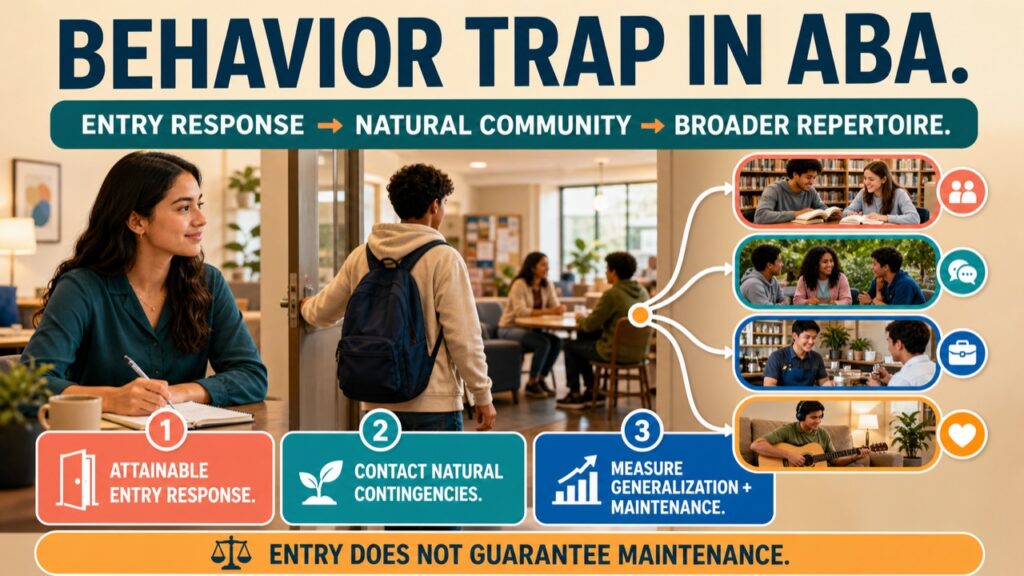
A behavior trap is an arrangement in which a relatively easy entry response brings behavior into contact with a natural community of reinforcement that can shape, expand, and maintain a broader repertoire. The historical source is Baer and Wolf’s 1967 presentation, The Entry into Natural Communities of Reinforcement, not a 1970 publication. Their preschool examples examined how teacher-supported entry into peer interaction could transfer control to reciprocal peer contingencies.
Table of Contents
- What Is a Behavior Trap in ABA?
- Components of a Behavior Trap
- Designing a Behavior Trap
- Distinguishing Behavior Traps from Similar Concepts
- Common Traps in Practice
- Evaluating Whether the Arrangement Worked
- Study Checklist
- Ready to Test Your Knowledge?
- Reference
The phrase behavioral trap ABA can sound negative in ordinary language, but the technical design goal is beneficial, durable participation. The entry response is only the starting point. After the learner enters, naturally occurring social, activity, sensory, academic, or vocational consequences must actually strengthen and differentiate useful behavior. Programmed prompts or reinforcers may still be needed during entry or later repair; the concept does not promise that contrived support disappears automatically. Generalization and maintenance are effects to measure, not properties guaranteed by the label.
Components of a Behavior Trap
Three interacting elements help identify the arrangement. First, the entry response must be attainable with the learner’s current skills or reasonable teaching support. “Easy” is relative to the person and setting; a short spoken request is not low effort for every learner. Second, the natural community of reinforcement is the people, activities, materials, and recurring consequences available after entry. Third, the natural contingencies must select and sustain additional useful behavior over repeated opportunities.
A preferred activity by itself is not a behavior trap. The analyst should be able to specify the entry response, what opportunities it contacts, which consequences are expected to follow which behaviors, and what broader repertoire may develop. Reinforcer value, response effort, accessibility, delay, and social acceptability are individual and contextual. What maintains reading for one learner may not maintain it for another, and a consequence that worked last month may lose value or become unavailable. Direct observation is therefore more informative than calling an activity “naturally reinforcing” in advance.
Designing a Behavior Trap
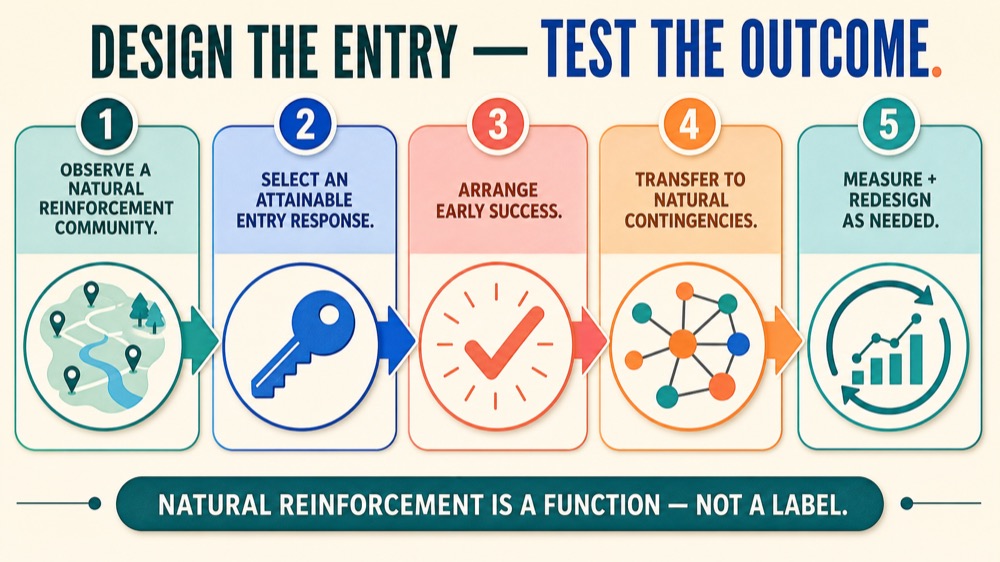
Practical design starts by observing an environment that already supports valued behavior. Identify an attainable entry response, teach or prompt it as needed, and arrange early success without assuming the initial support will be permanent. Then measure whether contact with the setting changes participation, expands the repertoire, transfers control to natural contingencies, and persists when programmed support is thinned. For more on relevant antecedent control, see our guide to stimulus control in ABA.
Define the outcomes before implementation. Measures might include independent entries, time engaged after entry, number or variety of appropriate responses, participation with new people or materials, and performance after prompts or programmed reinforcers are reduced. Include treatment-integrity or opportunity measures so a low response rate is not mistaken for failure when the learner rarely had access. Sample across settings and time to assess generalization and maintenance. If the arrangement does not sustain behavior, reassess response effort, preferences, competing contingencies, accessibility, social responses, and whether the proposed “community” actually delivers the expected consequences.
Example: Peer Interaction Trap: Consider a preschooler who rarely initiates conversation. The entry response might be waving and saying “Hi” to a peer. The natural community is the peer group, which may reinforce further conversation, sharing toys, and joint play. If the peer group ignores or fails to reinforce the entry response, the trap fails. The analyst must assess not only the entry but also whether the natural contingencies actually maintain social behavior.
Example: Reading Trap: A student who can decode a few words may use a simple book-selection routine as the entry response. Story information, illustrations, successful decoding, and conversation with peers are candidate consequences, but their reinforcing function must be demonstrated for that learner. Track independent selections, time reading, new text types, and return to reading after programmed prompts are thinned. If texts are inaccessible or the consequences have little value, the repertoire may not expand.
Examples: Recreation and Vocational Routines: In recreation, learning one attainable action such as joining a walking group at the posted start time may contact conversation, scenery, movement, and repeated invitations. In a vocational routine, using a visual cue to begin one familiar stocking task may contact completed-product feedback, coworker interaction, access to varied tasks, and ordinary workplace consequences. Neither example is a trap merely because the activity is preferred or socially valued. Evidence would include broader independent participation, contact with the proposed consequences, performance with less programmed support, and maintenance over time.
Distinguishing Behavior Traps from Similar Concepts
Use functional features rather than the everyday meaning of “trap”:
- Coercive trap: This is not a synonym for the Baer-and-Wolf arrangement. In ordinary or clinical discussions it may describe escalating coercive interaction, power, or aversive control. Analyze the actual contingencies and risks instead of importing the positive generalization concept.
- Negative-reinforcement cycle: Here a response increases because it terminates, reduces, or postpones an aversive condition. A behavior trap is defined by entry into a wider community that supports a developing repertoire; the two descriptions answer different questions.
- Bribery: This is a colloquial moral label, not a distinct operant process. A promised consequence may still be positive reinforcement, but a one-time offer does not by itself create entry into a naturally sustaining community.
- Hard-to-leave situation: Persistence or difficulty leaving does not establish a behavior trap. Look for an identifiable entry response, contact with a natural reinforcement community, repertoire expansion, and measured generalization or maintenance.
Multiple contingencies may operate in one setting, so positive and negative reinforcement should be identified from their effects on behavior rather than from labels. The educational term does not excuse coercion, restrict choice, or make an arrangement beneficial by definition.
Common Traps in Practice
Behavior analysts should avoid these frequent errors when designing or evaluating behavior traps:
- Calling an activity intrinsically reinforcing: Assess value, effort, delay, accessibility, and actual response change for the individual.
- Measuring entry but not what follows: Record broader repertoire growth, contact with consequences, generalization, and maintenance—not just completion of the first response.
- Choosing an inaccessible entry: Adjust communication mode, prerequisite skills, prompts, environment, or response effort when independent contact is unlikely.
- Ignoring competing or aversive contingencies: Peer rejection, task difficulty, limited access, or weak implementation may outweigh proposed benefits.
- Assuming entry guarantees generalization: Program and measure across people, materials, settings, and time; add teaching or redesign when natural support is insufficient. See our guide to stimulus generalization in ABA.
Evaluating Whether the Arrangement Worked
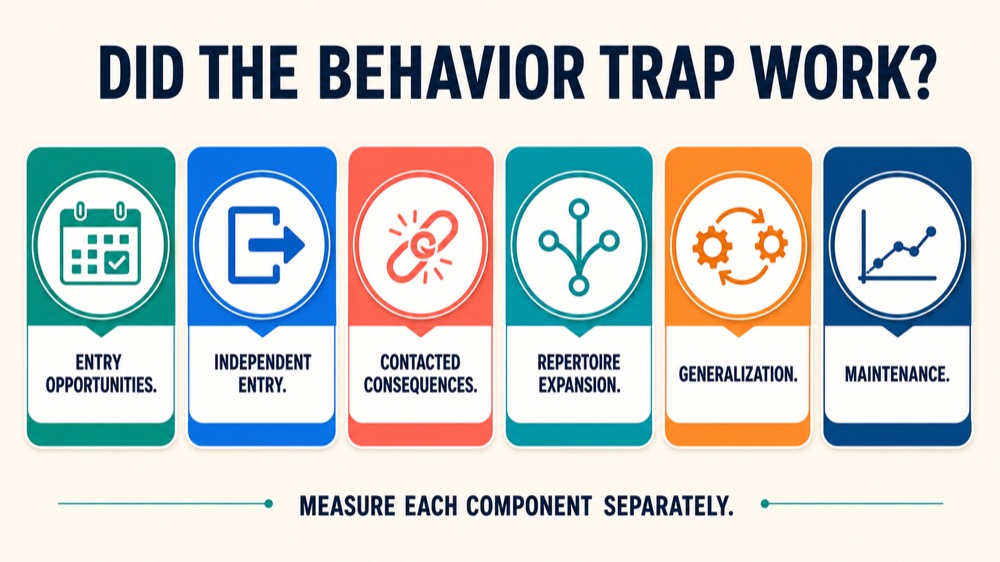
Evaluate the entry, the contacted contingencies, and the broader outcomes separately. A learner may perform the entry response more often while the proposed natural community fails to shape anything else. Conversely, the broader repertoire may improve only while staff continue dense prompting or programmed reinforcement, showing that control has not yet transferred as intended. Plotting these measures separately prevents an increase in one component from being mistaken for complete success.
A practical evaluation can ask six questions. Did the learner have repeated opportunities to enter? Did the entry occur independently and at acceptable effort? What consequences actually followed, and did behavior increase in relation to them? Did new or more varied responses emerge within the setting? Did performance occur with new people, materials, or locations? Did it persist across meaningful time after programmed support was thinned? Answers may reveal a successful arrangement, partial contact that needs redesign, or a setting that is not currently functioning as a reinforcement community for this learner.
Social validity belongs in the evaluation as well. Confirm that the goals and participation are valued by the learner and relevant stakeholders, that access remains voluntary within the service context, and that the arrangement does not expose the learner to avoidable exclusion or excessive effort. Review client preference and assent-related information when applicable. A technically increasing response is not sufficient evidence of a well-designed behavior trap if the larger participation outcome is unwanted, inaccessible, or harmful.
Study Checklist
The current BCBA Test Content Outline (6th ed.) provides related anchors: stimulus and response generalization, response maintenance, procedures to promote generalization, and transfer to naturally occurring reinforcers. Use those observable processes and outcomes to analyze the arrangement rather than memorizing the metaphor alone.
- Define the arrangement through an attainable entry response, a natural community of reinforcement, and natural contingencies.
- Separate the procedure or arrangement from its possible effects on generalization and maintenance.
- Identify original examples in peer, academic, recreation, and vocational settings without treating preference alone as proof.
- Distinguish the concept from coercive interaction, negative reinforcement, bribery language, and mere persistence.
- Specify measures for entry, repertoire expansion, transfer to natural consequences, generalization, maintenance, and implementation.
- Explain why unsuccessful data require reassessment rather than assuming the learner failed to enter correctly.
Use our Free BCBA Mock Exam for independently written practice and feedback across behavior-analytic content. It does not reproduce live BACB exam items or guarantee that this exact term appears.
Ready to Test Your Knowledge?
Use the checklist to analyze whether an arrangement merely creates entry or actually contacts natural consequences that expand and sustain behavior. Our Free BCBA Mock Exam provides independently written practice and feedback, while the source materials linked here remain the basis for this concept.
Reference
- BACB BCBA Test Content Outline
- Baer & Wolf (1967), The Entry into Natural Communities of Reinforcement



