
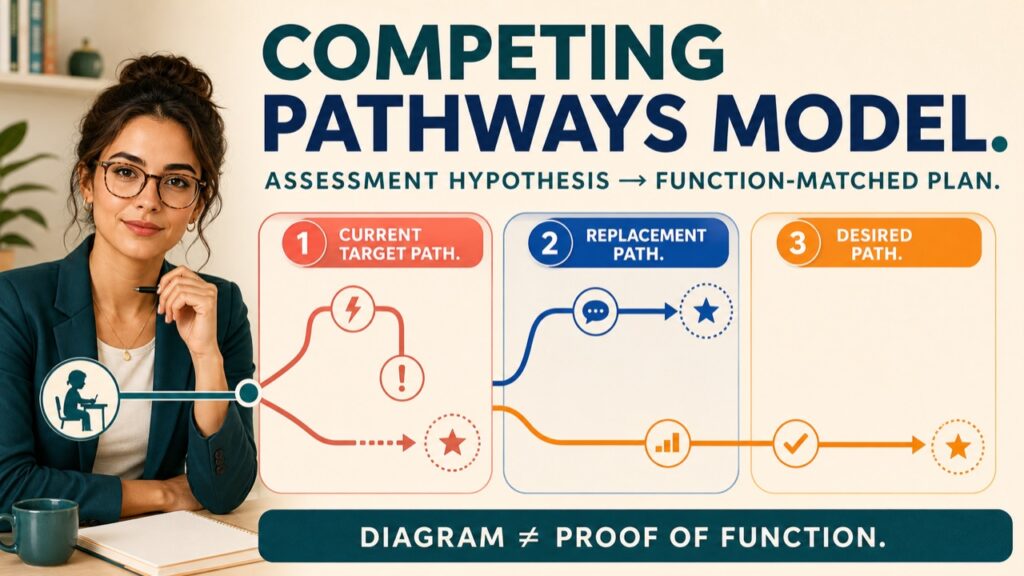
What Is the Competing Pathways Model ABA?
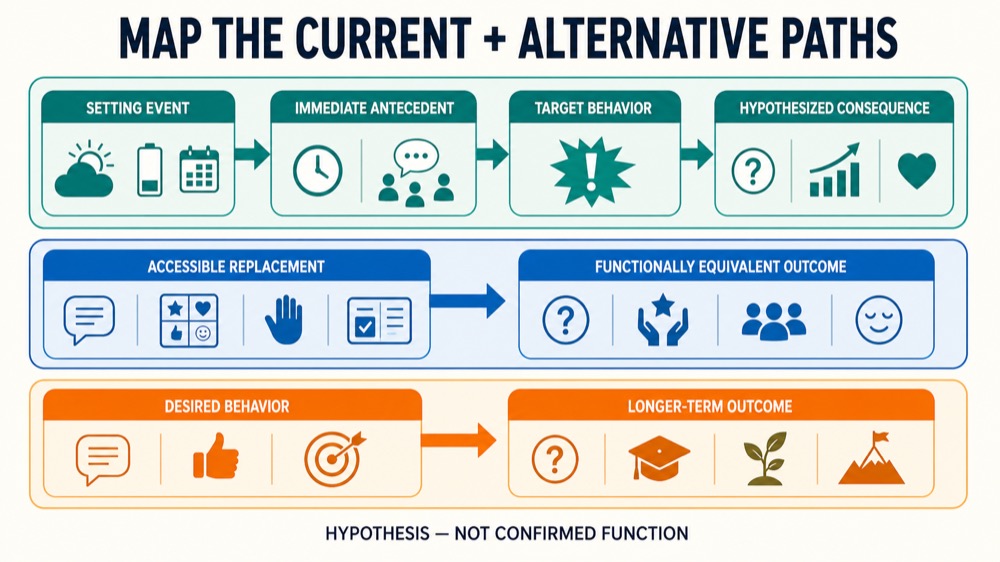
The competing pathways model ABA is a structured visual summary of a functional behavioral assessment hypothesis. It links setting events, immediate antecedents, an operationally defined target behavior, and a hypothesized maintaining consequence. It also identifies a feasible replacement behavior that can contact a functionally equivalent outcome and a desired behavior that represents a longer-term goal.
Table of Contents
- What Is the Competing Pathways Model ABA?
- Practical Example of the Competing Pathways Model
- Step-by-Step Guide to Building a Competing Pathways Diagram
- Mapping Interventions onto the Competing Pathways
- Common Traps and Misconceptions
- Studying the Competing Pathways Model for the BCBA Exam
Templates often display a current target-behavior path, a replacement-behavior path, and a desired-behavior path; conceptually, the latter two form the planned alternative to the current pathway. The diagram helps a team connect prevention, teaching, consequence strategies, implementation supports, and measurement to the assessment hypothesis. It is a planning aid, not proof of function or a universal treatment recipe.
- Setting events: Broader contextual events or conditions associated with a change in the likelihood of the target behavior under later conditions. Some may have motivating effects, but the label does not establish a specific behavioral function. Examples can include fatigue, illness, schedule disruption, or a change in available support.
- Immediate antecedents: Proximal events observed just before the target behavior, such as a task presentation, transition cue, denied request, or loss of attention. An antecedent may have discriminative or motivating functions, but temporal order alone does not establish which function it has or that it causes the response.
- Target behavior: The response selected for assessment and change, defined in observable and measurable terms. Its operational definition describes what counts; the FBA hypothesis separately describes environmental variables that may maintain it.
- Maintaining consequence: The consequence hypothesized to reinforce the target behavior, such as escape, attention, access to an activity or item, or automatic reinforcement. A consequence is maintaining only when assessment evidence supports that effect on future behavior.
- Desired behavior: A client-informed, socially valid longer-term performance, such as participating in appropriately sized work with available support. It may require prerequisite teaching and may contact different or additional natural consequences rather than serving as an immediate substitute.
- Replacement behavior: A feasible alternative designed to contact the same functional outcome as the target behavior, such as an accessible break or help request. It should initially be efficient, reliable, within the learner’s repertoire or readily teachable, and acceptable to the learner and implementation context.
- Setting event vs. immediate antecedent: A setting event is a broader contextual variable associated with different responding under later conditions; an immediate antecedent is the proximal event preceding the response. Either may have discriminative or motivating effects, but those functions require evidence and should not be inferred from timing alone.
- Replacement behavior vs. desired behavior: The replacement is selected for functionally equivalent access and near-term feasibility. The desired behavior is the longer-term performance the team values and may contact different or additional consequences. Requesting help can be a replacement while completing an appropriately adapted task becomes a later goal.
- Pathway hypothesis vs. proof of function: The diagram summarizes the current weight of assessment evidence; it does not confirm a causal relation. Evidence may include records, interviews, direct observation, and—when indicated, feasible, and safe—experimental functional analysis. These methods support different strengths of inference, and outcome data remain necessary after intervention begins.
Practical Example of the Competing Pathways Model
Consider a fictional third-grade student, Maya. Direct observations show that clearly defined disruptive vocalizations occur more often during difficult independent math work and are frequently followed by teacher interaction or assistance. Documented sleep disruption is treated as a possible setting event, the difficult worksheet as an immediate antecedent, and teacher interaction as the hypothesized maintaining consequence. The diagram records hypotheses; it does not convert these correlations into proof.
The team selects an accessible help request as the replacement behavior and participation in appropriately adapted independent work as the desired behavior. The plan provides prompt, reliable help following the request, adjusts task conditions based on assessment, teaches manageable work steps, and measures both responses plus implementation fidelity. Any delay, schedule thinning, or increase in task requirements is gradual and data based while communication remains effective. Safety, assent, feasibility, family and school input, and the student’s outcomes guide revision.
Step-by-Step Guide to Building a Competing Pathways Diagram
- Step 1: Identify the current pathway. Record possible setting events, immediate antecedents, the operationally defined target behavior, and the hypothesized maintaining consequence. Link each entry to the available assessment evidence and state uncertainty where evidence is incomplete.
- Step 2: Define the desired behavior. Specify a client-informed, observable longer-term performance with contextual fit. Identify the skills, supports, and plausible natural consequences needed instead of assuming the environment will reinforce it automatically.
- Step 3: Select a replacement behavior. Choose an accessible response intended to produce the same functional outcome. It should initially be efficient and reliable enough to compete, be acceptable to the learner, fit communication and motor abilities, and be teachable in the actual setting.
- Step 4: Map the alternative pathway. Show the planned antecedent conditions, the replacement response, and prompt access to the functionally equivalent consequence. Add the desired-behavior path and its likely consequences without pretending the original context must remain unchanged.
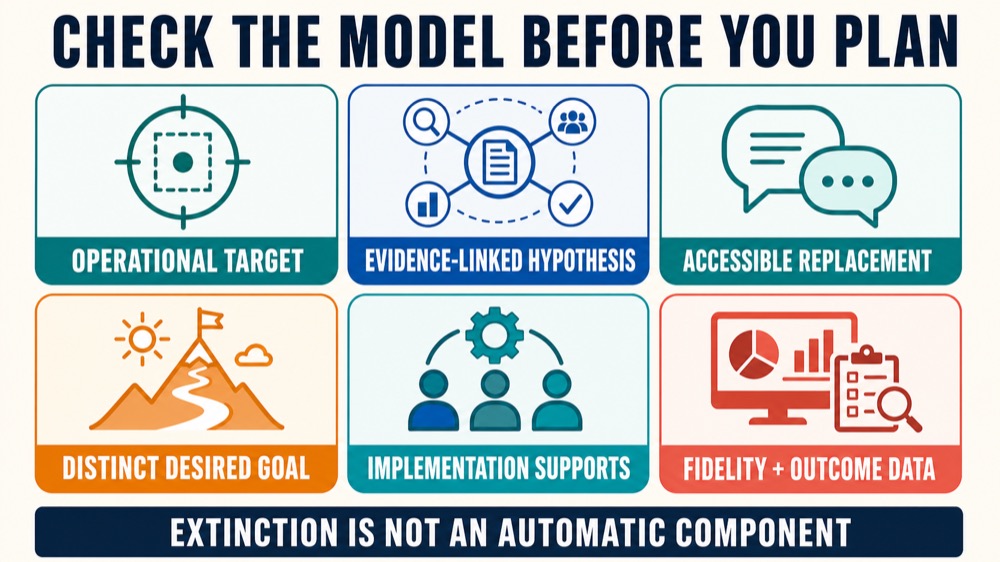
- Step 5: Plan interventions. Map assessment-linked prevention, teaching, reinforcement, response, and safety procedures to the relevant boxes. Extinction is not an automatic component; any use requires a specific rationale, competence, feasibility review, safeguards, and monitoring of intended and unintended effects.
- Step 6: Include implementation supports. Note who will deliver interventions, the context, materials needed, and progress monitoring data collection. Assign team roles and schedule regular review meetings.
Mapping Interventions onto the Competing Pathways
The diagram helps the team ask where support is needed, but a box does not prescribe a procedure. Candidate strategies should follow assessment evidence, client preferences, contextual fit, scientific support, implementer capacity, and risk review. The plan should define what will be measured for the target, replacement, and desired behaviors as well as opportunity, fidelity, and possible unwanted effects.
- Address relevant setting conditions within professional scope: coordinate predictable routines, confirm needed materials and supports, share documented patterns with caregivers, and refer health or medication concerns to qualified professionals rather than prescribing lifestyle or medication changes.
- Select antecedent supports from the hypothesis and context, such as meaningful choice, task adaptation, clearer cues, predictable transitions, or scheduled access to relevant consequences. Do not treat a menu of strategies as function matched without data.
- Teach the replacement response with individualized prompting, modeling, rehearsal, feedback, and reinforcement as appropriate, then program opportunities in the settings where the functional outcome is needed.
- Use shaping if the replacement behavior is complex, reinforcing successive approximations toward the target. For example, first reinforce any appropriate request, then shape a specific phrase.
- Check response effort, delay, reliability, and communication accessibility. The replacement need not be permanently easier, but it usually must be sufficiently efficient during acquisition to compete with the established pathway.
- Arrange prompt, reliable access to the hypothesized functional outcome following the replacement response. Initial schedule density, amount, duration, and later thinning are individualized and evaluated from response and welfare data.
- Build the desired behavior through attainable steps and additional reinforcement while preserving effective communication. Do not make completion of extra demands a hidden condition for honoring a newly taught break or help request unless that contingency is explicitly justified and evaluated.
- Specify differential reinforcement contingencies for replacement and desired behavior. If withholding the maintaining consequence from target behavior is proposed, evaluate whether that is extinction, whether it is feasible and safe, and what less intrusive or reinforcement-based alternatives are available.
- Define response procedures that are least intrusive, feasible, and consistent with the assessed function, client welfare, assent, and the implementer’s competence. Planned ignoring and escape extinction are not generic defaults and can be inappropriate or unsafe in many cases.
- For dangerous behavior, develop an individualized safety or crisis plan with qualified personnel, clear decision rules, training, documentation, and applicable emergency procedures. Basic needs, communication access, medical care, and legally protected rights are not treatment reinforcers to withhold.
- Monitor intended outcomes, distress, escalation, variability, relapse, and other unwanted effects regardless of the selected procedure. Predetermine pause, consultation, modification, and safety criteria rather than assuming a worsening pattern is an expected phase to push through.
- Assign team roles, schedule intervention sessions, and collect data on both problem behavior and replacement behavior frequency, latency, or duration. Use a data sheet that tracks setting events, antecedents, behavior, and consequences for ongoing evaluation.
- Conduct fidelity checks to ensure interventions are implemented as designed. Use visual schedules, checklists, and staff training to support consistent implementation.
- Review data regularly to make data-based decisions. If progress stalls, reassess the function or adjust the replacement behavior.
Common Traps and Misconceptions
- Claiming the diagram proves function: The model organizes a hypothesis, not a confirmed causal relation. Gather direct observation and other appropriate assessment evidence; consider experimental analysis when indicated and safe; and evaluate whether intervention outcomes support or contradict the pathway.
- Equating desired behavior with replacement behavior: They serve different roles; the replacement behavior is the immediate goal, while the desired behavior is the ultimate outcome reached through shaping and fading. Confusing them leads to teaching a behavior that may not contact natural reinforcement.
- Treating setting events as immediate triggers: Setting events describe broader context, whereas immediate antecedents are proximal. Neither label proves an MO, SD, or causal effect. Describe the observed relation and test predictions instead of calling the antecedent a direct trigger.
- Assuming one fixed pathway fits all: Behavior and implementation are context dependent. Separate materially different target responses or hypotheses when needed, and revise the diagram as assessment, fidelity, and outcome data change.
Studying the Competing Pathways Model for the BCBA Exam
- Be able to label possible setting events, immediate antecedents, an operationally defined target behavior, a hypothesized maintaining consequence, a replacement behavior, and a desired behavior.
- Practice drawing the diagram from a case scenario. Label each component correctly.
- Differentiate temporal position from behavioral function: an immediate antecedent may have discriminative or motivating effects, but the diagram alone does not establish an SD, S-delta, or motivating operation.
- Explain why the replacement behavior is selected for functionally equivalent access and why efficiency, reliability, accessibility, and contextual fit matter during acquisition.
- Map prevention, teaching, reinforcement, response, safety, implementation, and measurement supports to the hypothesis without assuming extinction is required.
- Recognize conceptual errors: confusing replacement and desired behavior, treating a pathway as proof, collapsing setting events into immediate antecedents, or ignoring implementation and outcome data.
- Use our Free BCBA Mock Exam for independently written practice and feedback across behavior-analytic content; it does not reproduce live BACB items or promise this exact topic.
The current BCBA Test Content Outline (6th ed.) does not explicitly name the competing pathways model. Study it as a planning framework connected to assessment, function-based intervention, implementation fidelity, and data-based revision—not as guaranteed exam content. For further reading, use the Texas SPED Support competing pathways resource and the open-access article on reinforcement cycles and educator implementation fidelity.
Next step for BCBA exam prep
Turn this topic into exam-day practice
Use this topic as a focused review, then test it in exam-style conditions with a free mock before deciding whether five full-length mocks are the right next step.
Start the Free BCBA Mock Exam
Continue with Five Full-Length Mocks — $99
Review the included materials and access details before ordering. No pass guarantee is implied.



