
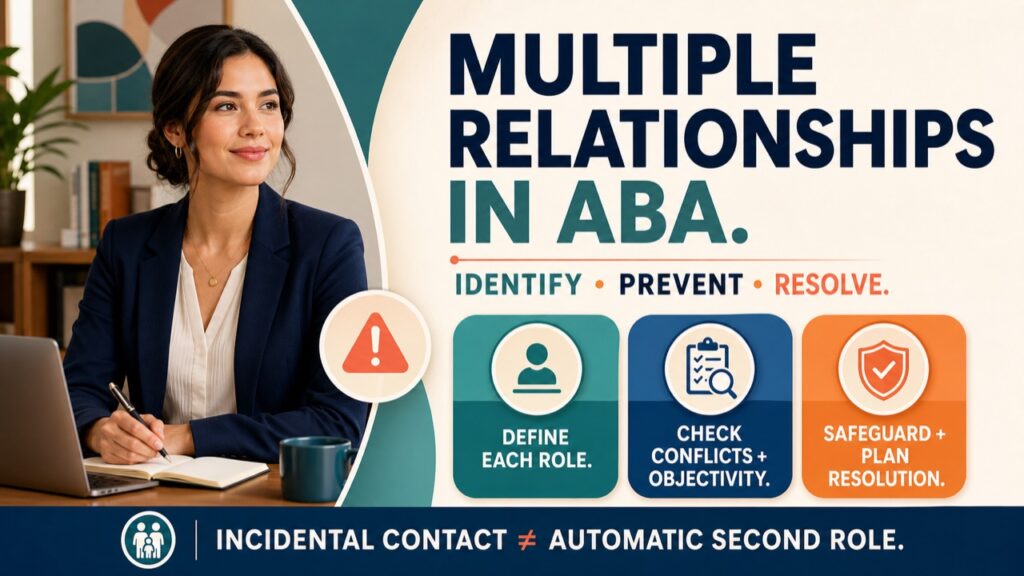
The current BACB Ethics Code for Behavior Analysts uses multiple relationship, not “dual relationship,” as its defined term. The glossary describes a comingling of two or more roles with a client, stakeholder, supervisee, trainee, research participant, or someone closely associated with or related to the client. The search phrase dual relationships aba is common, but the broader Code term is more accurate because more than two roles can overlap.
Table of Contents
- What Is a Multiple Relationship in ABA?
- Why Multiple Relationships Are Risky
- Examples of Multiple Relationships
- Common Traps and Misconceptions
- Prevention and Risk Mitigation
- When to Consult or Transition
- Study Checklist
- Test Your Knowledge with Free BCBA Mock Exam
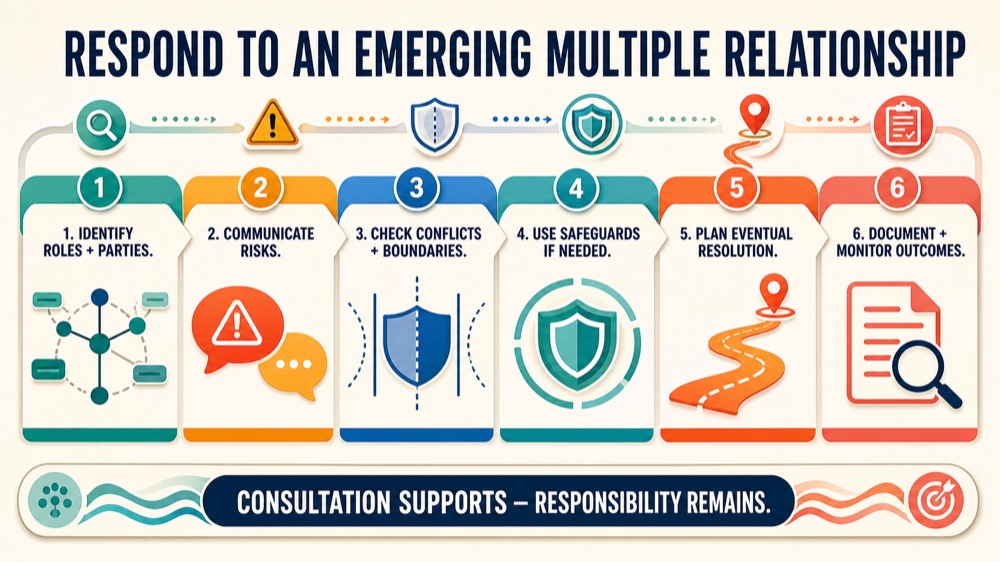
Code 1.11 directs behavior analysts to avoid entering into or creating multiple relationships because they may produce a conflict of interest that harms one or more parties. It also requires communicating the risks, monitoring for development of overlapping roles, taking steps to resolve them, and documenting actions and outcomes. If immediate resolution is not possible, the analyst must establish safeguards that identify and avoid conflicts and create a plan to eventually resolve the relationship.
Incidental contact is not automatically a second role. Seeing a client’s family at a grocery store or attending the same large community event may create privacy or boundary questions without necessarily creating a multiple relationship. The relevant analysis asks whether another role has actually developed and whether it threatens objectivity, confidentiality, professional judgment, welfare, or the ability to maintain appropriate boundaries. The answer is contextual rather than a universal legal rule.
What Is a Multiple Relationship in ABA?
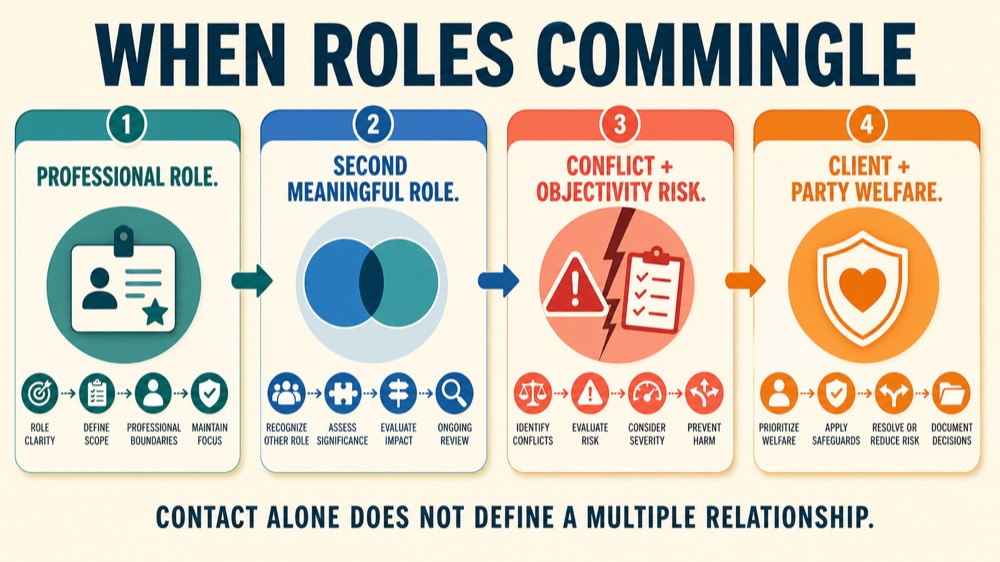
A multiple relationship exists when professional responsibilities are commingled with another meaningful role. Examples may include becoming a business partner with a stakeholder, supervising a close friend, employing someone whose services the analyst is simultaneously evaluating, or developing a personal friendship with a client’s family. A signed side agreement is not required; the functional question is whether the person now participates in two or more roles with competing expectations, power, access, or loyalties.
The current standard is 1.11. It does not say that disclosure or agreement by both parties automatically makes an overlapping role acceptable. Because the behavior analyst controls important professional decisions, consent may coexist with pressure, dependency, or impaired judgment. Prevention therefore starts before the second role forms: clarify the defined professional role, communication channels, financial terms, social-media boundaries, and how foreseeable community contact will be handled.
Ordinary unavoidable contact should be distinguished from a new personal, financial, familial, or organizational role. The same church, school event, or neighborhood does not by itself answer the ethics question. The analyst should examine frequency, privacy, authority, financial benefit, expectations outside service, effects on professional boundaries, and whether either party can realistically decline the added role without professional consequences.
Why Multiple Relationships Are Risky
Multiple relationships in ABA carry several well-documented risks. The most serious include impaired objectivity, conflict of interest, exploitation, confidentiality breaches, and harm to the professional relationship. Each risk can undermine the effectiveness of behavior-analytic services and violate the Ethics Code.
Impaired objectivity occurs when personal feelings color professional decisions. For instance, a behavior analyst who is friends with a client’s parent might hesitate to deliver difficult feedback about the parent’s implementation of a behavior plan. This hesitation could lead to inconsistent intervention and poorer outcomes for the client. Conflict of interest arises when competing loyalties divide the analyst’s commitment. A behavior analyst who also serves on a school board might prioritize the school’s interests over the client’s needs.
Exploitation is a serious concern because the power differential in the professional relationship makes it difficult for clients to refuse additional roles. Even if a client agrees to a business transaction, such as buying a used car from the analyst, the client may feel pressured. Confidentiality can also be compromised when information from one role spills into another. For example, a supervisor who also rents property from a supervisee might inadvertently discuss supervision issues in a social context. Finally, when boundaries blur, the client’s trust erodes, damaging the therapeutic relationship.
Agreement by the other person does not remove the analyst’s responsibilities under 1.11 or the separate ban on coercive and exploitative relationships in 1.13. A client, stakeholder, supervisee, or trainee may agree while still experiencing a power imbalance or fearing consequences. Documentation supports accountability, but it does not transform a harmful arrangement into an ethical one. The analyst must prevent avoidable role commingling, continually monitor emerging risks, and act when judgment, confidentiality, or client welfare could be compromised.
Examples of Multiple Relationships
Examples help identify role commingling, but each category has its own context and sometimes a separate Code standard:
- Personal or social: A behavior analyst and a stakeholder begin a close friendship that adds reciprocal favors and expectations beyond the service agreement.
- Business or financial: An analyst and client family become partners in an unrelated business, giving the analyst a financial interest that can compete with professional judgment.
- Supervisory: A supervisor evaluates a trainee who is also the supervisor’s tenant or paid household worker, creating competing financial and evaluative roles.
- Organizational: An analyst holds a decision-making role in two organizations whose interests conflict over the same client’s services.
- Community contact: Two people recognize each other at a public event, but no additional personal or financial role develops. Privacy planning may still be needed even when this is not a multiple relationship.
Romantic or sexual relationships are governed specifically by 1.14, gifts by 1.12, and coercion or exploitation by 1.13. Social media, side businesses, or exchanges of services should be analyzed for the actual roles, benefits, power differences, confidentiality risks, and applicable requirements rather than treated as automatically harmless or automatically equivalent.
Common Traps and Misconceptions
Even experienced behavior analysts can fall into traps regarding multiple relationships. Below are common misconceptions followed by correct understanding.
- “Both parties agreed.” Agreement does not remove a power differential, restore objectivity, or neutralize a conflict of interest.
- “It is documented, so it is ethical.” Documentation is required for accountability; it is not permission to continue an avoidable harmful role.
- “Any contact outside service is prohibited.” Incidental contact is not necessarily another role, although confidentiality and boundary risks still require planning.
- “A former client can be dated immediately.” Code 1.14 prohibits romantic or sexual relationships with former clients or stakeholders for a minimum of two years after the professional relationship ends. Other relationship categories in 1.14 have different boundaries.
- “The Code permits every small gift.” Code 1.12 sets a monetary ceiling of $10 US or equivalent purchasing power and also requires the gift to function as an infrequent expression of gratitude without financial benefit to the recipient. Ongoing or cumulative gifts may still violate the standard.
The exam-relevant skill is to identify the defined roles, power, competing interests, likely harm, and applicable standard—not to rely on one shortcut such as disclosure, consent, value, or good intentions.
Prevention and Risk Mitigation
Prevention begins with clear professional boundaries. At the outset, define the professional role, financial arrangements, communication channels, confidentiality limits, social-media practices, and foreseeable community-contact plan. Avoid inviting a second personal, familial, financial, or organizational role merely because it appears convenient. Continue monitoring because a relationship can change after services or supervision begin.
Risk mitigation is required when an overlapping role emerges unexpectedly. Identify the roles and affected people, communicate the risks, assess effects on objectivity and confidentiality, consult the Code and applicable requirements, and document the actions and outcomes. If immediate resolution is impossible, Code 1.11 calls for safeguards that identify and avoid conflicts plus a plan to eventually resolve the multiple relationship. Safeguards might include independent review of decisions, reassignment of a financial or evaluative task, limits on information flow, or another context-specific control; they must address the actual risk rather than merely exist on paper.
Consultation can expose blind spots, but the behavior analyst remains responsible for the decision. A transition or referral may be appropriate when the risk cannot be adequately controlled, provided continuity and appropriate transition duties are addressed. Ending the nonprofessional role may be the better option in another case. The choice should protect the client and other affected parties without assuming that one remedy fits every setting.
When to Consult or Transition
Seek consultation when the roles, power differences, confidentiality risks, or feasible safeguards are unclear. An objective reviewer can challenge assumptions and help test whether the proposed controls address the actual conflict. Record the relevant facts, consulted standards, advice considered, selected actions, responsible people, review dates, and outcomes while protecting confidential information.
Transition is appropriate when the second role creates risk that cannot be promptly or reliably controlled. Plan continuity rather than abruptly abandoning service: communicate within applicable consent and confidentiality boundaries, identify an appropriate receiving professional when feasible, transfer records lawfully, and document the transition. In other cases, ending or reassigning the nonprofessional role may resolve the conflict with less disruption. Code 1.11 requires an eventual resolution plan when immediate resolution is impossible; it does not make transfer the automatic answer to every community overlap.
Study Checklist
When studying multiple relationships for the BCBA exam, focus on understanding the Ethics Code standards and applying them to realistic scenarios. Use this checklist to guide your review:
- Use the current Code term multiple relationship and locate it at 1.11.
- Identify each role, the people affected, the power differential, and any personal, financial, familial, or organizational interest.
- Distinguish incidental contact from a meaningful second role without ignoring privacy or boundary risks.
- Check for conflict of interest, impaired objectivity, confidentiality problems, coercion, exploitation, and harm.
- Keep 1.11 separate from the specific requirements for gifts (1.12), coercive or exploitative relationships (1.13), and romantic or sexual relationships (1.14).
- Remember the required response: communicate risks, monitor, resolve, use safeguards when immediate resolution is impossible, plan eventual resolution, and document actions and outcomes.
- Do not treat consent, disclosure, consultation, or documentation as automatic permission.
- Use our Free BCBA Mock Exam for independently written practice and feedback across behavior-analytic content.
Test Your Knowledge with Free BCBA Mock Exam
Use the Free BCBA Mock Exam to practice independently written behavior-analytic questions with feedback. It does not reproduce live BACB exam items, guarantee that this exact topic appears, or replace the current Ethics Code and context-specific professional judgment.



