

Short answer: Behavior intervention plan data collection is the written system for measuring whether a BIP target and its replacement behavior are changing, under what conditions, and with what level of implementation accuracy. A useful plan names the behavior, selects a measure that matches its critical dimension, identifies who collects data and when, and states how the team will review the pattern.
Table of Contents
- What should BIP data collection answer?
- How do you choose a BIP measurement method?
- What belongs in a BIP data-collection plan?
- What does a BIP data collection example look like?
- How should a BCBA review BIP data?
- How do treatment integrity and data quality fit?
- What are common BIP data-collection exam traps?
- Behavior intervention plan data collection FAQ
- Take the Free BCBA Mock Exam
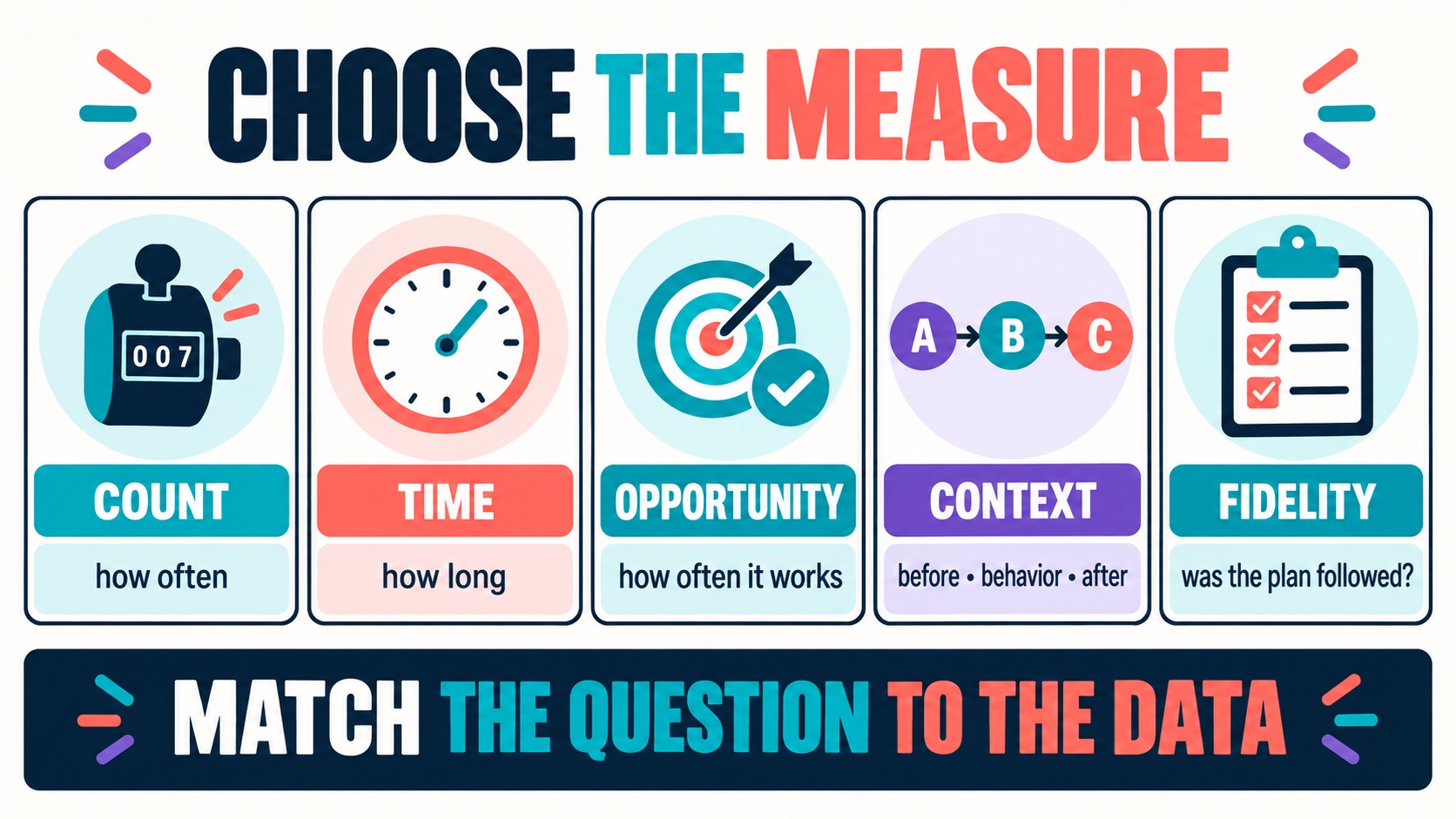
For a BCBA-style question, do not start by choosing a favorite form. Start with the decision. Are you measuring how often a response occurs, how long it lasts, how quickly it starts, whether it happens during opportunities, or whether the intervention was implemented as written? The correct data system follows the behavior and the question—not the template that happens to be available. Table of Contents
What should BIP data collection answer?
A behavior intervention plan translates assessment information into prevention, teaching, reinforcement, response, and review procedures. Its data section should make the plan testable. It should show whether the target behavior is changing, whether the replacement behavior is being acquired or used, and whether the team delivered the relevant components well enough to interpret the outcome.
The Vanderbilt IRIS BIP framework connects assessment data, hypothesized function, replacement behavior, intervention, and progress monitoring. That sequence matters: data collection is not a decorative appendix. It is the bridge between the reason for the plan and the decision to maintain, modify, or fade an intervention.
The current BACB BCBA Test Content Outline includes operational definitions, measurement selection, data display, interpretation, and data-based decisions. Therefore, a strong study answer usually includes more than “collect ABC data.” It identifies the behavior dimension, the measurement procedure, the observation conditions, and the decision rule that will make the data useful.
- Outcome question: Is the target behavior decreasing, increasing, maintaining, or changing in form?
- Replacement question: Is the functionally relevant alternative occurring independently and contacting reinforcement?
- Context question: In which settings, activities, people, or antecedent conditions does the pattern appear?
- Integrity question: Was the intervention delivered with enough accuracy to interpret the outcome?
- Decision question: What pattern would lead the team to continue, revise, probe, consult, or fade a component?
How do you choose a BIP measurement method?
Choose the smallest measurement system that captures the behavior’s critical dimension and supports the decision. A behavior that happens once for two seconds is not described adequately by the same measure used for a 20-minute episode. A replacement request should not be judged only by the absence of problem behavior; its independent occurrence and functional effectiveness may be the key data. Use the following decision path:
- Define the response: write observable examples and nonexamples so different observers can identify the same event.
- Identify the dimension: decide whether frequency, rate, duration, latency, topography, intensity, interval occurrence, or percentage of opportunities is most relevant.
- Check observation constraints: consider session length, number of targets, safety, setting, staff workload, privacy, and whether continuous observation is possible.
- Protect the denominator: when using percentage or per-opportunity measures, define what counts as a valid opportunity and do not silently change the denominator.
- Pair outcomes with replacement data: if the goal is to reduce a behavior by teaching an alternative, measure the alternative in a way that can show whether it is becoming efficient and independent.
Frequency or event recording may fit discrete responses that have a clear beginning and end. Rate can make counts more comparable when observation periods differ. Duration fits behavior where how long an episode lasts is central. Latency fits the time from a defined cue to response onset. Interval recording can be useful when continuous observation is impractical, but it estimates occurrence and can over- or under-represent the actual pattern depending on the system. Percentage of opportunities can fit skill acquisition or replacement responses only when the opportunity definition is stable.
Texas SPED Support’s ABC recording resource explains how antecedent-behavior-consequence observations can help identify patterns across multiple observations. ABC data can be valuable for a functional question, but it is not automatically the best outcome measure for every BIP. If the decision is whether aggression episodes are becoming shorter, duration data may be more informative than a narrative ABC form alone.
What belongs in a BIP data-collection plan?
Write the plan so an appropriately trained implementer can answer the same questions without inventing missing details. The plan should identify the target and replacement behavior, the measurement method, the observation period, the collector, the data location, the prompting and consequence fields that matter, and the person responsible for graphing or review.
- Target behavior: operational definition, examples, nonexamples, start and stop rules, and the relevant context.
- Replacement behavior: exact response form, acceptable communication modes, prompt level, and the functional consequence arranged for the response.
- Measurement: selected procedure, unit, scoring rule, opportunity definition, and how missing or interrupted observations are recorded.
- Sampling: settings, activities, people, sessions, or time periods in which data will be collected and why they represent the question.
- Implementation fields: prompt delivered, reinforcement delivered, antecedent strategy used, response procedure followed, and any clinically relevant deviation.
- Review: graphing schedule, who reviews the data, how often decisions occur, and what pattern triggers a change or consultation.
Use plain language when the plan will be implemented by a team. Technical precision is important, but a definition that only one person understands is not a reliable measurement system. Train observers with examples, practice scoring, feedback, and a plan for checking agreement when observer consistency is important.
What does a BIP data collection example look like?
The table below is an educational example, not a client-specific plan. It shows how different questions can require different measures. A real plan must be individualized from assessment data and reviewed by the responsible professional.
| Question | Possible measure | Record | Review signal |
|---|---|---|---|
| How often does calling out occur? | Frequency or rate | Count, observation length, activity, and relevant antecedent | Compare rates across comparable periods, not raw counts from unequal observations. |
| How long does an episode last? | Duration | Start, stop, total duration, and interruption rules | Inspect level and trend; a lower frequency with longer episodes may not be improvement. |
| Does the learner request a break? | Percentage of opportunities plus prompt level | Valid opportunity, independent or prompted request, response, and access | Check whether independent requests replace the target response and contact the planned outcome. |
| What happens before and after a behavior? | ABC or structured descriptive observation | Antecedent, observable behavior, consequence, setting event, and context | Look for repeated patterns across observations; do not treat description as proof of function. |
| Was the BIP implemented as written? | Treatment-integrity checklist or fidelity percentage | Required steps, completed steps, omissions, and observer | Separate a weak outcome from a weak implementation before changing the intervention. |
How should a BCBA review BIP data?
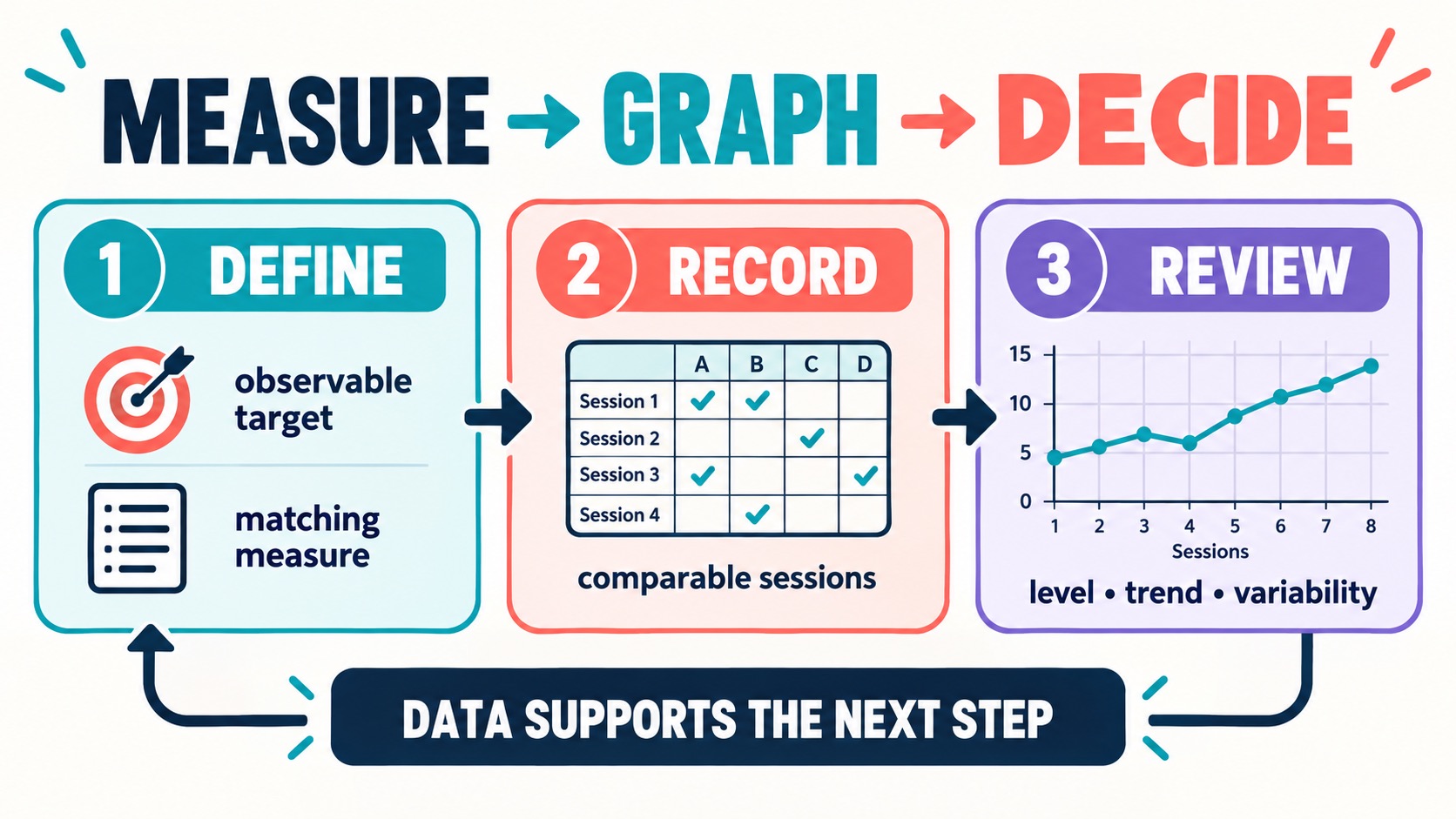
Review data against the question and the decision rule written in the plan. Inspect level, trend, variability, and the conditions under which the data were collected. A single low point rarely justifies a major plan change, and a flat graph cannot be interpreted without checking whether the intervention was implemented and whether the measurement system was valid.
Compare target and replacement patterns together. If problem behavior decreases while independent replacement behavior increases, the plan may be teaching a functional alternative. If problem behavior decreases but the replacement response is also absent, check for suppression, missing opportunity, under-measurement, or another change in the environment. If both responses increase, review the consequence and prompting arrangement rather than assuming the BIP is working.
- Verify the data: confirm definitions, denominators, observation length, missing values, and any changes in the collector or setting.
- Display the pattern: use a graph or summary that makes level, trend, variability, and phase changes visible.
- Check the context: note schedule changes, staffing, demands, sleep or health information when relevant and authorized for the plan.
- Check fidelity: compare implementation data with outcome data before concluding that the intervention itself is ineffective.
- Make a bounded decision: maintain, adjust one component, collect more information, seek supervision, or consider whether a new assessment is needed.
Data-based decision-making is not the same as changing a plan every time the graph moves. A defensible review explains which evidence supports the decision, what uncertainty remains, and how the next observation will test the change. The PENT data-collection guidance is a helpful reminder that the measurement system should fit the behavior and the purpose for tracking it.
How do treatment integrity and data quality fit?
Treatment-integrity data answer a different question from client-outcome data. Outcome data ask what the learner did. Integrity data ask whether the adults delivered the planned antecedent, teaching, reinforcement, response, and documentation steps. Both can be necessary when interpreting a BIP.
Keep the checklist feasible. A 30-step form that staff skip is not stronger than a short checklist that captures the essential steps reliably. Define which steps are critical, train the implementer, provide feedback, and decide how fidelity will be sampled. The current BACB BCBA Handbook is the appropriate place to verify current certification or fieldwork documentation requirements; this article does not replace it.
- Definition agreement: observers score the target and replacement behavior consistently.
- Procedure agreement: implementers know the steps, prompt rules, reinforcement criteria, and safety boundaries.
- Data agreement: a planned check confirms that the record is accurate enough for the decision.
- Privacy and dignity: data are collected, stored, and shared according to the applicable professional and organizational safeguards.
What are common BIP data-collection exam traps?
- Choosing ABC for every question: descriptive ABC data can reveal patterns, but it does not automatically measure frequency, duration, or function.
- Using raw count across unequal sessions: compare rate or otherwise standardize the observation period when the opportunity to respond differs.
- Measuring only the problem behavior: a functionally matched replacement behavior needs its own independent and prompted data.
- Confusing outcome with fidelity: poor progress may reflect incomplete implementation, an invalid definition, or an intervention mismatch.
- Changing the denominator: percentage of opportunities is meaningless if “opportunity” changes from one observation to the next without documentation.
- Calling a descriptive pattern a function: antecedent and consequence records can guide hypotheses but do not prove causal function by themselves.
- Collecting more data instead of better data: a larger form is not automatically more valid, reliable, or useful.
- Copying a template as a plan: a sample must be individualized to the assessment, behavior, context, and team competency.
Quick review: Define the behavior, identify the decision, select the critical dimension, specify the collector and observation conditions, track replacement behavior and integrity when needed, graph comparable data, and make a bounded decision. For additional context, the site’s broader behavior intervention plan data collection overview covers the larger plan concept; this page focuses on the measurement layer. For more scenario practice on measurement and data-based decisions, try the free BCBA mock exam. It is a study resource and does not claim to reproduce official BACB questions.
Behavior intervention plan data collection FAQ
What is the most important data in a BIP? The most important data are the data that answer the plan’s defined question. That may be frequency, rate, duration, latency, interval, percentage of opportunities, replacement behavior, or treatment integrity—not one universal measure.
Should a BIP measure the replacement behavior? Usually, if the plan teaches a replacement response, measure whether it occurs, how independently it occurs, and whether it contacts the planned functional outcome. The exact method depends on the response and the decision.
Is ABC data the same as BIP data collection? ABC recording is one descriptive data method that records antecedents, behavior, and consequences. BIP data collection is broader and may include outcome, replacement, integrity, and context data.
How often should BIP data be reviewed? Use the schedule and decision rules written for the plan, with enough observations to see a meaningful pattern. Review frequency should also account for safety, measurement quality, supervision, and applicable requirements.
Can I download a generic BIP data sheet and use it? A template can help organize fields, but it should not be used without checking the operational definition, measure, denominator, privacy, training, and decision rule. A qualified professional should individualize and review the system.
Take the Free BCBA Mock Exam
When you are ready to apply the idea, use the free practice resource below for additional feedback. Take the Free BCBA Mock Exam



