
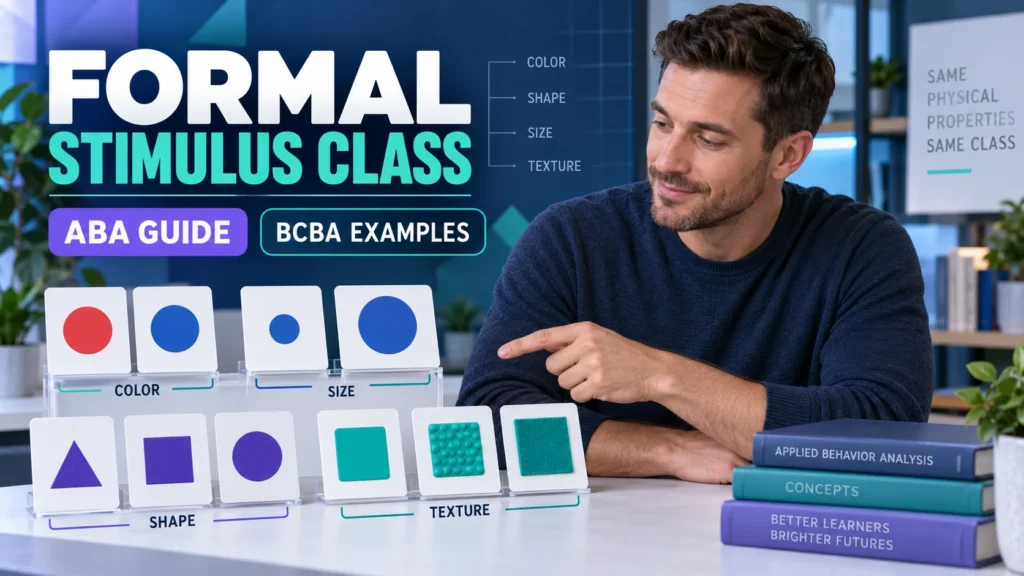
Short answer: A formal stimulus class is a group of stimuli connected by a shared observable form, physical property, structure, or relative relationship. The members may differ as objects, but they have a feature that can be described before you interpret their behavioral function—for example, the same color, shape, texture, size, or spatial relation. For BCBA exam questions, identify what the stimuli have in common before deciding whether the stem is describing a formal, arbitrary, functional, or response class.
Table of Contents
- What is a formal stimulus class in ABA?
- Which properties can define the class?
- How do you recognize one in a BCBA scenario?
- How is it different from other classes?
- What evidence is needed before you call it a class?
- How does it relate to generalization?
- How should you solve a BCBA exam question?
- What are the common mistakes?
- Formal stimulus class FAQ
- Take the Free BCBA Mock Exam
The word formal does not mean “official” or “well organized.” It points to the form or arrangement of the stimuli. A red card, red cup, and red block can be grouped by color even though they are different objects. A triangle, square, and circle are not a formal class merely because they are all classroom materials; the relevant property must be stated or demonstrated. The best answer is always tied to the property, the teaching history, and the way responding was tested. Table of Contents
What is a formal stimulus class in ABA?
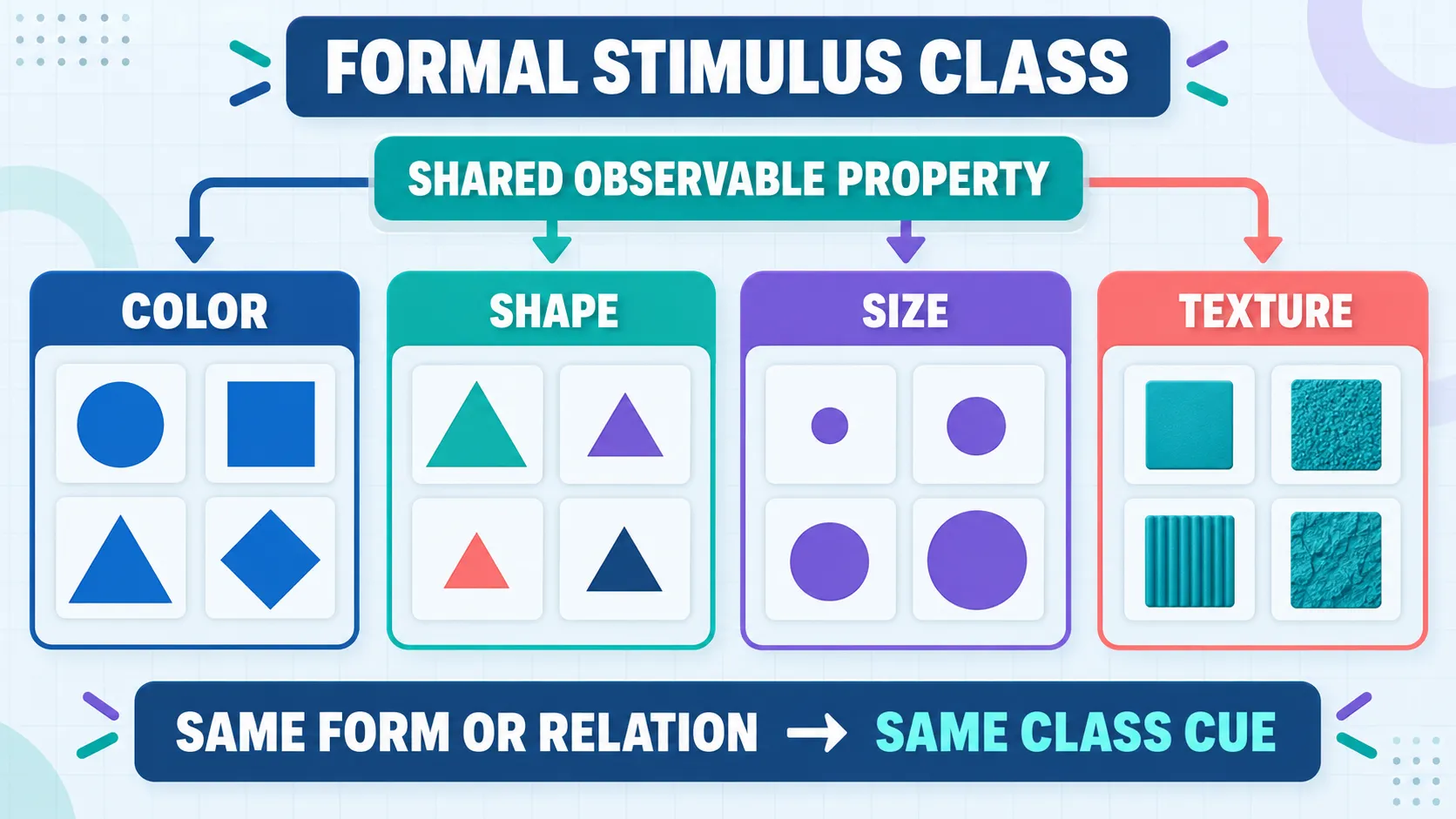
A formal stimulus class is a set of stimuli that share a relevant physical form, structure, or observable relation. “Relevant” matters because every stimulus has many properties at once. A card may be blue, rectangular, laminated, large, and located on the left side of an array. The class depends on the dimension that is correlated with the response requirement or that the question identifies as the basis for grouping.
Consider a receptive-identification program. A learner sees a blue circle, a blue square, and a blue book and is reinforced for selecting the blue item. If the color is the programmed dimension, those different objects can be treated as examples that share a formal feature. If the same learner is reinforced for selecting circles regardless of color, shape is the relevant dimension instead. The objects have not changed only in name; the controlling classification has changed with the task.
A formal stimulus class should not be treated as an invisible category that exists independently of behavior. Stimulus-class research has emphasized that claims about a class are grounded in the training and test procedures used to show that stimuli participate in related responding. In practical language, describe the property, vary the other dimensions, and test new exemplars. That gives you a more defensible interpretation than saying that the learner “understands the category” after one familiar response.
Terminology can vary across ABA textbooks and study resources. Some resources use formal stimulus class and feature stimulus class as overlapping labels for stimuli related by physical properties or relations. When an exam stem defines the terms, follow its definition. When it does not, use the operational core: name the shared observable basis and separate it from the behavioral function of the stimuli.
Which properties can define the class?
The phrase “shared form” is broad, so a strong explanation names the exact dimension. Common examples include:
- Color: red items, blue cards, or stimuli with the same color pattern.
- Shape: circles, triangles, four-sided figures, or a specified outline.
- Size: small objects, large objects, or items that are bigger than a reference.
- Texture or material: rough surfaces, smooth surfaces, wood, or a tactile pattern.
- Auditory form: sounds with a shared pitch, duration, or other described acoustic feature.
- Spatial or relative relation: above, under, inside, next to, closer than, or farther than another stimulus.
One stimulus can participate in several possible formal classes. A large blue circle could be a member of a “large” class, a “blue” class, and a “circle” class. That does not mean all three dimensions control responding at the same time. The relevant dimension is the one supported by the contingency, the instructional arrangement, and the data.
This is why a formal-class question is not solved by naming the objects. “These are all toys” describes a verbal label, not necessarily the stimulus property controlling behavior. Ask instead: What could be measured or observed about every member, and which of those properties was correlated with reinforcement or the target response?
How do you recognize one in a BCBA scenario?
Start with the stimulus side of the contingency. List the items or events in the class, then write the shared property in concrete language. If the answer is “they all produce attention,” you may be describing a functional class. If the answer is “they are all blue,” you have identified a formal feature. If the answer is “a spoken word, a printed word, and a picture were linked through training,” look for an arbitrary or conditional relation rather than simple physical similarity. A useful recognition sequence is:
- Name the stimuli: separate antecedent events from the learner’s responses and consequences.
- Find the common form: identify color, shape, size, texture, arrangement, or another observable relation.
- Check what was varied: if color stays constant while shape and size change, color is the likely programmed feature.
- Check the learning history: ask what response was reinforced and whether the property was actually tested.
- Rule out shortcuts: consider position, instructor prompts, item order, or a single familiar exemplar.
For example, a teacher presents a red triangle, a red square, and a red spoon. The learner is reinforced for touching the red stimulus after the instruction “find red.” During a later probe, the teacher presents a red cup and a blue spoon in new positions. The intended formal basis is color, not shape, spoon-ness, or location. If the learner touches the red cup, that is evidence consistent with generalization across new items; it is not proof that every red object will control responding in every setting.
The distinction also protects against overinterpreting a correct choice. A learner might select the correct card because it is always on the left, because the instructor looks at it, or because it was presented after a prompt. A formal stimulus class is a claim about the relation among stimuli and responding, so the arrangement should give the target property a fair chance to control behavior.
How is it different from other classes?
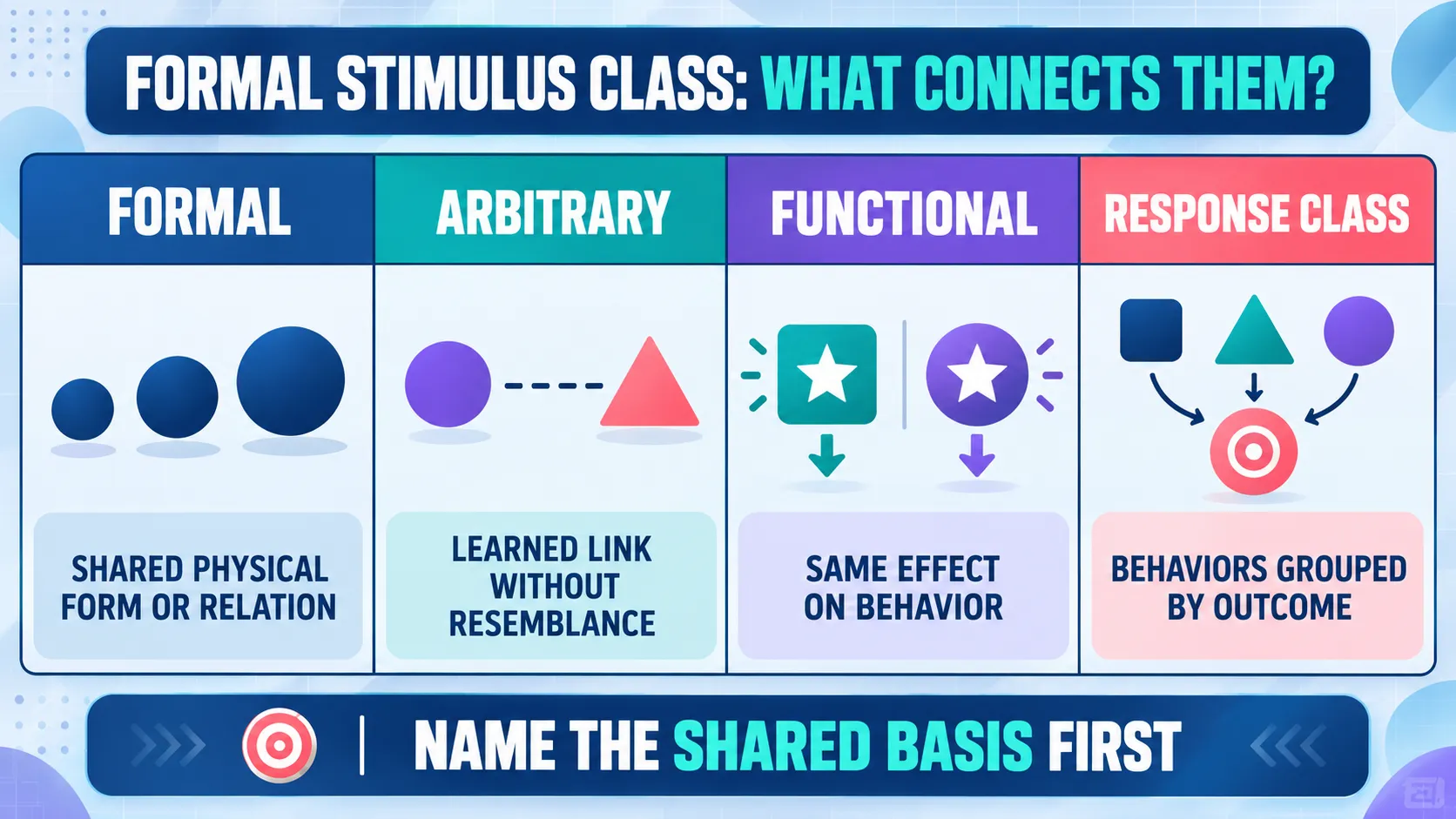
Several class types can appear in the same story. The quickest way to separate them is to ask what connects the members. The following comparison uses the common BCBA-study distinctions while acknowledging that terminology may vary by source.
| Class or term | What connects the members? | Example | Exam clue |
|---|---|---|---|
| Formal stimulus class | Shared physical form, structure, or relative relation | Blue items, rough items, or objects arranged under a reference | Ask what observable property is common |
| Arbitrary stimulus class | A learned relation that does not require physical resemblance | A printed word, spoken word, and picture linked by training | Look for a symbolic or conditional relation |
| Functional stimulus class | Stimuli share an effect on behavior under a relevant history | Several different signals occasion stopping at a crossing | Focus on what the stimuli do, not how they look |
| Response class | Different behaviors grouped by a common outcome or function | Pointing, signing, or saying “break” to access a break | The grouped members are responses, not stimuli |
Do not assume that a formal class and a functional class are mutually exclusive in every analysis. The same stimulus may have a physical feature and also acquire a behavioral function. The question is which relation the stem asks you to identify. If the prompt emphasizes “same color,” answer at the formal level. If it emphasizes “each signal occasions the same response,” answer at the functional level.
What evidence is needed before you call it a class?
A visible similarity is a candidate basis, not automatically a demonstrated stimulus class. At minimum, explain the relation in observable terms and connect it to the relevant arrangement. Good evidence usually includes varied exemplars, changes to irrelevant dimensions, and probes with novel stimuli.
For example, if a learner correctly selects a blue card on every trial, that tells you little about whether “blue” controls responding if the blue card is always in the same position. Rotate positions, change the shape and size, and present new blue items. Also present nonblue items that share the old position or shape. This helps distinguish control by color from control by an accidental feature.
Research on stimulus-class formation makes a related conceptual point: analysts should describe what training and tests produced rather than treating classes as mental objects that automatically exist before testing. A careful report might say, “Under these probe conditions, responding generalized across exemplars sharing the programmed color.” That statement is narrower, clearer, and more behavior analytic than “the learner formed a permanent color category.”
How does it relate to generalization?
Formal stimulus classes often appear in discussions of stimulus generalization because the learner may respond to new stimuli that share a relevant property with trained stimuli. Generalization should be planned rather than assumed. Vary noncritical dimensions while keeping the target dimension consistent, then probe across people, materials, positions, and settings when those changes matter.
- Use multiple exemplars that share the target feature but differ in irrelevant features.
- Rotate locations and presentation order to reduce position and sequence bias.
- Include close nonexamples that share an irrelevant feature but not the target feature.
- Probe novel exemplars without immediately prompting the answer.
- Record the operationally defined response and the stimulus conditions in which it occurs.
- Review prompt fading so the instructor’s cue does not replace the intended stimulus property.
Suppose the goal is selecting rough items. Teaching only one rough sponge may produce responding to that particular sponge. Teaching rough objects that vary in color, shape, size, and material gives the learner more opportunities to contact the relevant dimension. The program still needs data: a new rough item is an example of a planned probe, not a reason to assume mastery without measurement.
How should you solve a BCBA exam question?
Use this four-part rule: stimuli, shared basis, learning history, boundary. First, identify what is being grouped. Second, name the physical form or relation. Third, check what response or consequence was correlated with that property. Fourth, compare the likely answer with an arbitrary, functional, or response-class explanation.
Mini-scenario: A learner is taught to select the item that is larger than a comparison object. The objects change across trials, and the correct response is reinforced when the learner selects the larger item. Which relation is most relevant? The answer is a formal or feature-based relation—“larger than”—not the identity of a particular object. If the learner instead selects a printed word after hearing a spoken word because those relations were trained, the stem is describing a learned arbitrary relation. If several different signals all occasion stopping, focus on their shared function.
The current BCBA Test Content Outline includes stimulus and stimulus-class distinctions within concepts and principles, along with procedures related to discrimination and generalization. The outline tells you the exam scope; it does not replace an individualized assessment or prescribe one universal teaching script. Read the stem for the level of analysis it actually asks about.
What are the common mistakes?
- Calling every group with the same name a formal class: a shared label may reflect verbal or arbitrary relations; name the observable property first.
- Confusing the stimulus with the response: pointing, matching, and signing are behaviors, even when the stimuli have a common form.
- Using one familiar item as proof of generalization: vary exemplars and test novel members.
- Ignoring location and prompt bias: the intended color or shape may not be controlling if the position or instructor cue never changes.
- Assuming all visible properties are relevant: only treat a dimension as controlling when the arrangement and data support it.
- Treating formal and feature as permanently different labels: study resources vary; follow the stem and explain the shared basis.
- Overstating the evidence: a probe supports a bounded interpretation under the tested conditions, not a guarantee across every context.
Bottom line: A formal stimulus class groups stimuli by a shared observable form, structure, or relation. On a BCBA question, identify the stimuli, state the common property, separate that property from the learner’s response, and check whether the teaching and probe arrangement supports the interpretation. When you want to practice the distinction in exam-style scenarios, try the free BCBA mock exam. It is a study resource and does not claim to reproduce official BACB questions.
Formal stimulus class FAQ
What is the simplest definition of a formal stimulus class? It is a group of stimuli connected by a shared physical feature, form, structure, or observable relation such as color, shape, texture, size, or “under.”
Is a formal stimulus class the same as a feature stimulus class? Many ABA study resources use the terms in overlapping ways. When a distinction is made, “formal” usually emphasizes observable form or structure, while “feature” highlights the specific shared property. Use the definition supplied by the question and name the property explicitly.
Is a formal stimulus class the same as a functional class? No. A formal class is described by shared form or relation. A functional class is described by a shared effect on behavior. The same stimuli can have both physical similarities and behavioral functions, so identify which relation the question emphasizes.
Can one stimulus belong to more than one class? Yes. A large blue circle can be grouped by size, color, or shape depending on the task. The contingency and data determine which dimension is relevant for the analysis.
How can a BCBA test whether the intended feature controls responding? Vary irrelevant features, rotate positions, include close nonexamples, present novel exemplars, fade prompts, and record the operationally defined response under the target stimulus conditions.
What should I remember for the exam? Use the phrase “name the shared basis first.” Physical form or relation suggests formal; a learned link without resemblance suggests arbitrary; the same effect on behavior suggests functional; and different behaviors grouped by an outcome suggests a response class.
Take the Free BCBA Mock Exam
When you are ready to apply the idea, use the free practice resource below for additional feedback. Take the Free BCBA Mock Exam



