
Quick answer: In naming ABA discussions, “Naming” usually refers to a higher-order verbal repertoire in which learning to respond as a speaker can be connected with learning to respond as a listener. A learner may hear someone label a new item, later say the item’s name when seeing it, and respond appropriately when another person says the name. The term is more specific than simply memorizing a label.
Table of Contents
- What Does Naming ABA Mean?
- How Does Naming Connect Speaker and Listener Behavior?
- How Is Naming Different From a Tact?
- How Do You Assess Naming Without Guessing?
- How Can You Teach Naming in a Natural, Measurable Way?
- What Are Practical Naming Examples in ABA?
- What Data Should a BCBA Track?
- What Are Common BCBA Exam Traps?
- FAQ
- Quick Review Checklist
- Take the Free BCBA Mock Exam
Naming is useful for BCBA study because the same word can appear in several different behavioral relations. Saying “ball” while looking at a ball may be a tact. Saying “ball” because the learner wants access to a ball may be a mand. Pointing to a ball after hearing “Where is the ball?” is listener responding. A Naming repertoire concerns how speaker and listener behavior become connected across learning opportunities, not just the sound or sign that a learner produces.
What Does Naming ABA Mean?
In behavior-analytic language research, Naming is often used for an integrated speaker–listener relation. The learner can acquire a word as a speaker, such as saying or signing “spoon,” and also respond to that word as a listener by selecting, orienting toward, or using the spoon. The two repertoires may be taught together, may emerge from related experiences, or may need to be assessed separately.
This is a study guide, not a claim that every author uses the word in exactly the same way. The research literature contains different accounts of Naming, including developmental and verbal-behavior perspectives. For an accessible primary research discussion of the term, see A Rose by Naming. For current exam boundaries, compare the official BCBA Test Content Outline rather than treating a blog definition as an official BACB definition.
| Relation | What evokes the response? | Illustrative response | What to measure |
|---|---|---|---|
| Tact or labeling | A nonverbal stimulus, such as an object or picture. | The learner sees a cup and says or signs “cup.” | Independent, accurate labels under defined stimulus conditions. |
| Listener responding | A spoken, signed, written, or otherwise accessible verbal stimulus. | After hearing “touch the cup,” the learner touches the cup. | Correct selection or action with prompt level and relevant distractors. |
| Naming repertoire | Related speaker and listener opportunities around a stimulus or class. | After learning “cup” in context, the learner labels it and responds to the word across new examples. | Speaker and listener performance, transfer to novel items, prompts, and maintenance. |
How Does Naming Connect Speaker and Listener Behavior?
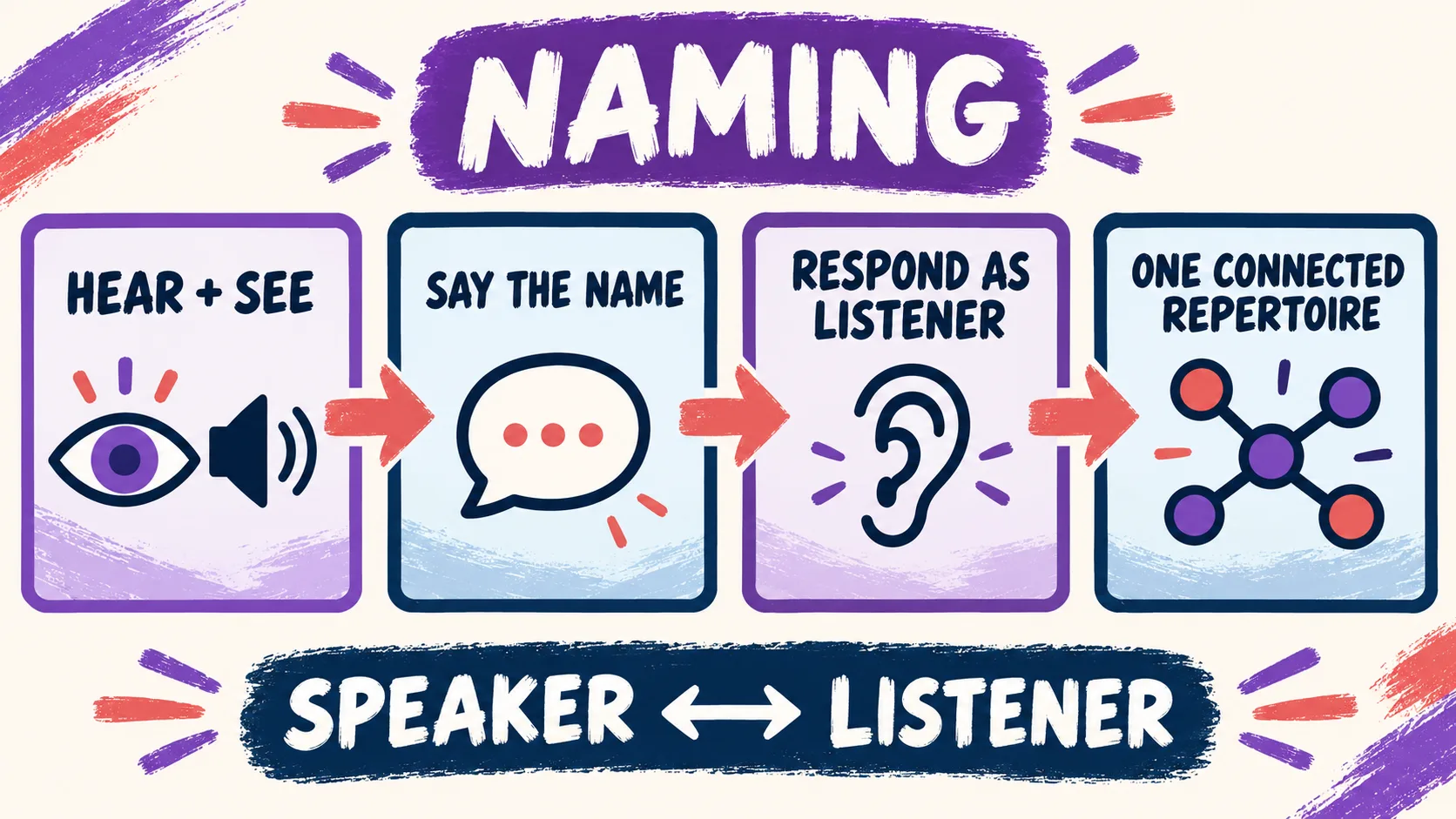
Imagine a teacher holding up an unfamiliar object and saying, “This is a whisk.” The learner hears the word while the object is present. Later, the learner may say “whisk” when seeing the object, point to the whisk when hearing the word, and follow an instruction that uses the word. These performances are not identical, but they can be related through a learning history that gives the spoken word and the nonverbal stimulus useful control.
A Naming account asks whether the learner acquired more than a single memorized response. If the only trained performance is repeating “whisk” immediately after an adult says it, the learner has demonstrated an echoic-like response under that condition. That trial alone does not show that the learner can identify a whisk, label a whisk, or use the word in a new routine. Assessment should separate what was directly taught from what emerged without direct teaching.
The relation also matters for learners who use signs, speech-generating devices, pictures, writing, or a mixture of response forms. The relevant question is functional and individualized: can the learner use an accessible response as a speaker and respond to an accessible verbal stimulus as a listener? Do not make vocal speech the hidden requirement for a language goal.
How Is Naming Different From a Tact?
A tact is a verbal operant controlled by a nonverbal stimulus and typically maintained by generalized social reinforcement. Naming may include tacting, but the term points to a broader integration of speaker and listener capabilities. If a learner sees a dog and says “dog,” that is useful evidence about tacting. It does not, by itself, establish the full set of speaker–listener relations that a Naming assessment may examine.
Context and consequence still matter. If the learner says “dog” only after a verbal model, record the prompt. If the learner says “dog” to obtain the dog’s toy, investigate whether the response is functioning as a mand in that situation. If the learner points to a dog after hearing “show me the dog,” measure listener responding. Identical words can belong to different operants when the controlling variables differ. Review the site’s tact in ABA guide for the narrower tact relation. Use it as a comparison point, not as a substitute for evaluating the broader speaker–listener pattern.
How Do You Assess Naming Without Guessing?
Start with a clear stimulus set and define the responses that will count. A practical assessment may include a speaker probe, a listener probe, and a transfer probe. Use materials that are meaningful and accessible to the learner, and record whether the item or word was already familiar. Avoid calling a performance “emergent” when the learner has received direct teaching, repeated prompts, or a matching exercise that already contains the answer.
- Choose a small set of novel stimuli. Check that the learner has not already mastered the labels or listener responses. Document the selection logic.
- Probe speaker responding. Present the item in a defined context and record whether the learner labels it independently, with a prompt, or not at all. Accept the planned communication form.
- Probe listener responding. Deliver a clear, accessible verbal instruction or question and record the learner’s selection or action. Control for position bias and irrelevant cues.
- Probe across roles and examples. Rotate speaker and listener opportunities, vary the person or material when appropriate, and avoid turning a probe into an unplanned teaching session.
- Interpret the pattern. Decide whether the learner shows an integrated relation, a speaker-only strength, a listener-only strength, or a prompt-dependent performance. Plan teaching from that pattern.
How Can You Teach Naming in a Natural, Measurable Way?
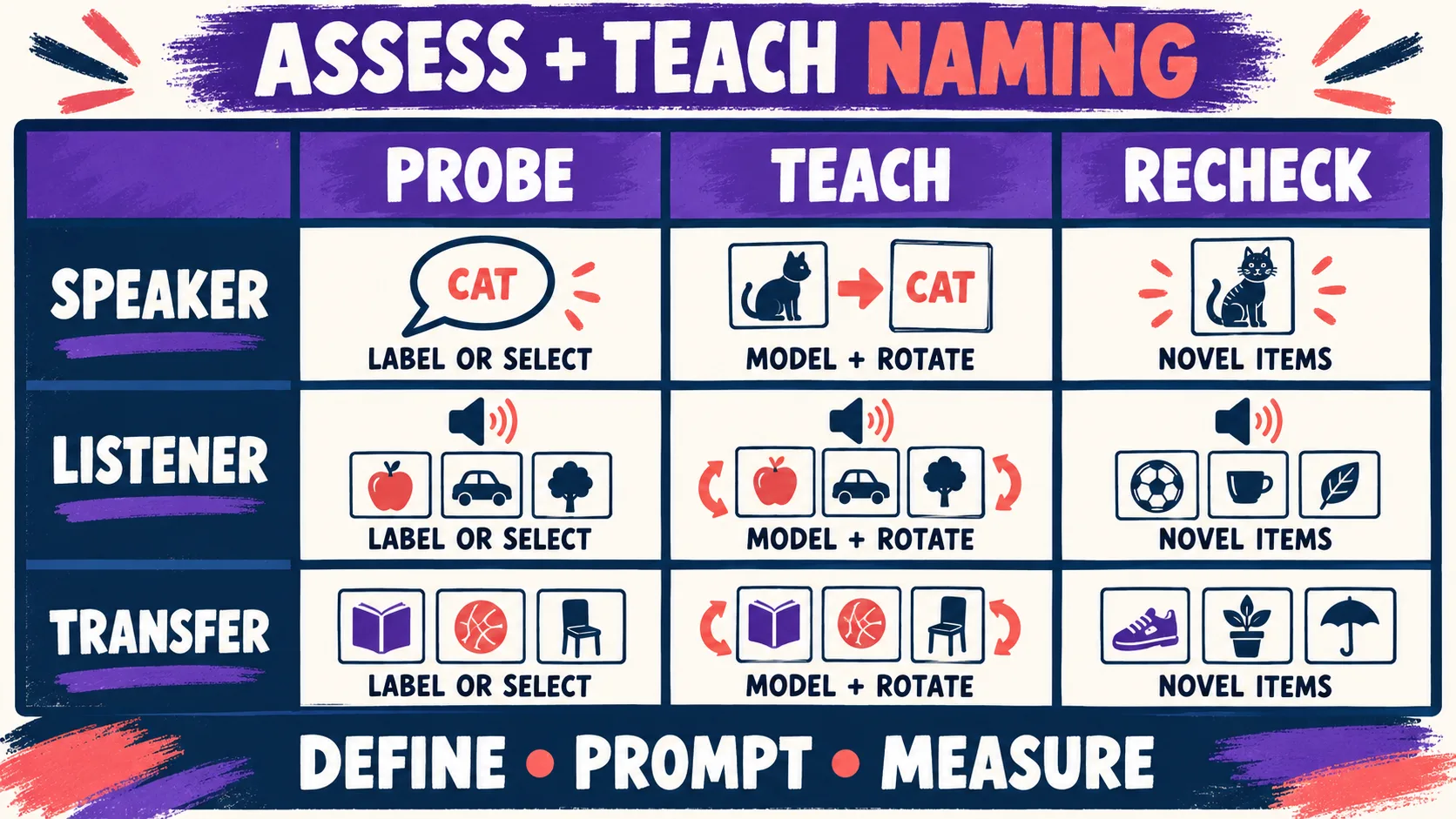
Teaching should be individualized rather than reduced to “say the word.” A learner may need instruction in attending to a stimulus, orienting to a communication partner, selecting an accessible response mode, or rotating speaker and listener opportunities. The behavior analyst should identify the prerequisite and the functional reason the repertoire matters. A useful teaching sequence can look like this:
- Arrange a meaningful interaction. Use an item, action, person, or event that matters in the learner’s routine. Make the communication opportunity relevant rather than presenting arbitrary drills only.
- Establish the response form. Model, prompt, or shape an accessible label or listener response according to the learner’s plan. Define the prompt hierarchy and how prompts will be faded.
- Rotate speaker and listener opportunities. After a learner responds as a speaker, provide opportunities to select or act as a listener, and then reverse the order when appropriate. Track each response separately.
- Vary exemplars deliberately. Use different examples from the same class, people, materials, and routines when the learner is ready. Do not change every variable at once if doing so prevents interpretation.
- Probe untrained relations. Test a new item or direction without immediately supplying the answer. A probe is useful only when the conditions and assistance are documented.
- Review social validity and generalization. Ask whether the repertoire helps the learner participate, communicate, or access meaningful activities. Check performance with the people who will actually use the skill.
What Are Practical Naming Examples in ABA?
Objects and actions: A learner is taught the label “open” while an adult opens a container. Later, the learner says or selects “open” when a new container is closed, and follows “find open” when shown several action pictures. The team should score the label, the listener response, the prompt level, and whether the relation transfers beyond the original container.
People and social routines: A learner may learn a caregiver’s name while the caregiver is present. A stronger plan checks whether the learner can identify the person from a group, use the name to initiate a functional interaction, and respond when another person refers to the caregiver. The goal is not forced eye contact or rote repetition; it is an individualized, observable communication repertoire.
Academic or community items: For school readiness, a learner may label “bus,” select a bus when hearing the word, and use the response in a picture schedule or community routine. The team can vary photographs, drawings, distances, and communication partners while preserving the functional meaning of the target.
What Data Should a BCBA Track?
Track speaker and listener responses in separate columns or measures. Record independent accuracy, prompt level, latency when it affects access, errors, stimulus set, response form, and the person or setting. If a learner succeeds with familiar items but not novel items, that is a different programming decision from failing both familiar and novel probes.
Also track the learning conditions that may be doing the work. Was the item visible? Was a verbal model provided? Was the answer embedded in the instruction? Did a specific person deliver the prompt? Data that omit these details can make a prompted echoic look like an independent Naming response.
For a related foundation, review the site’s listener responding guide. If the learner’s performance involves derived relations, the site’s stimulus equivalence overview can provide a separate comparison. Keep the page boundaries clear: Naming, listener responding, tacting, and stimulus equivalence may interact, but they are not interchangeable labels for every language performance.
What Are Common BCBA Exam Traps?
- Confusing a word with an operant: The topography “ball” does not identify the controlling variables.
- Calling echoic repetition Naming: Repeating a model is evidence for that prompted relation, not automatic evidence of speaker–listener integration.
- Assuming a tact proves listener responding: Labeling an item and responding to its name are related but distinct performances to measure.
- Ignoring communication modality: A valid speaker or listener response does not have to be vocal if the learner’s plan uses signs, pictures, writing, or AAC.
- Claiming emergence without checking teaching history: Review prior prompts, matching tasks, multiple-exemplar instruction, and exposure before interpreting a new response.
FAQ
Is naming the same as labeling in ABA?: Not always. Labeling is often used for tacting an object or event. Naming can refer to a broader speaker–listener relation in which the learner both responds to and uses a name across related conditions. Check the author’s definition and the observable response being measured.
Does a learner need to speak out loud to show Naming?: No. The response form should match the learner’s accessible communication system. A sign, selection, written response, or speech-generating-device response can be measured when it serves the defined speaker or listener function.
Why are novel items important?: Novel items help distinguish direct memorization from transfer. They do not prove a relation by themselves; the team must define the probe, control for prompts, and interpret the result alongside the learning history and other data.
Bottom line: Naming ABA content is about more than naming an object. For BCBA exam reasoning, identify the controlling stimulus, the response role, the prompt history, and whether speaker and listener performances transfer across meaningful examples. When you are ready to practice these distinctions in applied scenarios, use the free BCBA mock exam. For targeted review, use our naming aba practice questions to apply the concept in exam-style scenarios.
Quick Review Checklist
Use this final checklist to turn naming aba into exam-ready reasoning. The goal is not to memorize a label in isolation; it is to identify the relevant evidence and explain why the best answer fits the scenario. Key ideas to review:
- State the central definition or decision point for naming aba in your own words.
- Identify the detail that makes naming aba different from its closest related ABA term.
- Separate the observable facts in a scenario from assumptions that are not supported by the facts.
- Write one example and one nonexample so you can recognize the concept in a new setting.
Exam application checks:
- Ask what the question is actually requesting before comparing the answer choices.
- Mark the antecedent, response, consequence, or other evidence that supports the selected answer.
- Look for a distractor that describes a related process but does not answer the specific question.
Final self-check:
- Explain how you would verify the interpretation with clear observations or data.
- Change one detail in the scenario and decide whether your answer should change.
- Give a one-sentence rationale that a supervisor or study partner could evaluate.
Take the Free BCBA Mock Exam
When you are ready to apply the idea, use the free practice resource below for additional feedback. Take the Free BCBA Mock Exam



