
Short answer: An ABA session schedule is a flexible plan that shows how a particular session will move from arrival and rapport to teaching, practice, data collection, transitions, caregiver communication, and closing review. It is not simply a clock with activities packed into every minute. A useful schedule connects each block to an observable goal, a data decision, and the learner’s current context.
Table of Contents
- What is an ABA session schedule?
- What should an ABA session schedule accomplish?
- How do you build an ABA session schedule?
- What does an ABA session schedule example look like?
- How should data and documentation fit the schedule?
- How can a session schedule stay flexible and respectful?
- What are common ABA session schedule mistakes?
- ABA session schedule FAQ
- Take the Free BCBA Mock Exam
For a BCBA-style planning question, ask three things: What must happen during this session? What evidence will show whether the plan is working? What can change without turning the schedule into a rigid demand? The best answer usually includes a clear sequence, planned reinforcement and breaks, prompt and error-correction logic, data checkpoints, and a rule for adjusting the next block. Table of Contents
What is an ABA session schedule?
An ABA session schedule is a written or visual sequence for one service period. It identifies the targets, activities, transitions, materials, prompting and reinforcement considerations, data opportunities, and people responsible for communication or documentation. The schedule can be brief: a few time blocks, a target for each block, and a decision rule may be more useful than a crowded minute-by-minute script.
The schedule should be distinguished from a learner’s visual schedule. A visual schedule is an instructional support that communicates what will happen to the learner. A session schedule is a planning tool for the team. The two can overlap, but they serve different audiences and may need different formats. It should also be distinguished from a session note: the schedule describes what is intended and how the team will respond to evidence; the note records what actually occurred.
The BACB BCBA Test Content Outline includes measurement, intervention implementation, data-based decision-making, and supervision-related tasks. Those domains support treating a session schedule as a decision-support tool rather than a promise that a fixed number of minutes will produce a fixed outcome. The schedule should be individualized and reviewed under the supervision and requirements that apply to the service.
What should an ABA session schedule accomplish?
A strong schedule reduces avoidable ambiguity while leaving room for the learner’s response, health, communication, motivation, and context. It should help the implementer answer what to teach, how to recognize a response, when to collect data, and what to do if the plan no longer fits the moment. It should also make the session easier to explain to a caregiver, supervisor, or another team member.
- Protect the target: each teaching block names an observable skill or behavior rather than a vague activity such as “work on communication.”
- Protect the measurement: each important target has a planned data method and a defined opportunity to observe it.
- Protect transitions: the schedule includes setup, cleanup, movement, and preview time instead of treating transitions as invisible.
- Protect reinforcement and choice: the plan identifies how preferences, breaks, and meaningful outcomes will be offered within the written program.
- Protect flexibility: the team can shorten, reorder, pause, or replace a block when the data or learner context makes the original sequence inappropriate.
- Protect communication: the schedule creates a realistic place for caregiver questions, supervision feedback, and a concise end-of-session summary.
These purposes are compatible with a study guide and with professional planning, but a blog template is not a treatment plan. A BCBA or appropriately supervised team must make decisions using the learner’s assessment, goals, consent or assent processes, safety needs, setting, available resources, and applicable rules.
How do you build an ABA session schedule?
Begin with the session question, not the clock. If the question is whether a learner can request a break independently, the schedule should create valid opportunities to request, specify how prompts will be handled, and identify the data needed. If the question is whether a skill generalizes to a new material, the schedule should reserve time for a planned generalization probe rather than use all the time for repeated teaching trials.
- Review the current plan: identify active goals, target definitions, teaching procedures, reinforcement arrangements, safety notes, and any restrictions on who may implement a procedure.
- Choose the session priorities: select a manageable number of targets based on progress, maintenance needs, generalization opportunities, and the learner’s context.
- Estimate the real blocks: include arrival, setup, transitions, breaks, materials, data entry, and communication rather than allocating the entire session to direct teaching.
- Assign one purpose to each block: label the target, activity, expected response, prompt plan, reinforcement opportunity, and data method.
- Place early success and choice: use an accessible opening activity when appropriate, then alternate effort, interests, movement, communication, and skill practice in a way that supports participation.
- Add decision points: define what will cause the team to continue, adjust the prompt, offer a break, collect a probe, or move to the next block.
- Plan the close: reserve time to check data quality, document changes, share a concise summary, and identify the next question—not just to end abruptly when the clock expires.
A good schedule is specific about the behavior but modest about prediction. “Run 10 opportunities for requesting with the planned prompt-fading procedure” is more useful than “communication for 20 minutes.” It tells the team what to observe and leaves the exact pace responsive to the learner.
What does an ABA session schedule example look like?
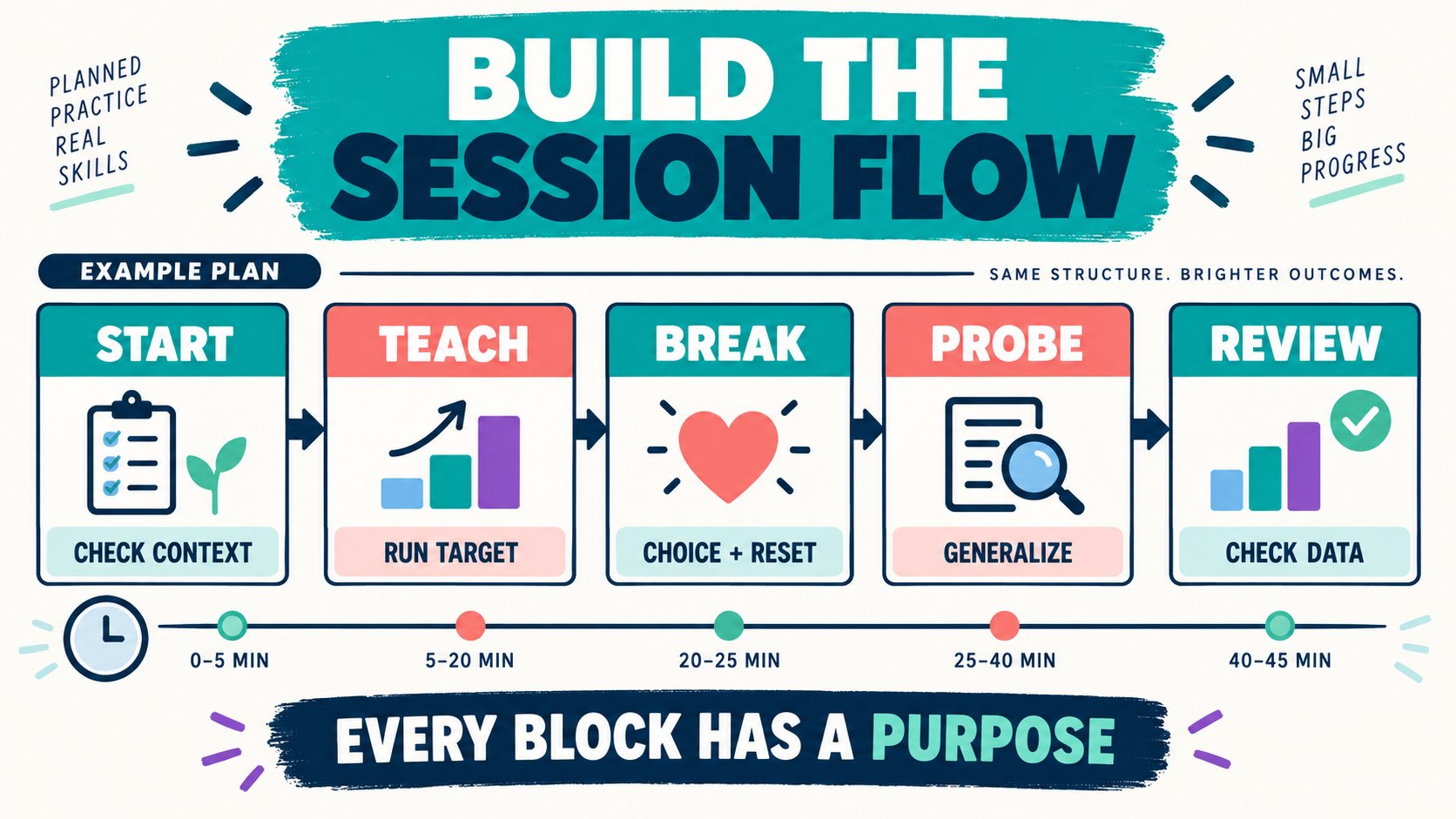
The table below is an illustrative planning example for study. It is not a required session length, a billing rule, or a recommendation for a particular learner. The times are placeholders that show how to connect a block with a purpose and a decision point.
| Block | Purpose | What to record | Decision point |
|---|---|---|---|
| Arrival and check-in | Review context, preferences, communication access, and readiness. | Relevant setting events and the learner’s chosen starting activity. | Keep, modify, or delay the first demand. |
| Warm-up and choice | Pair the context, practice communication, and identify current interests. | Choice response, engagement, and any planned preference information. | Select a realistic first teaching target. |
| Skill-acquisition block | Run planned opportunities for one priority skill with the written prompt and reinforcement procedure. | Independent, prompted, incorrect, latency, or other defined response data. | Continue, fade, change exemplars, or pause based on the plan and data. |
| Break or movement choice | Support regulation, choice, and a transition to the next context. | Break request, duration if relevant, and safe return to the next activity. | Resume, shorten the next block, or consult the plan. |
| Generalization or maintenance | Test a planned variation in material, person, place, or response context. | Probe result and the conditions under which the response occurred. | Return to teaching, record maintenance, or plan another probe. |
| Close and review | Check data, summarize meaningful events, and prepare the next question. | Completed targets, deviations, integrity notes, and communication items. | Carry forward, revise, or escalate for supervision. |
This example shows why an ABA session schedule should not be judged by how many activities it contains. A shorter schedule with valid opportunities and clean data may answer the clinical or study question better than a busy schedule that creates fatigue, rushed transitions, or unreliable measurement.
How should data and documentation fit the schedule?
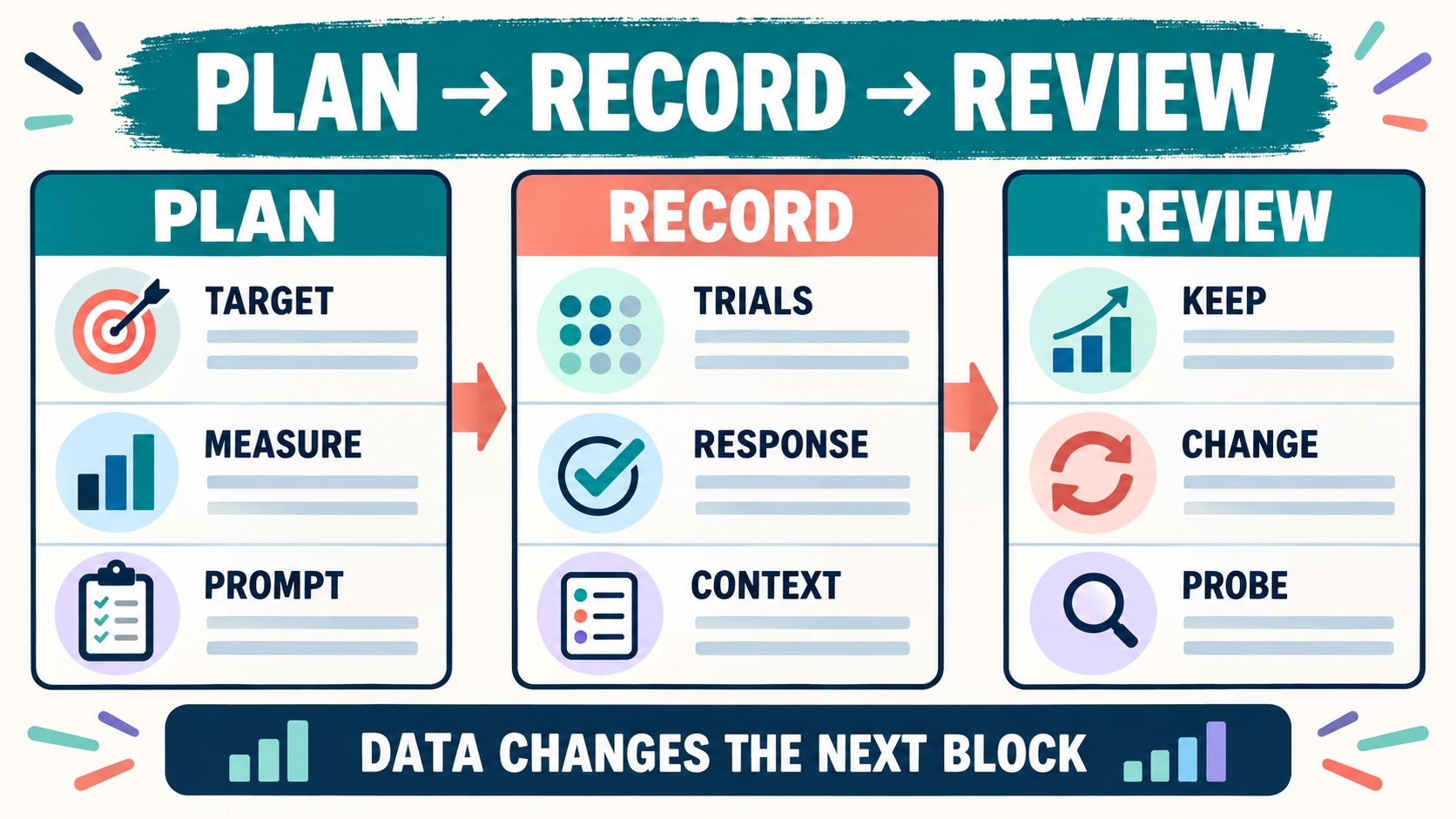
Data collection belongs at the point where it can answer a defined question. If the goal is independent requesting, record the opportunity, the response, and the prompt level. If the goal is a reduction target, use the selected measure—such as frequency, rate, duration, latency, or interval recording—consistently with its operational definition. Do not add a data sheet simply because it appears in a template library.
The current BACB BCBA Handbook and BACB fieldwork guidance emphasize maintaining documentation and checking that records demonstrate what occurred. Those sources are especially relevant for trainees and supervisors, but they do not turn this sample session schedule into a universal fieldwork or service-delivery form. Always check the latest applicable handbook, supervisor direction, setting rules, and state or payer requirements.
- Before the block: identify the target, measurement, materials, prompt plan, reinforcement arrangement, and decision rule.
- During the block: collect only the data needed to evaluate the target and record deviations that could affect interpretation.
- After the block: compare the observed pattern with the criterion and decide whether to continue, change, probe, or seek supervision.
- At the end: confirm that the note and data sheet agree about what happened, what was changed, and what question remains.
Separate treatment data from impressions. “The learner looked tired” may be useful context, but it is not the same as a defined measure. If context affects responding, document it in a way that allows the team to interpret the target data without presenting an unsupported causal conclusion.
How can a session schedule stay flexible and respectful?
Flexibility is not the absence of structure. It is a planned ability to respond to evidence. A schedule can include a primary route, a lower-effort alternative, and a clear reason for changing routes. For example, if a learner communicates a need for a break, the team can follow the written communication and safety procedure, record the opportunity, and adjust the next block rather than treating the break as a failure of the schedule. Build flexibility before the session:
- Offer meaningful choices where the plan allows them, such as which materials or activity begins a block.
- Use accessible communication and do not make participation dependent on a particular speech form when an approved alternative is available.
- Define what counts as a pause, break, transition, or stop request and how staff will respond.
- Identify a safe, lower-demand option that still supports the session goal when the original activity is not workable.
- Record the change and review whether the schedule, skill, prompt, environment, or expectation needs revision.
The BACB ethics-code resource is a useful boundary for study: consumer protection, assent, and professional responsibility matter alongside efficiency. A schedule that looks productive but ignores communication, dignity, or meaningful participation is not a high-quality schedule.
What are common ABA session schedule mistakes?
- Filling every minute: the schedule leaves no room for transitions, data entry, choice, or unexpected context.
- Using activity names instead of targets: “table work” does not say what response, criterion, or consequence is being evaluated.
- Confusing a visual schedule with a team plan: the learner-facing format and the practitioner-facing plan may need different details.
- Confusing a session note with a schedule: documentation of what happened cannot replace planning how evidence will be collected.
- Collecting data without a question: a large template can create effort without producing interpretable information.
- Ignoring prompt level: prompted success and independent success should not be collapsed into one score.
- Making a sample look mandatory: example times and block lengths are not universal dosage or billing requirements.
- Skipping the review loop: if the data never change the next plan, the schedule is only a calendar.
Quick review: Start with the session question, choose observable targets, reserve realistic blocks, place data checkpoints, include transitions and choice, define adjustment rules, and close the loop with documentation. A strong ABA session schedule is structured enough to guide the team and flexible enough to respond to the learner. For additional BCBA-style practice with data, prompting, and intervention decisions, try the free BCBA mock exam. It is a study resource and does not claim to reproduce official BACB questions.
ABA session schedule FAQ
How long should an ABA session be? There is no universal session length that fits every learner, setting, service, or plan. Use the applicable authorization, plan, supervision, and setting requirements, then schedule realistic teaching, transitions, breaks, and documentation within that period.
What should happen first in an ABA session? Begin with the context check and the plan: review relevant setting events, communication access, preferences, safety information, and the first target. The exact first activity should be individualized rather than forced by a generic template.
Should every session include discrete trial training? Not automatically. A session schedule should match the target and teaching procedure. DTT may be appropriate for some goals; naturalistic teaching, task analysis, modeling, shaping, or other procedures may be more relevant for others.
How often should data be collected? Collect data at opportunities that represent the target and support the decision you need to make. The measure and frequency should be defined in the plan; collecting more data is not automatically better if it reduces accuracy or participation.
Can I use this ABA session schedule as a treatment plan? No. It is an educational planning example. A qualified BCBA and the relevant team must individualize procedures, confirm competence, consider assent and safety, and follow the requirements that apply to the learner and service.
Take the Free BCBA Mock Exam
When you are ready to apply the idea, use the free practice resource below for additional feedback. Take the Free BCBA Mock Exam



