
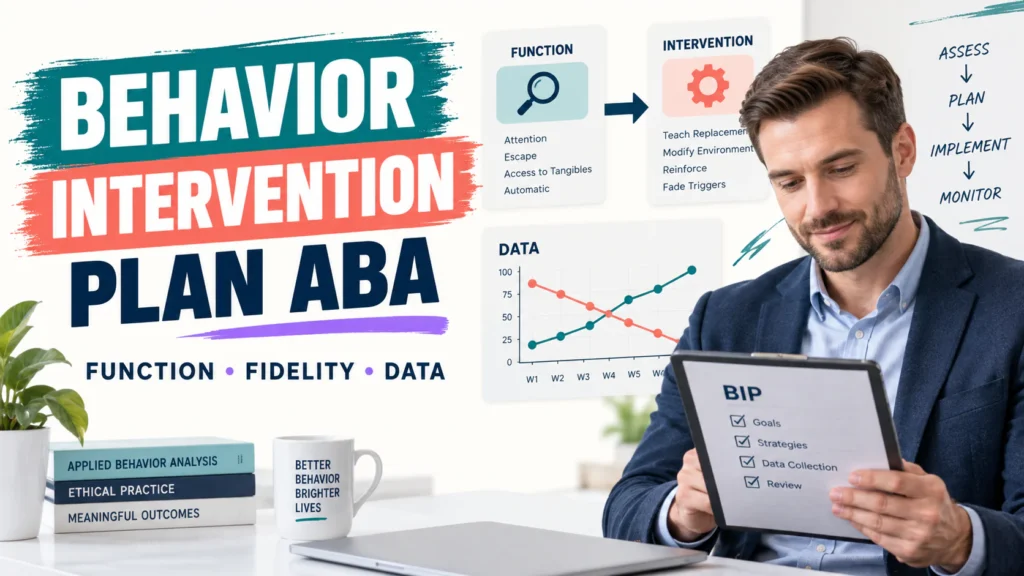
A behavior intervention plan in ABA is the written bridge between assessment findings and day-to-day intervention. It should tell a team what behavior to measure, what function the assessment supports, what replacement skill to teach, how to respond, and how the team will know whether the plan is being implemented and helping.
Table of Contents
- Behavior Intervention Plan ABA: The Short Answer
- Build the FBA-to-BIP Decision Chain
- Define the Target, Function, and Replacement Behavior
- Choose Intervention Components That Match the Function
- Separate Implementation Fidelity From Outcome Data
- Use a Maintain, Adjust, or Pause Review
- BCBA Exam Traps and Study Use
- Frequently Asked Questions
- Sources for Further Study
- Take the Free BCBA Mock Exam
This guide takes a focused angle on behavior intervention plan ABA work: the decision chain after an FBA and the review that follows implementation. The existing broad BIP reference, BIP guide, and FBA-to-BIP page remain read-only references. This new page does not replace or change them.
A template can organize thinking, but it cannot make a plan individualized. Confirm the current assessment, consent and collaboration requirements, supervision expectations, safety procedures, privacy rules, and service authorization with the responsible BCBA and applicable authorities. This article is educational guidance, not a client-specific treatment plan or legal advice.
Behavior Intervention Plan ABA: The Short Answer
A BIP is an individualized plan for reducing a defined problem behavior and increasing useful, socially meaningful behavior. In an ABA context, the plan should be connected to assessment evidence rather than built from a generic list of consequences. The function hypothesis helps determine what the person is trying to obtain, avoid, communicate, or regulate in the relevant context; it does not excuse guessing or turn a diagnostic label into a function.
A strong plan makes the next action observable. A staff member should be able to identify the target behavior, arrange the agreed antecedent supports, prompt or teach the replacement response, deliver the specified consequence, record the required data, and know when to ask for supervision. If two trained implementers would read the same plan and do two different things, the procedure is not yet operational enough.
- Assessment link: the target and intervention are traceable to current observation, record review, interview, or other appropriate assessment evidence.
- Function link: the plan addresses the suspected maintaining variable instead of only suppressing the visible response.
- Skill-building link: the learner receives a feasible replacement or alternative response with a way to contact the same outcome when appropriate.
- Measurement link: the team collects outcome and implementation data that support a specific decision.
Build the FBA-to-BIP Decision Chain

Move through the chain in order. Skipping from “the behavior is difficult” to “use a consequence” is one of the fastest ways to create a plan that is hard to implement and impossible to interpret. The word function describes a relationship supported by assessment evidence; it is not a personality judgment and not a guarantee that every episode has one identical cause.
| Step | Question to answer | Evidence to carry forward |
|---|---|---|
| Define | What exactly counts as the target response, and what does not? | Observable definition, start and stop rules, examples, nonexamples, and baseline measurement. |
| Function | What antecedent and consequence patterns support the current hypothesis? | Relevant setting events, triggers, consequences, competing explanations, and limits of the assessment. |
| Replace | What safer or more efficient response can contact a meaningful outcome? | Skill definition, teaching sequence, prompts, reinforcement, generalization plan, and fluency criteria. |
| Intervene | What will the team arrange, teach, reinforce, record, and review? | Written procedures, roles, fidelity checklist, outcome graph, decision rule, and safety escalation path. |
Notice that the chain ends in a reviewable procedure, not merely a label such as “attention-maintained.” The plan should explain what attention will be made available for the replacement response, how staff will prompt it, and what they will do when the target behavior occurs. It should also identify what would cause the team to revisit the hypothesis.
Define the Target, Function, and Replacement Behavior
Start with the smallest set of details that makes the plan testable. “Aggression decreased” is not enough if the team does not agree whether grabbing clothing, hitting an open hand, and pushing furniture belong in the same target. Combine the operational definition with a measurement system that fits the response class. Frequency or rate may fit discrete events; duration may fit episodes; latency may fit the time to begin a response. Use the least complicated measure that answers the decision question reliably.
| BIP component | Minimum clarity check | Common weak version |
|---|---|---|
| Target behavior | An observer can score it consistently across the intended settings. | A broad label such as “noncompliance” with no observable examples. |
| Function hypothesis | The antecedent-behavior-consequence pattern and uncertainty are documented. | A presumed function copied from a previous case or diagnosis. |
| Replacement behavior | It is observable, teachable now, efficient enough to compete, and linked to the relevant outcome. | “Use coping skills” without a response definition, prompt plan, or reinforcement rule. |
| Goal and criterion | The team knows the level, duration, context, and generalization condition that count as progress. | A percentage goal with no denominator, observation window, or maintenance expectation. |
Replacement behavior is not just a nicer name for compliance. It should give the learner a practical way to access the relevant reinforcer, communicate a need, tolerate a change, or complete a task. Consider response effort, speed, social validity, prompts, reinforcement, and whether the replacement can be used in the real setting. If the replacement is much harder or slower than the target response, the team should not be surprised when it is not selected.
Choose Intervention Components That Match the Function
Organize the procedure around what happens before, during, and after the response. The exact components depend on the case and the supervising clinician’s judgment, but the plan should make each component measurable.
- Antecedent supports: adjust task clarity, choice, pacing, materials, signals, transitions, or response effort when assessment suggests those variables matter.
- Teaching procedure: specify the prompt, model, practice opportunity, error correction, and fading plan for the replacement or alternative response.
- Reinforcement plan: define what consequence follows the replacement, how quickly it is delivered, and how the team will thin or generalize it without removing the skill’s value.
- Response to the target: state what staff should do consistently while protecting dignity and safety. Avoid vague instructions such as “do not reinforce” when the actual procedure has not been defined.
- Team coordination: identify the implementer, supervisor, caregiver or teacher role, training method, and route for reporting barriers or unexpected effects.
Function-based does not mean consequence-only. A complete BIP can include prevention, teaching, reinforcement, environmental design, and safety steps. It should also state what the plan does not authorize. If a procedure may be restrictive, risky, or regulated, pause and follow the current policy, supervision, consent, reporting, and legal requirements instead of improvising from a blog or template.
Separate Implementation Fidelity From Outcome Data

When a plan appears not to work, ask two different questions: “Was the plan implemented as written?” and “Did the target or replacement behavior change?” Outcome data alone cannot answer the first question. A low-fidelity implementation can make an effective plan look ineffective; a high-fidelity implementation with no improvement can signal a weak hypothesis, an inaccurate measure, an insufficient teaching history, or a mismatch between the plan and the context.
| Review question | Measure or inspect | Next decision |
|---|---|---|
| Was the procedure delivered? | Step checklist, opportunities, prompts, reinforcement timing, staff training, and treatment-integrity sample. | Clarify, model, coach, or redesign the procedure before calling the intervention ineffective. |
| Did the target change? | The chosen frequency, rate, duration, latency, or interval measure under the same scoring rules. | Compare with baseline and the decision criterion; inspect context rather than relying on a single episode. |
| Did the replacement generalize? | Independent use across people, settings, materials, or response forms, plus maintenance probes. | Program transfer, fade prompts carefully, or return to teaching if the skill is not functional outside training. |
| Did risk or burden change? | Incidents, distress, missed opportunities, acceptability, staff burden, and unexpected side effects. | Escalate to the supervising clinician and apply the current safety and reporting process. |
Graph the measures in a way that keeps baseline, intervention, setting, and major plan changes visible. Record when a new staff member, schedule, medication, environment, or instructional demand may have changed the context, without assuming that any one variable explains the result. The purpose of the graph is to support a defensible clinical conversation, not to make a weak plan look precise.
Use a Maintain, Adjust, or Pause Review
Give the BIP a written decision rule before the team is under pressure. A useful review asks whether the plan is safe, feasible, implemented with adequate fidelity, producing the intended change, and acceptable to the people who use it. “Adjust” should name what will change and why; “pause” should identify who must be contacted and what immediate safety or continuity steps apply.
- Maintain: fidelity is adequate, the target and replacement data move in the intended direction, and the procedure remains safe and workable. Continue monitoring and plan generalization or maintenance rather than removing support suddenly.
- Adjust implementation: the plan is reasonable but staff are missing steps, prompts are inconsistent, or reinforcement is delayed. Retrain, simplify, model, and sample fidelity again before changing the function hypothesis.
- Reassess: fidelity is adequate but data do not improve, the replacement is not competitive, the target definition is unstable, or the context has changed. Review the assessment and measurement with the supervising clinician.
- Pause and escalate: there is a safety concern, unexpected harm, a procedure outside the team’s authority, or a serious privacy, consent, or service-authorization question. Follow the current organizational and jurisdictional process.
A BIP should be understandable to the team and respectful of the learner. Invite feedback from caregivers, teachers, direct staff, and the person receiving services when appropriate. Their observations can reveal that a replacement is too slow, a schedule is unrealistic, or a procedure is not socially acceptable even when a graph looks orderly.
BCBA Exam Traps and Study Use
For BCBA exam questions, separate the assessment finding from the intervention decision and the data-review decision. Common traps include:
- Choosing a consequence before identifying the likely maintaining variable.
- Treating a diagnostic label or a vague topography as a functional assessment.
- Confusing a replacement behavior with a verbal goal that cannot be observed or measured.
- Declaring treatment failure without checking procedural integrity.
- Assuming a reduction in one setting proves generalization or maintenance.
- Using a template as if it were individualized clinical authorization.
Use official BACB resources for current certification and ethics context, then practice deciding what evidence is missing in a scenario. The Free BCBA Mock Exam can help you diagnose whether the difficulty is defining behavior, selecting the function-based response, interpreting data, or applying an ethics boundary. It is a study tool, not a promise of certification or a substitute for supervision.
Frequently Asked Questions
What is a behavior intervention plan in ABA?: It is an individualized written plan that connects assessment evidence to prevention, teaching, reinforcement, responses to the target behavior, measurement, implementation roles, and review rules. It should be specific enough for the trained team to implement consistently.
Does every BIP have to include an FBA?: The appropriate assessment process depends on the case, setting, scope, and current requirements. A BIP should still have a defensible connection to assessment evidence and should not treat a generic template as a substitute for individualized evaluation. The responsible clinician should determine the appropriate assessment and documentation.
What is the difference between fidelity data and outcome data?: Fidelity data describe whether the intervention steps were implemented as planned. Outcome data describe what happened to the target and replacement behavior. You need both to interpret a result: low fidelity calls for implementation support, while adequate fidelity with poor outcomes may call for reassessment or an intervention change.
Can I download a BIP template and use it for a client?: A template can organize fields, but it cannot supply the client’s operational definition, function hypothesis, replacement skill, risk review, consent, teaching plan, or decision rule. Use current supervision and applicable policy to individualize every section, and do not copy another client’s identifying information.
Sources for Further Study
Review the BACB Ethics Codes for current professional boundaries and the BCBA Handbook for current certification resources. The Vanderbilt IRIS BIP module offers an educational planning sequence, and ABA Navigator’s BIP explainer provides a plain-language secondary reference. Recheck source pages, local requirements, supervision guidance, and the individual case before using a plan.
Take the Free BCBA Mock Exam
When you are ready to apply the idea, use the free practice resource below for additional feedback. Take the Free BCBA Mock Exam



