

Generalization training ABA is the deliberate process of helping a learned response occur with relevant new people, materials, settings, instructions, or response forms—not only under the exact teaching conditions. A useful plan does more than name a strategy. It identifies what must transfer, measures performance outside the teaching arrangement, and changes the plan when the data show a narrow skill.
Table of Contents
- Generalization Training ABA: The Short Answer
- Define the Transfer Target Before You Teach
- Baseline the Transfer Dimensions
- Choose a Programming Strategy
- Run, Test, and Adjust the Training Loop
- Generalization Versus Maintenance
- BCBA Exam Traps and Study Use
- Frequently Asked Questions
- Sources for Further Study
- Quick Review Checklist
- Take the Free BCBA Mock Exam
This guide focuses on programming and data review. It is different from a definition-only explanation or a list of generalization strategies. Use it as a study framework for BCBA-style decisions and as a reminder that real clinical programming must be individualized, supervised, safe, assent-aware, and consistent with current professional and local requirements.
The current BACB BCBA Test Content Outline is the exam-scope boundary. It does not turn one website explanation into an official BACB protocol. For a real learner, review the relevant assessment, treatment plan, data, context, and ethics requirements before selecting a procedure.
Generalization Training ABA: The Short Answer
Teaching is not complete when a learner responds correctly with one therapist, one set of materials, and one prompt sequence. Generalization training asks whether the relevant behavior appears when a meaningful feature changes. The change might be a different instructor, a new room, another example, a natural instruction, or a functionally equivalent way to respond.
Start with the intended outcome, not with a favorite procedure. Write one sentence such as: “When a familiar adult presents a reasonable request in a home or community routine, the learner will request a break using speech, a card, or the agreed device response without a training prompt.” Then decide which parts of that sentence must be tested and which variations would be irrelevant or unsafe. Three questions keep the plan precise:
- What response must transfer? Define its observable topography, function, quality, and measurement.
- Across which dimensions? Name the people, settings, materials, instructions, times, and response forms that matter.
- What evidence will count? Specify the probe condition, prompt rule, mastery criterion, and decision if performance drops.
Define the Transfer Target Before You Teach
A vague goal such as “generalize communication” is difficult to program and impossible to graph cleanly. Convert it into a transfer map. Keep the trained response and the intended variations separate so you do not accidentally change the target and the test condition at the same time.
| Planning field | Write it in observable terms | Avoid |
|---|---|---|
| Response | What the learner says, selects, signs, writes, or does; include the acceptable response forms. | A broad label such as “uses communication” without a response definition. |
| Antecedent | The natural cue or routine that should occasion the response after teaching support is faded. | A teaching prompt that will never be present in the target routine. |
| Consequence | The natural or planned outcome that makes the response useful and likely to continue. | Assuming the same contrived reinforcer will be available in every setting. |
| Mastery and probe | A criterion, prompt level, number of opportunities, and unprompted test condition. | Calling transfer complete because one teaching session was successful. |
Also record what must remain stable. If the learner is learning a safety response, changing the consequence or removing an essential prompt may be inappropriate. Good generalization programming varies meaningful features while protecting safety, clarity, and the learner’s access to reinforcement.
Baseline the Transfer Dimensions
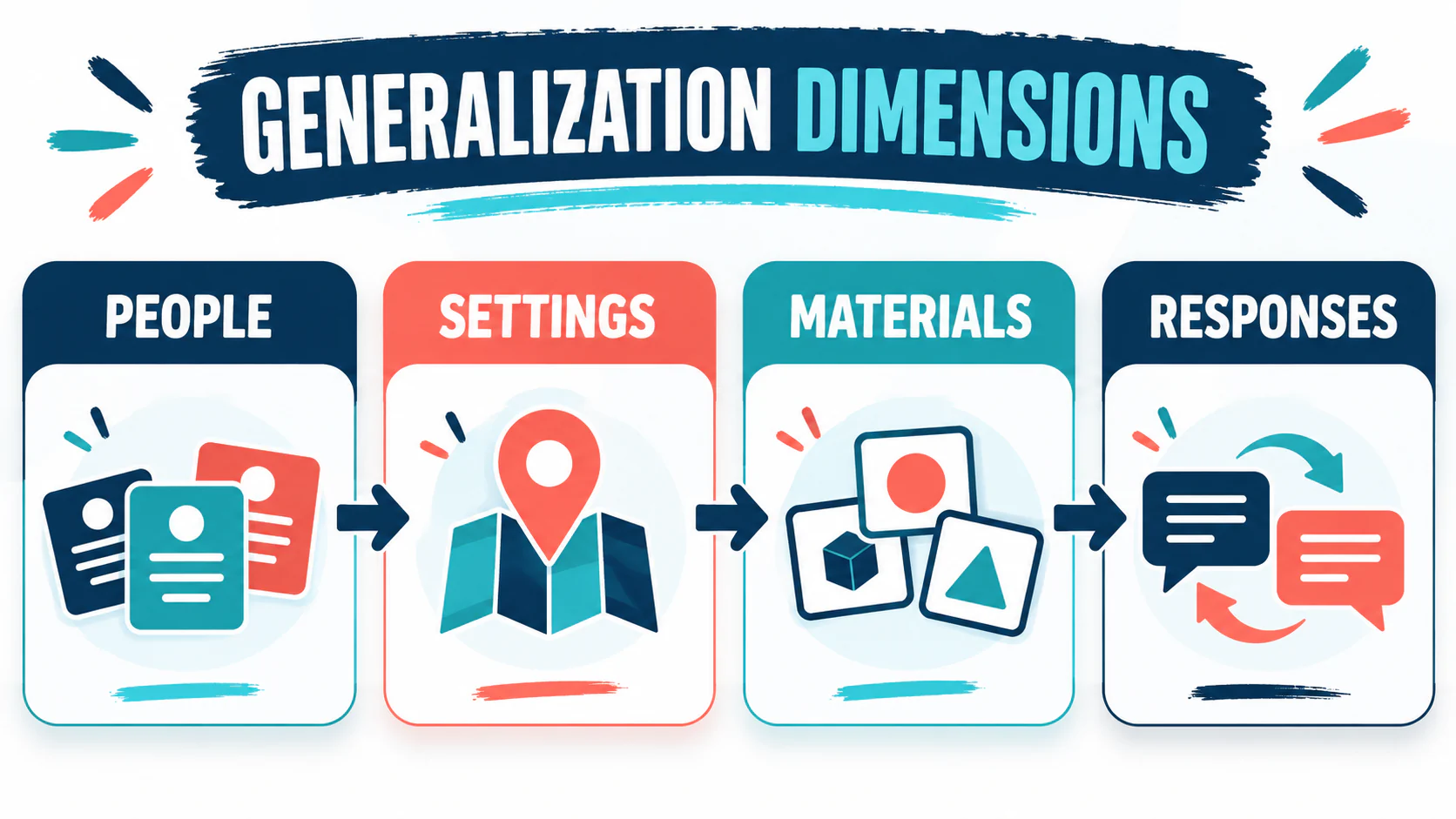
Before adding many variations, sample the dimensions that matter. A short baseline does not need to test every possible person or setting. It should show whether the skill is already present, where it fails, and which variation is most important for the learner’s daily life.
| Dimension | Example probe | Data question |
|---|---|---|
| People | A caregiver, teacher, or trained staff member gives the natural cue. | Does performance depend on one instructor’s voice, proximity, or prompt style? |
| Settings | A relevant home, school, community, or telehealth context is sampled. | Does the response occur when materials, noise, layout, or routine changes? |
| Materials and examples | Rotate exemplars while keeping the functional relation intact. | Is the learner responding to the concept or memorizing one item, picture, or sequence? |
| Responses | Accept a functionally equivalent response form when the goal allows it. | Are different forms equivalent in function, or are they actually different skills? |
Use the baseline to prioritize. If a learner performs well with new materials but not with a second caregiver, a person-focused plan is more useful than adding ten more materials. If the response fails only in a noisy setting, test the environmental arrangement before declaring that the concept itself was not learned.
Choose a Programming Strategy
Programming strategies are tools, not labels to collect. Select the smallest arrangement that addresses the observed transfer barrier, then test the result. Common approaches can be combined:
- Multiple exemplar training: teach enough examples to contact the relevant class rather than relying on one memorized exemplar.
- Programming common stimuli: bring a meaningful feature from the natural environment into teaching so the later context is more familiar.
- Vary nonessential features: rotate people, materials, wording, order, and location while keeping the target relation clear.
- Train loosely: vary timing, practice partners, and small contextual features when doing so is safe and does not make the instruction ambiguous.
- Contact natural contingencies: move reinforcement and feedback toward the outcomes that make the response useful outside the teaching session.
Do not change every variable at once. A transfer probe should tell you something. If the learner misses the response after a new person, new material, and a new room are introduced simultaneously, you cannot tell which dimension needs support. Change one priority dimension first or use a planned matrix that makes each combination visible.
Run, Test, and Adjust the Training Loop
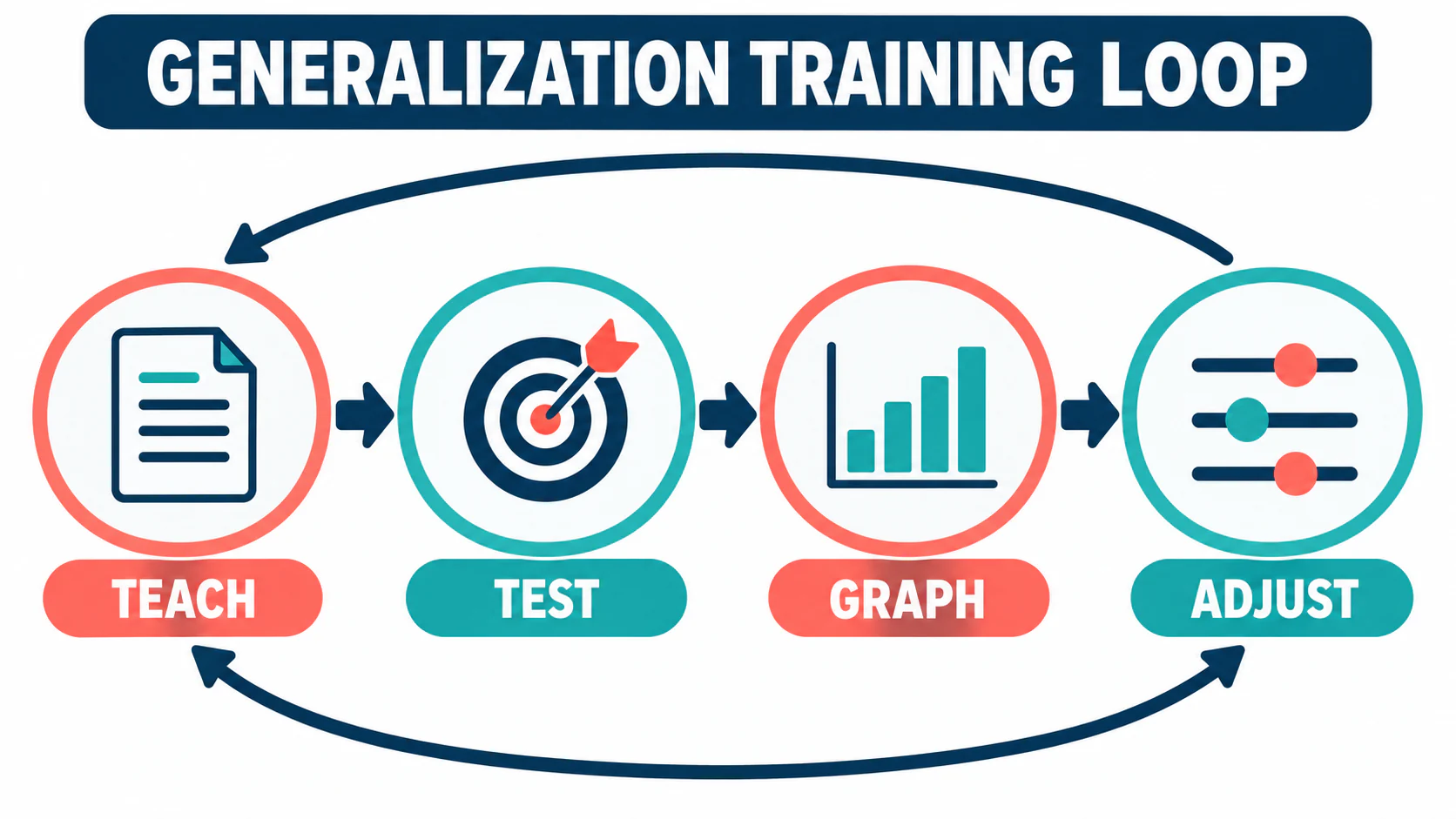
A compact training loop keeps generalization from becoming an assumption:
- Teach: establish the response under clear conditions, using the least intrusive effective prompt and a consequence that supports the goal.
- Vary: introduce one planned change, such as a second person or a new exemplar, while recording the condition.
- Test: run a brief probe with the teaching prompt removed or reduced according to the plan. Record opportunities, independent responses, errors, latency, and any safety issue.
- Graph: display performance by dimension instead of combining all conditions into one percentage that hides a weak setting.
- Adjust: if transfer is low, return to the smallest useful support, change the arrangement, and test again. If transfer is stable, add the next meaningful variation.
Predefine the decision rule. For example, a team might require a specified level of independent responding across two people and two relevant settings before expanding the matrix. The exact criterion must fit the learner and goal; the important point is that it is written before the result is known.
Review errors functionally. An error may indicate that the learner needs another exemplar, that the natural cue is not salient, that the reinforcer is unavailable, that the response form is inefficient, or that the test context is unsafe or too difficult. Do not respond to every error by adding more prompts. A prompt can produce correct performance while masking whether the natural cue controls the response.
Generalization Versus Maintenance
Generalization and maintenance are related but ask different questions. Generalization asks whether the behavior transfers across relevant stimulus or response dimensions. Maintenance asks whether the behavior continues over time after teaching intensity, prompts, or programmed reinforcement change.
| Question | Generalization | Maintenance |
|---|---|---|
| What changes? | People, settings, materials, cues, or response forms. | Time, teaching intensity, prompts, or programmed reinforcement. |
| What does the probe show? | Whether the response occurs under a relevant new condition. | Whether the response remains strong at a later review point. |
| Common mistake | Testing one new example and declaring transfer everywhere. | Stopping data collection immediately after mastery. |
A good program schedules both types of probes. A skill can generalize to a new person today but not maintain next month. It can also maintain with one caregiver while failing to generalize to the classroom. Keep the conditions and dates visible in the data file.
BCBA Exam Traps and Study Use
For BCBA-style questions, identify what the vignette changed and what outcome it measured. If the question changes the person, material, setting, or cue, think about generalization. If it changes the time since teaching or the level of programmed support, think about maintenance. If it asks whether a new response form serves the same function, inspect response generalization rather than assuming that any different topography is equivalent.
Use the existing generalization definition guide and generalization strategy guide as read-only companions. Then test yourself with the Free BCBA Mock Exam. A practice result tells you which discrimination to review; it does not guarantee certification.
Frequently Asked Questions
What is generalization training in ABA?: It is the planned teaching and testing of a learned behavior under relevant new conditions, such as different people, settings, materials, cues, or functionally equivalent response forms. The plan should define the target, probe the change, and use data to decide what happens next.
What is an example of generalization training?: A learner first practices requesting a break with one therapist and one card. The team then tests the same functional request with a caregiver, in a different routine, and with a second approved response form, while recording independent responding and prompts. The exact sequence should be individualized and safe.
Is generalization the same as maintenance?: No. Generalization concerns transfer across relevant stimulus or response dimensions. Maintenance concerns persistence over time or after teaching support changes. Both should be measured because success in one does not prove success in the other.
Which generalization strategy should I use first?: Use the baseline to identify the barrier. Multiple exemplars may fit a narrow stimulus class, common stimuli may help when the natural setting is missing from teaching, and natural contingencies may matter when the response is not useful outside therapy. Do not select a procedure from a list without reviewing the learner’s data and context.
Sources for Further Study
Review the current BACB BCBA Test Content Outline, 6th edition, the official BCBA resource hub, the BCBA Handbook, and the BACB Ethics Codes. Recheck official sources when requirements or editions change, and use qualified supervision for real clinical decisions.
Quick Review Checklist
Use this final checklist to turn generalization training aba into exam-ready reasoning. The goal is not to memorize a label in isolation; it is to identify the relevant evidence and explain why the best answer fits the scenario. Key ideas to review:
- State the central definition or decision point for generalization training aba in your own words.
- Identify the detail that makes generalization training aba different from its closest related ABA term.
- Separate the observable facts in a scenario from assumptions that are not supported by the facts.
- Write one example and one nonexample so you can recognize the concept in a new setting.
Exam application checks:
- Ask what the question is actually requesting before comparing the answer choices.
- Mark the antecedent, response, consequence, or other evidence that supports the selected answer.
- Look for a distractor that describes a related process but does not answer the specific question.
Final self-check:
- Explain how you would verify the interpretation with clear observations or data.
- Change one detail in the scenario and decide whether your answer should change.
- Give a one-sentence rationale that a supervisor or study partner could evaluate.
Take the Free BCBA Mock Exam
When you are ready to apply the idea, use the free practice resource below for additional feedback. Take the Free BCBA Mock Exam



