
An ABA treatment plan example is useful when it shows how assessment information becomes measurable goals, procedures, caregiver participation, service rationale, and a review decision. It is not useful when it is a blank template that suggests every client should receive the same goals or number of hours.
Table of Contents
- ABA Treatment Plan Example: The Short Answer
- Map the Plan Before You Write the Example
- A Fictional ABA Treatment Plan Example
- Treatment Plan vs BIP vs Skill-Acquisition Plan
- Turn the Example Into a Data-Review Decision
- BCBA Exam Traps and Study Use
- Frequently Asked Questions
- Sources for Further Study
- Quick Review Checklist
- Take the Free BCBA Mock Exam
This page gives a clearly labeled fictional framework for reading and studying a treatment plan. The existing ABA assessment and treatment-plan reference, ABA goals guide, and skill-acquisition example remain read-only references. This new URL does not replace or modify them.
The sample below is fictional, non-client-specific, and intentionally incomplete as a clinical document. Actual plans require individualized assessment, collaboration, consent, supervision, current payer forms, authorization rules, and applicable law. Do not copy sample values or identifying details into a real record.
ABA Treatment Plan Example: The Short Answer
An ABA treatment plan is a coordinated clinical document that explains why services are being considered, what meaningful outcomes are targeted, how progress will be measured, how caregivers or other partners will participate, and when the plan will be reviewed. A behavior intervention plan may be one component of that larger plan. A skill-acquisition plan may describe teaching details for one skill area. They are related, but they are not interchangeable labels. When you study an ABA treatment plan example, look for a chain that can be checked:
- Referral question: what decision or functional need brought the case forward?
- Assessment and baseline: what was measured, in what context, and under what definition?
- Goal: what observable change is expected, by when, and under which conditions?
- Procedure and supports: what will be taught or changed, by whom, and with what safeguards?
- Review: what data and decision rule determine whether to continue, adjust, generalize, or pause?
That chain is more valuable than a polished form because it lets a reader test whether the plan is individualized and internally consistent.
Map the Plan Before You Write the Example
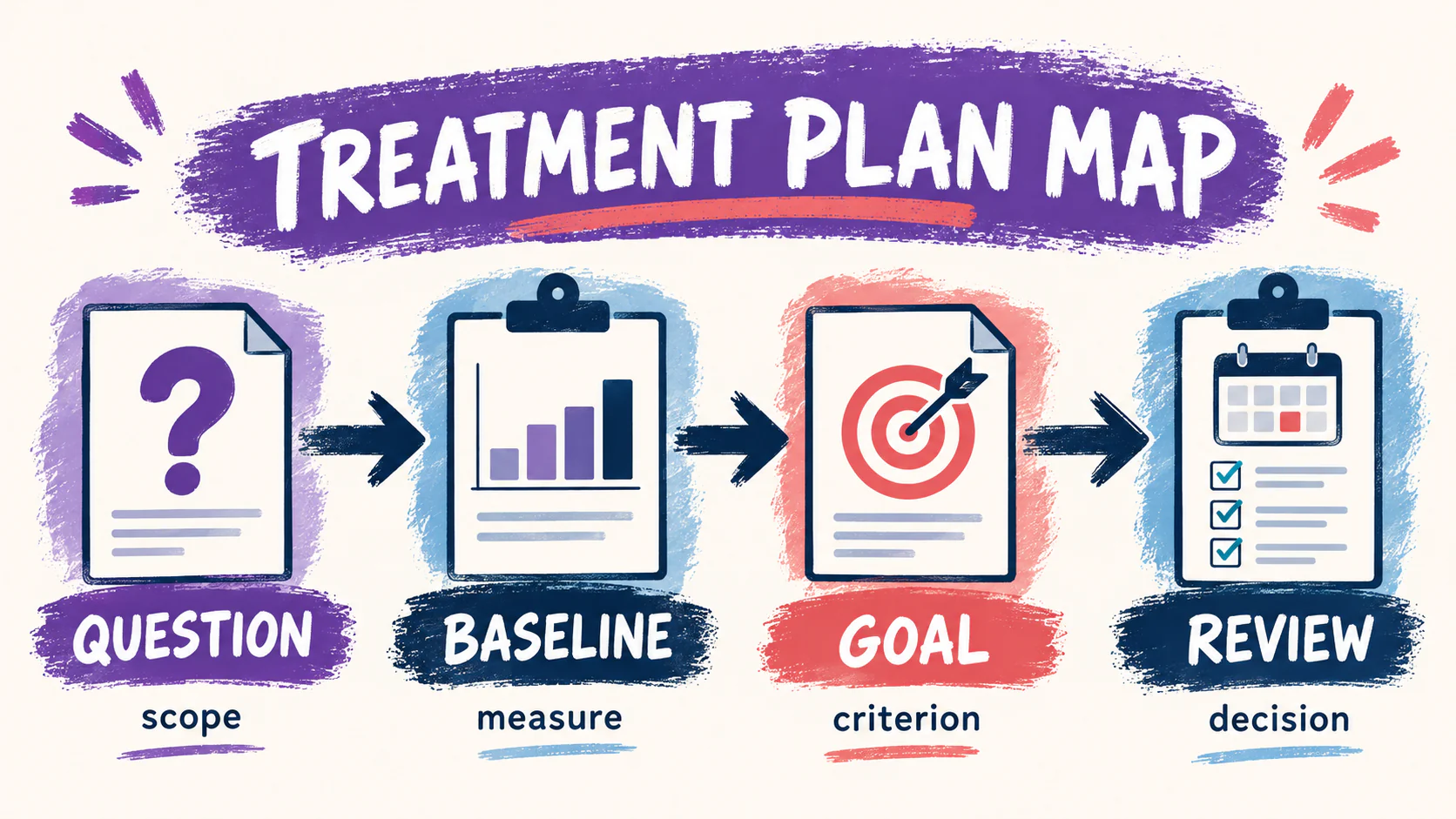
Use the four-part map in the infographic as a reading tool. The question establishes scope; the baseline gives a starting point; the goal defines the intended change; and the review field prevents the plan from becoming a document that is never revisited.
| Plan field | What it should answer | Weak example |
|---|---|---|
| Referral question | What meaningful participation, safety, communication, or learning problem needs assessment? | “Needs ABA” without a decision or context. |
| Baseline | What is the observable starting level, measured consistently? | “Often” or “rarely” with no measure or observation window. |
| Goal | What response will change, by how much, under what conditions, and by what date? | “Improve social skills” without an observable criterion. |
| Review rule | Which data trigger maintenance, adjustment, reassessment, generalization, or pause? | “Review as needed” with no owner or date. |
A Fictional ABA Treatment Plan Example
The following is a study example, not a recommendation for a real client. Imagine a fictional learner, “Case A,” whose team wants to improve participation during a short, predictable classroom transition. No age, diagnosis, payer, location, identifying detail, or service-hour recommendation is supplied because those details would require a real assessment and current requirements.
| Example section | Fictional entry | Why it matters |
|---|---|---|
| Referral question | How can Case A move from a preferred activity to the next classroom routine with less adult delay and a functional communication response? | It defines a participation problem rather than labeling the learner. |
| Operational definition | Transition delay: more than 30 seconds between the transition cue and movement toward the marked next activity after the agreed prompt opportunity. | Different observers can score the same event and exclude ordinary variation. |
| Baseline | Across a fictional five-observation sample, the median delay is 90 seconds; independent transition communication occurs in 1 of 5 opportunities. | The goal can be compared with a defined starting point; the numbers are not real-client norms. |
| Short-term goal | During the specified routine, Case A will use the taught transition response within 30 seconds in at least 4 of 5 opportunities across three consecutive observations. | It names the response, opportunity count, time criterion, and stability rule. |
| Procedure | Preview the sequence, offer the agreed choice, teach the communication response, prompt and fade according to the supervisor’s procedure, and reinforce independent movement or communication. | It connects the goal to prevention, teaching, reinforcement, and measurement without prescribing a universal protocol. |
| Caregiver or team component | Practice the same response definition and prompt language in the agreed routine; record barriers and bring questions to supervision. | Participation is observable and supported, not just a promise to “involve the family.” |
| Review | Review weekly sample data and fidelity; revisit the plan at the scheduled clinical and authorization review or sooner if safety, burden, or context changes. | The team knows what evidence matters and when an earlier review is required. |
Notice what this example does not do. It does not select a diagnosis, promise a payer will authorize service, choose a universal number of hours, or claim that one transition procedure will work for every learner. It demonstrates the relationship between fields so a qualified clinician can decide what belongs in the actual document.
Treatment Plan vs BIP vs Skill-Acquisition Plan
These documents can overlap, but they answer different planning questions. Mixing them can make a goal sound complete when the implementation details or broader service rationale are missing.
| Document | Primary job | Do not assume |
|---|---|---|
| Treatment plan | Coordinate assessment findings, goals, services, caregiver participation, rationale, review, and continuity. | It contains every step of every teaching procedure. |
| BIP | Describe function-based prevention, teaching, reinforcement, response, safety, and data procedures for a target behavior. | It automatically supplies the full service rationale or payer form. |
| Skill-acquisition plan | Specify the teaching sequence, prompts, practice, mastery, generalization, and maintenance for a skill. | It replaces assessment, consent, broader goals, or treatment-plan review. |
Turn the Example Into a Data-Review Decision
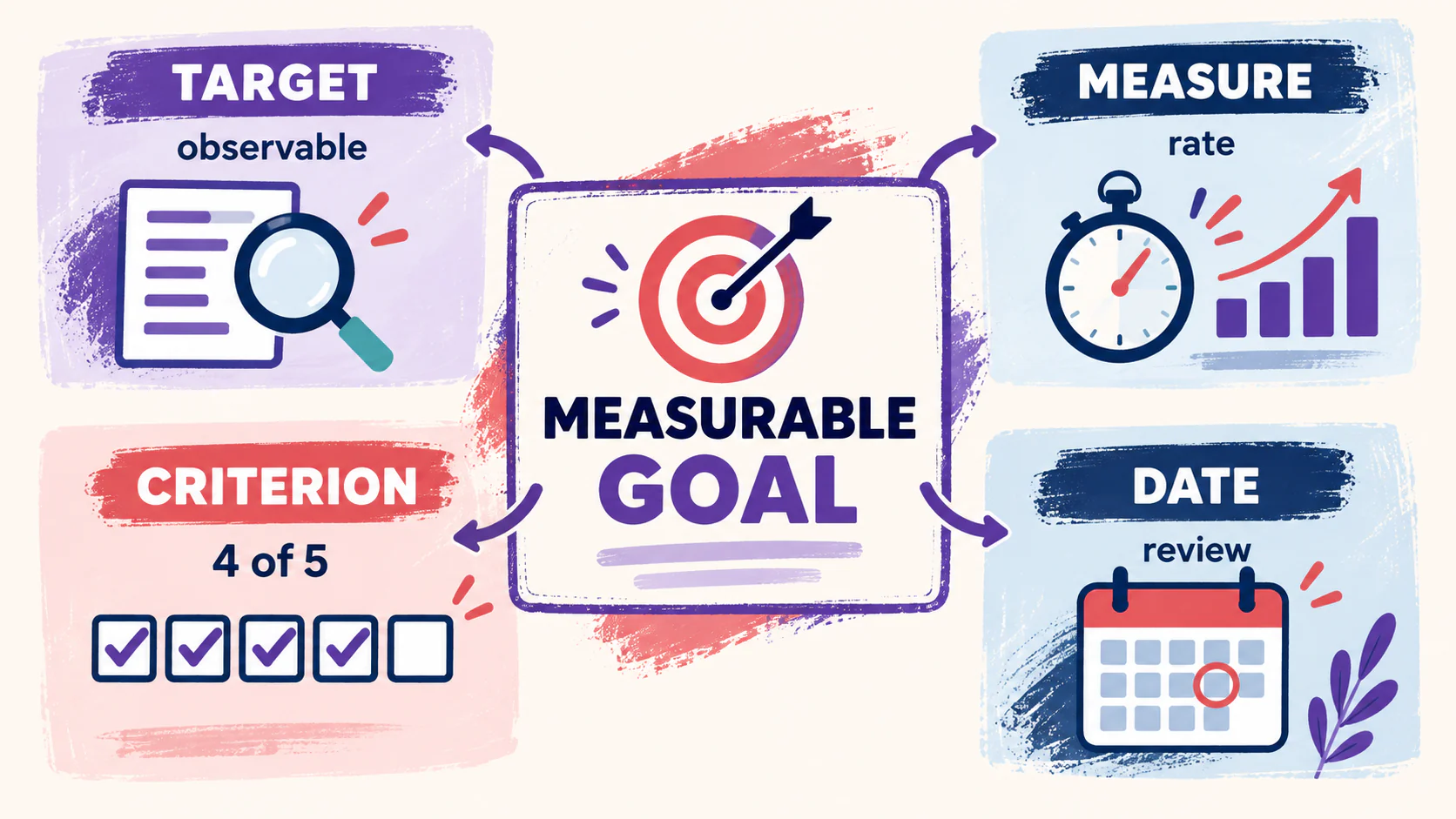
A measurable goal is a promise about what evidence will be reviewed, not a guarantee of an outcome. Use the goal card in the infographic to test four fields: the response is observable, the measure fits the response, the mastery criterion has a denominator and context, and the review date or trigger is clear.
- Check the target: confirm the definition and scoring agreement before comparing numbers.
- Check implementation: sample whether the planned teaching, prompts, reinforcement, and data collection occurred as written.
- Check the graph: compare baseline and intervention under the same measurement rules, and note context or plan changes.
- Make the decision: maintain, generalize, adjust implementation, reassess, or pause according to the clinical team’s rule and current requirements.
If a goal is missed, do not immediately rewrite the entire plan. First ask whether the goal was observable, whether the measure was reliable, whether the procedure was feasible, whether the replacement or skill was taught, and whether the context changed. If there is a safety or authorization concern, follow the responsible supervisor’s and organization’s escalation process.
BCBA Exam Traps and Study Use
On a BCBA exam question, a treatment-plan example may hide the real task. Look for the missing link:
- A vague goal may need an operational definition and measurement system.
- A measurable goal may still lack a function, baseline, or individualized rationale.
- A BIP may describe target behavior procedures but not the broader service plan.
- A payer checklist may show required fields for one program, not a universal clinical standard.
- A successful trial in one context does not prove generalization or maintenance.
Use the official BCBA Handbook and BACB Ethics Codes for current certification and professional context. Then use the Free BCBA Mock Exam to practice spotting the missing baseline, criterion, data rule, or ethical boundary. It is a study diagnostic, not a clinical form or certification promise.
Frequently Asked Questions
Can I use this ABA treatment plan example as a template?: Use it only as an educational map of relationships between fields. A real plan must be individualized, current, supervised, collaborative, and adapted to the actual payer, setting, client needs, and applicable requirements. Do not copy fictional values or identifying information.
What should be included in an ABA treatment plan?: Common sections include the referral question, assessment summary, operational definitions, baseline, measurable goals, procedures, caregiver or team participation, service rationale, data collection, safety and continuity considerations, and review rules. Exact fields vary by program and payer.
Is an ABA treatment plan the same as a BIP?: No. A BIP usually provides detailed function-based procedures for target behavior, while a treatment plan coordinates broader assessment findings, goals, services, participation, rationale, and review. A BIP can support a treatment plan without replacing it.
How many goals should an ABA treatment plan have?: There is no universal number that can be selected from a blog example. Goals should reflect assessment, meaningful outcomes, available teaching and supervision capacity, and current payer or program requirements. Quality and measurability matter more than filling a quota.
Sources for Further Study
For current professional boundaries and certification context, review the BACB Ethics Codes and BCBA Handbook. Compare the educational Vanderbilt IRIS BIP module with the payer-specific TRICARE West checklist, and remember that neither is a universal replacement for current local guidance. Recheck every source before using a real treatment plan.
Quick Review Checklist
Use this final checklist to turn aba treatment plan example into exam-ready reasoning. The goal is not to memorize a label in isolation; it is to identify the relevant evidence and explain why the best answer fits the scenario. Key ideas to review:
- State the central definition or decision point for aba treatment plan example in your own words.
- Identify the detail that makes aba treatment plan example different from its closest related ABA term.
- Separate the observable facts in a scenario from assumptions that are not supported by the facts.
- Write one example and one nonexample so you can recognize the concept in a new setting.
Exam application checks:
- Ask what the question is actually requesting before comparing the answer choices.
- Mark the antecedent, response, consequence, or other evidence that supports the selected answer.
- Look for a distractor that describes a related process but does not answer the specific question.
Final self-check:
- Explain how you would verify the interpretation with clear observations or data.
- Change one detail in the scenario and decide whether your answer should change.
- Give a one-sentence rationale that a supervisor or study partner could evaluate.
Take the Free BCBA Mock Exam
When you are ready to apply the idea, use the free practice resource below for additional feedback. Take the Free BCBA Mock Exam



