
Choosing behavior analyst education is more than picking a degree: match the route to your role, verify coursework, plan fieldwork, and identify the BCBA requirements that will apply when you apply. If you are searching for behavior analyst education, you may be comparing psychology, education, applied behavior analysis, and online graduate programs at the same time. The hard part is that a degree, behavior-analytic coursework, supervised fieldwork, and BCBA certification are related—but they are not interchangeable. This guide gives you a role-first way to compare them and a practical checklist for the 2027 transition.
Table of Contents
- Behavior Analyst Education Starts With the Role You Want
- The Five Building Blocks of a BCBA Education Plan
- How the 2027 BCBA Requirements Change Your Planning
- How to Compare Behavior Analyst Education Programs
- A Practical Education-to-Eligibility Planning Sequence
- Connect Coursework to BCBA Exam Preparation
- Behavior Analyst Education Mistakes That Cost Time
- Frequently Asked Questions
- Official Sources and Verification Notes
- Quick Review Checklist
- Take the Free BCBA Mock Exam
This is an education-planning guide, not an eligibility determination. BACB requirements, university offerings, state rules, and employer expectations can change. Before enrolling or submitting an application, verify the current BACB handbook and ask the program how it documents the requirements that apply to your pathway.
Behavior Analyst Education Starts With the Role You Want
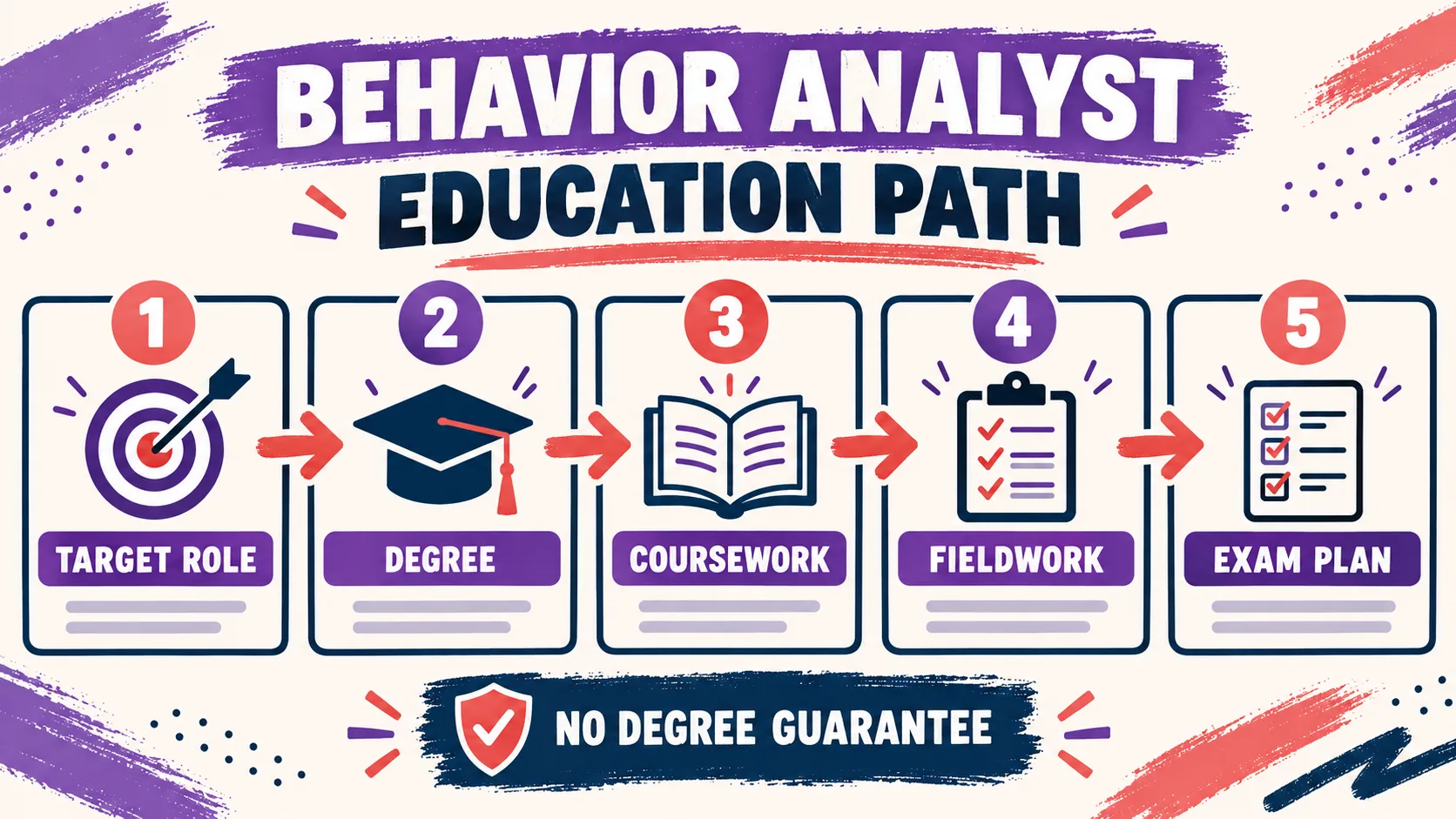
Start with the destination, not the school advertisement. A person who wants to implement behavior plans, a person who wants to work as a BCaBA, and a person who wants to become a BCBA do not need the same education plan. “Behavior analyst” is often used broadly in conversation, while the BACB credentials have specific eligibility and maintenance requirements.
An undergraduate degree can be a useful foundation for behavior-related work, but it does not by itself make someone a BCBA. A master’s degree can satisfy an important part of a BCBA plan, but the degree title alone does not prove that the program provides the required behavior-analytic coursework, fieldwork arrangement, or documentation. Likewise, a certificate or a collection of individual classes may help you learn the science without automatically making you eligible for certification.
| Target role or outcome | Education question to answer | What the education does not automatically guarantee |
|---|---|---|
| Behavior-support or technician work | What training, competency assessment, supervision, and employer requirements apply to the position? | A college course alone does not create a professional credential or authorize independent practice. |
| BCaBA pathway | Does the undergraduate-level education and supervised fieldwork plan match the current BCaBA requirements? | A bachelor’s degree or ABA minor is not the same as BCaBA certification. |
| BCBA certification | Which BACB eligibility pathway will you use, and how will the program document degree, coursework, fieldwork, and examination readiness? | A master’s degree by itself does not equal BCBA eligibility or certification. |
| Research, teaching, or related work | Which research methods, ethics, data analysis, and domain knowledge will support the actual job? | A non-certification academic route may be valuable, but it should not be advertised as a guaranteed BACB route. |
This role-first step prevents an expensive mismatch. Ask certification questions before comparing tuition, and choose research methods, ethics, data interpretation, and schedule flexibility when your goal is broader behavior-science knowledge.
The Five Building Blocks of a BCBA Education Plan
A strong behavior analyst education plan has several connected pieces. Think of them as a chain: if one link is unclear, the plan needs a verification step before you pay a deposit or count a course toward eligibility.
- Degree. The degree level and the date and type of program matter. For BCBA planning, the BACB describes a graduate-level certification and publishes pathway-specific degree requirements. Confirm that the degree you will earn is acceptable for the pathway and application date you are targeting.
- Behavior-analytic content or coursework. A program title is not enough. Ask for the curriculum, course descriptions, content-hour allocation, and the person who will attest that your coursework meets the applicable requirements. “Includes ABA classes” is not the same as a documented coursework route.
- Supervised fieldwork. Coursework teaches concepts; fieldwork gives you structured practice under supervision. Verify who can supervise, how hours are tracked, how monthly requirements are reviewed, and what happens if the placement changes.
- Certification examination. The examination is a separate requirement. A program can teach the content and support preparation, but BACB—not the school—controls the application and examination process. Plan for deliberate retrieval practice instead of waiting until the final semester.
- Maintenance and professional development. Certification does not end at the exam. Continuing education, supervision, ethics, renewal, and other maintenance requirements need a place in your long-term plan. A school that only discusses graduation is not giving you the entire professional picture.
That is why two programs with the same degree label can produce very different experiences: one may provide a fieldwork network and knowledgeable program contact, while another leaves you to verify every requirement yourself.
How the 2027 BCBA Requirements Change Your Planning
The date-sensitive part of behavior analyst education is the BCBA eligibility transition. BACB’s published 2027 requirements state that, beginning January 1, 2027, applicants may use two pathways: a pathway based on an accredited or recognized degree program, or a pathway based on behavior-analytic coursework. The transition guidance also explains that pathways 3 and 4 will no longer be available for new applications after the transition.
If you are trying to be reviewed under the current requirements, BACB says your complete application, including payment and required documents, must be received by December 31, 2026. That is not a suggestion to rush into a program or submit an incomplete application. It is a planning date: if you will not have an approvable application by then, build your education plan around the requirements that take effect on January 1, 2027.
For a student choosing a program now, ask the school to explain the transition in writing: which pathway it supports, which requirements apply to 2027 completers, who attests to coursework, and how updates reach enrolled students. Save the answer and compare it with current BACB documents.
Do not treat a 2027 headline as a guarantee. Eligibility depends on the complete combination of degree, coursework or content, fieldwork, application documentation, and BACB review—not simply on a program using the words “behavior analysis.”
How to Compare Behavior Analyst Education Programs
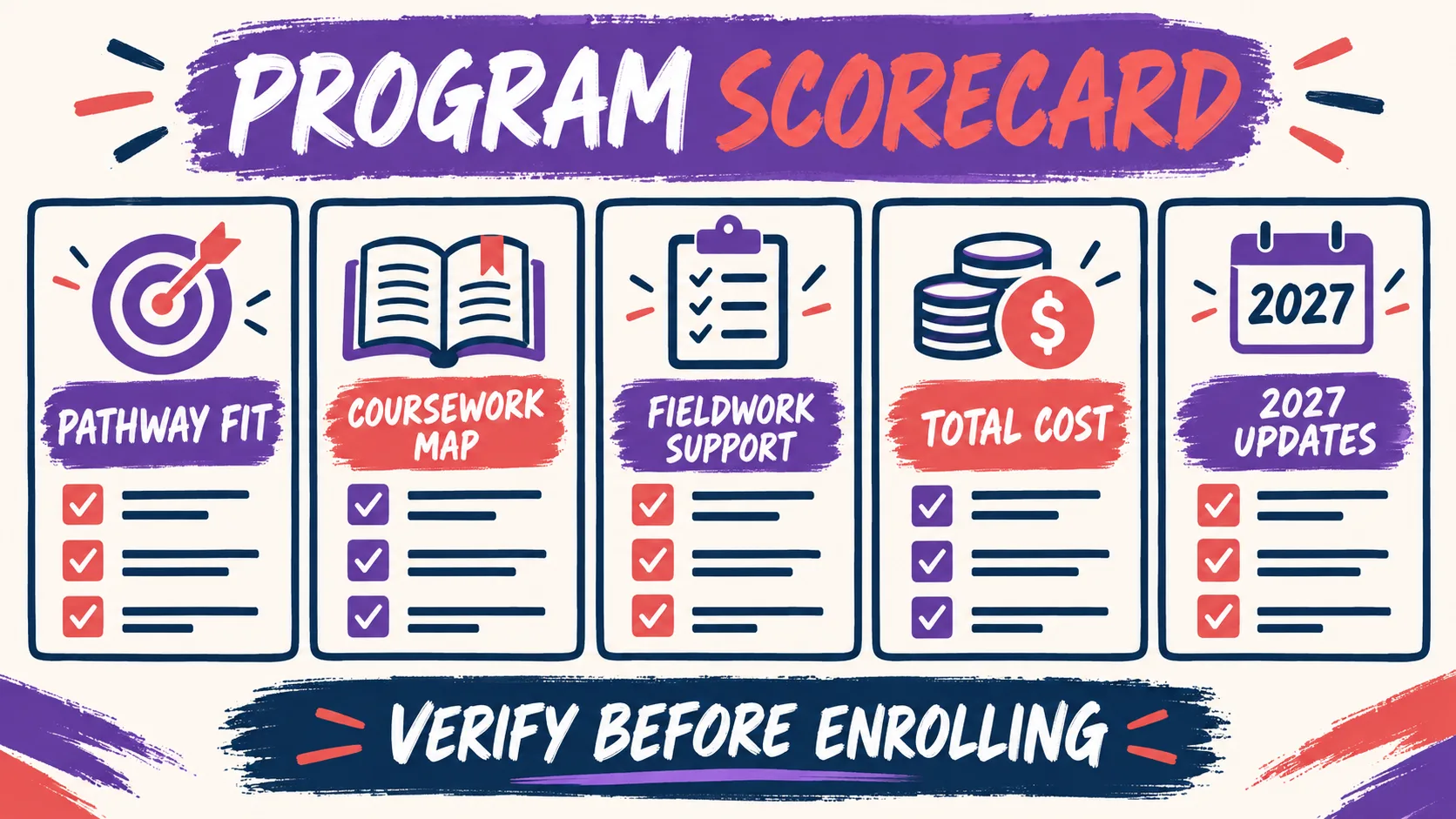
Once you know your target role and application date, score programs on evidence rather than marketing language. Use one spreadsheet row per school and record the date of each answer so tradeoffs are visible before enrollment.
| Scorecard category | Question to ask the program | Evidence worth saving |
|---|---|---|
| Pathway fit | Which current or 2027 BCBA pathway is this program designed to support? | A written program explanation linked to the current BACB handbook or requirements document. |
| Coursework coverage | Can the program map each required content area and explain how hours are counted? | Current curriculum, course descriptions, content map, and the name of the responsible program contact. |
| Fieldwork support | Who helps students locate qualified supervision and review fieldwork documentation? | Placement process, supervisor expectations, tracking tools, and a contingency plan for a placement ending. |
| Schedule and cost | What is the total cost and realistic weekly workload, including fieldwork? | Tuition, fees, technology costs, expected semesters, and fieldwork time—not only the advertised per-credit price. |
| Transition communication | How will current students be notified if BACB requirements or course documentation change? | Student handbook, update policy, contact details, and a dated answer to your transition question. |
Be cautious with “automatic eligibility” or “guaranteed certification.” Ask whether the claim means graduation, application approval, exam eligibility, or exam passage; those are different outcomes.
A Practical Education-to-Eligibility Planning Sequence
Use this sequence whether you are starting from a bachelor’s degree, changing careers, or already enrolled in graduate school:
- Write the target in one sentence. For example: “I want a BCBA application plan for the requirements in effect when I expect to apply.” Include the intended month and year.
- Build a document folder. Keep transcripts, syllabi, course maps, supervision agreements, monthly fieldwork records, and official program answers together. A screenshot of a sales page is not a substitute for a current official document.
- Confirm the pathway before counting credits. Ask the university contact or BACB what must be completed and attested for your route. Do not assume that a course with “ABA” in the title fills a required content area.
- Plan fieldwork early. Identify a supervision arrangement, expected weekly hours, privacy limits, and the method used to correct documentation errors. Fieldwork should not be an afterthought added after graduation.
- Map each course to exam content. Use the current BCBA Test Content Outline to make a study map. Mark concepts that were introduced, practiced, and still feel weak.
- Recheck the rules before applying. Requirements are date-sensitive. Review the current handbook, application instructions, and transition notices immediately before you submit documents.
Connect Coursework to BCBA Exam Preparation
Turn each course into retrieval practice: write one operational definition, one data-based example, one ethical or contextual boundary, and one question that distinguishes the concept from a close alternative. Use the BCBA Test Content Outline, 6th edition, as your exam map. A mock exam is a preparation diagnostic, not an eligibility decision: it shows whether you recognize a concept, apply it to a vignette, and eliminate an unsupported answer.
When you have completed a first content pass, try the Free BCBA Mock Exam. Review each missed item by asking: was the problem knowledge, discrimination, application, wording, or time? Then return to the relevant course material and the official outline instead of simply memorizing the answer.
Behavior Analyst Education Mistakes That Cost Time
- Choosing by degree name alone. The program title cannot tell you whether the curriculum and documentation fit your intended BACB pathway.
- Confusing learning ABA with earning a credential. Courses can be valuable without being a complete certification route.
- Leaving fieldwork until the end. A delayed supervision plan can become the bottleneck after coursework is complete.
- Using old transition advice. A saved post or forum answer may describe a prior requirement set. Use the current BACB publication date.
- Trusting a guarantee. Ask whether a school means graduation, application approval, exam eligibility, or exam passage.
- Ignoring the weekly workload. Tuition is only part of the cost; include study time, fieldwork time, commuting, supervision, and documentation.
Frequently Asked Questions
What degree do you need to become a behavior analyst?: The answer depends on the credential and the requirements in effect when you apply. BCBA certification is a graduate-level credential with pathway-specific degree, coursework or content, fieldwork, application, and examination requirements. A degree alone does not guarantee certification.
Is a psychology degree enough for BCBA certification?: A psychology degree may be a useful foundation, but the degree title alone does not establish that you meet BCBA requirements. You would still need to verify the applicable pathway, behavior-analytic coursework or content, supervised fieldwork, and the remaining BACB requirements.
Can I study behavior analysis online?: Online coursework may be possible, but verify how the program handles required content, identity and assessment policies, supervised fieldwork, program contact or attestation, and the application rules that apply to your target date. “Online” describes delivery; it does not decide eligibility.
What should I ask a behavior analyst education program before enrolling?: Ask which BCBA pathway the program supports, how the curriculum maps to current requirements, who documents coursework, how fieldwork and supervision are arranged, what the full cost and workload are, and how students are notified about rule changes. Request written answers and keep the date.
Official Sources and Verification Notes
For current requirements, review BACB’s 2027 BCBA Requirements, the Guidance for Meeting the BCBA Requirements During the 2027 Transition, and the BCBA Handbook. For exam planning, use the BCBA Test Content Outline, 6th edition. BACB’s BCBA resource page is another useful starting point. These official sources control over this educational summary if the requirements change. Bottom line: Choose the role, verify the pathway, degree, coursework, and fieldwork, map the exam content, and recheck the rules before applying.
Quick Review Checklist
Use this final checklist to turn behavior analyst education into exam-ready reasoning. The goal is not to memorize a label in isolation; it is to identify the relevant evidence and explain why the best answer fits the scenario. Key ideas to review:
- State the central definition or decision point for behavior analyst education in your own words.
- Identify the detail that makes behavior analyst education different from its closest related ABA term.
- Separate the observable facts in a scenario from assumptions that are not supported by the facts.
- Write one example and one nonexample so you can recognize the concept in a new setting.
Exam application checks:
- Ask what the question is actually requesting before comparing the answer choices.
- Mark the antecedent, response, consequence, or other evidence that supports the selected answer.
- Look for a distractor that describes a related process but does not answer the specific question.
Final self-check:
- Explain how you would verify the interpretation with clear observations or data.
- Change one detail in the scenario and decide whether your answer should change.
- Give a one-sentence rationale that a supervisor or study partner could evaluate.
Take the Free BCBA Mock Exam
A useful next step is to apply this idea in a fresh set of BCBA-style practice questions and review the feedback. Take the Free BCBA Mock Exam



