
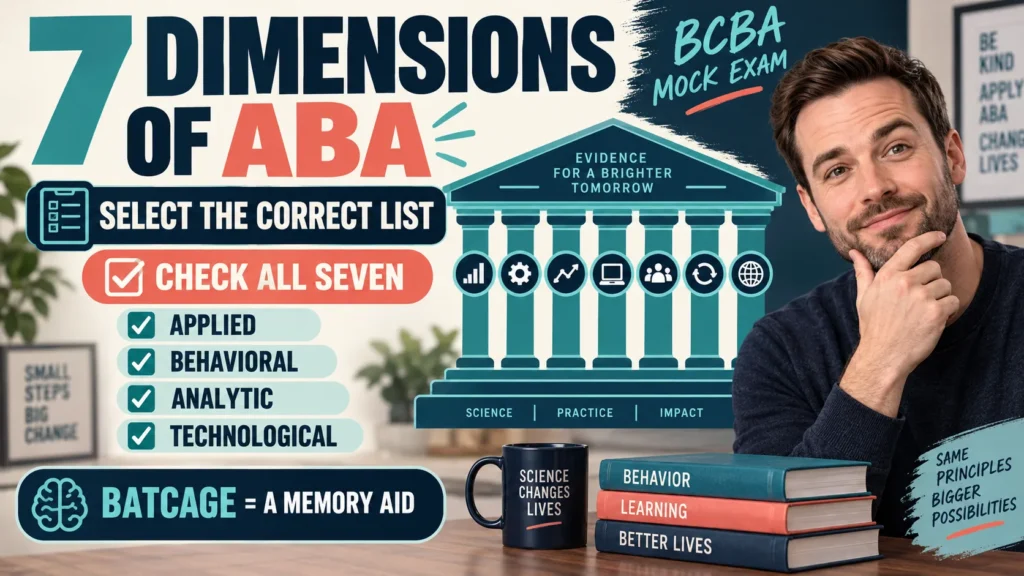
If a BCBA question asks you to select the correct list of 7 dimensions of ABA, the safest move is to verify every name—not just recognize a familiar mnemonic. This guide gives the exact list, one decision question per dimension, and a fast way to reject near-miss answer choices.
Table of Contents
- Select the Correct List of 7 Dimensions of ABA
- The Seven Names: One Decision Question per Dimension
- Near-Miss Terms That Do Not Create an Eighth Dimension
- A 30-Second Method for Choosing the Correct ABA List
- Short Scenarios, Common Traps, and Exam Practice
- Frequently Asked Questions
- Sources and Verification Notes
- Quick Review Checklist
- Take the Free BCBA Mock Exam
The classic list is Applied, Behavioral, Analytic, Technological, Conceptually Systematic, Effective, and Generality. These dimensions trace to Baer, Wolf, and Risley’s 1968 paper, Some Current Dimensions of Applied Behavior Analysis. Some summaries use “conceptual systems” when discussing the original wording; current study materials often say “conceptually systematic.” For a list-selection question, treat those as a wording distinction within the same dimension, not as two separate dimensions.
The search phrase select the correct list of 7 dimensions of ABA describes a recognition task. You are not being asked to list every valuable quality of behavior-analytic practice. You are being asked to identify the seven-item framework and avoid distractors such as ethics, social validity, maintenance, or evidence-based practice being presented as an eighth item.
Select the Correct List of 7 Dimensions of ABA
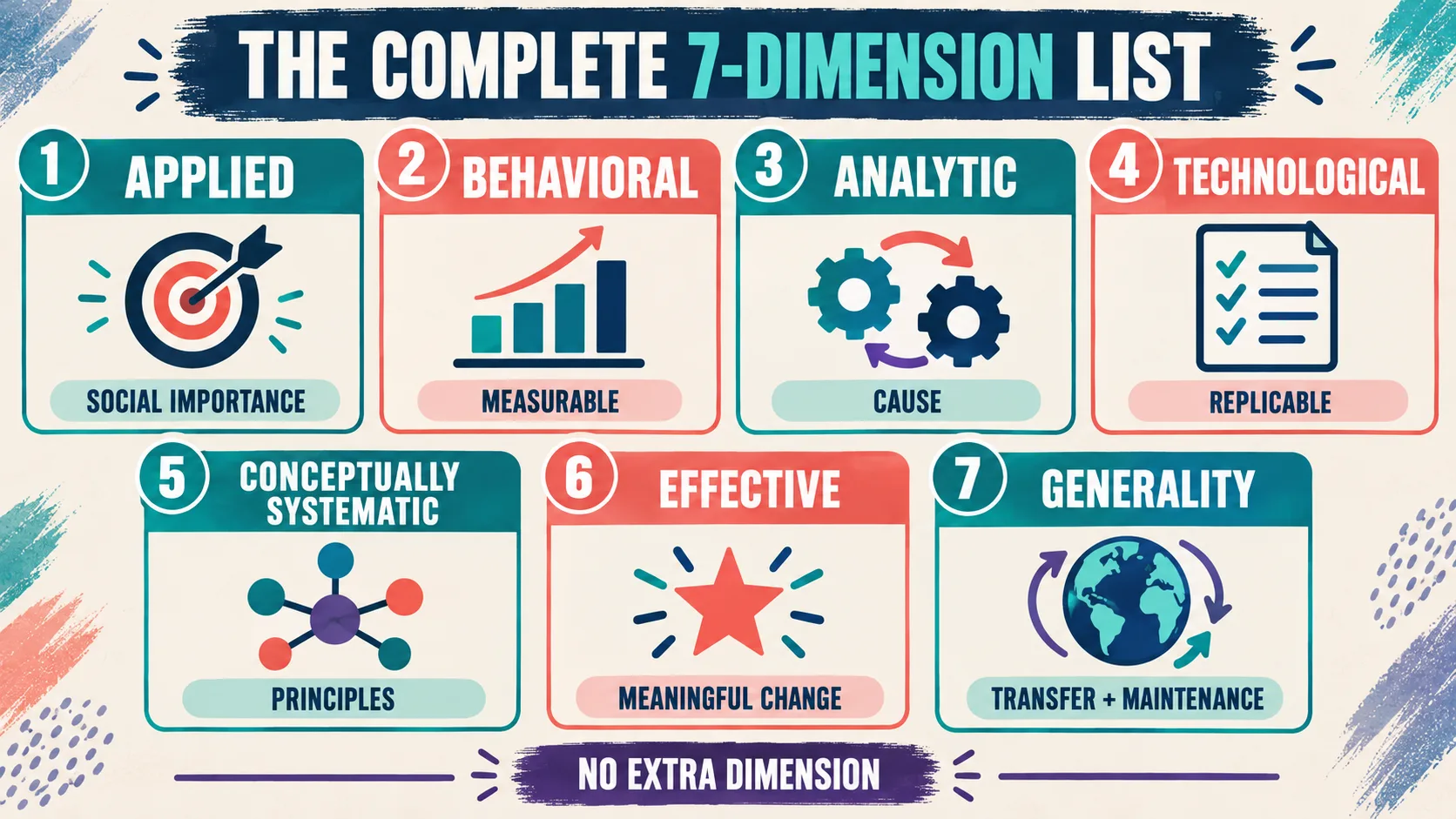
Use this exact sequence as your starting point:
- Applied
- Behavioral
- Analytic
- Technological
- Conceptually Systematic
- Effective
- Generality
A mnemonic can help you recall the order, but do not let the mnemonic replace the meaning. One common arrangement is BATCAGE: Behavioral, Applied, Technological, Conceptually Systematic, Analytic, Generality, and Effective. The order is not the point; the inclusion of all seven and the absence of an unrelated extra term are the point.
On a multiple-choice item, first scan each option for the seven anchors. If one option contains all seven and another swaps one out for “ethical” or “socially valid,” the anchor check usually resolves the question quickly. If two options contain the same words in a different order, move to the definitions and the wording of the scenario.
This is a historical and conceptual framework, not a replacement for the current BACB Test Content Outline. Use the current BACB exam materials for what is tested now, and use the primary article for what the original seven-dimension framework means.
The Seven Names: One Decision Question per Dimension
The fastest way to keep the list distinct is to pair every name with one question. The question does not replace a full definition; it gives you a recognition cue when an exam stem is short.
| Dimension | Recognition question | What the stem may show | Common near miss |
|---|---|---|---|
| Applied | Does the target address a socially important problem? | The team selects communication, safety, independence, or another meaningful outcome rather than a convenient laboratory response. | “Useful” alone is not the definition; look for social importance. |
| Behavioral | Can the behavior be observed and measured, or can a report be validated? | The target has an operational definition and a measurement system that describes what the person does. | “The client is unmotivated” is a label, not a behavioral definition. |
| Analytic | Is there a believable demonstration that the intervention caused the change? | Data and an appropriate design show a functional relation or a convincing basis for the decision. | A pre/post improvement may be promising but does not automatically demonstrate experimental control. |
| Technological | Could a trained reader implement the procedure from its description? | Steps, materials, timing, and decision rules are described precisely enough to replicate. | “Use positive reinforcement” without specifying how is too vague. |
| Conceptually Systematic | Can the procedure be connected to recognizable behavioral principles? | The plan is more than a package of tricks; its procedures relate to behavior-analytic concepts. | “Conceptual systems” is not an eighth item; it is the original-literature wording for this idea. |
| Effective | Did the intervention produce a meaningful improvement? | The change is large enough to matter in the person’s real context, not merely statistically or visually noticeable. | A causal demonstration is not the same as a socially meaningful outcome; analytic and effective are related but distinct. |
| Generality | Does the change extend across people, settings, behaviors, or time? | The skill or behavior change transfers beyond the exact teaching arrangement and continues after formal treatment. | Maintenance and generalization are evidence within this dimension, not separate eighth and ninth dimensions. |
Near-Miss Terms That Do Not Create an Eighth Dimension
Distractors often use real ABA language. That is why they can feel plausible. The question is not whether a term matters; it is whether the term belongs to the classic seven-item list.
- Ethical: Ethical practice is essential, but “ethical” is not one of the seven classic dimensions. An answer option that replaces Analytic with Ethical is not the classic list.
- Social validity: Social validity helps evaluate whether goals, procedures, and outcomes matter to stakeholders. It can support applied and effective decision-making, but it is not a separate member of the seven.
- Maintenance: Maintenance refers to behavior change continuing over time. It is commonly discussed under Generality rather than added as another dimension.
- Evidence-based: Evidence-based practice is a broad decision framework involving research evidence, expertise, and client values and context. It is not a replacement word for Analytic or a new dimension.
- Treatment integrity: Fidelity tells you whether a procedure was implemented as planned. It may help you interpret an analytic result, but it is not the seven-dimension list itself.
Also watch for options that include only “Applied, Behavioral, and Analytic.” Those are the first three dimensions, not the full list. Another distractor may include the right seven names plus an eighth attractive quality. If the question asks for the correct list of seven, the extra term makes that option wrong even if every word in it sounds professionally desirable.
A 30-Second Method for Choosing the Correct ABA List
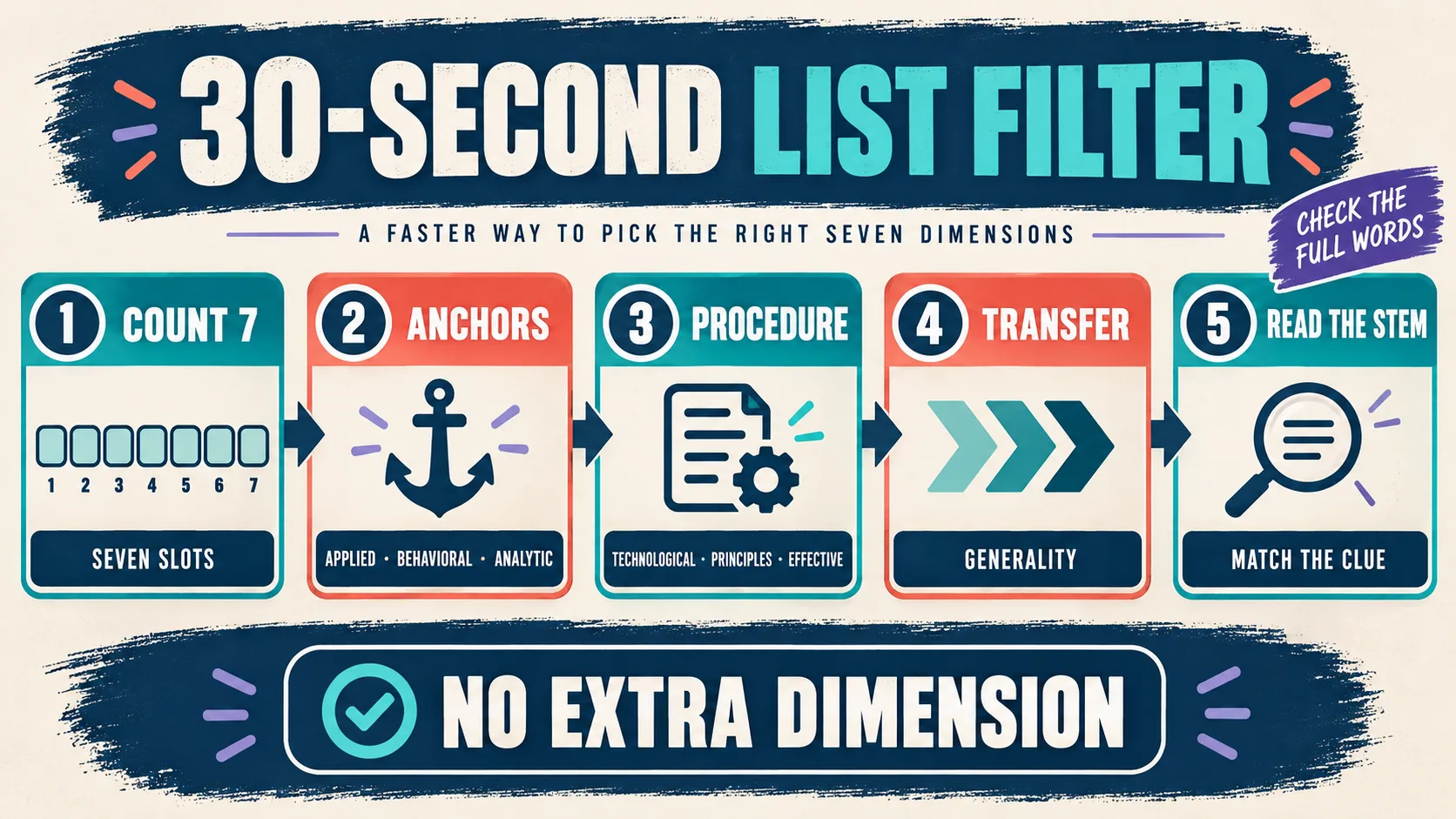
When time is short, use this five-step filter:
- Count the slots. The classic framework has seven entries. Cross out options with six, eight, or an unlabelled combination.
- Find the anchor trio. Applied, Behavioral, and Analytic should all be present. If one is missing, the option is not the classic list.
- Find the procedure trio. Technological, Conceptually Systematic, and Effective should all be present. Do not confuse “conceptual systems” with a separate item.
- Find the transfer term. Generality is the seventh anchor. It covers extension and persistence; maintenance is not an extra slot.
- Read the stem again. If the question asks about a specific scenario, use the list to classify the clue. If it asks for the list itself, stop once the seven anchors are verified.
For memory, you can rehearse BATCAGE, then translate each letter back into the full name. Avoid memorizing only the initials because answer choices may use “conceptual systems,” reorder the words, or describe the dimension without naming it. Full-word recall makes the near-miss terms easier to reject.
Short Scenarios, Common Traps, and Exam Practice
Scenario recognition is different from list recognition, but the same seven anchors can guide you. Consider these quick examples:
- A team chooses independent dressing because it affects daily participation and family priorities. That clue points to Applied.
- A target is defined as “leaves the seat for longer than five seconds,” measured by frequency and duration. That clue points to Behavioral.
- A multiple-baseline arrangement shows behavior changes only after the intervention is introduced across tiers. That clue supports Analytic.
- A protocol specifies the prompt hierarchy, error-correction steps, materials, and mastery rule. That clue supports Technological.
- A plan explains why a stimulus-control or reinforcement principle should produce the change. That clue supports Conceptually Systematic.
- A graph shows a change that is large enough to improve classroom participation, not merely a small numerical difference. That clue supports Effective.
- A skill transfers to a new teacher and community setting and remains after practice is faded. That clue supports Generality.
Do not force one scenario to demonstrate all seven. A question may test one dimension, two dimensions, or the list as a whole. The phrase “the intervention worked” is not enough to choose Effective unless the improvement is meaningful; the phrase “the procedure was detailed” is not enough to choose Analytic because replicable description belongs to Technological.
For a timed review, write the seven full names from memory, then create one sentence for each. Circle any name you cannot define without looking. That is the item to practice. You can also compare the exact list with the existing seven-dimensions overview and the separate scenario-recognition page; those pages remain separate resources, while this page is focused on selecting the right list.
When you want a timed set of related questions, use the Free BCBA Mock Exam. After each missed item, write the dimension name, the evidence in the stem, and the near-miss term that tempted you. That review builds discrimination rather than only repeating a mnemonic.
Frequently Asked Questions
What is the correct list of 7 dimensions of ABA?: The classic list is Applied, Behavioral, Analytic, Technological, Conceptually Systematic, Effective, and Generality. Some original-literature discussions say “conceptual systems” for the same conceptual dimension. Is BATCAGE the seven dimensions of ABA?: BATCAGE is a memory aid, not a second framework. It commonly expands to Behavioral, Applied, Technological, Conceptually Systematic, Analytic, Generality, and Effective. The order may differ across mnemonics, but the seven concepts are the same. Is maintenance one of the 7 dimensions?: Maintenance is important evidence that behavior change lasts, but it is generally discussed under Generality rather than counted as an additional dimension in the classic seven-item list.
Are ethics and social validity dimensions of ABA?: They are important parts of responsible behavior-analytic practice and decision-making, but they are not additional entries in the classic seven-dimension list. Read the question carefully to see whether it asks for the historical list or for a broader quality or ethics framework.
Sources and Verification Notes
The seven-dimension framework comes from Baer, Wolf, and Risley’s primary paper, Some Current Dimensions of Applied Behavior Analysis. For a professional summary, see the seven-dimensions overview. For current exam boundaries, use the official BCBA Test Content Outline and BCBA Handbook. This page is a study aid, not an official BACB answer key.
Bottom line: Select Applied, Behavioral, Analytic, Technological, Conceptually Systematic, Effective, and Generality. Then use the definitions to reject extra terms, reversed concepts, and incomplete lists. Memorize the names, but answer the scenario by matching the evidence to the dimension.
Quick Review Checklist
Use this final checklist to turn select the correct list of 7 dimensions of aba into exam-ready reasoning. The goal is not to memorize a label in isolation; it is to identify the relevant evidence and explain why the best answer fits the scenario. Key ideas to review:
- State the central definition or decision point for select the correct list of 7 dimensions of aba in your own words.
- Identify the detail that makes select the correct list of 7 dimensions of aba different from its closest related ABA term.
- Separate the observable facts in a scenario from assumptions that are not supported by the facts.
- Write one example and one nonexample so you can recognize the concept in a new setting.
Exam application checks:
- Ask what the question is actually requesting before comparing the answer choices.
- Mark the antecedent, response, consequence, or other evidence that supports the selected answer.
- Look for a distractor that describes a related process but does not answer the specific question.
Final self-check:
- Explain how you would verify the interpretation with clear observations or data.
- Change one detail in the scenario and decide whether your answer should change.
- Give a one-sentence rationale that a supervisor or study partner could evaluate.
Take the Free BCBA Mock Exam
When you are ready to apply the idea, use the free practice resource below for additional feedback. Take the Free BCBA Mock Exam



