

A useful behavior analysis glossary does more than list definitions. It helps you choose the term that matches the evidence, the measurement rule, the behavior-change procedure, or the professional responsibility in front of you. If you are searching for a behavior analysis glossary, use this page as a decision-first study guide. The terms below are grouped by the question they help answer: What happened? How was it measured? What might explain it? What procedure changes behavior? What ethical boundary protects the client?
Table of Contents
- Behavior Analysis Glossary: Start With the Decision
- Measure, Assess, and Interpret Without Blending Terms
- Behavior-Change Terms That Appear Together
- Ethics and Professional-Practice Terms
- Near-Miss Pairs: The Difference Is the Answer
- Turn Definitions Into Exam Decisions
- Frequently Asked Questions
- Sources and Verification Notes
- Quick Review Checklist
- Take the Free BCBA Mock Exam
This is study support, not a complete A–Z dictionary, treatment protocol, or substitute for the current BACB Test Content Outline, BCBA Handbook, Ethics Code, or qualified supervision. A short definition can orient your reading; it cannot determine the right clinical decision for a real person.
Behavior Analysis Glossary: Start With the Decision
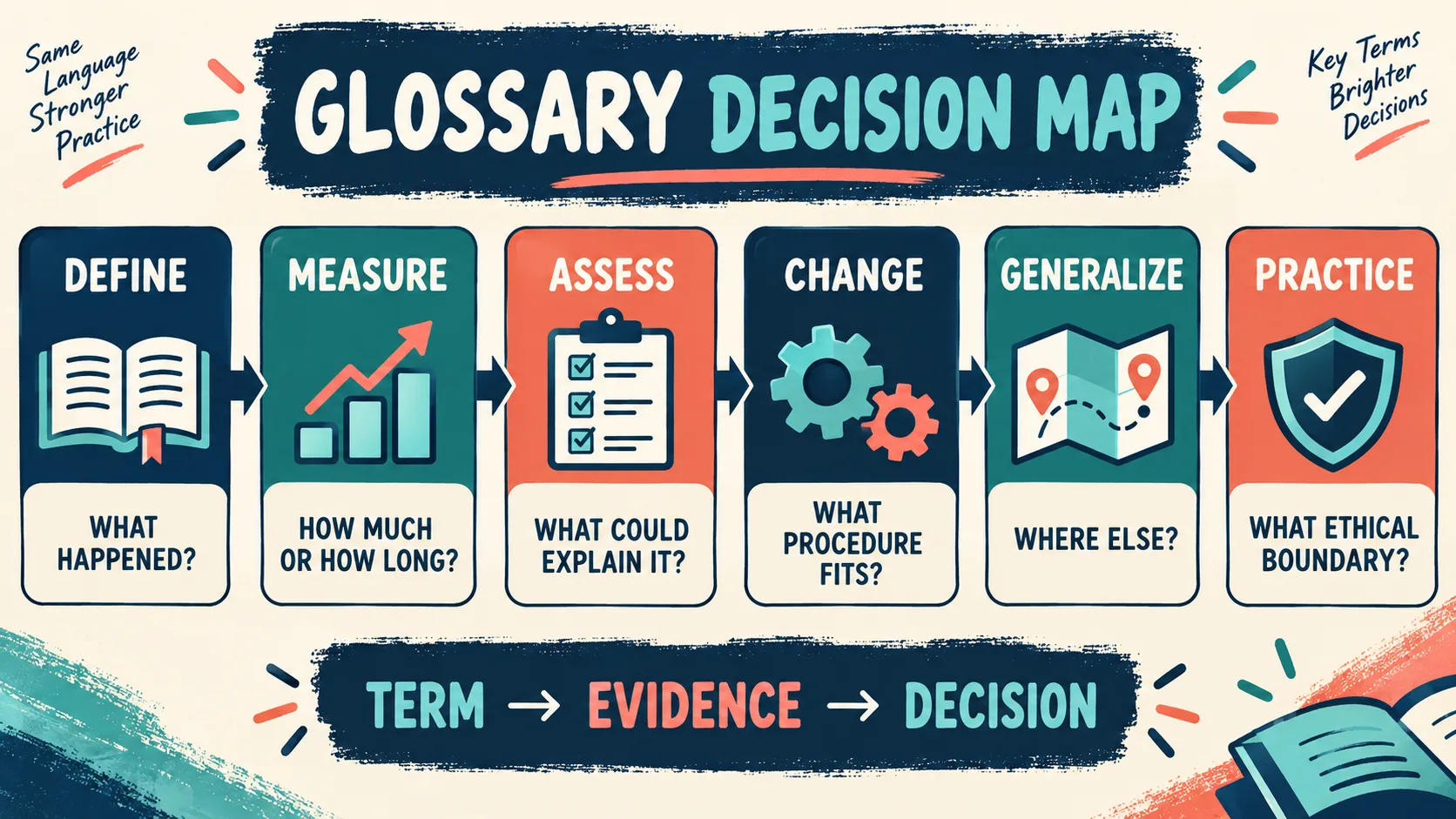
A term is easiest to remember when you attach it to a question. Begin with observable events, then move to measurement, assessment, behavior change, generalization, and ethics. The sequence keeps you from calling a label a function or calling a preferred item a reinforcer before you have evidence. 1. Behavior: Behavior is an observable, measurable activity of an organism. A private event may matter clinically, but a behavior-analytic definition needs enough clarity that an observer can detect the response under stated conditions.
2. Response and topography: A response is one occurrence of behavior. Topography describes what the response looks like. Topography does not automatically reveal function: two different-looking responses can produce the same consequence, and one form can occur for different reasons.
3. Stimulus, antecedent, and consequence: A stimulus is an event or condition that can affect behavior. An antecedent occurs before the response, and a consequence follows it. The terms describe position in a sequence; they do not by themselves prove that one event caused another.
4. Function: Function is the effect a behavior produces in its environment or the relation that maintains it. Common hypotheses include social positive reinforcement, social negative reinforcement, and automatic reinforcement. A topographic label is not a functional assessment.
5. Operational definition: An operational definition states a behavior in observable terms and sets boundaries for when it counts. “Aggressive” is too broad by itself; a definition may specify the contact, body part, force, context, and start and stop rules relevant to the measurement plan. These first terms answer the question, “What exactly are we talking about?” If a question stem uses an impression such as “unmotivated,” translate it into observable behavior before selecting a measurement or intervention.
Measure, Assess, and Interpret Without Blending Terms
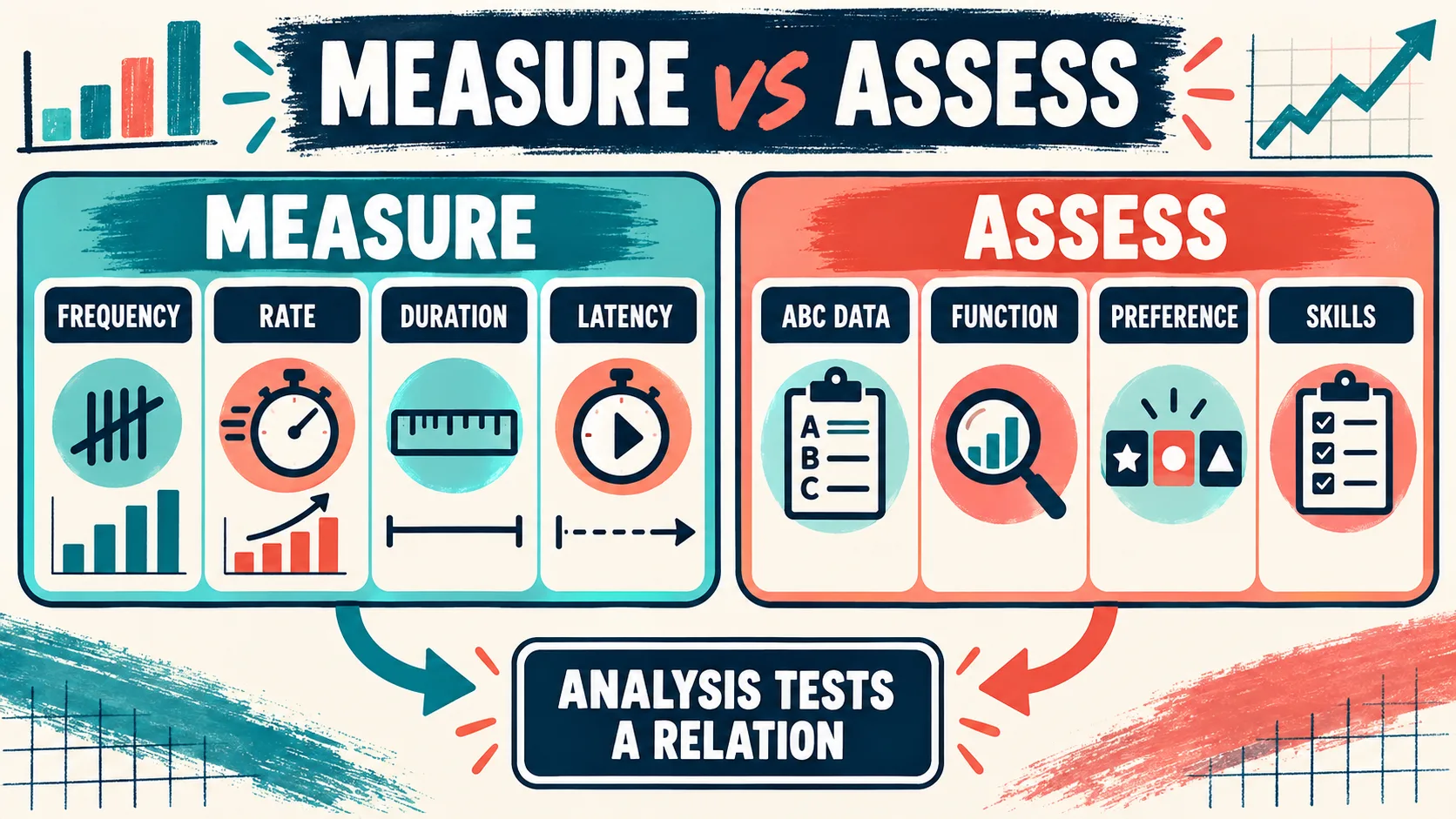
Measurement terms tell you how behavior was recorded. Assessment terms tell you how information was gathered to understand skills, context, preference, or possible function. Analysis terms make a stronger claim about relations. Keeping those levels separate is one of the highest-value habits in BCBA study.
6. Frequency and rate: Frequency is the number of responses. Rate is frequency divided by a unit of time. Rate allows a fairer comparison when observation periods differ. “Eight responses” and “eight responses per hour” are not interchangeable data statements.
7. Duration, latency, and interresponse time: Duration measures how long behavior lasts. Latency measures the time from an event, such as an instruction, to the start of a response. Interresponse time measures the time between two responses. Choose among them based on the dimension that matters.
8. Percentage and trial-based measurement: Percentage expresses a portion of opportunities or responses as a proportion of the total. It can be useful for discrete teaching trials, but the denominator must be clear. A percentage of correct responses is not automatically a percentage of independent responses.
9. Permanent product: Permanent-product measurement counts or evaluates an outcome that remains after the behavior, such as completed items or a written response. It can reduce observer reactivity, but the product must reliably represent the target behavior and not merely reflect an unrelated result.
10. Direct and indirect assessment: Direct assessment involves observing the target behavior or relevant conditions. Indirect assessment gathers information from interviews, rating scales, or reports. Indirect data can guide questions, but a report is not the same as direct observation or experimental analysis.
11. ABC data: ABC data records antecedent, behavior, and consequence information around an event. It can support a descriptive hypothesis. It does not automatically establish a functional relation, because the observer has not necessarily arranged and compared conditions experimentally.
12. Functional assessment and functional analysis: Functional assessment is the broader process of collecting information to understand possible behavioral function. A functional analysis is an experimental arrangement that systematically compares conditions to test functional relations. In an exam stem, do not call a descriptive ABC observation a functional analysis. When a question gives a graph, first identify the measurement dimension and observation conditions. Then ask what conclusion the data support. A graph can show change over time without proving why the change occurred.
Behavior-Change Terms That Appear Together
13. Reinforcement: Reinforcement is a consequence arrangement that increases the future probability of behavior under relevant conditions. It is defined by the effect on future responding, not by the therapist’s intention or the item’s popularity.
14. Positive and negative reinforcement: Positive reinforcement adds a stimulus after behavior and behavior increases. Negative reinforcement removes or postpones a stimulus after behavior and behavior increases. Positive and negative describe addition or removal; neither means good or bad.
15. Punishment: Punishment is a consequence arrangement that decreases future behavior. Positive punishment adds a stimulus; negative punishment removes a stimulus. Identify the future effect before naming the procedure, and consider ethical and least-restrictive requirements.
16. Extinction: Extinction is discontinuing the reinforcement that previously maintained a behavior. It is not ignoring every behavior and not simply withholding attention. The relevant reinforcer, response, context, safety plan, and possible burst or variability must be assessed.
17. Prompting and prompt fading: A prompt is an added stimulus or assistance that increases the likelihood of a correct response. Prompt fading systematically reduces that assistance so the response comes under the intended stimulus control rather than remaining dependent on the prompt. 18. Shaping: Shaping differentially reinforces successive approximations toward a target response. The learner does not need to perform the final form at the beginning; the steps should move toward a meaningful, clearly defined goal.
19. Chaining and task analysis: Task analysis breaks a complex skill into teachable steps. Chaining teaches those steps in an arranged sequence, such as forward, backward, or total-task formats. A task analysis is the sequence; chaining is one way to teach it.
20. Stimulus control: Stimulus control occurs when behavior is more likely in the presence of a particular stimulus because reinforcement has been correlated with that stimulus and not with others. It is not the same as physical control or coercion.
21. Generalization and maintenance: Generalization means behavior transfers across people, settings, stimuli, or responses. Maintenance means behavior continues over time after the teaching arrangement or support changes. A skill can maintain in one setting without generalizing to a new one.
Ethics and Professional-Practice Terms
22. Informed consent and assent: Informed consent is permission based on understandable information about the service, risks, benefits, alternatives, and the right to ask questions or withdraw when applicable. Assent is the learner’s observable agreement or willingness when the person can meaningfully participate. Consent and assent are not interchangeable words. 23. Competence: Competence means practicing within the knowledge, skills, training, experience, and professional limits needed for the work. A practitioner should seek consultation, training, or referral when a case exceeds current competence.
24. Confidentiality and data security: Confidentiality concerns protecting information from unauthorized disclosure. Data security adds the operational controls that protect records, accounts, devices, transmission, and storage. A consent form does not make careless sharing safe.
25. Social validity and meaningful outcomes: Social validity asks whether goals, procedures, and outcomes matter to the learner and stakeholders and are acceptable in context. A behavior can be easy to measure without being socially important. Ethical decision-making keeps quality of life and dignity in view.
Near-Miss Pairs: The Difference Is the Answer
Many BCBA-style questions are not testing whether you have seen a word. They are testing whether you can distinguish a near-miss term. Use the evidence in the stem, not the emotional tone of the vocabulary.
| Pair | Difference | Question to ask | Common trap |
|---|---|---|---|
| Reinforcement / punishment | Future behavior increases or decreases. | What happened to later responding? | Calling a consequence reinforcement because it was pleasant. |
| Positive / negative | A stimulus is added or removed. | Was something presented or taken away? | Treating negative as harmful. |
| Frequency / rate | Rate includes a time unit. | Were observation durations equal? | Comparing raw counts across unequal sessions. |
| Assessment / analysis | Analysis tests a relation experimentally. | Were conditions arranged and compared? | Calling an interview a functional analysis. |
| Generalization / maintenance | Transfer differs from persistence over time. | New context or later time? | Assuming one proves the other. |
| Shaping / chaining | Approximations differ from ordered steps. | Is the plan building a form or a sequence? | Using the terms as synonyms. |
Turn Definitions Into Exam Decisions
Use this three-pass study routine. First, cover the definition and retrieve it from the term. Second, write a one-sentence example and a near-miss example. Third, read a short question stem and identify the evidence that would change your answer: a time unit, a future effect, a comparison condition, a new setting, or a consent boundary.
The BACB Test Content Outline is the right place to confirm the domain and task language. The Ethics Code is the authority for professional responsibilities. A glossary can help you recognize a term, but it should always send you back to the current official source when the question involves eligibility, practice, supervision, privacy, or a high-stakes clinical decision.
For focused retrieval practice, use the Free BCBA Mock Exam. When you miss an item, record the term pair you confused and the evidence you overlooked. That creates a personal glossary based on decisions, not passive rereading.
Frequently Asked Questions
Is a behavior analysis glossary the same as the BACB handbook?: No. A glossary is a study aid. The BACB handbook, current Test Content Outline, Ethics Code, and relevant official forms control certification and professional requirements.
Why do behavior-analysis definitions feel similar?: Many terms describe adjacent parts of one process. The best distinction usually comes from the question being asked: observable form, measurement dimension, inferred function, experimental evidence, future behavior, transfer, persistence, or ethical responsibility.
Can I use these definitions to choose treatment for a client?: Not by themselves. Real services require individualized assessment, informed consent, competence, supervision, data review, and applicable law. Use the definitions to communicate and study, not to skip clinical decision-making.
How often should I update a BCBA glossary?: Check it against the current BACB materials whenever the handbook, Test Content Outline, ethics resources, or examination information changes. Record the access date and source version so an old definition does not silently become your study authority.
Sources and Verification Notes
Use the BCBA Test Content Outline, BACB Ethics Code, BCBA Handbook, BACB supervision and training resources, and official examination information as the primary verification points. The Association of Professional Behavior Analysts overview and National Academies evidence context provide secondary context; neither replaces the current BACB materials.
Quick Review Checklist
Use this final checklist to turn behavior analysis glossary into exam-ready reasoning. The goal is not to memorize a label in isolation; it is to identify the relevant evidence and explain why the best answer fits the scenario. Key ideas to review:
- State the central definition or decision point for behavior analysis glossary in your own words.
- Identify the detail that makes behavior analysis glossary different from its closest related ABA term.
- Separate the observable facts in a scenario from assumptions that are not supported by the facts.
- Write one example and one nonexample so you can recognize the concept in a new setting.
Exam application checks:
- Ask what the question is actually requesting before comparing the answer choices.
- Mark the antecedent, response, consequence, or other evidence that supports the selected answer.
- Look for a distractor that describes a related process but does not answer the specific question.
Final self-check:
- Explain how you would verify the interpretation with clear observations or data.
- Change one detail in the scenario and decide whether your answer should change.
- Give a one-sentence rationale that a supervisor or study partner could evaluate.
Take the Free BCBA Mock Exam
When you are ready to apply the idea, use the free practice resource below for additional feedback. Take the Free BCBA Mock Exam



