
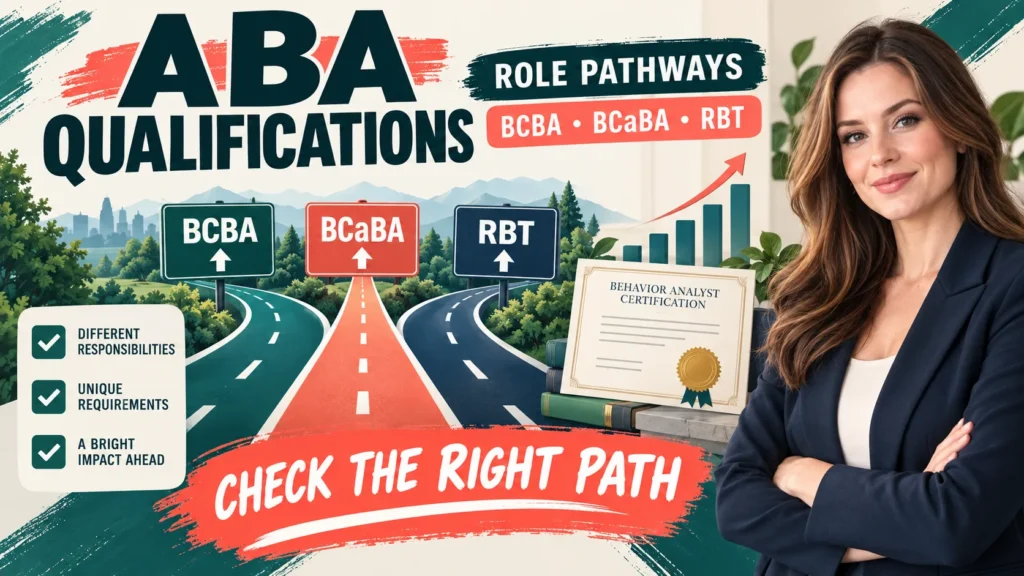
ABA qualifications are not one universal checklist. The correct path depends on whether you want to become a BCBA, BCaBA, RBT, behavior technician, educator, or another professional supporting behavior-analytic services. If you search for ABA qualifications, begin by naming the role you mean. The Behavior Analyst Certification Board (BACB) has different credentials for BCBAs, BCaBAs, and RBTs, while a state may separately regulate the practice of behavior analysis. Employers and payers can add their own credentialing, background-check, training, and documentation requirements. Combining all of those layers into one list creates a tempting but inaccurate answer.
Table of Contents
- ABA Qualifications: Start With the Role
- BCBA Qualifications: Graduate Study, Coursework, Fieldwork, and Exam
- BCaBA Qualifications: An Undergraduate-Level Path With Supervision
- RBT Qualifications: A Paraprofessional Path With Defined Oversight
- Support Roles and Employer Qualifications
- Match Qualifications to the Work and the Setting
- Certification, Licensure, Employer, and Payer Are Different
- A Qualification Document Checklist
- The Version-Check Habit
- Use BCBA Exam Practice to Organize the Path
- Frequently Asked Questions
- Sources and Verification Notes
- Quick Review Checklist
- Take the Free BCBA Mock Exam
This guide is a role-first map of the major qualification layers in the United States. It is educational information, not legal, licensing, admissions, employment, or certification advice. Requirements change, and your application is judged under the current official handbook and the rules of the state, employer, and payer involved.
ABA Qualifications: Start With the Role
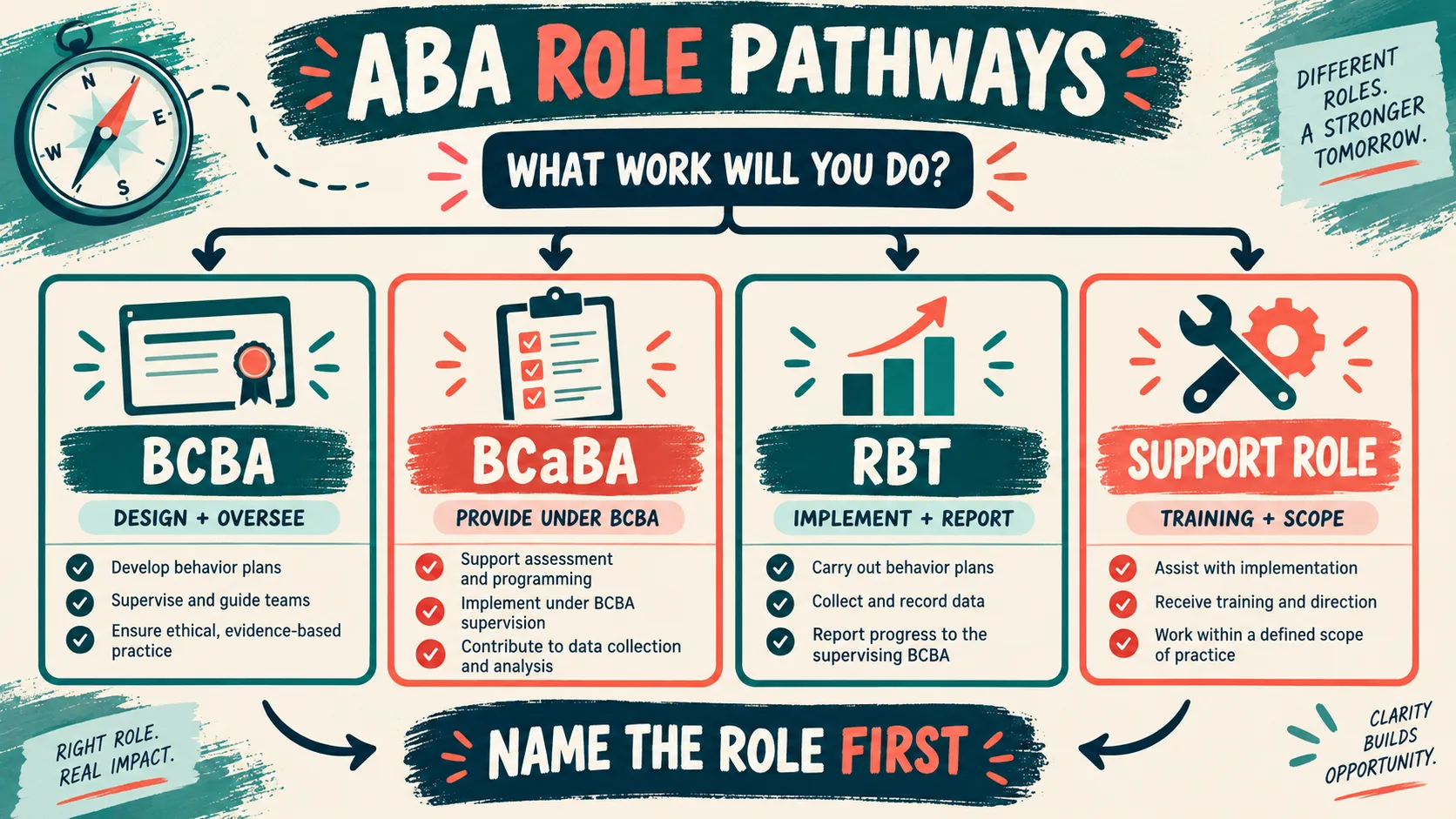
The fastest way to make the query useful is to identify the work the person will perform. A person designing and overseeing behavior-change programs is asking a different question from a person implementing a plan under supervision. A hiring manager may be asking about a credential, while a parent may be asking how to verify the practitioner’s status.
| Role or question | Primary qualification layer | Supervision or authority | First official check |
|---|---|---|---|
| BCBA | Graduate-level BACB certification pathway | State rules, ethics, competence, and any payer or employer limits still apply. | Current BCBA resources |
| BCaBA | Undergraduate-level BACB certification pathway | Provides behavior-analytic services under BCBA supervision. | Current BCaBA resources |
| RBT | Paraprofessional BACB certification pathway | Works under the direction and close supervision named by the BACB. | Current RBT Handbook |
| Behavior technician or ABA therapist | Employer-defined education, competency, and screening | The job title alone does not establish a BACB credential or state license. | Job description, state rules, and employer policy |
| Parent, teacher, or support professional | Role-specific training and scope | Follow the approved plan and professional boundaries; do not assume a certification role. | Training record and supervising professional |
Use the table as a routing tool, not as proof that someone is qualified. The BACB’s consumer resources explain that the board offers BCBA, BCaBA, and RBT certifications and that many, but not all, U.S. states require behavior analysts to be licensed. That is why a credential search and a state-license search are separate actions.
BCBA Qualifications: Graduate Study, Coursework, Fieldwork, and Exam
BCBA qualifications are determined by the current BCBA Handbook and the pathway under which an applicant applies. In broad terms, a candidate must meet the applicable graduate-degree requirement, complete qualifying behavior-analytic coursework or an accepted program route, complete supervised fieldwork, submit the application and documentation, and pass the BCBA examination after approval. The exact evidence, form version, and dates matter.
The BACB’s current handbook is the controlling reference for an application. A transcript showing that a degree exists does not automatically prove that every coursework or fieldwork requirement is satisfied. Keep the official transcript, pathway documentation, supervision agreements, fieldwork verification forms, and any records required for an audit. If a program or supervisor cannot explain how the current handbook applies, pause before assuming the hours will count.
Certification is also not the same as competence for every possible case. A BCBA must practice within competence, follow the Ethics Code, obtain appropriate consent, protect confidentiality, document services, and comply with state law and payer rules. Employers may require additional experience, training, background checks, CPR or safety training, or service-specific competencies.
BCaBA Qualifications: An Undergraduate-Level Path With Supervision
BCaBA qualifications are built for an undergraduate-level certification path. The BACB describes BCaBAs as professionals who provide behavior-analytic services under the supervision of a BCBA. That supervision boundary is not a small footnote; it affects how a practice designs caseloads, clinical decision rights, documentation review, and escalation.
Use the current BCaBA Handbook to verify the degree, behavior-analytic content, fieldwork, application, examination, and maintenance requirements that apply to the applicant’s date and pathway. A bachelor’s degree alone is not the same as BCaBA certification. Likewise, a person may have relevant coursework or experience without being authorized to use a protected title or perform a task in a particular jurisdiction. For an employer, the qualification question is two-sided: does the person hold the current credential, and has the organization built the supervision structure required for the role?
RBT Qualifications: A Paraprofessional Path With Defined Oversight
RBT qualifications are different again. The BACB defines the RBT as a paraprofessional certification in behavior analysis. RBTs assist with behavior-analytic services under the direction and close supervision of an RBT Supervisor and/or RBT Requirements Coordinator who is responsible for their work.
The current RBT Handbook lists requirements such as minimum age, high-school-level education or equivalent, recent background and abuse-registry checks, a qualifying 40-hour training, and an initial competency assessment. The timing windows and document versions are part of the requirement. A generic “40-hour course certificate” is not enough if the training does not meet the current BACB standard.
RBT applicants should confirm who is allowed to attest, assess, train, and supervise them. A person may be excellent at working with learners and still need the formal RBT application steps. Conversely, an RBT credential does not authorize independent behavior-analytic assessment or treatment-plan design. The role is defined by the credential, the supervising structure, the service plan, and applicable state and employer rules.
Support Roles and Employer Qualifications
Many ABA organizations employ people whose job titles do not correspond to a BACB certification. “Behavior technician,” “ABA therapist,” “registered behavior technician,” and “paraprofessional” are not interchangeable labels. An employer should state the credential requirement, actual job duties, supervision, training, background checks, documentation expectations, and limits on clinical decisions.
For non-certificant staff, qualification may include a high-school or college requirement, experience with children or adults, communication skills, safety training, confidentiality training, and demonstrated competency with the organization’s procedures. Those requirements can be meaningful without being presented as a BACB certification. Do not advertise an employee as a BCBA, BCaBA, or RBT unless the credential can be verified through the appropriate official process.
Match Qualifications to the Work and the Setting
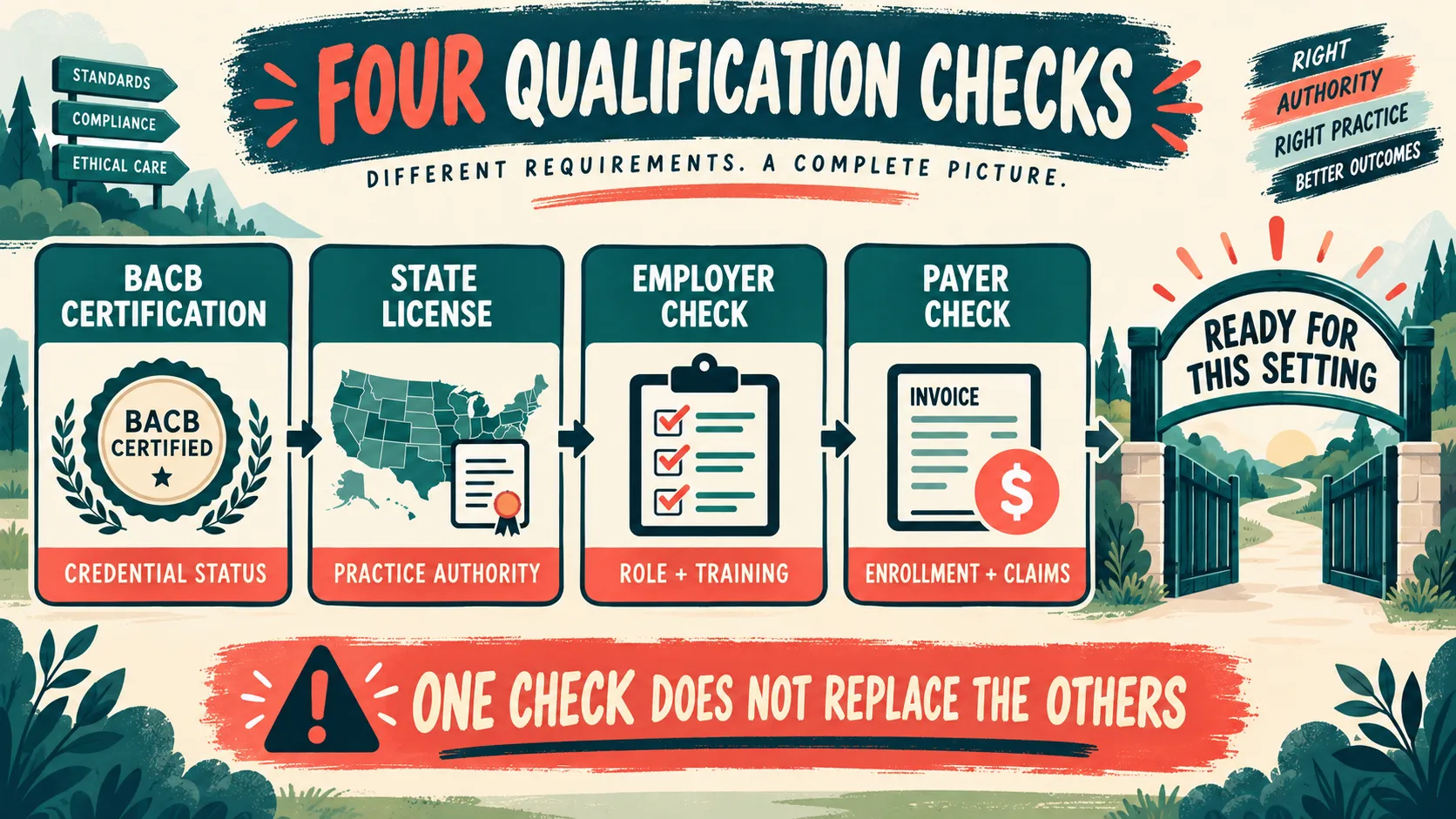
A good qualification decision connects the person, the work, and the authority that governs the work. Ask what the person will do, where the service will occur, who will supervise, which records will be created, and who will pay. Then check each layer independently.
| Layer | What it answers | What it does not answer |
|---|---|---|
| BACB certification | Whether the person meets a national credential’s requirements and maintains it. | Whether every state, payer, employer, or case accepts the person. |
| State license | Whether the state permits a regulated practice or title under its law. | Whether the person has the correct BACB certification or employer training. |
| Employer credentialing | Whether the organization has verified identity, training, scope, and role fit. | Whether the state board or BACB has granted a credential. |
| Payer credentialing | Whether a funding source recognizes the provider, group, service, and documentation. | Whether the payer’s decision creates a professional license. |
This four-layer check is especially important for telehealth, school consultation, home services, and multi-state organizations. A credential may travel across a border while a practice license, supervision rule, consent requirement, or payer contract does not.
Certification, Licensure, Employer, and Payer Are Different
The most common qualification error is treating a national credential as permission to practice everywhere. The BACB states that many, but not all, states require behavior analysts to be licensed. Start with the state board or official licensure page for the location and service being delivered. Check titles, exemptions, telehealth rules, renewal, continuing education, supervision, and disciplinary requirements.
Then review the employer and payer. A health plan may require a provider to be credentialed, enrolled, authorized for a code, attached to a group, or supervised in a particular way. An employer may require training beyond the certification’s minimum. None of those checks should be described as if they were the BACB’s own certification requirements.
For a client or caregiver, verification usually means checking the practitioner’s name and status in the official registry where applicable, asking which professional is responsible for the plan, and confirming the state license when the state regulates the practice. For a candidate, it means saving the current handbook, official forms, and application date in one place.
A Qualification Document Checklist
Build the checklist for the role rather than collecting every possible document. A BCBA applicant may need degree, coursework, fieldwork, application, and examination records. An RBT applicant needs a different set. An employer needs verification and training records, not a substitute credential.
- Current BACB handbook and the page or section that applies to the pathway.
- Official transcript or education evidence required by that pathway.
- Training, fieldwork, supervision, competency, and verification forms in the correct version.
- Credential number, registry verification, and expiration or maintenance date where applicable.
- State license or exemption evidence for the location and service.
- Employer onboarding, background checks, confidentiality training, and role-specific competency records.
- Payer enrollment, authorization, and documentation requirements when services are funded.
The Version-Check Habit
Qualification articles age quickly. Before applying, hiring, or promising a client that someone is qualified, check the date on the official handbook and the current application page. The BACB has announced significant BCBA and BCaBA requirement changes taking effect January 1, 2027. The transition notice says that a complete application, including payment and required documents, must be received by December 31, 2026 to be reviewed under the current 2022 requirements. That is a date-sensitive rule, not a reason to copy an old checklist.
Save the source URL, access date, handbook version, and the question you were trying to answer. If the official materials do not resolve a personal eligibility question, use the BACB contact process and discuss the pathway with a qualified supervisor or mentor. A search result, course advertisement, or social-media post cannot guarantee application approval.
Use BCBA Exam Practice to Organize the Path
BCBA exam preparation can help candidates review ethics, measurement, assessment, supervision, and professional practice vocabulary, but it does not grant a credential or decide whether a degree, coursework, fieldwork, or state license qualifies. Keep the official handbook as the authority.
For focused review, use the Free BCBA Mock Exam. After each missed question, label the gap as ethics, measurement, assessment, supervision, or role boundary. That makes practice useful without implying that a quiz replaces an application review.
Frequently Asked Questions
What qualifications do you need for ABA?: It depends on the role. A BCBA, BCaBA, RBT, behavior technician, and caregiver-support role have different education, credential, supervision, and state requirements. Start by naming the job and the setting, then use the current official handbook and state rules.
Is a degree enough to become a BCBA?: No. A degree is one part of the applicable pathway. Coursework, supervised fieldwork, application documentation, examination, ethics, and maintenance requirements also matter, and the current BACB Handbook controls the details.
Is an ABA therapist the same as an RBT?: Not necessarily. “ABA therapist” is often an employer or market term. RBT is a specific BACB paraprofessional certification with defined eligibility and supervision requirements. Verify the credential instead of inferring it from a job title.
Does BCBA certification automatically provide a state license?: No. Many states regulate behavior analysis separately, and the rules vary. Check the relevant state board and confirm whether the person’s services, title, and location fall within the state’s requirements.
Sources and Verification Notes
Start with the current BCBA Handbook, BCBA resources, BCaBA resources, RBT Handbook, BACB supervision and training resources, BACB consumer resources, the 2027 transition notice, and official examination information. Recheck the current version before acting.
Quick Review Checklist
Use this final checklist to turn aba qualifications into exam-ready reasoning. The goal is not to memorize a label in isolation; it is to identify the relevant evidence and explain why the best answer fits the scenario. Key ideas to review:
- State the central definition or decision point for aba qualifications in your own words.
- Identify the detail that makes aba qualifications different from its closest related ABA term.
- Separate the observable facts in a scenario from assumptions that are not supported by the facts.
- Write one example and one nonexample so you can recognize the concept in a new setting.
Exam application checks:
- Ask what the question is actually requesting before comparing the answer choices.
- Mark the antecedent, response, consequence, or other evidence that supports the selected answer.
- Look for a distractor that describes a related process but does not answer the specific question.
Final self-check:
- Explain how you would verify the interpretation with clear observations or data.
- Change one detail in the scenario and decide whether your answer should change.
- Give a one-sentence rationale that a supervisor or study partner could evaluate.
Take the Free BCBA Mock Exam
When you are ready to apply the idea, use the free practice resource below for additional feedback. Take the Free BCBA Mock Exam



