
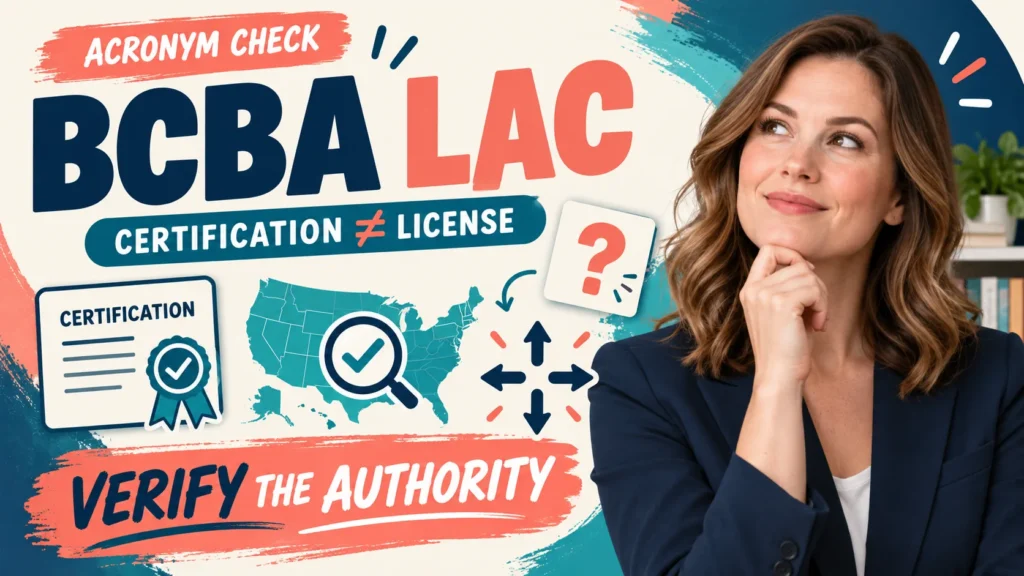
“LAC” is not a universal BACB certification label. When a page says “BCBA LAC,” the safe next step is to identify the state, organization, or document that uses the acronym before deciding what it means.
Table of Contents
- BCBA LAC: Do Not Guess the Acronym
- What the BCBA Credential Actually Tells You
- BCBA Certification and State License Are Separate
- Nearby Roles, Titles, and Abbreviations
- A Four-Step Verification Workflow
- If You Are an Employer or Client
- Check the Date Before You Trust the Label
- Use BCBA Practice to Learn the Boundary
- Frequently Asked Questions
- Sources and Verification Notes
- Quick Review Checklist
- Take the Free BCBA Mock Exam
If you searched for BCBA LAC, you may be looking at a credential profile, a state license abbreviation, an employer title, a brand or entity name, or a neighboring profession. The BACB’s standard certification names are BCBA, BCaBA, and RBT; an unfamiliar acronym beside BCBA should not be treated as an official BACB designation without verification.
This guide does not invent an expansion for LAC. It gives you a practical way to resolve the acronym and separate four different questions: Is the person BACB-certified? Is the person authorized by the state? Is the person qualified for the employer’s role? Is the service recognized by the payer? Those answers can be different.
BCBA LAC: Do Not Guess the Acronym
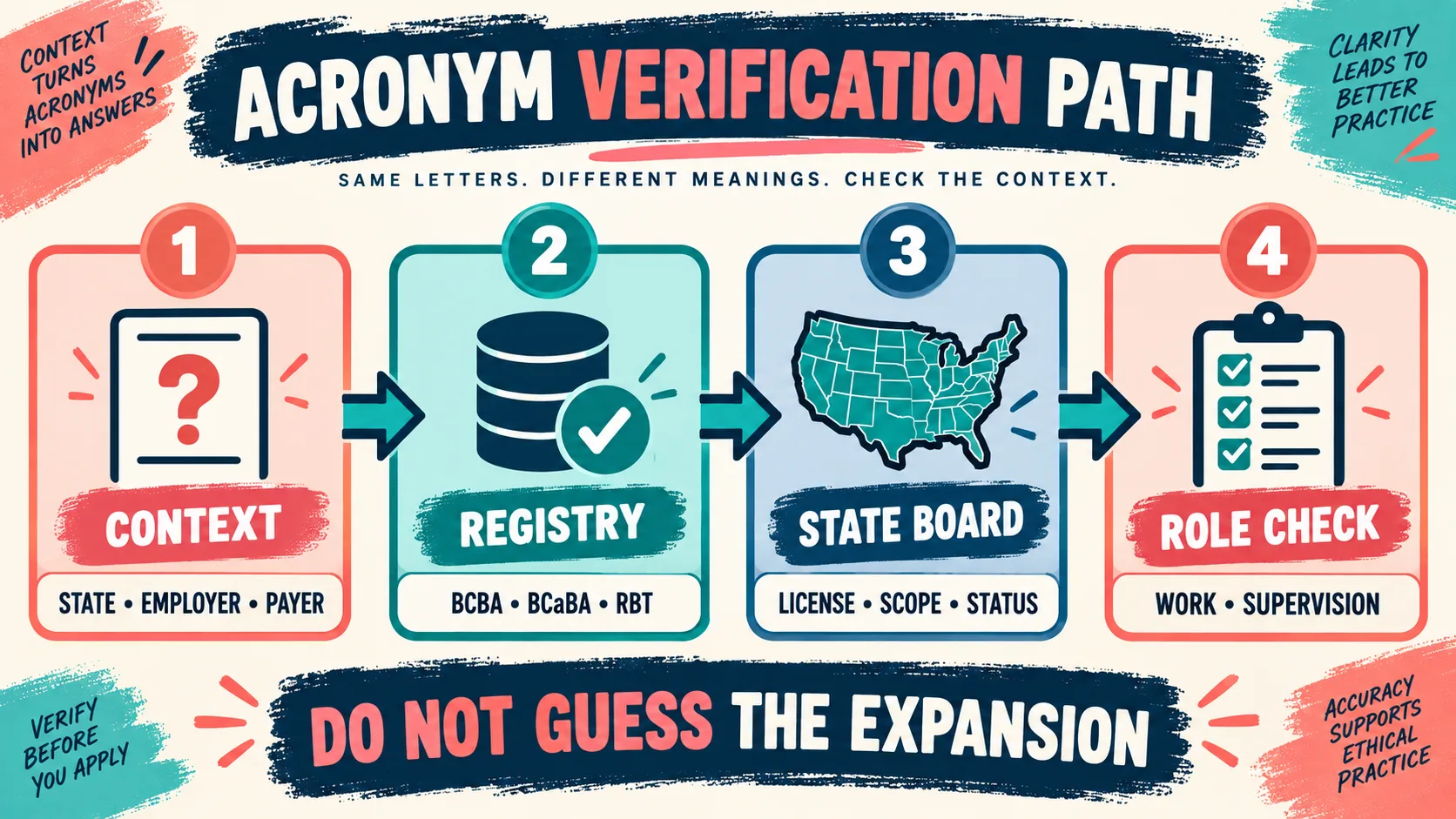
The first answer is deliberately cautious: there is no single nationwide definition of “LAC” that can be safely attached to every BCBA profile. An abbreviation can mean different things in different states, agencies, payer systems, job descriptions, or search results. It may refer to a license title, a local role, a program, an organization, or a completely different profession.
Use the word next to the acronym as a clue, not as proof. “License,” “certification,” “designation,” “provider type,” “clinical title,” and “program” point to different authorities. A state-board license page is stronger evidence for a state title than an employer’s job-posting abbreviation. A BACB registry result is stronger evidence for a BACB certification than a social-media bio.
There is a second reason to avoid guessing: a wrong expansion can send a candidate toward the wrong application, make a client think a person has a license they do not hold, or make an employer advertise a role with inaccurate credential language. The correct SEO answer to an ambiguous query is a verification path, not a confident invented definition.
What the BCBA Credential Actually Tells You
The BACB describes the BCBA as a graduate-level certification in behavior analysis. A BCBA certification can show that the person met the BACB’s applicable eligibility, examination, ethics, and maintenance requirements. It does not tell you that every state uses the same license title, that every payer has enrolled the provider, or that the person is competent for every population and service.
Verify the credential by using the official BACB Certificant Registry and checking the person’s name, certification type, and status. If the record does not match the spelling, credential type, or current status shown by the profile, pause. A certificate image or the letters after a name are not a substitute for an official verification result.
Also distinguish BCBA from BCBA-D. The BACB explains that BCBA-D is a designation rather than a separate certification and does not grant privileges beyond BCBA certification. That is an example of why a suffix or acronym needs to be read in its official context instead of assumed to be a new license.
BCBA Certification and State License Are Separate
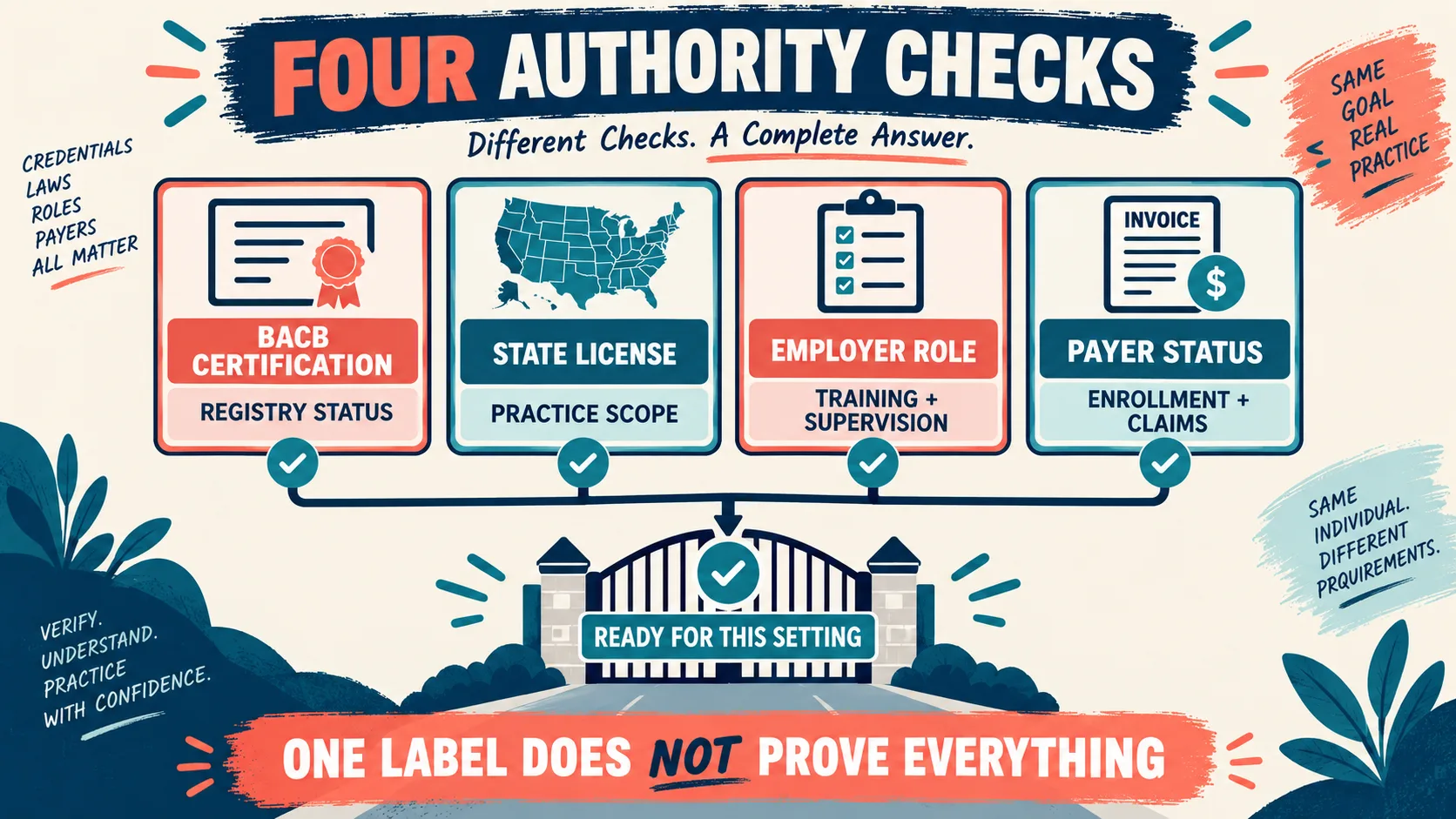
The BACB is a certification body; state governments regulate professional practice or title use. The BACB’s U.S. licensure page directs behavior analysts to review the relevant state board and determine whether a license, exemption, or other authorization applies. A BCBA may need a state license, and the license title may not be identical to “BCBA.”
| Question | Best authority | Evidence to look for | What it does not prove |
|---|---|---|---|
| Is the person a BCBA? | BACB Certificant Registry | Matching name, BCBA type, and active status. | A state license or payer enrollment. |
| May the person practice here? | State licensing board or law | License type, number, status, scope, and exemptions. | BACB certification alone everywhere. |
| Can the person perform this job? | Employer and supervising professional | Role description, competency, training, and supervision plan. | A job title as a legal credential. |
| Will the service be paid? | Payer contract and authorization rules | Enrollment, provider type, authorization, and required records. | A payer decision as a professional license. |
This distinction matters for telehealth and multi-state work. The location of the client, the location of the provider, the location where supervision occurs, and the payer contract may all create separate questions. Ask the state board and payer rather than relying on an acronym in a profile.
Nearby Roles, Titles, and Abbreviations
Searchers often see several labels together: BCBA, BCaBA, RBT, behavior technician, ABA therapist, LBA, LABA, or an acronym such as LAC. These terms do not form one universal ladder. The BACB lists BCBA, BCaBA, and RBT as its certification programs, while states may regulate behavior analysts, assistant behavior analysts, technicians, or titles through different laws.
“Behavior technician” and “ABA therapist” may be employer or market terms. RBT is a specific BACB paraprofessional certification with its own eligibility and supervision requirements. A person can work in a technician role without holding RBT certification where the employer and law allow it, and an RBT still works within the supervision and role boundaries that apply. Do not expand LAC from a random list of abbreviations. First identify where it appears:
- On a state-board page: read the statute, rules, license lookup, and definitions page together.
- On an employer page: ask whether it is an internal job level, a required license, or a credential abbreviation.
- On a payer page: check provider-type and billing definitions rather than assuming the title means certification.
- On a personal profile: verify the person through the BACB registry and the relevant state board.
- In a school or program name: treat it as a possible entity or service label until the organization defines it.
A Four-Step Verification Workflow
Use this sequence whenever a search result combines BCBA with an unfamiliar abbreviation. Step 1: Capture the exact context: Copy the sentence, page title, state, employer, and date where LAC appears. The same three letters may mean different things in different jurisdictions. Do not search only the acronym; search the exact phrase plus the state or organization.
Step 2: Verify the BACB part: Use the BACB Registry to check whether the person is listed as BCBA, BCaBA, RBT, or another available certification type. Record the status and access date. If the registry does not support the claimed credential, do not use the profile as proof.
Step 3: Verify the state part: Use the official state licensing board linked from the BACB licensure page or the state’s own government site. Look for the legal name of the license, the license number, current status, expiration, scope, and any exemption. “LAC” may be a state-specific term, but that can be concluded only from the state’s source.
Step 4: Verify the work and payment part: Ask the employer or payer what LAC controls: hiring, supervision, credentialing, provider enrollment, or billing. Request the written definition and the document required to prove it. A payer’s provider taxonomy can support billing; it does not rename a BACB certification.
If You Are an Employer or Client
Employers should not place an unexplained acronym in a job posting and expect applicants to infer its authority. Write the full title, the required credential, the state license if applicable, who supervises the role, the tasks the person may perform, and the evidence required at hire. If LAC is an internal level, label it as an internal level.
Clients and caregivers can ask four plain questions: What does the acronym mean in this organization? Which official body issued it? Where can I verify the current status? Who is responsible for assessment, treatment planning, supervision, and complaints? A professional should be able to answer without treating reasonable verification as distrust. For a practice owner, keep four records separate: BACB verification, state-license verification, employer competency and supervision records, and payer enrollment. This prevents a credential screenshot from being reused as evidence for a different authority.
Check the Date Before You Trust the Label
Certification and licensure information changes. The BACB’s recent-changes page lists updates to BCBA and BCaBA requirements, RBT requirements, and future 2027 changes. A page that was accurate for an earlier application year may not answer a current question. Save the source URL, access date, document version, and jurisdiction.
The word “current” should mean more than “appears near the top of a search result.” Use the official registry or state board for the live status, and use a current handbook or rule for the eligibility or practice standard. If two official pages appear inconsistent, contact the issuing body instead of combining the most convenient parts.
Use BCBA Practice to Learn the Boundary
For BCBA study, an unfamiliar acronym is a cue to ask which authority the question is testing. Is the stem about certification, state regulation, supervision, employer competency, a payer, or ethics? That classification often matters more than memorizing a possible expansion.
Use the Free BCBA Mock Exam to practice reading the authority boundary. When a question contains a credential or license abbreviation, write down who issued it, what it authorizes, and what evidence the stem provides. The exercise is terminology practice, not a license lookup or application decision.
Frequently Asked Questions
What does LAC mean after BCBA?: There is no single nationwide answer that can be assumed from the letters alone. LAC may be a state-specific license abbreviation, an employer or program term, a brand/entity name, or a neighboring profession. Verify the exact context with the issuing authority.
Is LAC a BACB certification?: LAC is not one of the standard BACB certification labels listed with BCBA, BCaBA, and RBT. That does not tell you what a state, employer, or payer means by LAC; it tells you not to use the BACB name as proof of an unexplained acronym.
How do I verify a BCBA?: Use the official BACB Certificant Registry for certification status, then check the relevant state licensing board for practice authorization. Ask the employer or payer for additional role and enrollment requirements when those apply.
Can a BCBA practice in every state?: Not automatically. State laws differ, and some jurisdictions require a license, registration, exemption, or other authorization. Check the state where the service occurs and any rules affecting telehealth or supervision.
Sources and Verification Notes
Use the BACB consumer resources, BACB Certificant Registry, U.S. licensure page, regulatory brief, and the recent and upcoming changes page as the primary verification points. Check the current state law, registry status, and document date before acting on any acronym.
Quick Review Checklist
Use this final checklist to turn bcba lac into exam-ready reasoning. The goal is not to memorize a label in isolation; it is to identify the relevant evidence and explain why the best answer fits the scenario. Key ideas to review:
- State the central definition or decision point for bcba lac in your own words.
- Identify the detail that makes bcba lac different from its closest related ABA term.
- Separate the observable facts in a scenario from assumptions that are not supported by the facts.
- Write one example and one nonexample so you can recognize the concept in a new setting.
Exam application checks:
- Ask what the question is actually requesting before comparing the answer choices.
- Mark the antecedent, response, consequence, or other evidence that supports the selected answer.
- Look for a distractor that describes a related process but does not answer the specific question.
Final self-check:
- Explain how you would verify the interpretation with clear observations or data.
- Change one detail in the scenario and decide whether your answer should change.
- Give a one-sentence rationale that a supervisor or study partner could evaluate.
Take the Free BCBA Mock Exam
When you are ready to apply the idea, use the free practice resource below for additional feedback. Take the Free BCBA Mock Exam



