

If you are pursuing BCBA certification and have heard the term “bcba unrestricted hours activities” but are not sure what qualifies, you are not alone. This guide provides a precise definition, real-client examples, proportion rules, common traps, and a practical checklist to help you document fieldwork correctly. The information reflects current Behavior Analyst Certification Board (BACB) requirements in the BCBA Handbook updated June 2026. Requirements and forms may change, especially with the 2027 eligibility transition, so always verify with the official handbook and your qualified supervisor.
Table of Contents
- What Are BCBA Unrestricted Hours Activities?
- BACB Proportion Rule for Restricted vs. Unrestricted Hours
- Real Examples of BCBA Unrestricted Hours Activities
- Common Traps and What Definitely Does Not Count
- Checklist for Documenting BCBA Unrestricted Hours
- Distinction Between Unrestricted and Restricted Tasks
- Supervisor Responsibility and Trainee Documentation
- Test Your Knowledge with a Free BCBA Mock Exam
What Are BCBA Unrestricted Hours Activities?
BCBA unrestricted hours activities are behavior-analytic work directly tied to real clients‘ services that most closely mirrors what a BCBA does in practice. These activities must be performed for the benefit of an actual client within a formal service relationship and must be supervised as required. The purpose and context of the task, not its job title or surface form, determine whether it counts as unrestricted. For example, collecting data solely while implementing an existing treatment plan is typically restricted, whereas collecting data as part of a functional assessment to guide future programming is usually unrestricted.
According to current BACB fieldwork standards, at least 60% of your total supervised fieldwork must consist of unrestricted activities. Restricted activities are optional, have no minimum, and may comprise no more than 40% of total fieldwork. Unrestricted does not mean unsupervised, unrelated to clients, or automatically countable. All fieldwork must satisfy applicable supervision, client, documentation, and supervisory-period requirements. The qualified supervisor is responsible for determining whether an activity meets BACB requirements and the trainee’s competency goals (supervisor determination), while the trainee remains responsible for accurate documentation. Always confirm classification before accruing substantial hours.
BACB Proportion Rule for Restricted vs. Unrestricted Hours
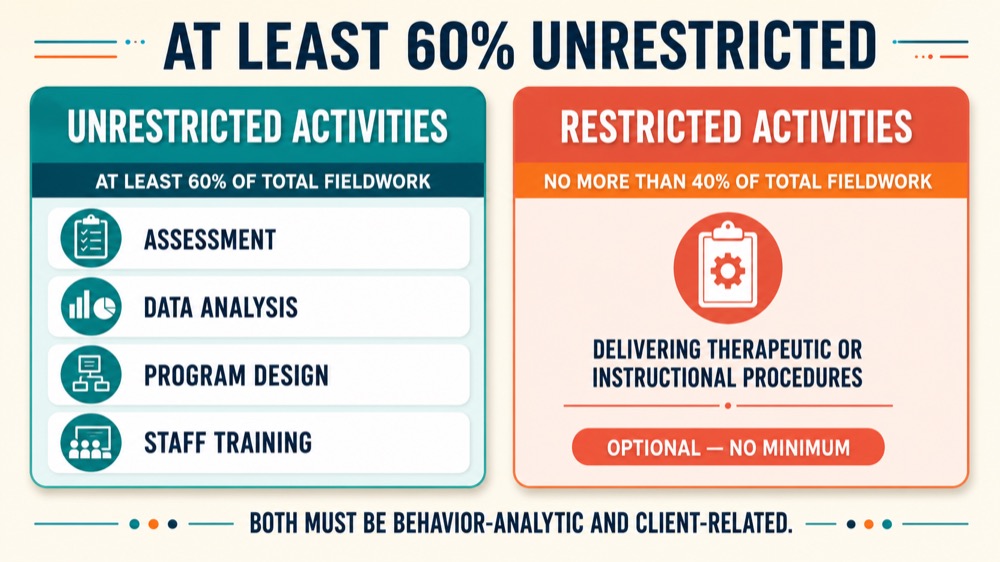
The BACB requires that at least 60% of total supervised fieldwork be unrestricted. Restricted hours may make up the remaining 40% or less. Restricted activities involve implementing components of behavior-analytic services under a supervisor’s direction—for example, direct implementation of a skill acquisition plan, discrete trial teaching, or following a behavior reduction protocol. Restricted hours build implementation skills but cannot exceed 40% of total fieldwork. Unrestricted activities must therefore carry the majority of your hours. Plan fieldwork so that unrestricted tasks occur consistently throughout each month, not just at the end when you realize you are short.
Both restricted and unrestricted hours require supervision. The distinction is about the nature of the work, not the amount of supervision. An unrestricted activity is behavior-analytic and client-related, but involves tasks a BCBA typically performs, such as assessment, program design, data graphing and analysis, and supervision of others. Unrestricted does not mean “without supervision”; it means the work is not limited to implementing pre-designed procedures under immediate direction. Always check with your supervisor when in doubt.
Real Examples of BCBA Unrestricted Hours Activities
Below are examples of bcba unrestricted hours activities drawn from current BACB guidance at Fieldwork: Getting It Right and the BCBA Handbook. Each example reflects actual behavior-analytic work tied to a specific client.
- Conducting intake interviews and assessments: Interviewing caregivers, reviewing records, and conducting preference assessments or functional assessments to identify client needs and baseline behaviors.
- Designing or evaluating data systems: Creating data sheets, choosing measurement methods, and setting up graphing systems for a client’s program.
- Performing behavior-analytic assessments: Conducting a functional analysis (FA), skills assessment (e.g., VB-MAPP, AFLS), or reinforcer assessment to inform programming.
- Graphing and analyzing data: Plotting data points, calculating trends or level changes, and making data-based decisions about intervention effectiveness.
- Researching literature for a current client: Reading peer-reviewed articles to find evidence-based interventions for a client’s specific challenging behavior or skill deficit.
- Writing or revising behavior intervention plans (BIPs) or skill acquisition plans: Drafting a BIP based on assessment results, or updating a plan when data show poor progress.
- Training caregivers or staff: Developing training materials, conducting behavioral skills training (BST), and assessing staff fidelity.
- Conducting risk-benefit analyses: Evaluating potential risks and benefits of an intervention before implementation, especially for intrusive procedures.
- Planning for discharge or service fading: Creating a transition plan that systematically reduces support while maintaining client gains.
These examples involve designing, analyzing, supervising, or making clinical decisions rather than simply carrying out prewritten procedures. The task must be done for a client with whom you have a formal service relationship. Simulated clients, hypothetical case studies, or stand-alone exercises do not count as unrestricted fieldwork, even if they resemble BCBA tasks.
Common Traps and What Definitely Does Not Count
Misclassifying activities is one of the most common fieldwork errors. The BACB provides clear nonexamples of countable fieldwork, including activities that are not behavior-analytic, not client-related, or not performed under qualified supervision. Here are activities that do NOT count as unrestricted (or restricted) fieldwork hours:
- Billing, coding, or other administrative tasks unrelated to clinical decision-making
- Studying for the BCBA certification examination
- Reading research not directly tied to a current client’s programming
- Attending conferences or ACE events, or listening to podcasts
- Completing hypothetical case studies, university homework, or workbook exercises
- CPR training or other non-behavior-analytic training
- Meetings with little or no behavior-analytic content
Additionally, data collection is not automatically unrestricted. A common trap is thinking any data collection counts as unrestricted because it is “assessment.” If you are collecting data while implementing a treatment (e.g., running DTT and recording correct/incorrect responses), that is restricted because the primary purpose is implementation. In contrast, data collection during a functional assessment you designed—where the goal is to identify the function of behavior to guide future intervention—is unrestricted. Purpose and context matter.
Another trap: believing unrestricted means unsupervised. All fieldwork must be supervised as required. Unrestricted activities must be conducted under a qualified supervisor who reviews your work and provides feedback. You cannot work alone and call it unrestricted.
The BACB does not pre-approve commercial curricula or packages that claim to provide “unrestricted hours.” Be wary of any product promising guaranteed unrestricted hours without a real client relationship. Your supervisor must determine whether each activity meets BACB requirements. If unsure, ask before logging hours.
Checklist for Documenting BCBA Unrestricted Hours
Use this checklist to ensure each unrestricted hour meets BACB standards. Review each item with your qualified supervisor if needed.
- Is the activity behavior-analytic? Does it involve principles of behavior, assessment, intervention design, data analysis, or supervision of implementation?
- Is it tied to a real client with whom you have a formal service relationship? The client may be an individual, group, or organization receiving behavior-analytic services.
- Is the purpose and context unrestricted? Is the activity most similar to what a BCBA does (design, analyze, supervise, train) rather than implementing a pre-existing plan?
- Is it conducted under qualified supervision? Your supervisor must observe, provide feedback, and sign off on hours according to current BACB supervision requirements.
- Is the activity documented accurately? Include date, start/end time, client identifier, description of the task, and supervisor signature.
- Does the activity avoid common traps? It is not billing, studying, unrelated research, conferences, hypotheticals, or other non-countable work.
- Are you confident the task would not better be classified as restricted? If in doubt, ask your supervisor before logging.
Remember, the qualified supervisor makes the final supervisor determination, but you are responsible for accurate documentation. Misrepresenting hours can result in audit findings, loss of fieldwork progress, or ethical violations under the BACB Ethics Code. Always err on the side of caution. For more guidance, see the BACB FAQs on supervised fieldwork requirements.
Distinction Between Unrestricted and Restricted Tasks
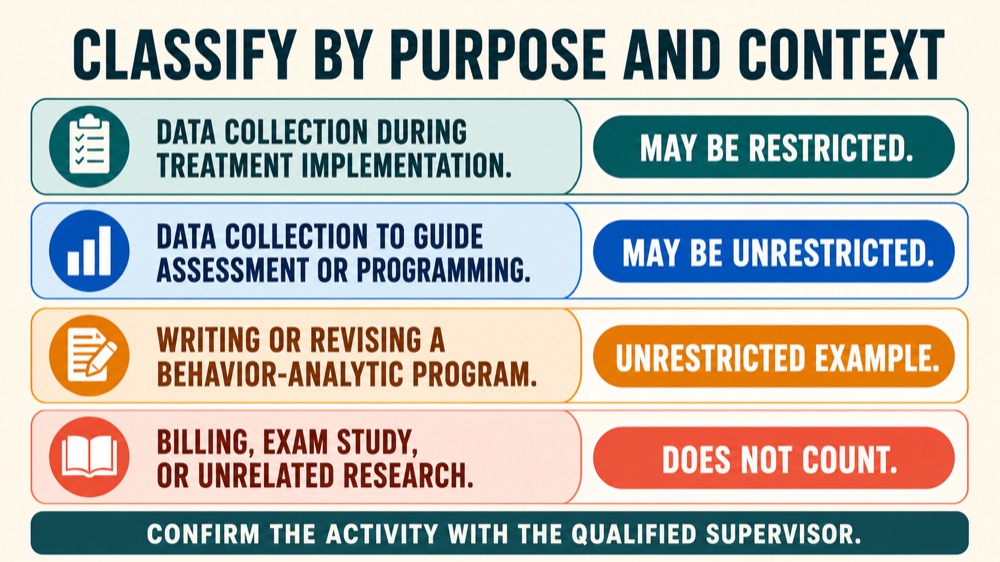
To further clarify, consider these comparison points between unrestricted and restricted hours:
- Assessment: Unrestricted? Designing and interpreting assessments to guide treatment. Restricted? Implementing a preference assessment under supervision without making design decisions.
- Data collection: Unrestricted? Collecting data as part of a functional analysis you designed to inform interventions. Restricted? Collecting trial-by-trial data while implementing a program your supervisor wrote.
- Intervention planning: Unrestricted? Writing or modifying a behavior intervention plan based on data. Restricted? Following the plan as written with no role in modification.
- Training: Unrestricted? Designing a staff training package and evaluating its effectiveness. Restricted? Role-playing a training procedure with a colleague under supervisor direction, not tied to a client.
The BCBA Test Content Outline (6th ed.) is a helpful guide for understanding domains of BCBA practice, but not every task listed there automatically qualifies as unrestricted fieldwork. For example, “assess procedural integrity” could be unrestricted if you design the integrity check and use it to make changes, but could be restricted if you only record whether steps were followed during implementation. Context rules.
Supervisor Responsibility and Trainee Documentation
The qualified supervisor is responsible for determining whether an activity meets BACB requirements and the trainee’s competency goals, including classifying hours as restricted or unrestricted. The trainee remains responsible for accurate tracking and documentation of every hour, including maintaining signed supervision contracts, monthly verification forms, and detailed activity logs. The BACB conducts audits, and discrepancies can lead to delays in certification or disciplinary action. If unsure about an activity, ask your supervisor before doing it and before logging it. It is better to confirm early than to lose hours later.
Supervisors should ensure trainees receive exposure to a variety of unrestricted activities to develop well-rounded BCBA competencies. The current handbook requires trainees to work with, be observed by, and receive supervisor feedback for multiple clients across fieldwork; it strongly encourages varied settings, populations, supervisors, and practice areas. Your supervisor should help design a plan that meets the 60% unrestricted rule while building broad competence.
Test Your Knowledge with a Free BCBA Mock Exam
Now that you know what counts as bcba unrestricted hours activities and how to document them, test your understanding with our Free BCBA Mock Exam. This practice tool provides realistic questions and instant feedback to help identify strengths and gaps. While the mock exam does not guarantee articles on this exact topic, it is an excellent way to review core ABA concepts, ethics, and fieldwork principles. Pair it with our guides on stimulus control and stimulus generalization to deepen your understanding. For direct BACB resources, refer to the BCBA Handbook, Fieldwork: Getting It Right, and the FAQs on supervised fieldwork requirements. Always consult current official documents before making fieldwork decisions.
Next step for BCBA exam prep
Turn this topic into exam-day practice
Use this topic as a focused review, then test it in exam-style conditions with a free mock before deciding whether five full-length mocks are the right next step.
Start the Free BCBA Mock Exam
Continue with Five Full-Length Mocks — $99
Review the included materials and access details before ordering. No pass guarantee is implied.



