

How many RBTs can a BCBA supervise at once? As of the June 2026 RBT Handbook, the Behavior Analyst Certification Board does not publish one total-caseload number that applies to every BCBA. The accurate answer is that there is no universal numeric cap, but the caseload is not unlimited. A BCBA must restrict supervisory volume to what still permits effective supervision, client protection, and compliance with every applicable requirement.
Table of Contents
- The Direct Answer Under Ethics Code Standard 4.03
- The Small-Group Meeting Rule Is Not a Caseload Cap
- Current RBT Ongoing-Supervision Requirements
- Client-Specific Knowledge and Coverage
- A Capacity Framework for Supervisory Volume
- External Rules May Be Stricter
- Common Errors When Answering the Question
- June 2026 Verification Checklist
- Practice Capacity-Based Reasoning
- References
This distinction matters because a frequently repeated “10 RBT” answer confuses the size of one small-group meeting with the total number of supervisees. This guide separates those rules, summarizes current RBT ongoing-supervision requirements, and provides a capacity framework without inventing a recommended staffing ratio. It is educational information, not legal, payer, employment, or individualized clinical advice.
The Direct Answer Under Ethics Code Standard 4.03
Ethics Code standard 4.03, Supervisory Volume, requires behavior analysts to accept only the number of supervisees or trainees that allows effective supervision and training. The standard does not substitute a fixed ratio for professional judgment. It requires an ongoing assessment of client demands, the analyst’s current supervisee or trainee caseload, time, logistical resources, and other relevant requirements.
When a behavior analyst determines that the threshold for effective supervision has been reached, standard 4.03 also requires documentation of that self-assessment and communication of the result to the employer or other relevant parties. A defensible answer therefore identifies the capacity process: assess the real work, preserve quality, document the threshold, communicate it, and reassess when circumstances change.
A number that is manageable in one service model may be unsafe or impractical in another. Client complexity, service locations, coverage arrangements, staff experience, and the analyst’s other responsibilities can change the time needed for adequate oversight. The professional question is not “What number can I register?” but “Can I meet every supervision, client-oversight, feedback, documentation, and continuity obligation for this proposed caseload?”
The Small-Group Meeting Rule Is Not a Caseload Cap
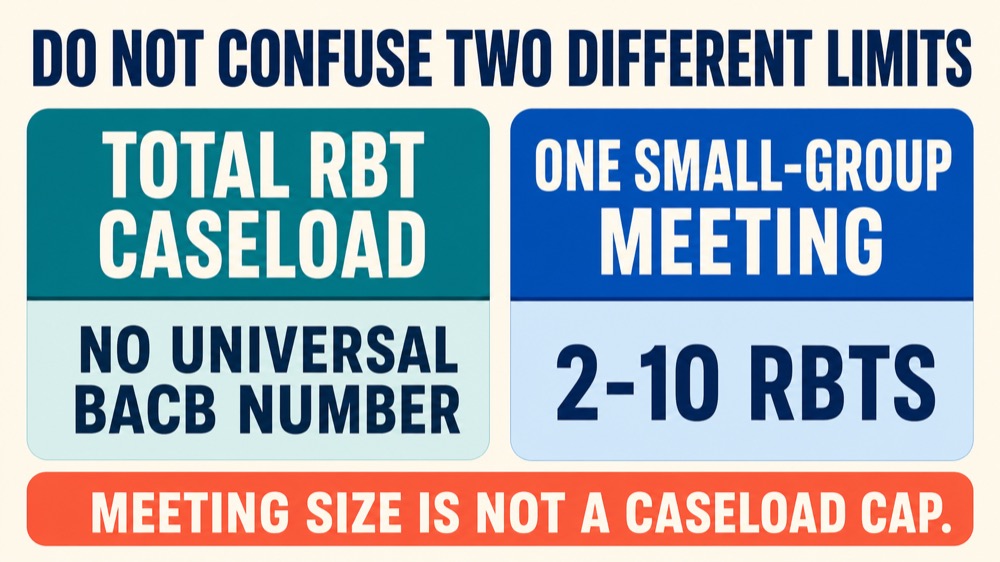
The current RBT Handbook describes a small-group meeting as an interactive meeting involving 2–10 RBTs who share similar experiences. No more than 10 RBTs may participate in that particular meeting, regardless of how many supervisors attend. This is a meeting-structure rule; it does not state the maximum number of RBT supervisees assigned to one BCBA.
The handbook also requires at least one of the two monthly real-time supervision contacts to be individual, with no other RBTs or trainees present. The other contact may be a qualifying small-group meeting. A supervisor who oversees a larger total roster would still need to arrange supervision so that every RBT independently satisfies the monthly requirements. Dividing names into groups does not by itself prove adequate supervision.
- Total supervisory caseload: evaluated under supervisory volume, effective practice, client needs, and all applicable rules.
- Individual contact: at least one required monthly real-time contact occurs without other RBTs or trainees present.
- Small-group meeting: an interactive meeting of 2–10 RBTs that may serve as the other required monthly contact.
- Observation: the supervisor observes the RBT providing services during at least one monthly meeting.
These requirements should be analyzed separately. The meeting-size ceiling does not create permission to accept any larger roster, and it does not override standard 4.03. Conversely, a BCBA whose roster is below 10 has not automatically demonstrated sufficient oversight. Quality depends on whether each RBT and each client receives the required, clinically informed supervision.
Current RBT Ongoing-Supervision Requirements
The June 2026 handbook states that an RBT must receive ongoing supervision for at least 5% of the hours spent providing behavior-analytic services during each calendar month. Supervision must include at least two face-to-face, real-time contacts per month. At least one contact is individual, and the other may be a small-group meeting. The supervisor observes service delivery during at least one of the monthly meetings.
In-person observation is preferred, while a qualifying observation may use a web camera, video conference, or similar live method when applicable rules permit it. Video monitoring by itself, without real-time interaction or feedback, may not count as supervision. The handbook encourages direct observation more often than the minimum. It does not establish a universal minimum duration for each contact, so staffing calculations should not invent one.
- Calculate the 5% amount separately from the RBT’s actual behavior-analytic service hours for the calendar month.
- Schedule at least two face-to-face, real-time contacts rather than relying on telephone calls, email, or passive recordings.
- Ensure at least one monthly contact is individual and any group contact remains interactive and within the 2–10 RBT range.
- Include observation of the RBT delivering services during at least one monthly meeting and provide meaningful interaction or feedback.
- Document service hours, supervision dates and duration, supervision format, observation dates, supervisors, and the supervisor-client relationship.
The handbook requires these supervision requirements to be met at each organization where an RBT provides behavior-analytic services. Hours from separate organizations cannot simply be combined to create compliance. A workload model must therefore consider organizational boundaries, the assigned supervision structure, and who is accountable for verifying that all requirements are met.
Client-Specific Knowledge and Coverage
The number of names on a supervisory list is only one part of capacity. The RBT Supervisor or RBT Requirements Coordinator must have sufficient client-specific knowledge to inform the clinical direction of the RBT’s work. The June 2026 handbook also states that appropriate supervisory coverage is needed for every client served by an RBT; coverage for some clients does not make uncovered work permissible.
This requirement makes client count and complexity central to supervisory volume. One RBT may work across several clients, settings, or treatment teams, each requiring program review, performance monitoring, coordination, and risk awareness. A simple supervisor-to-RBT ratio can hide that work. Capacity should be evaluated at the intersection of RBT assignments, client assignments, service hours, and the analyst’s clinical responsibility.
A Capacity Framework for Supervisory Volume
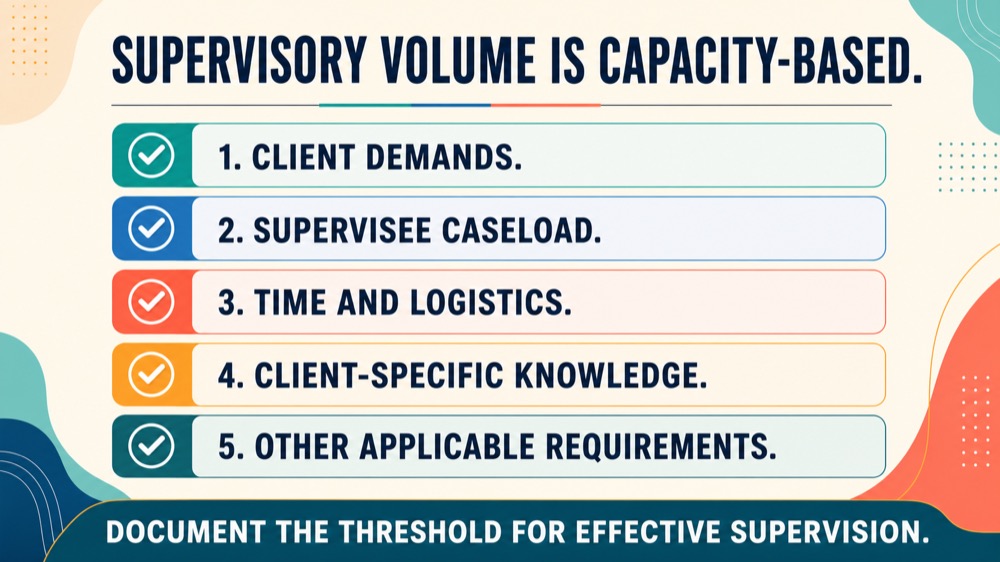
A practical capacity review starts with required work rather than a preferred headcount. Map every recurring obligation, reserve time for variable demands, and compare the result with time that is genuinely available. Do not count the same hour simultaneously as client service, travel, documentation, and supervision. If the schedule works only when nothing changes, it is not a resilient supervision plan.
- Client demand: number of clients, clinical complexity, safety risk, rate of program change, and coordination needs.
- RBT service pattern: behavior-analytic service hours, schedule variability, experience, performance needs, and organizational location.
- Required contacts: individual contacts, possible small-group meetings, live observation opportunities, and feedback time.
- Clinical oversight: data review, treatment-integrity monitoring, program decisions, team communication, and client-specific preparation.
- Logistics: travel, time zones, technology, cancellations, rescheduling, and access to clients during service delivery.
- Documentation: supervision records, performance feedback, self-assessment, organizational records, and audit readiness.
- Continuity: planned leave, illness, emergencies, turnover, backup supervisors, and transitions between responsible individuals.
- Other duties: the BCBA’s direct caseload, assessment, caregiver collaboration, training, meetings, administrative work, and professional development.
Turn the list into a variable-based worksheet. For each RBT and client assignment, identify mandatory monthly contacts, live observations, preparation, feedback, recordkeeping, travel, and likely unscheduled support. Add the analyst’s non-supervision responsibilities and a realistic contingency reserve. The resulting workload can inform a local threshold, but it should not be advertised as a BACB ratio or a universal benchmark.
External Rules May Be Stricter
Ethics Code standard 4.01 requires knowledge of and compliance with applicable supervisory requirements, including BACB rules, licensure requirements, funder requirements, and organization policies. Contracts and employment policies may add conditions as well. Because these rules vary and can change, a general article should not assign an unverified national ratio or claim that one jurisdiction’s rule applies everywhere.
- Check the current BACB RBT Handbook, Ethics Code, supervision resources, and BACB portal instructions.
- Check applicable licensing-board or regulatory requirements in the location where services occur.
- Review current payer manuals, contracts, authorizations, and billing rules that affect oversight.
- Review employer policies, job responsibilities, clinical-governance procedures, and coverage plans.
- Resolve differences by following all applicable requirements and obtaining qualified legal or compliance guidance when needed.
An external rule may be more restrictive than the BACB’s capacity-based standard, but meeting an external numeric rule does not eliminate the BCBA’s ethical duty to provide effective supervision. The operative limit is the most restrictive applicable requirement together with the analyst’s demonstrated capacity. A lower local threshold may be necessary when quality, safety, or continuity would otherwise be compromised.
Common Errors When Answering the Question
- Treating 10 as a total-caseload ceiling: 10 is the maximum attendance for one qualifying small-group meeting, not the BACB’s total RBT roster rule.
- Calling the caseload unlimited: standard 4.03 creates a functional threshold based on effective supervision and requires action when that threshold is reached.
- Inventing a preferred ratio: a local staffing pattern is not automatically a BACB requirement or evidence of adequate supervision.
- Counting only RBT names: client assignments, service hours, risk, locations, documentation, feedback, and other BCBA duties also consume capacity.
- Confusing RBT oversight with fieldwork supervision: ongoing RBT supervision and supervised fieldwork toward BCBA or BCaBA certification have different requirements.
- Ignoring outside rules: licensure, payer, contract, and organization requirements may impose additional conditions.
- Planning to the minimum with no reserve: a schedule that cannot absorb cancellations, urgent clinical needs, or supervisor absence may not support continuity.
June 2026 Verification Checklist
Before adding an RBT, record the version date of the sources reviewed and complete a documented capacity assessment. The BACB supervision and training page directs supervisors to the relevant current handbook and role-specific resources. Because the handbook may be updated, verify the live documents again rather than relying on an old training slide or a remembered ratio.
- Can every RBT meet the monthly percentage, contact, individual-meeting, observation, and documentation requirements?
- Does the responsible supervisor have sufficient client-specific knowledge for every client served by each RBT?
- Can the BCBA provide timely performance monitoring, feedback, clinical direction, and problem solving?
- Have travel, time zones, cancellations, leave, emergency demand, backup coverage, and transitions been included?
- Have current BACB, portal, licensing, payer, contract, and organization requirements been checked?
- Is the threshold self-assessment documented and ready to be communicated if the proposed addition would exceed capacity?
If any answer is uncertain, pause the assignment and resolve the gap before relying on a headcount. The safest conclusion is precise: the BACB supplies a quality-and-capacity standard rather than one total number, and each BCBA remains accountable for demonstrating that the actual supervisory arrangement works.
Practice Capacity-Based Reasoning
For study purposes, analyze supervision scenarios by separating meeting rules, monthly RBT requirements, client oversight, supervisory volume, and external requirements. Our Free BCBA Mock Exam provides original practice and feedback on broader behavior-analytic reasoning. It does not replace current BACB documents, employer review, payer guidance, or individualized professional judgment.
References
- Behavior Analyst Certification Board. Registered Behavior Technician Handbook, updated June 2026.
- Behavior Analyst Certification Board. Ethics Code for Behavior Analysts.
- Behavior Analyst Certification Board. Supervision, Assessment, Training, and Oversight.
Complete BCBA Exam Prep
Turn this topic into exam-day practice
Practice concepts in context with five full-length 6th Edition mock exams, two bonus practice exams, a 6th Edition study guide, and key-term flashcards—all in one $120 USD package.
Get the $120 All-in-One Prep Pack
Review everything included on the product page before ordering. No pass guarantee is implied.



