
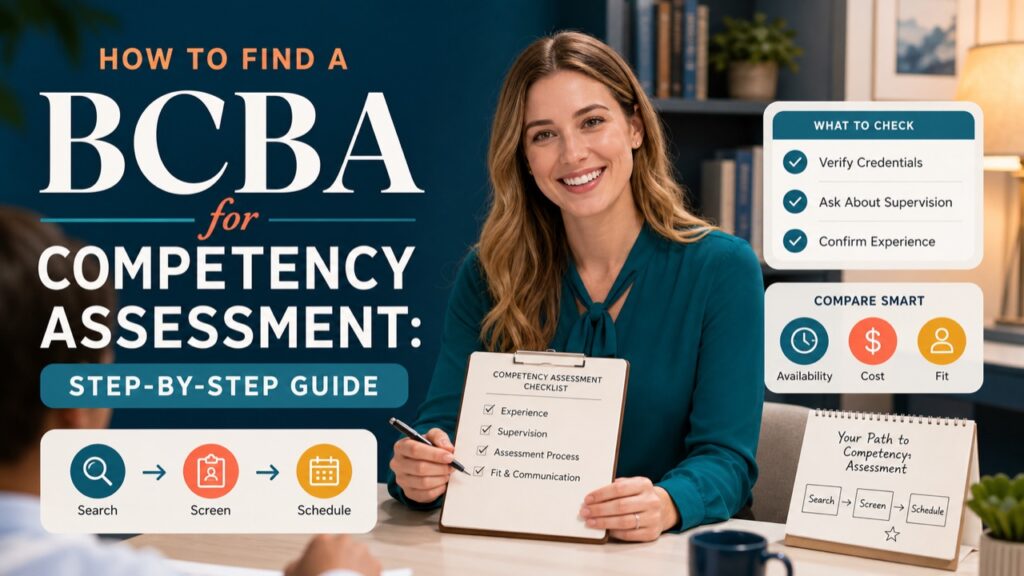
What Is the RBT Initial Competency Assessment?
The RBT Initial Competency Assessment is a required step for RBT certification under the 2026 BACB requirements. It must be completed after finishing the 40-hour training and no more than 90 days before submitting your RBT certification application. The assessment evaluates your ability to perform behavior-analytic tasks with a client, not through role-play alone. Three specific tasks from the Skill Acquisition and Behavior Reduction categories must be demonstrated with a client. The responsible assessor—either an active BCBA or BCaBA who has completed the 8-hour supervision training—oversees the entire process, signs the BACB form, and retains records for at least seven years. Assistant assessors may conduct portions under the responsible assessor’s supervision, but the responsible assessor remains accountable for quality and compliance.
Table of Contents
- What Is the RBT Initial Competency Assessment?
- Step-by-Step Guide to Find a BCBA for Competency Assessment
- Understanding the Relationship Rule
- The Assessment Window and Timeline
- Responsibilities of the Responsible Assessor
- Final Checklist Before Your Assessment
- Common Traps and How to Avoid Them
- Test Your Knowledge with a Free BCBA Mock Exam
Step-by-Step Guide to Find a BCBA for Competency Assessment
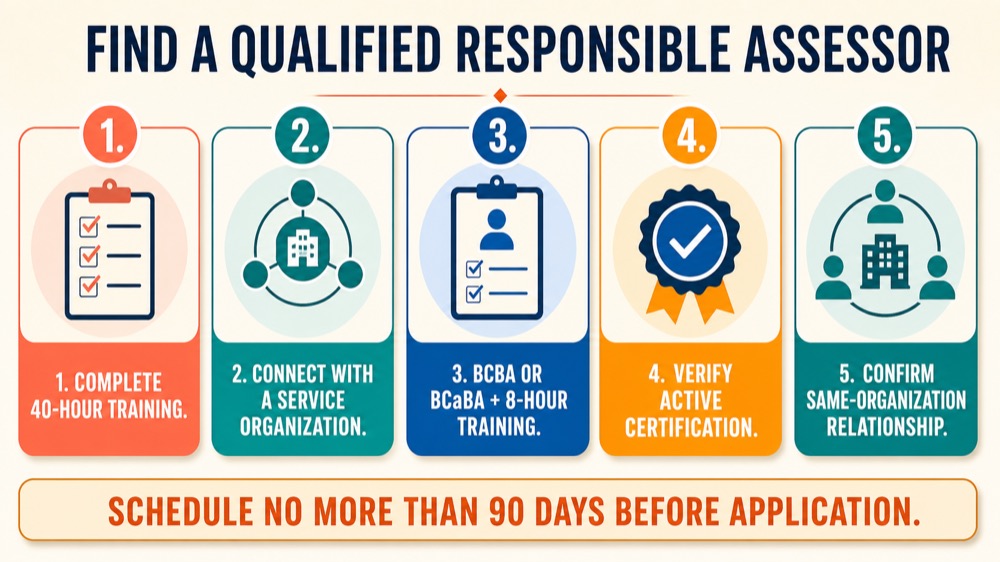
Follow this ordered process to locate a qualified assessor and satisfy the main 2026 assessment requirements.
Step 1: Complete Your 40-Hour Training First: Before the competency assessment begins, you must finish a 40-hour RBT training that meets the applicable BACB requirements. The training must cover the required curriculum and result in documentation showing completion. The Initial Competency Assessment cannot begin before that training is complete. Ask the provider how its course meets the current BACB training requirements, retain the completion certificate, and compare the dates carefully when planning the later assessment and certification application.
Step 2: Identify an Organization Providing Behavior-Analytic Services: The 2026 rules require the responsible assessor, any assistant assessors, and the applicant to be employed at, or all have a contractual relationship with, the same organization. That organization must also provide behavior-analytic services to every client involved in the assessment. Start with an employer or contracting organization that actually serves clients and can include you in an appropriate service relationship. If you do not yet have that connection, ask legitimate ABA providers about employment or contracting pathways before paying for an assessment.
Step 3: Ask Your Organization or Training Provider About Qualified Assessors: Once you are connected to an appropriate service organization, ask a clinical leader, supervisor, or HR contact whether an active BCBA or BCaBA can serve as the responsible assessor and has completed the 8-hour supervision training. A training provider may identify organizations to contact, but the eventual arrangement must independently satisfy every BACB relationship condition. Request the assessor’s certification number and confirmation of supervision training. The assessor cannot be related to you, subordinate to you, or employed by you.
Step 4: Verify the Assessor's Certification Using the BACB Certificant Registry: Use the BACB Certificant Registry to confirm the assessor’s current certification status and review whether reportable disciplinary actions are listed. Registry status alone does not prove completion of the 8-hour supervision training, a valid organizational relationship, appropriate client access, or competence to conduct this assessment. Treat the registry as one verification step, then confirm supervision training and the assessor’s employment or contract with the organization that provides services to the participating client.
Step 5: Confirm the Same-Organization and Client-Service Relationship: This is the most critical step. You, the responsible assessor, and every assistant assessor must be employed at, or all have a contractual relationship with, the same organization; that organization must provide services to the client used in the assessment. For example, if you work or contract with ABC Clinic, the assessor must also work or contract with ABC Clinic, and the participating client must receive services from ABC Clinic. Direct payment does not waive these relationship expectations or make an otherwise unrelated assessor eligible.
Step 6: Schedule the Assessment Within the 90-Day Window: The Initial Competency Assessment must occur after the 40-hour training completion and no more than 90 days before you submit your RBT certification application. Plan accordingly. The assessment may span one or more sessions and can be conducted in person, live online, or through purpose-made recorded observations. However, the permitted observation type is item-specific: three Skill Acquisition and Behavior Reduction tasks must be demonstrated with a client in real time or via recorded video that meets BACB guidelines. Schedule enough time to cover all tasks without rushing.
Understanding the Relationship Rule
The 2026 relationship rule is precise: the responsible assessor, assistant assessors, and applicant must be employed at, or all have a contractual relationship with, the same organization. That organization must be the entity providing services to the client involved. A client receives services from the organization; the rule does not say that the client must be its employee or contractor. An assessor may not be related to, subordinate to, or employed by the applicant. Compensation paid by the applicant for assessment services is not itself employment, but payment also does not create the required organizational relationship.
Common traps to avoid:
- Assuming any BCBA found online can sign off.
- Believing that remote assessment removes the client relationship requirement.
- Accepting an assessor who is a relative, friend, or personal employee.
- Thinking that paying a freelance assessor automatically makes the assessment valid.
- Relying solely on BACB Registry status as proof of all requirements.
To illustrate, consider this scenario: An RBT candidate works at Bright Horizons ABA and pays a BCBA from another company to conduct the assessment via Zoom with a client who is also from Bright Horizons. This violates the rule because the assessor is not employed by or under contract with Bright Horizons. The correct arrangement would have the BCBA also working at Bright Horizons.
The Assessment Window and Timeline
The 90-day window is a hard deadline. The assessment must be completed after the 40-hour training and within 90 days before application submission. If the assessment is done too early, it expires. If done too late, you cannot use it. Coordinate with your assessor to select a date that falls within this window. The assessment may be broken into multiple sessions if needed, but all tasks must be completed within the window. Allow extra time for scheduling conflicts and retakes if you do not pass a task on the first attempt. Keep a copy of the signed BACB form as proof of completion.
Example timeline:
- Complete 40-hour training: January 1, 2026
- Schedule assessment: February 1, 2026 (within 90 days of planned application submission on April 1)
- Assessment sessions: February 1–15, 2026
- Signed form received: February 15, 2026
- Submit RBT application: March 1, 2026 (within 90 days of assessment)
Responsibilities of the Responsible Assessor
The responsible assessor must be an active BCBA or BCaBA who completed the 8-hour supervision training. That person oversees assessment quality, signs the BACB form, and maintains assessment records for at least seven years, even when portions are delegated. An assistant assessor must have demonstrated proficiency through direct observation and hold an active RBT certification or higher. When an assistant assessor is an RBT or BCaBA, the current packet adds supervisor-relationship conditions that must also be checked. Delegation never removes the responsible assessor’s quality oversight.
Final Checklist Before Your Assessment
- Completed 40-hour training (certificate on hand).
- Identified an organization that provides behavior-analytic services to clients.
- You are an employee or contractor of that organization.
- A responsible assessor (BCBA or BCaBA with 8-hour supervision training) is available from the same organization.
- The assessor is not related to you, subordinate to you, or employed by you.
- The assessor’s certification is verified as active via the BACB Registry.
- The assessor’s 8-hour supervision training completion is documented.
- The client used in the assessment receives services from the same organization.
- Assessment is scheduled within 90 days before your RBT application.
- Three Skill Acquisition and Behavior Reduction tasks will be demonstrated with a client.
- You understand the assessment format (in-person, live online, or recorded observations per item).
- Signed BACB form will be retained for seven years by the assessor.
Common Traps and How to Avoid Them
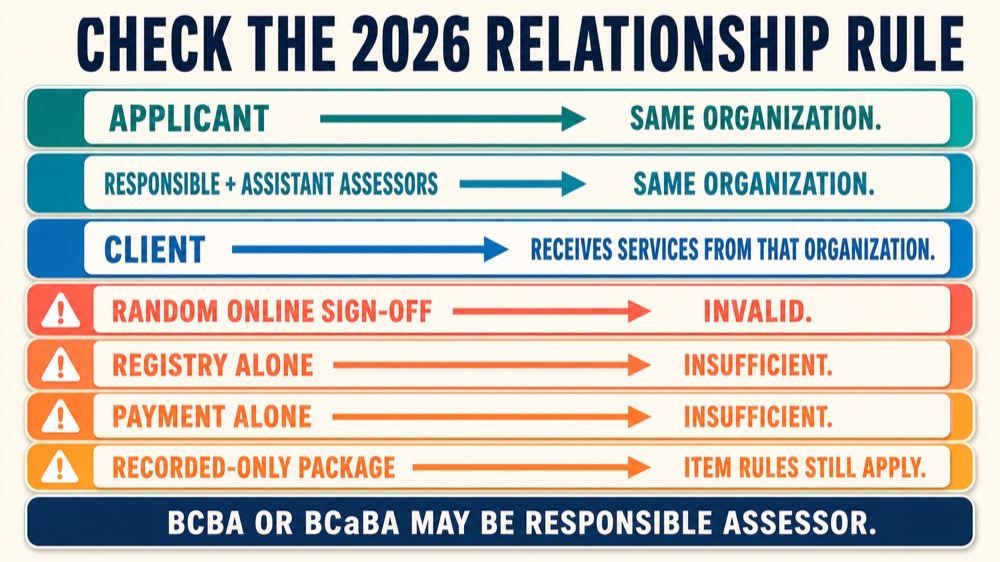
Avoid the following common misconceptions:
- Freelance sign-offs: A BCBA you find on social media who offers to assess you for a fee without a shared organization is not acceptable.
- Assessment mills: Companies that promise instant assessments without verifying your relationship with a client are red flags.
- Non-BACB forms: Only use the official BACB Initial Competency Assessment form. Third-party forms may not comply.
- Prerecorded-only packages: Recorded observations must be created specifically for the assessment, assessment type is item-specific, interview items require a live interview, and three tasks in Skill Acquisition and Behavior Reduction require demonstration with a client.
- No client access: Any claim that assessment can be done without an appropriate client-service relationship is false.
Before scheduling, cross-reference the arrangement with BACB Supervision and Training and the 2026 RBT Initial Competency Assessment packet. These are the primary sources for the requirements described here.
Test Your Knowledge with a Free BCBA Mock Exam
Ready to practice for the BCBA exam? Our Free BCBA Mock Exam offers realistic practice questions and detailed feedback on your performance. While it does not cover this exact article topic, it helps you build fluency in core ABA concepts. Visit today and start sharpening your skills.



