
A practical BCBA exam guide for decoding supervision shorthand without confusing fieldwork, ongoing service oversight, or supervisor training. If you see BCBA SUPV in a note, study guide, or practice question, read it as shorthand for BCBA supervision—not as the name of a BACB credential. The useful question is what kind of supervision the stem describes: supervision for a trainee accruing fieldwork, ongoing supervision of services, or training and oversight of a role such as an RBT assessor.
Table of Contents
- What does BCBA SUPV mean?
- The three supervision contexts hidden behind SUPV
- The four-step BCBA SUPV exam filter
- Fieldwork supervision versus ongoing supervision
- The 2027 boundary: verify the date before choosing a rule
- Common BCBA SUPV exam traps
- Practice the role decision
- BCBA SUPV FAQ
- The bottom line
- Official sources to recheck
- Take the Free BCBA Mock Exam
This article is an exam-preparation explanation, not an official BACB rulebook or individualized compliance advice. The current BACB handbook, supervision resources, and forms control real decisions. Because the abbreviation is informal, always expand it into the specific role before choosing an answer.
What does BCBA SUPV mean?
BCBA SUPV normally means BCBA supervision or a supervision-related BCBA task. SUPV is a compressed label, not an official certification title, BACB pathway, or permission to supervise every person in every setting. In an exam stem, the abbreviation tells you the topic family; the facts that follow determine the correct supervision lane.
The current BACB supervision resources separate oversight into different roles. A BCBA may supervise a future BCBA or BCaBA trainee who is accruing supervised fieldwork, supervise ongoing services for an RBT or BCaBA, assess or train an RBT, or work with a consulting supervisor. Those roles have different handbooks, forms, qualifications, and documentation expectations.
That is why a question asking for the meaning of BCBA SUPV should not be answered with a single number or a memorized percentage. First identify the person being supervised, the purpose of the supervision, and the date or rule set in the scenario. Then verify the exact current BACB resource.
The three supervision contexts hidden behind SUPV
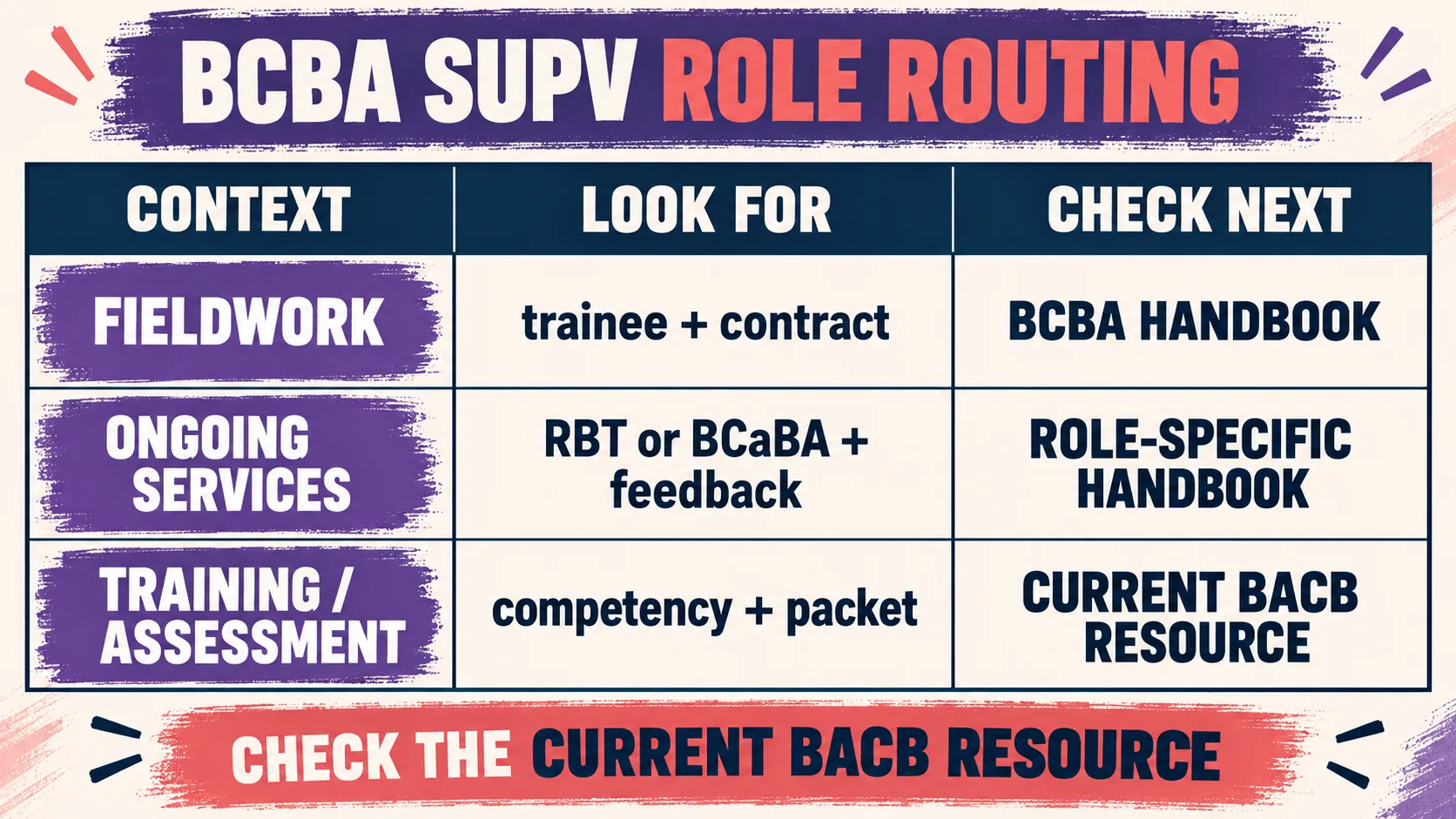
The fastest way to decode the shorthand is to sort the stem into one of three contexts. The BACB’s Supervision, Assessment, Training, and Oversight page distinguishes these functions instead of treating all supervision as one activity.
| If SUPV refers to… | Who is involved? | Exam cue |
|---|---|---|
| Supervised fieldwork | A trainee pursuing BCBA or BCaBA certification and a qualified fieldwork supervisor. | Look for a supervision contract, fieldwork hours, monthly forms, observations, or restricted and unrestricted activities. |
| Ongoing service supervision | A current RBT or BCaBA receiving oversight while providing behavior-analytic services. | Look for service quality, feedback, competency, ongoing supervision, or an RBT/BCaBA handbook. |
| Assessment or training | A person being trained or assessed for a defined role, such as an RBT competency assessment. | Look for an assessment packet, trainer or assessor responsibility, competency evidence, or the 8-hour training requirement. |
These categories can overlap in real work. For example, an RBT may also be a trainee accruing future BCBA fieldwork. The exam task is to identify which requirement the question is testing, not to assume that one supervision label makes every hour or meeting count for every purpose.
The four-step BCBA SUPV exam filter
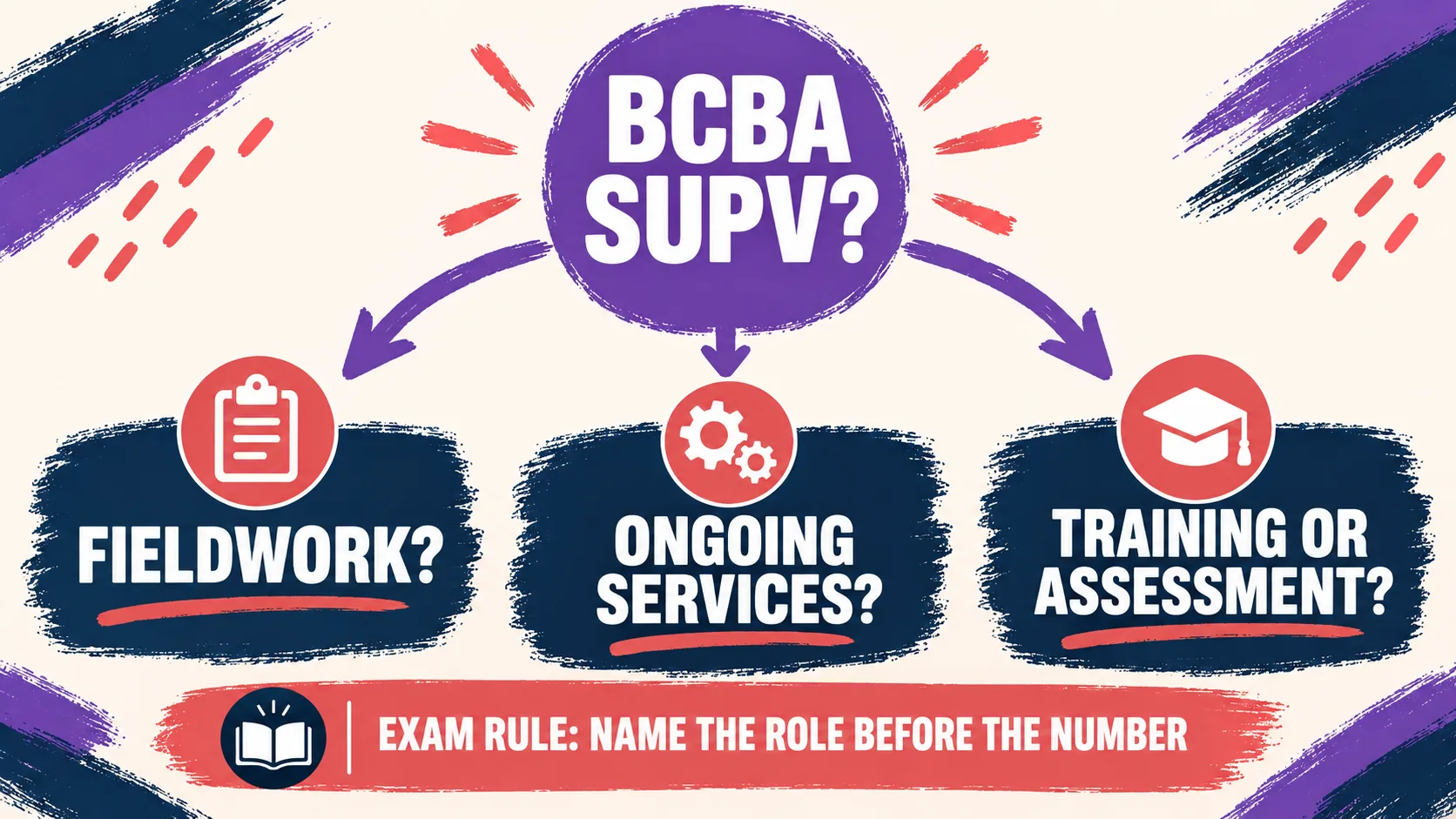
When several answer choices use the word supervision, apply this filter before calculating anything:
- Name the supervisee. Is the person a BCBA or BCaBA applicant, an RBT, a current BCaBA, or someone outside BACB certification? The role often resolves the question faster than the abbreviation.
- Name the purpose. Is the supervision documenting certification fieldwork, protecting service quality, assessing competency, or training a supervisor? Do not transfer a fieldwork rule into an ongoing-service question.
- Find the controlling resource. Match fieldwork to the BCBA or BCaBA Handbook, ongoing service oversight to the relevant handbook, and training or assessment to the current BACB packet or curriculum outline.
- Check the date. If the stem mentions an application date, 2027, new forms, or a transition, use the rule set that applies to that date and verify it against the BACB change page.
- Expand SUPV before interpreting the rest of the stem.
- Separate the person supervised from the person who signs the form.
- Separate certification fieldwork from ongoing service oversight.
- Check whether a contract or handbook requirement is stated.
- Use a date-specific rule when the question gives one.
This method prevents the most common error: choosing an answer because it contains a familiar supervision percentage without first identifying which supervision system the percentage belongs to.
Fieldwork supervision versus ongoing supervision
The distinction matters because the same BCBA may perform both activities, but the purpose and documentation are not interchangeable. The BACB’s fieldwork FAQ emphasizes that the supervisor is responsible for determining whether an activity meets the applicable fieldwork requirements, and that a contract and qualified supervisor matter.
| Comparison point | Fieldwork supervision | Ongoing service supervision |
|---|---|---|
| Main goal | Build and document competencies for a future certification application. | Support competent, ethical, and effective services delivered by a current RBT or BCaBA. |
| Evidence the stem may mention | Supervision contract, monthly verification, fieldwork activity, observation, or unrestricted-hours decision. | Ongoing meetings, feedback, competency, service delivery, or the RBT/BCaBA supervision section. |
| Best exam move | Ask whether the activity meets the certification fieldwork rules in force for the application. | Ask whether the oversight meets the current role-specific service requirements. |
Some hours may satisfy more than one requirement only when all applicable rules are met. The BACB fieldwork FAQ gives a conditional example of “double dipping,” but it also warns that a person qualified to supervise an RBT may not be qualified to supervise fieldwork. On the exam, a blanket statement that every supervised meeting counts twice is usually too broad.
The 2027 boundary: verify the date before choosing a rule
The word SUPV does not tell you whether the 2022 or 2027 requirements apply. The BACB says revisions to core BCBA eligibility and maintenance requirements take effect January 1, 2027. A question that includes the application date, transition forms, or a 2027 fieldwork plan is testing date control as well as supervision knowledge.
Under the current BACB 2027 overview, supervised fieldwork is listed as 2,000 hours with 5% supervision, while concentrated supervised fieldwork is listed as 1,500 hours with 7.5% supervision. The overview also gives the 20-to-160-hour supervisory-period range, 60- or 90-minute cumulative client observations depending on the fieldwork type, at least 50% individual supervision, and at least 60% unrestricted activities. These are date-sensitive requirements, not a universal definition of BCBA SUPV.
For a practice question, write the date at the top of the page before doing the math. Then ask whether the question is about the eligibility pathway, the fieldwork documentation, or ongoing supervision of a current credential holder. If the stem is vague, choose the answer that recognizes the need to verify the current handbook rather than inventing a timeless rule.
Common BCBA SUPV exam traps
Trap 1: treating SUPV as a credential. “BCBA SUPV” does not create a new certification level. It is a shorthand label for a supervision topic. Trap 2: using a fieldwork percentage for an RBT question. A fieldwork percentage belongs to a certification-acquisition context. It does not automatically answer an ongoing RBT supervision question. Trap 3: assuming every BCBA can supervise every role. The BACB overview lists role-specific qualifications and training. Check the role, active status, training, and consultation conditions described in the stem. Trap 4: ignoring the application date. A 2027 form or application date can change which requirement set controls. Read the date before selecting a number.
Trap 5: confusing supervision with management. A supervisor may provide feedback and oversight, but the exam may be testing a fieldwork requirement, an ethical responsibility, or an employer policy. Name the controlling task rather than accepting a broad management answer.
- Do not copy an old percentage into a new-date scenario.
- Do not assume the abbreviation tells you the supervisee.
- Do not treat one form as proof that all requirements were met.
- Do not call a local employer policy an official BACB requirement.
- Do not replace the current handbook with a flashcard definition.
Practice the role decision
Once the abbreviation makes sense, practice the harder step: selecting the supervision rule that actually matches a vignette. The Free BCBA Mock Exam can help you identify whether your gap is in role recognition, fieldwork documentation, date control, or distinguishing ongoing service supervision. It is original study practice, not BACB material, continuing-education credit, legal advice, or a passing-score guarantee.
BCBA SUPV FAQ
Is BCBA SUPV an official BACB credential?: No. It is shorthand for a supervision-related topic. Use the full official role and the current BACB resource when you make a real certification or service decision. Does BCBA SUPV always mean supervising a BCBA trainee?: No. It may refer to supervised fieldwork, ongoing supervision of RBTs or BCaBAs, or training and assessment responsibilities. The supervisee and purpose in the question determine the lane.
Can the same meeting count for fieldwork and ongoing supervision?: Sometimes, but only when every applicable requirement is met, including the relevant contract, qualified supervisor, activity, and documentation rules. A blanket “yes” is not a safe exam answer.
Where should I verify a BCBA supervision rule?: Start with the current BACB Supervision, Assessment, Training, and Oversight page and the relevant BCBA or BCaBA Handbook. If the scenario involves 2027, also check the BACB 2027 Requirements and Recent & Upcoming Changes pages.
The bottom line
BCBA SUPV is a shorthand clue, not a complete answer. Expand it into the role being supervised, the purpose of the oversight, the controlling handbook or form, and the date. Once you make those four decisions, the difference between fieldwork supervision, ongoing service supervision, and training becomes much easier to apply on a BCBA exam.
Official sources to recheck
- BACB Supervision, Assessment, Training, and Oversight
- BACB FAQs About Supervised Fieldwork Requirements
- BACB 2027 BCBA Requirements
- BACB Recent & Upcoming Changes
- BACB BCBA Handbook
Take the Free BCBA Mock Exam
When you are ready to apply the idea, use the free practice resource below for additional feedback. Take the Free BCBA Mock Exam



